From Surf Wiki (app.surf) — the open knowledge base
Wild fisheries
Area containing fish that are harvested commercially

Area containing fish that are harvested commercially
A wild fishery is a natural body of water with a sizeable free-ranging fish or other aquatic animal (crustaceans and molluscs) population that can be harvested for its commercial value. Wild fisheries can be marine (saltwater) or lacustrine/riverine (freshwater), and rely heavily on the carrying capacity of the local aquatic ecosystem.
Wild fisheries are sometimes called capture fisheries. The aquatic life they support is not artificially controlled in any meaningful way and needs to be "captured" or fished. Wild fisheries exist primarily in the oceans, and particularly around coasts and continental shelves, but also exist in lakes and rivers. Issues with wild fisheries are overfishing and pollution. Significant wild fisheries have collapsed or are in danger of collapsing, due to overfishing and pollution. Overall, production from the world's wild fisheries has levelled out, and may be starting to decline.
As a contrast to wild fisheries, farmed fisheries can operate in sheltered coastal waters, in rivers, lakes and ponds, or in enclosed bodies of water such as pools or fish tanks. Farmed fisheries are technological in nature, and revolve around developments in aquaculture. Farmed fisheries are expanding, and Chinese aquaculture in particular is making many advances. Nevertheless, the majority of fish consumed by humans continues to be sourced from wild fisheries. As of the early 21st century, fish is humanity's only significant wild food source.
Marine and inland production
Main article: World fish production
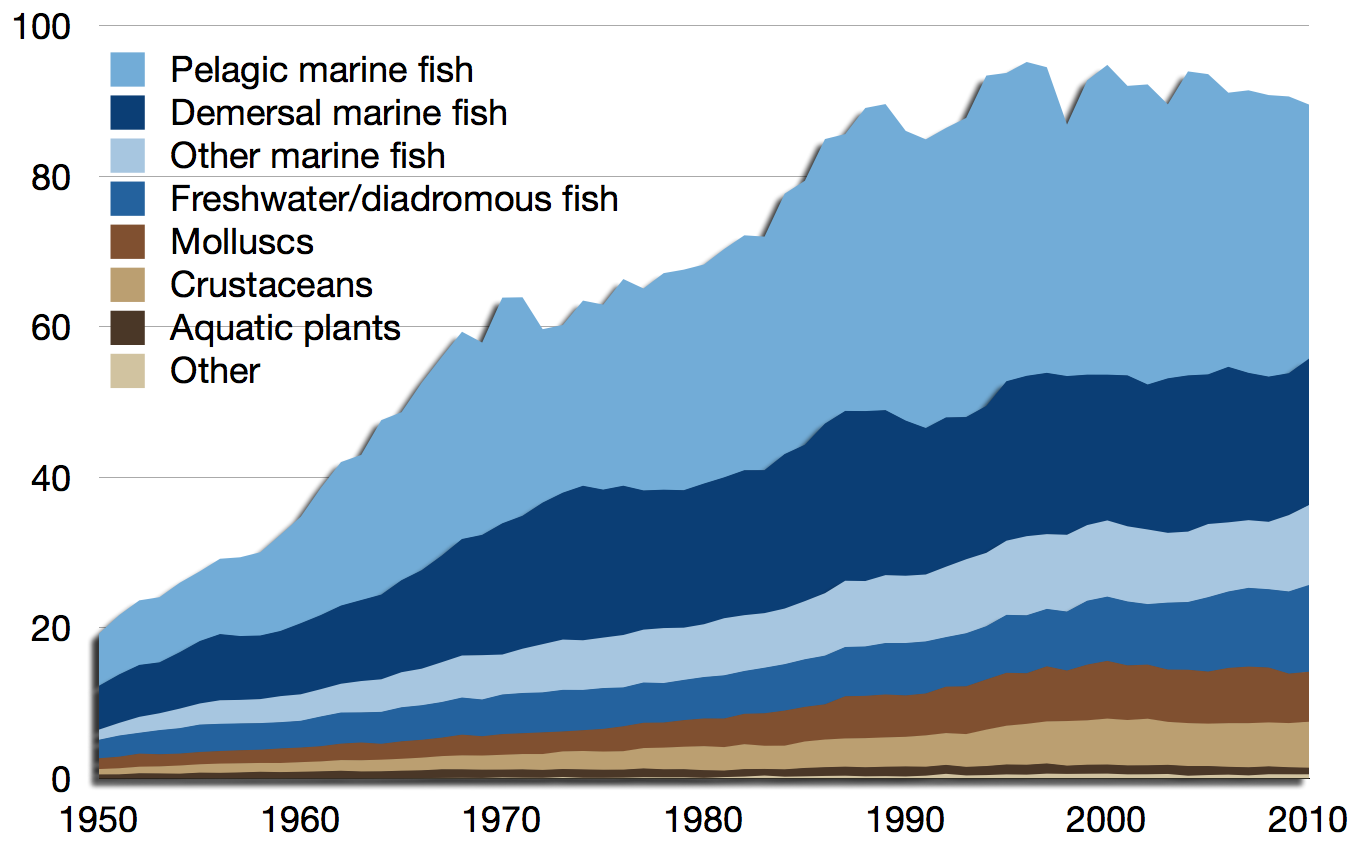
According to the Food and Agriculture Organization (FAO), the world harvest by commercial fisheries in 2010 consisted of 88.6 million tonnes of aquatic animals captured in wild fisheries, plus another 0.9 million tons of aquatic plants (seaweed etc.). This can be contrasted with 59.9 million tonnes produced in fish farms, plus another 19.0 million tons of aquatic plants harvested in aquaculture.
Marine fisheries
Topography
| [[File:Mid-ocean ridge system.gif | thumb | upright=1.7 | ]] |
|---|
Ocean currents
| [[File:Ocean surface currents.jpg | thumb | right | 300px | Major ocean surface currents. [[NOAA]] map.]] |
|---|
| More on currents | ||||
|---|---|---|---|---|
| [[File:Antarctic bottom water.svg | thumb | 200px | right | Example of different ocean currents in the [[Southern Ocean]] ]] |
Gyres and upwelling
| float=left | width=260px | image1=Animation of the upwelling process. |
|---|
| Prominent gyres |
|---|
| * The Humboldt Current. This gyre produces a cold, low-salinity ocean current that flows north-westward along the west coast of South America from the southern tip of Chile to northern Peru. This results in the most prominent upwelling system in the world, supporting an extraordinary abundance of marine life. Upwelling occurs off Peru year-round and off Chile during the spring and summer. Approximately 18-20% of the world's fish catch comes from the Humboldt Current LME. The species are mostly pelagic: sardines, anchovies and jack mackerel. The LME's high primary and secondary productivity supports other important fishery resources as well as marine mammals. |
Biomass
| [[File:Seawifs global biosphere.jpg | right | thumb | 300px | Estimate of [[biomass (ecology) | biomass]] produced by [[photosynthesis]] from September 1997 to August 2000. This is a rough indicator of the [[primary production]] potential in the oceans. Provided by the [[SeaWiFS]] Project, [[NASA]]/[[Goddard Space Flight Center]] and [[ORBIMAGE]].]] | float=right | width=260px | image1=Animation of global primary production |
|---|
| Primary biomass | Biome Ecosystem Type | Area | Mean Net Primary Production | World Primary Production | Mean biomass | World biomass | Minimum replacement rate | ||
|---|---|---|---|---|---|---|---|---|---|
| [[File:Krill666.jpg | thumb | Antarctic krill comprise about 0.7% of the Earth's biomass, the highest of any single animal species.]] | |||||||
| (million km2) | (gram dryC / m2 / year) | (billion tonnes / year) | (kg dryC / m2) | (billion tonnes) | (years) | ||||
| Open ocean | 332.00 | 125.00 | 41.50 | 0.003 | 1.00 | 0.02 | |||
| Upwelling zones | 0.40 | 500.00 | 0.20 | 0.02 | 0.01 | 0.04 | |||
| Continental shelf | 26.60 | 360.00 | 9.58 | 0.01 | 0.27 | 0.03 | |||
| Algal beds and reefs | 0.60 | 2,500.00 | 1.50 | 2.00 | 1.20 | 0.80 | |||
| Estuaries & mangroves | 1.40 | 1,500.00 | 2.10 | 1.00 | 1.40 | 0.67 | |||
| Total marine | 361.00 | 152.01 | 54.88 | 0.01 | 3.87 | 0.07 | |||
| Lakes and streams | 2.00 | 250.00 | 0.50 | 0.02 | 0.04 | 0.08 | |||
| Terrestrial | 147.00 | 554.51 | 114.90 | 12.55 | 1,873.38 | 16.15 | |||
| Grand total | 510.00 | 333.87 | 170.28 | 3.68 | 1,877.29 | 11.02 | |||
| Source: ; Ecological Studies Vol 14 (Berlin) |
Habitats
| {{externalimage | float=right | width=180px | image1=Conservation status map of the global 200 |
|---|
Coastal waters
| [[File:Klamath river estuary.jpg | thumb | 200px | right | Estuary of [[Klamath River]]]] |
|---|
Continental shelves
| [[File:World map of bathymetric data - GEBCO 2014.jpg | thumb | right | upright=1.6 | ]] |
|---|
| Continental shelves: Details |
|---|
| The character of the shelf changes dramatically at the shelf break, where the continental slope begins. With a few exceptions, the shelf break is located at a remarkably uniform depth of roughly 140 m; this is likely a hallmark of past ice ages, when sea level was lower than it is now. |
Coral reefs
| [[File:Coral reef locations.jpg | thumb | 350px | Locations of coral reefs.]] |
|---|
| Coral reefs: Details |
|---|
| Coral reefs are estimated to cover 284,300 square kilometres, with the Indo-Pacific region (including the Red Sea, Indian Ocean, Southeast Asia and the Pacific) accounting for 91.9% of the total. Southeast Asia accounts for 32.3% of that figure, while the Pacific including Australia accounts for 40.8%. Atlantic and Caribbean coral reefs only account for 7.6% of the world total. |
Open sea
| In the deep ocean, much of the ocean floor is a flat, featureless underwater desert called the abyssal plain. Many pelagic fish migrate across these plains in search of spawning or different feeding grounds. Smaller migratory fish are followed by larger predator fish and can provide rich, if temporary, fishing grounds. |
|---|
Seamounts
| [[File:Seamount Locations.png | thumb | 380px | right | The locations of the world's major seamounts]] |
|---|
| Seamounts: Details |
|---|
| Seamounts often project upwards into shallower zones more hospitable to sea life, providing habitats for marine species that are not found on or around the surrounding deeper ocean bottom. In addition to simply providing physical presence in this zone, the seamount itself may deflect deep currents and create upwelling. This process can bring nutrients into the photosynthetic zone, producing an area of activity in an otherwise desert-like open ocean. Seamounts may thus be vital stopping points for some migratory animals such as whales. Some recent research indicates whales may use such features as navigational aids throughout their migration. |
Maritime species
Freshwater fisheries
Lakes
Worldwide, freshwater lakes have an area of 1.5 million square kilometres. Saline inland seas add another 1.0 million square kilometres. There are 28 freshwater lakes with an area greater than 5,000 square kilometres, totalling 1.18 million square kilometres or 79 percent of the total.
Freshwater fisheries are essential to supporting human life around the globe whether they are used for recreation or commercial use. Climate change presents several challenges in sustaining these fisheries as waters become warmer resulting in decreased dissolved oxygen, as the toxicity of pollutants increases, and as the physiological changes in fishes and changes in their habitat systems alter what we are used to. Deoxygenation and eutrophication are two major effects that are detrimental to fish and ecosystem health and the problem is more prevalent as the size of the body of water decreases. Details on the changes occurring in fish physiology and their habitats can be found at the respective citation.
Increased management and surveillance on freshwater fisheries will be vital to the longevity, sustainability, and productivity of the fisheries and essential to maintaining our food production from that source.
Rivers
Pollution
Main article: Marine pollution
Pollution is the introduction of contaminants into an environment. Wild fisheries flourish in oceans, lakes, and rivers, and the introduction of contaminants is an issue of concern, especially as regards plastics, pesticides, heavy metals, and other industrial and agricultural pollutants which do not disintegrate rapidly in the environment. Land run-off and industrial, agricultural, and domestic waste enter rivers and are discharged into the sea. Pollution from ships is also a problem.
Plastic waste
Main article: Marine debris
Marine debris is human-created waste that ends up floating in the sea. Oceanic debris tends to accumulate at the centre of gyres and coastlines, frequently washing aground where it is known as beach litter. Eighty percent of all known marine debris is plastic - a component that has been rapidly accumulating since the end of World War II. Plastics accumulate because they don't biodegrade as many other substances do; while they will photodegrade on exposure to the sun, they do so only under dry conditions, as water inhibits this process.
Discarded plastic bags, six-pack rings and other forms of plastic waste which finish up in the ocean present dangers to wildlife and fisheries. Aquatic life can be threatened through entanglement, suffocation, and ingestion.
Nurdles, also known as mermaids' tears, are plastic pellets typically under five millimetres in diameter, and are a major contributor to marine debris. They are used as a raw material in plastics manufacturing, and are thought to enter the natural environment after accidental spillages. Nurdles are also created through the physical weathering of larger plastic debris. They strongly resemble fish eggs, only instead of finding a nutritious meal, any marine wildlife that ingests them will likely starve, be poisoned and die.
Many animals that live on or in the sea consume flotsam by mistake, as it often looks similar to their natural prey. Plastic debris, when bulky or tangled, is difficult to pass, and may become permanently lodged in the digestive tracts of these animals, blocking the passage of food and causing death through starvation or infection. Tiny floating particles also resemble zooplankton, which can lead filter feeders to consume them and cause them to enter the ocean food chain. In samples taken from the North Pacific Gyre in 1999 by the Algalita Marine Research Foundation, the mass of plastic exceeded that of zooplankton by a factor of six. More recently, reports have surfaced that there may now be 30 times more plastic than plankton, the most abundant form of life in the ocean.
Toxic additives used in the manufacture of plastic materials can leach out into their surroundings when exposed to water. Waterborne hydrophobic pollutants collect and magnify on the surface of plastic debris, thus making plastic far more deadly in the ocean than it would be on land. Hydrophobic contaminants are also known to bioaccumulate in fatty tissues, biomagnifying up the food chain and putting great pressure on apex predators. Some plastic additives are known to disrupt the endocrine system when consumed, others can suppress the immune system or decrease reproductive rates.
Toxins
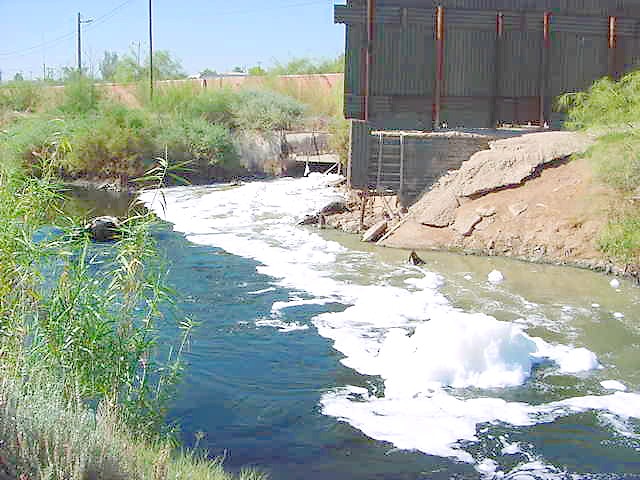

Apart from plastics, there are particular problems with other toxins which do not disintegrate rapidly in the marine environment. Heavy metals are metallic chemical elements that have a relatively high density and are toxic or poisonous at low concentrations. Examples are mercury, lead, nickel, arsenic and cadmium. Other persistent toxins are PCBs, DDT, pesticides, furans, dioxins and phenols.
Such toxins can accumulate in the tissues of many species of aquatic life in a process called bioaccumulation. They are also known to accumulate in benthic environments, such as estuaries and bay muds: a geological record of human activities of the last century.
Some specific examples are
-
Chinese and Russian industrial pollution such as phenols and heavy metals in the Amur River have devastated fish stocks and damaged its estuary soil.
-
Wabamun Lake in Alberta, Canada, once the best whitefish lake in the area, now has unacceptable levels of heavy metals in its sediment and fish.
-
Acute and chronic pollution events have been shown to impact southern California kelp forests, though the intensity of the impact seems to depend on both the nature of the contaminants and duration of exposure.
-
Due to their high position in the food chain and the subsequent accumulation of heavy metals from their diet, mercury levels can be high in larger species such as bluefin and albacore. As a result, in March 2004 the United States FDA issued guidelines recommending that pregnant women, nursing mothers and children limit their intake of tuna and other types of predatory fish.
-
Some shellfish and crabs can survive polluted environments, accumulating heavy metals or toxins in their tissues. For example, mitten crabs have a remarkable ability to survive in highly modified aquatic habitats, including polluted waters. The farming and harvesting of such species needs careful management if they are to be used as a food.{{cite journal |name-list-style=vanc | display-authors = 1 }}{{cite journal
-
Mining has a poor environmental track record. For example, according to the United States Environmental Protection Agency, mining has contaminated portions of the headwaters of over 40% of watersheds in the western continental US.{{cite web | archive-url=https://web.archive.org/web/20020525042127/http://www.epa.gov/water/liquidassets/dirtywater.html | url-status=dead | archive-date=May 25, 2002 | access-date = 2007-01-23}} Much of this pollution finishes up in the sea.
-
Heavy metals enter the environment through oil spills - such as the Prestige oil spill on the Galician coast - or from other natural or anthropogenic sources.
Eutrophication
Main article: Eutrophication

Eutrophication is an increase in chemical nutrients, typically compounds containing nitrogen or phosphorus, in an ecosystem. It can result in an increase in the ecosystem's primary productivity (excessive plant growth and decay), and further effects including lack of oxygen and severe reductions in water quality, fish, and other animal populations.
The biggest culprit are rivers that empty into the ocean, and with it the many chemicals used as fertilizers in agriculture as well as waste from livestock and humans. An excess of oxygen depleting chemicals in the water can lead to hypoxia and the creation of a dead zone.
Surveys have shown that 54% of lakes in Asia are eutrophic; in Europe, 53%; in North America, 48%; in South America, 41%; and in Africa, 28%. Estuaries also tend to be naturally eutrophic because land-derived nutrients are concentrated where run-off enters the marine environment in a confined channel. The World Resources Institute has identified 375 hypoxic coastal zones around the world, concentrated in coastal areas in Western Europe, the Eastern and Southern coasts of the US, and East Asia, particularly in Japan. Selman, Mindy (2007) Eutrophication: An Overview of Status, Trends, Policies, and Strategies. World Resources Institute. In the ocean, there are frequent red tide algae blooms{{cite web |access-date=2006-12-27 |archive-date=2015-05-07 |archive-url=https://web.archive.org/web/20150507132040/http://www.tulane.edu/~bfleury/envirobio/enviroweb/DeadZone.htm |url-status=dead
In addition to land runoff, atmospheric anthropogenic fixed nitrogen can enter the open ocean. A study in 2008 found that this could account for around one third of the ocean's external (non-recycled) nitrogen supply and up to three per cent of the annual new marine biological production. It has been suggested that accumulating reactive nitrogen in the environment may have consequences as serious as putting carbon dioxide in the atmosphere.
Acidification
Main article: Ocean acidification
The oceans are normally a natural carbon sink, absorbing carbon dioxide from the atmosphere. Because the levels of atmospheric carbon dioxide are increasing, the oceans are becoming more acidic. The potential consequences of ocean acidification are not fully understood, but there are concerns that structures made of calcium carbonate may become vulnerable to dissolution, affecting corals and the ability of shellfish to form shells.{{Citation |display-authors=etal |access-date=14 April 2017 |archive-url=https://web.archive.org/web/20051108092429/http://www.royalsoc.ac.uk/displaypagedoc.asp?id=13314 |archive-date=8 November 2005 |url-status=dead
A report from NOAA scientists published in the journal Science in May 2008 found that large amounts of relatively acidified water are upwelling to within four miles of the Pacific continental shelf area of North America. This area is a critical zone where most local marine life lives or is born. While the paper dealt only with areas from Vancouver to northern California, other continental shelf areas may be experiencing similar effects.
Effects of fishing
Habitat destruction
Main article: Environmental effects of fishing
Fishing nets that have been left or lost in the ocean by fishermen are called ghost nets, and can entangle fish, dolphins, sea turtles, sharks, dugongs, crocodiles, seabirds, crabs, and other creatures. Acting as designed, these nets restrict movement, causing starvation, laceration and infection, and—in those that need to return to the surface to breathe—suffocation.
Fishing operations often use trawl netting dragging and dredging them across the ocean bottom. Numerous habitats and ecosystems are disturbed and destroyed by trawling including coral reefs, sediments, and grasses that provide feeding and breeding grounds for a plethora of marine organisms. Coastal habitats such as mangroves are often sites of aquaculture farming practices in which the mangroves are either destroyed for easier use of the land or experience harmful conditions due to the farm being abandoned once the area becomes too polluted with excess nutrients.
Overfishing
Main article: Overfishing
Some specific examples of overfishing.
- On the east coast of the United States, the availability of bay scallops has been greatly diminished by the overfishing of sharks in the area. A variety of sharks have, until recently, fed on rays, which are a main predator of bay scallops. With the shark population reduced, in some places almost totally, the rays have been free to dine on scallops to the point of greatly decreasing their numbers.
- Chesapeake Bay's once-flourishing oyster populations historically filtered the estuary's entire water volume of excess nutrients every three or four days. Today that process takes almost a year, and sediment, nutrients, and algae can cause problems in local waters. Oysters filter these pollutants, and either eat them or shape them into small packets that are deposited on the bottom where they are harmless.
- The Australian government alleged in 2006 that Japan illegally overfished southern bluefin tuna by taking 12,000 to 20,000 tonnes per year instead of their agreed 6,000 tonnes; the value of such overfishing would be as much as US$2 billion. Such overfishing has resulted in severe damage to stocks. "Japan's huge appetite for tuna will take the most sought-after stocks to the brink of commercial extinction unless fisheries agree on more rigid quotas" stated the WWF. Japan disputes this figure, but acknowledges that some overfishing has occurred in the past.
- Jackson, Jeremy B C et al. (2001) Historical overfishing and the recent collapse of coastal ecosystems Science 293:629-638.

Our World in Data provides a figure showing the trend in global fishing exploitation over a few decades to reveal the intensifying circumstances at hand:
Overfishing presents many threats to fish population densities, obviously. However, as these populations plummet below the maximum sustainable yield (MSY) value for the specific population, you are now risking the loss of biodiversity and possibility for extinction due to less diversity. This loss in diversity is especially concerning as we deal with environmental changes from climate change since less diversity decreases a populations ability to adapt and survive the alterations of the habitat. File:Maximum-sustainable-yield-of-fish-with-addition.png|This graph demonstrates the importance of following a specific quota of exploitation to sustain a resource such as a fish population.
Loss of biodiversity
Main article: Biodiversity
Each species in an ecosystem is affected by the other species in that ecosystem. There are very few single prey-single predator relationships. Most prey are consumed by more than one predator, and most predators have more than one prey. Their relationships are also influenced by other environmental factors. In most cases, if one species is removed from an ecosystem, other species will most likely be affected, up to the point of extinction.
Species biodiversity is a major contributor to the stability of ecosystems. When an organism exploits a wide range of resources, a decrease in biodiversity is less likely to have an impact. However, for an organism which exploit only limited resources, a decrease in biodiversity is more likely to have a strong effect.
Reduction of habitat, hunting and fishing of some species to extinction or near extinction, and pollution tend to tip the balance of biodiversity. For a systematic treatment of biodiversity within a trophic level, see unified neutral theory of biodiversity.
Threatened species
The global standard for recording threatened marine species is the IUCN Red List of Threatened Species. This list is the foundation for marine conservation priorities worldwide. A species is listed in the threatened category if it is considered to be critically endangered, endangered, or vulnerable. Other categories are near threatened and data deficient.
Marine
Many marine species are under increasing risk of extinction and marine biodiversity is undergoing potentially irreversible loss due to threats such as overfishing, bycatch, climate change, invasive species and coastal development.
By 2008, the IUCN had assessed about 3,000 marine species. This includes assessments of known species of shark, ray, chimaera, reef-building coral, grouper, marine turtle, seabird, and marine mammal. Almost one-quarter (22%) of these groups have been listed as threatened.
| Group | Species | Threatened | Near threatened | Data deficient |
|---|---|---|---|---|
| Sharks, rays, and chimaeras | 17% | 13% | 47% | |
| Groupers | 12% | 14% | 30% | |
| Reef-building corals | 845 | 27% | 20% | 17% |
| Marine mammals | 25% | |||
| Seabirds | 27% | |||
| Marine turtles | 7 | 86% |
- Sharks, rays, and chimaeras: are deep water pelagic species, which makes them difficult to study in the wild. Not a lot is known about their ecology and population status. Much of what is currently known is from their capture in nets from both targeted and accidental catch. Many of these slow growing species are not recovering from overfishing by shark fisheries around the world.
- Groupers: Major threats are overfishing, particularly the uncontrolled fishing of small juveniles and spawning adults.
- Coral reefs: The primary threats to corals are bleaching and disease which has been linked to an increase in sea temperatures. Other threats include coastal development, coral extraction, sedimentation and pollution. The coral triangle (Indo-Malay-Philippine archipelago) region has the highest number of reef-building coral species in threatened category as well as the highest coral species diversity. The loss of coral reef ecosystems will have devastating effects on many marine species, as well as on people that depend on reef resources for their livelihoods.
- Marine mammals: include whales, dolphins, porpoises, seals, sea lions, walruses, sea otter, marine otter, manatees, dugong and the polar bear. Major threats include entanglement in ghost nets, targeted harvesting, noise pollution from military and seismic sonar, and boat strikes. Other threats are water pollution, habitat loss from coastal development, loss of food sources due to the collapse of fisheries, and climate change.
- Seabirds: Major threats include longline fisheries and gillnets, oil spills, and predation by rodents and cats in their breeding grounds. Other threats are habitat loss and degradation from coastal development, logging and pollution.
- Marine turtles: Marine turtles lay their eggs on beaches, and are subject to threats such as coastal development, sand mining, and predators, including humans who collect their eggs for food in many parts of the world. At sea, marine turtles can be targeted by small scale subsistence fisheries, or become bycatch during longline and trawling activities, or become entangled in ghost nets or struck by boats.
An ambitious project, called the Global Marine Species Assessment, is under way to make IUCN Red List assessments for another 17,000 marine species by 2012. Groups targeted include the approximately 15,000 known marine fishes, and important habitat-forming primary producers such mangroves, seagrasses, certain seaweeds and the remaining corals; and important invertebrate groups including molluscs and echinoderms.
Freshwater
Freshwater fisheries have a disproportionately high diversity of species compared to other ecosystems. Although freshwater habitats cover less than 1% of the world's surface, they provide a home for over 25% of known vertebrates, more than 126,000 known animal species, about 24,800 species of freshwater fish, molluscs, crabs and dragonflies, and about 2,600 macrophytes. Continuing industrial and agricultural developments place huge strain on these freshwater systems. Waters are polluted or extracted at high levels, wetlands are drained, rivers channelled, forests deforestated leading to sedimentation, invasive species are introduced, and over-harvesting occurs.
In the 2008 IUCN Red List, about 6,000 or 22% of the known freshwater species have been assessed at a global scale, leaving about 21,000 species still to be assessed. This makes clear that, worldwide, freshwater species are highly threatened, possibly more so than species in marine fisheries. However, a significant proportion of freshwater species are listed as data deficient, and more field surveys are needed.
Fisheries management
Main article: Fisheries management
A recent paper published by the National Academy of Sciences of the USA warns that: "Synergistic effects of habitat destruction, overfishing, introduced species, warming, acidification, toxins, and massive runoff of nutrients are transforming once complex ecosystems like coral reefs and kelp forests into monotonous level bottoms, transforming clear and productive coastal seas into anoxic dead zones, and transforming complex food webs topped by big animals into simplified, microbially dominated ecosystems with boom and bust cycles of toxic dinoflagellate blooms, jellyfish, and disease".
References
- World Ocean Atlas (2005) World ocean database. Retrieved 19 April 2008.
- The Columbia Electronic Encyclopedia (2007) The World Ocean. Retrieved 19 April 2008.
- Jacques, Peter (2006) Globalization and the world ocean Rowman Altamira.
- Pauly, Daniel; Watson, Reg and Alder, Jackie (2005) Global trends in world fisheries: impacts on marine ecosystems and food security Philosophical transactions of the Royal Society, Volume 360, Number 1453.
- De Young, Cassandra (2007) Review of the state of world marine capture fisheries management FAO, Fisheries Technical Paper 488, Rome. .
References
- Based on data sourced from the [http://faostat.fao.org/site/629/default.aspx FishStat database]
- (30 June 2016). "Mapping EU fishing activities using ship tracking data". Journal of Maps.
- [http://oceanmotion.org/html/background/upwelling-and-downwelling.htm Wind Driven Surface Currents: Upwelling and Downwelling]
- Carina Stanton. [http://seattletimes.nwsource.com/html/localnews/2002377292_ocean13m.html Warmer oceans may be killing West Coast marine life]. ''[[Seattle Times]]''. 13 July 2005. Retrieved 22 March 2008.
- "Aquatic food webs".
- Animation based on CASA-VGPM and SeaWiFS data in Behrenfeld et al. 2001, Science 291:2594-2597.
- (1997). "Fisheries Technical Paper 367: Krill Fisheries of the World". [[Food and Agriculture Organization.
- Field, C.B.. (1998). "Primary production of the Biosphere: Integrating Terrestrial and Oceanic Components". [[Science (journal).
- Ross, R. M. and Quetin, L. B. (1988). Euphausia superba: a critical review of annual production. Comp. Biochem. Physiol. 90B, 499-505.
- [http://www.uni-oldenburg.de/zoomorphology/Biology.html Biology of Copepods] {{webarchive. link. (2009-01-01 at [[Carl von Ossietzky University of Oldenburg]])
- [https://web.archive.org/web/20051130034159/http://www.panda.org/about_wwf/where_we_work/ecoregions/ecoregion_list/index.cfm List of the Global 200]
- Pritchard, D. W. (1967) ''What is an estuary: physical viewpoint''. p. 3–5 ''in:'' G. H. Lauf (ed.) ''Estuaries'', A.A.A.S. Publ. No. 83, Washington, D.C.
- G.Branch, Estuarine vulnerability and ecological impacts, TREE vol. 14, no. 12 Dec. 1999
- [http://scidiv.bcc.ctc.edu/gj/AAAS-MangrovesEstuaries.pdf Mangroves and estuaries]
- [http://www.merriam-webster.com/dictionary/littoral ''Littoral''] (2008). Merriam-Webster Online Dictionary. Retrieved 13 August 2008
- Encyclopædia Britannica (2008) [http://www.britannica.com/EBchecked/topic/344269/littoral-zone ''Littoral zone'']
- [[Office of Naval Research. US Office of Naval Research]]. [http://www.onr.navy.mil/focus/ocean/regions/littoralzone1.htm ''Ocean Regions: Littoral Zone - Characteristics''] {{webarchive. link. (2008-09-17)
- [http://dictionary.reference.com/browse/neritic%20zone?r=14 ''Neritic zone''] Webster's New Millennium Dictionary of English, Preview Edition (v 0.9.7). Lexico Publishing Group, LLC. Accessed: 12 August 2008.
- [http://www.merriam-webster.com/dictionary/neritic ''Littoral''] (2008). Merriam-Webster Online Dictionary. Retrieved 13 August 2008
- "Office of Naval Research".
- [http://www.britannica.com/EBchecked/topic/208713/fishing-bank ''Fishing bank''] (2008) In Encyclopædia Britannica. Retrieved July 26, 2008, from Encyclopædia Britannica Online
- Gross 43.
- Pinet, 37.
- Pinet 316-17, 418-19.
- "Corals reveal impact of land use". ARC Centre of Excellence for Coral Reef Studies.
- Spalding, Mark, Corinna Ravilious, and Edmund Green. 2001. ''World Atlas of Coral Reefs''. Berkeley, CA: University of California Press and UNEP/WCMC.
- Nybakken, James. 1997. ''Marine Biology: An Ecological Approach.'' 4th ed. Menlo Park, CA: Addison Wesley.
- Castro, Peter and Michael Huber. 2000. ''Marine Biology.'' 3rd ed. Boston: McGraw-Hill.
- Ryan Holl. (17 April 2003). "Bioerosion: an essential, and often overlooked, aspect of reef ecology". [[Iowa State University]].
- Hughes, et al. 2003. Climate Change, Human Impacts, and the Resilience of Coral Reefs. ''[[Science (journal). Science]]''. Vol 301 15 August 2003
- Save Our Seas, 1997 Summer Newsletter, Dr. Cindy Hunter and Dr. Alan Friedlander
- Tun, K., L.M. Chou, A. Cabanban, V.S. Tuan, Philreefs, T. Yeemin, Suharsono, K.Sour, and D. Lane, 2004, p:235-276 in C. Wilkinson (ed.), Status of Coral Reefs of the world: 2004.
- Kleypas, J.A., R.A. Feely, V.J. Fabry, C. Langdon, C.L. Sabine, and L.L. Robbins, 2006, Impacts of Ocean Acidification on Coral Reefs and Other Marine Calcifiers: A guide for Future Research, NSF, NOAA, & USGS, 88 pp.
- Cinner, J. et al. (2005). Conservation and community benefits from traditional coral reef management at Ahus Island, Papua New Guinea. Conservation Biology 19 (6), 1714–1723
- "Coral Reef Management, Papua New Guinea". [[NASA]]'s [[Earth Observatory]].
- [http://www.bbc.co.uk/programmes/b009jsjv 'The Coral Gardener'-documentary on coral gardening by Counterpart]
- "Practical Action coral reef restoration".
- Morato, Telmo. [http://www.ices.dk/marineworld/seamounts.asp ''Seamounts – hotspots of marine life.''] {{Webarchive. link. (2010-04-13 [[International Council for the Exploration of the Sea). ICES]]. Retrieved 19 June 2008.
- Boehlert, G. W. and Genin, A. 1987. A review of the effects of seamounts on biological processes. 319-334. ''Seamount, islands and atolls''. ''Geophysical Monograph 43'', edited by B. H. Keating, P. Fryer, R. Batiza, and G. W. Boehlert.
- (1994). "Advances in Marine Biology Volume 30".
- Morato, T., Varkey, D.A., Damaso, C., Machete, M., Santos, M., Prieto, R., Santos, R.S. and Pitcher, T.J. (2008) Evidence of a seamount effect on aggregating visitors. Marine Ecology Progress Series 357: 23-32.
- Black, Richard (2004) [http://news.bbc.co.uk/2/hi/science/nature/3719590.stm ''Deep-sea trawling's great harm''] BBC.
- Shiklomanov, I A, (1993) ''World fresh water resources'' in Glick, P H, ed., Water in Crisis: Oxford University Press, p 13-24.
- O'Sullivan, Patrick. (2004-01-26). "The Lakes Handbook: Limnology and Limnetic Ecology". Wiley.
- [https://pubs.usgs.gov/fs/fs-0058-99/ U.S. Geological Survey Fact Sheet FS-058-99]
- Ficke, Ashley D.. (2007-11-01). "Potential impacts of global climate change on freshwater fisheries". Reviews in Fish Biology and Fisheries.
- Alan Weisman. (2007). "The World Without Us". St. Martin's Thomas Dunne Books.
- Alan Weisman. (Summer 2007). "Polymers Are Forever". Orion magazine.
- [http://www.algalita.org/pelagic_plastic_mov.html Algalita.org] {{webarchive. link. (2012-07-20)
- "UNEP.org".
- "Six pack rings hazard to wildlife".
- [http://www.seagrantfish.lsu.edu/resources/factsheets/litter_mess.htm Louisiana Fisheries - Fact Sheets]
- (7 December 2006). "Plastics 'poisoning world's seas'". BBC News.
- Kenneth R. Weiss. (2 August 2006). "Plague of Plastic Chokes the Seas". Los Angeles Times.
- Charles Moore. (November 2003). "Across the Pacific Ocean, plastics, plastics, everywhere.". Natural History.
- (2006). "Plastics and Marine Debris". Algalita Marine Research Foundation.
- "Learn". NoNurdles.com.
- "Plastic Debris: from Rivers to Sea". Algalita Marine Research Foundation.
- [http://www.npolar.no/ansipra/english/Indexpages/Ethnic_groups.html#19 "Indigenous Peoples of the Russian North, Siberia and Far East: Nivkh" ] by Arctic Network for the Support of the Indigenous Peoples of the Russian Arctic]
- Grigg, R.W. and R.S. Kiwala. 1970. Some ecological effects of discharged wastes on marine life. California Department of Fish and Game 56: 145-155.
- Stull, J.K. 1989. Contaminants in sediments near a major marine outfall: history, effects and future. OCEANS ’89 Proceedings 2: 481-484.
- North, W.J., D.E. James and L.G. Jones. 1993. History of kelp beds (''Macrocystis'') in Orange and San Diego Counties, California. Hydrobiologia 260/261: 277-283.
- Tegner, M.J., P.K. Dayton, P.B. Edwards, K.L. Riser, D.B. Chadwick, T.A. Dean and L. Deysher. 1995. Effects of a large sewage spill on a kelp forest community: catastrophe or disturbance? Marine Environmental Research 40: 181-224.
- (1998). "Nonpoint pollution of surface waters with phosphorus and nitrogen". Ecological Applications.
- (March 2004). "What You Need to Know About Mercury in Fish and Shellfish".
- Stephen Gollasch. (2006-03-03). "Ecology of ''Eriocheir sinensis''".
- Perez-Lopez ''et al.'' (2006)
- Gerlach: Marine Pollution, Springer, Berlin (1975)
- ILEC/Lake Biwa Research Institute [Eds]. 1988–1993 Survey of the State of the World's Lakes. Volumes I-IV. International Lake Environment Committee, Otsu and United Nations Environment Programme, Nairobi.
- Duce, R A and 29 others (2008) ''Impacts of Atmospheric Anthropogenic Nitrogen on the Open Ocean'' Science. Vol 320, pp 893–89
- [http://www.eurekalert.org/pub_releases/2008-05/uov-at051208.php ''Addressing the nitrogen cascade''] {{Webarchive. link. (2016-08-23 Eureka Alert, 2008.)
- Orr, James C.. (2005). "Anthropogenic ocean acidification over the twenty-first century and its impact on calcifying organisms". Nature.
- Key, R.M.. (2004). "A global ocean carbon climatology: Results from GLODAP". Global Biogeochemical Cycles.
- (2008). "Evidence for Upwelling of Corrosive "Acidified" Seawater onto the Continental Shelf". Science.
- (28 June 2007). "'Ghost fishing' killing seabirds". BBC News.
- "Preserve habitats".
- "Oyster Reefs: Ecological importance". US National Oceanic and Atmospheric Administration.
- [https://www.theguardian.com/environment/2007/jan/22/japan.conservationandendangeredspecies Japan warned tuna stocks face extinction] Justin McCurry, guardian.co.uk, Monday January 22, 2007. Retrieved 2008-04-02.
- [http://www.theage.com.au/news/national/japanese-accused-of-2bn-tuna-fraud/2006/08/11/1154803098670.html TheAge.com.au]
- [http://www.iht.com/articles/ap/2006/10/16/asia/AS_GEN_Japan_Tuna_Fishing.php IHT.com]
- [http://www.iucnredlist.org/static/introduction The 2008 IUCN Red List of Threatened Species] {{webarchive. link. (2009-07-06)
- [[IUCN]]: [http://cmsdata.iucn.org/downloads/status_of_the_world_s_marine_species.pdf Status of the world's marine species] {{Webarchive. link. (2010-03-20)
- [[IUCN]]: [http://cmsdata.iucn.org/downloads/freshwater_biodiversity_a_hidden_resource_under_threat.pdf Freshwater biodiversity a hidden resource under threat]
- Jackson, Jeremy B C (2008) [http://www.pnas.org/content/early/2008/08/08/0802812105.full.pdf+html ''Ecological extinction and evolution in the brave new ocean''] Proceedings of the National Academy of Sciences of the USA.
This article was imported from Wikipedia and is available under the Creative Commons Attribution-ShareAlike 4.0 License. Content has been adapted to SurfDoc format. Original contributors can be found on the article history page.
Ask Mako anything about Wild fisheries — get instant answers, deeper analysis, and related topics.
Research with MakoFree with your Surf account
Create a free account to save articles, ask Mako questions, and organize your research.
Sign up freeThis content may have been generated or modified by AI. CloudSurf Software LLC is not responsible for the accuracy, completeness, or reliability of AI-generated content. Always verify important information from primary sources.
Report