From Surf Wiki (app.surf) — the open knowledge base
Wikipedia community
Volunteers who create and maintain Wikipedia

Volunteers who create and maintain Wikipedia
| Field | Value |
|---|---|
| name | Wikipedia community |
| type | Informal organization of individual contributors |
| image | Wikimania 2025 group photo with participants forming a "W" shape with their hands.jpg |
| alt | A large group of people seen from above. Everyone is looking at the camera. |
| caption | Wikimania 2025 group photograph at Trademark Hotel in Nairobi, Kenya |
| area_served | Worldwide |
| focus | Free, open-content, wiki-based Internet encyclopedias |
| services | Authoring and editing Wikipedia |
| homepage |
The Wikipedia community, collectively and individually known as Wikipedians, is an online community of volunteers who create and maintain Wikipedia, an online encyclopedia. Wikipedians may or may not consider themselves part of the Wikimedia movement, a global network of volunteer contributors to Wikipedia and other related projects hosted by the Wikimedia Foundation.
Demographics
In April 2008, writer and lecturer Clay Shirky and computer scientist Martin Wattenberg estimated the total time spent creating Wikipedia at roughly 100 million hours. As of November 2025, there are approximately 123 million registered user accounts across all language editions, of which around 528,000 are "active" (i.e., made at least one edit in the last thirty days).
A study published in 2010 found that the contributor base to Wikipedia "was barely 13% women; the average age of a contributor was in the mid-20s". A 2011 study by researchers from the University of Minnesota found that females comprised 16.1% of the 38,497 editors who started editing Wikipedia during 2009. In a January 2011 New York Times article, Noam Cohen observed that 13% of Wikipedia's contributors are female according to a 2008 Wikimedia Foundation survey.
Sue Gardner, a former executive director of the Wikimedia Foundation, hoped to see female contributions increase to 25% by 2015. Linda Basch, president of the National Council for Research on Women, noted the contrast in these Wikipedia editor statistics with the percentage of women currently completing bachelor's degrees, master's degrees and PhD programs in the United States (all at rates of 50% or greater).
In response, various universities have hosted edit-a-thons to encourage more women to participate in the Wikipedia community. In fall 2013, 15 colleges and universities—including Yale, Brown, and Penn State—offered college credit for students to "write feminist thinking" about technology into Wikipedia. A 2008 self-selected survey of the diversity of contributors by highest educational degree indicated that 62% of responding Wikipedia editors had attained either a high school or undergraduate college education.
In August 2014, Wikipedia co-founder Jimmy Wales said in a BBC interview that the Wikimedia Foundation was "... really doubling down our efforts ..." to reach 25% of female editors (originally targeted by 2015), since the Foundation had "totally failed" so far. Wales said "a lot of things need to happen ... a lot of outreach, a lot of software changes".
Andrew Lih, writing in The New York Times, was quoted by Bloomberg News in December 2016 as supporting Wales's comments concerning shortfalls in Wikipedia's outreach to female editors. Lih states his concern with the question indicating that: "How can you get people to participate in an [editing] environment that feels unsafe, where identifying yourself as a woman, as a feminist, could open you up to ugly, intimidating behavior".
In October 2023, a representative survey of 1,000 adults in the U.S. by YouGov found that 7% had ever edited Wikipedia, 20% had considered doing so but had not, 55% had neither considered editing Wikipedia nor done it, and 17% had never visited Wikipedia.
Motivation


In a 2003 study of Wikipedia as a community, economics Ph.D. student Andrea Ciffolilli argued that the low transaction costs of participating in wiki software create a catalyst for collaborative development, and that a "creative construction" approach encourages participation. A paper written by Andrea Forte and Amy Bruckman in 2005, called "Why Do People Write for Wikipedia? Incentives to Contribute to Open-Content Publishing", discussed the possible motivations of Wikipedia contributors. It applied Latour and Woolgar's concept of the cycle of credit to Wikipedia contributors, suggesting that the reason that people write for Wikipedia is to gain recognition within the community.
Oded Nov, in his 2007 paper "What Motivates Wikipedians", related the motivations of volunteers in general to the motivations of people who contribute to Wikipedia. Nov carried out a survey using the six motivations of volunteers, identified in an earlier paper. The survey found that the most commonly indicated motives were "fun", "ideology", and "values", whereas the least frequently indicated motives were "career", "social", and "protective". The six motivations he used were:
- Values – expressing values to do with altruism and helping others
- Social – engaging with friends, taking part in activities viewed favourably by others
- Understanding – expanding knowledge through activities
- Career – gaining work experience and skills
- Protective – e.g., reducing guilt over personal privilege
- Enhancement – demonstrating knowledge to others
To these six motivations he also added:
- Ideology – expressing support for what is perceived to be the underlying ideology of the activity (e.g., the belief that knowledge should be free)
- Fun – enjoying the activity
The Wikimedia Foundation has carried out some surveys of Wikipedia contributors and users. In 2008, the Wikimedia Foundation, which, alongside the Collaborative Creativity Group at UNU-Merit, launched a survey of readers and editors of Wikipedia. The results of the survey were published two years later on 24 March 2010. The Wikimedia Foundation began a process in 2011 of semi-annual surveys in order to understand Wikipedia editors more and better cater to their needs.
"Motivations of Wikipedia Content Contributors", a paper by Heng-Li Yang and Cheng-Yu Lai, hypothesised that, because contributing to Wikipedia is voluntary, an individual's enjoyment of participating would be the highest motivator. This paper suggests that although people might initially start editing Wikipedia out of enjoyment, the most likely motivation for continuing to participate is self-concept-based motivations such as "I like to share knowledge which gives me a sense of personal achievement."
A study in 2014 by Cheng-Yu Lai and Heng-Li Yang explored the reasons why people continue editing Wikipedia's content. The study used authors of the English-language version of the site and received 288 valid online survey responses. Their results indicated and confirmed that subjective task value, commitment, and procedural justice affected satisfaction of Wikipedians; and satisfaction influenced an author's continued intention to edit Wikipedia's content.
Also in 2014, a study of edits made to health-related Wikipedia articles conducted by researchers at University College London was published. The study found that contributors were motivated to edit health-related articles to correct errors and bring them up to professional standards, out of a sense of care and responsibility, when it seemed that no one else was interested in a particular article. The most common motivation was the desire to learn and then share this knowledge with others, which became a source of personal fulfillment for many, despite some negative experiences such as hostility and unfriendliness. One participant explained 'When people are hiding behind anonymity, they become a lot less nice. And on Wikipedia, we already have a significant issue with civility problems.' However, this was also seen by others as necessary.
Editors of Wikipedia have given personal testimonials of why they contribute to Wikipedia's content. A theme of these testimonials is the enjoyment that editors may get from contributing to Wikipedia's content and being part of the Wikipedia community. Also mentioned is the potential addictive quality of editing Wikipedia. Gina Trapani of Lifehacker said "it turns out editing an article isn't scary at all. It's easy, surprisingly satisfying and can become obsessively addictive." Jimmy Wales has also commented on the addictive quality of Wikipedia, saying "The main thing about Wikipedia ... is that it's fun and addictive".
Wikipedians sometimes award one another "barnstars" for good work. These personalized tokens of appreciation reveal a range of valued work extending beyond "simple editing" to include social support, administrative actions, and types of articulation work. The barnstar phenomenon has been analyzed by researchers seeking to determine what implications it might have for other communities engaged in some collaborations. Since 2012, the Wikipedia page curation interface has included a tab offering editors a "WikiLove" option for giving barnstars and other such awards to other editors "as a reward for carefully curated work". WikiLove has been described as "an immaterial P2P reward mechanism" that substitutes for a formal reputation-valuing system on the site.
Media
Wikipedia has spawned a number of community news publications. An online newsletter, The Signpost, has been published since 10 January 2005. Professional cartoonist Greg Williams created a webcomic called ** which ran in The Signpost from 2006 to 2008. A podcast called Wikipedia Weekly was active from 2006 to 2009, while a series of conference calls titled "Not the Wikipedia Weekly" ran from 2008 to 2009.
The annual Great American Wiknic was a social gathering that took place in some cities of the United States during the summer. The Wiknic concept allowed Wikipedians to bring picnic food and to personally interact. There is a yearly WikiConference North America organized by and for Wikipedia editors, enthusiasts, and volunteers. The first two events were held at New York Law School and Washington, D.C.'s National Archives Building in 2014 and 2015, respectively. Staff from the Wiki Education Foundation, which co-sponsored the 2015 event,Wiki Education Foundation, 2015:
- and the Wikimedia Foundation also attend each year.
There is WikiConference India which is a national conference organised in India. The first conference was held in November 2011, in Mumbai, the capital of the Indian state of Maharashtra. It was organised by the Mumbai Wikipedia community in partnership with Wikimedia India Chapter. The conference focus is on matters concerning India on Wikipedia projects and other sister projects in English and other Indian folk languages. WikiConference India 2023 took place in Hyderabad from 28 to 30 April 2023. Additionally, there is Wiki Indaba which is the regional conference for African Wikimedians. The conference includes Wikimedia projects such as Wikipedia, other wikis, open-source software, free knowledge, free content and how these projects affect the African continent.
Criticism
Main article: Criticism of Wikipedia#Criticism of the community
The Seigenthaler and Essjay incidents caused criticism of Wikipedia's reliability and usefulness as a reference. Complaints related to the community include the effects of users' anonymity, attitudes toward newcomers, abuses of privileges by administrators, biases in the social structure of the community (in particular gender bias and lack of female contributors) and the role of the project's co-founder Jimmy Wales in the community. One particular controversy with regards to paid contributors to Wikipedia prompted the Wikimedia Foundation to send a cease and desist letter to the Wiki-PR agency.
Wikipedia's co-founder Larry Sanger (who later founded rival project Citizendium) characterized the Wikipedia community in 2007 as ineffective and abusive, stating that "The community does not enforce its own rules effectively or consistently. Consequently, administrators and ordinary participants alike are able essentially to act abusively with impunity, which begets a never-ending cycle of abuse." Oliver Kamm of The Times expressed skepticism toward Wikipedia's reliance on consensus in forming its content: "Wikipedia seeks not truth but consensus, and like an interminable political meeting the end result will be dominated by the loudest and most persistent voices."
Recognition
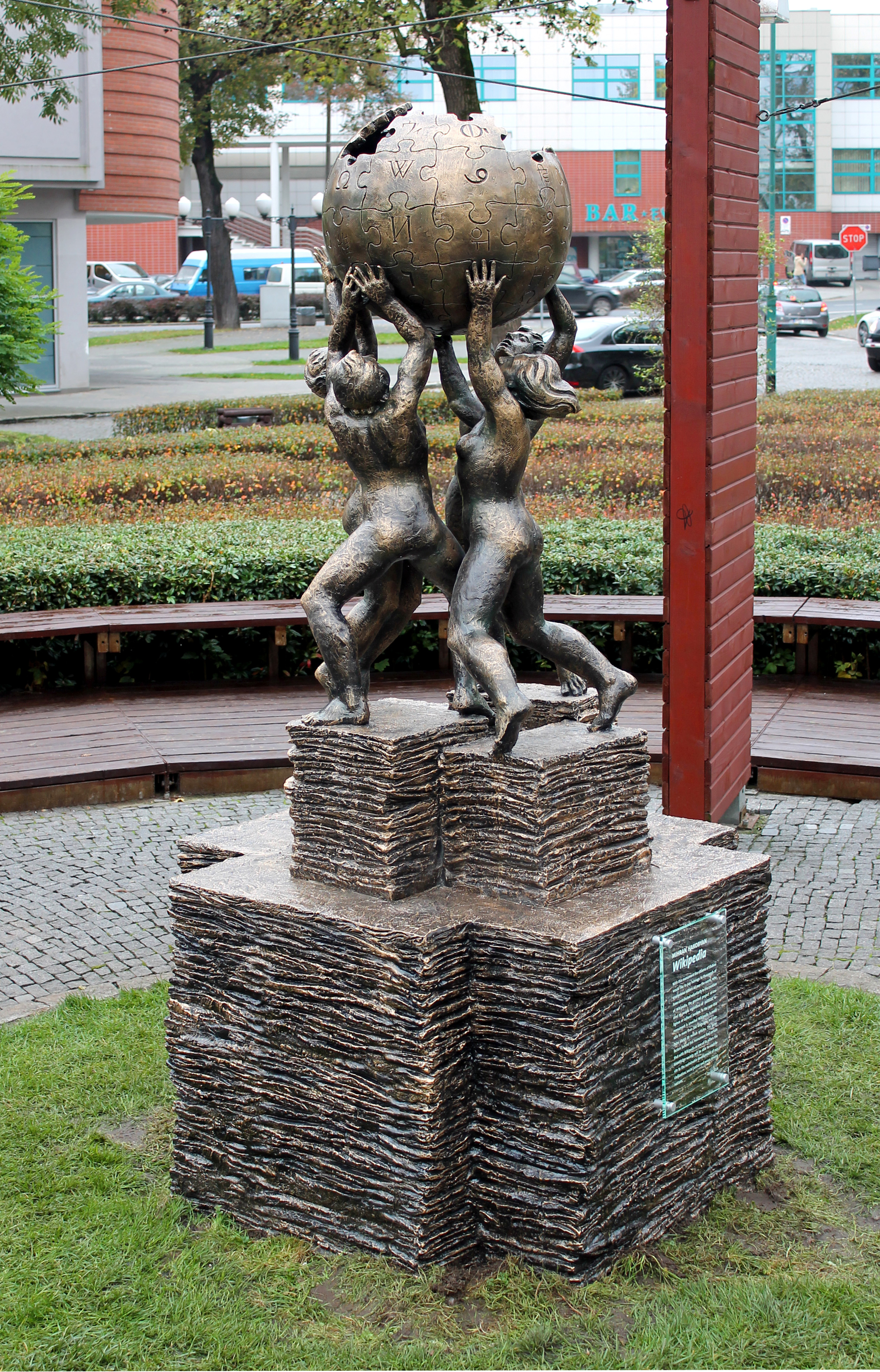
A Wikipedia Monument by sculptor Mihran Hakobyan was erected in Słubice, Poland, in 2014 to honor the Wikipedia community. The 2015 Erasmus Prize was awarded to the Wikipedia community for promoting the dissemination of knowledge through a comprehensive and universally accessible encyclopedia. To achieve that, the initiators of Wikipedia have designed a new and effective democratic platform. The prize specifically recognizes Wikipedia as a community—a shared project that involves tens of thousands of volunteers around the world."
References
References
- Shirky, Clay. (7 May 2008). "Gin, Television, and Social Surplus". World Changing.
- "List of Wikipedias - Meta".
- (2 February 2011). "Where Are the Women in Wikipedia? – Room for Debate". [[The New York Times]].
- (3–5 October 2011). "WP:Clubhouse? An Exploration of Wikipedia's Gender Imbalance". WikiSym 2011.
- Chom, Noam. (30 January 2011). "Define Gender Gap? Look Up Wikipedia's Contributor List". The New York Times.
- Basch, Linda. (6 February 2011). "Male-Dominated Web Site Seeking Female Experts". The New York Times.
- (27 August 2013). "OCAD to 'Storm Wikipedia' this fall". CBC News.
- Wikimedia Foundation. (April 2009). "WMF Strategic Plan Survey".
- "Wikipedia 'completely failed' to fix gender imbalance". BBC News.
- (December 22, 2016). "Is Wikipedia Woke?".
- "YouGov Survey: Wikipedia". YouGov.
- Ciffolilli, Andrea. "[http://firstmonday.org/ojs/index.php/fm/article/view/1108 Phantom authority, self-selective recruitment and retention of members in virtual communities: The case of Wikipedia] {{Webarchive. link. (8 September 2013 ", ''[[First Monday (journal)). First Monday]]'' December 2003.
- (2005). "Why Do People Write for Wikipedia? Incentives to Contribute to Open-Content Publishing". SIGGROUP 2005 Workshop: Sustaining Community.
- Nov, Oded. (2007). "What Motivates Wikipedians?". Communications of the ACM.
- Clary, E.. (1998). "Understanding and assessing the motivations of volunteers: A functional approach". Journal of Personality and Social Psychology.
- Möller, Erik. (3 April 2010). "New Reports from November 2008 Survey Released". Wikimedia Foundation.
- Glott, Ruediger. "Wikipedia Survey – Overview of Results". UNU-MERIT.
- Wikimedia Foundation. (10 June 2011). "Wikipedia editors do it for fun: First results of our 2011 editor survey". Wikimedia Foundation.
- Wikimedia Foundation. (19 April 2011). "Launching our semi-annual Wikipedia editors survey". Wikimedia Foundation.
- Yang, Heng-Li. (November 2010). "Motivations of Wikipedia content contributors". Computers in Human Behavior.
- (2014). "The reasons why people continue editing Wikipedia content – task value confirmation perspective". Behaviour & Information Technology.
- (2014-12-03). "Motivations for Contributing to Health-Related Articles on Wikipedia: An Interview Study". Journal of Medical Internet Research.
- Trampani, Gina. (28 October 2005). "Geek to Live: How to contribute to Wikipedia". Gawker Media.
- Griffin, Ricky W.. (2011). "Management". South-Western Cengage Learning.
- T. Kriplean. (2008). "Articulations of wikiwork". Proceedings of the ACM.
- Krista Kennedy, ''Textual Curation: Authorship, Agency, and Technology in Wikipedia and Chambers Cyclopedia'' (2016), [https://books.google.com/books?id=TcNHDQAAQBAJ&pg=PT122 p. 122].
- Primavera De Filippi, "Translating Commons-Based Peer Production Values into Metrics: Toward Commons-Based Cryptocurrencies", in David Lee Kuo Cheun, ed., ''Handbook of Digital Currency: Bitcoin, Innovation, Financial Instruments, and Big Data'' (Elsevier, 2015), [https://books.google.com/books?id=RfWcBAAAQBAJ&pg=PA469 p. 469].
- (2008). "How Wikipedia Works: And how You Can be a Part of it". No Starch Press.
- "WIKIWORLD Comics by Greg Williams".
- "Wikipedia Weekly".
- Lih, Andrew. (2009). "The Wikipedia Revolution: How a Bunch of Nobodies Created the World's Greatest Encyclopedia". Hachette Books.
- "Wikimania". wikimedia.org.
- (August 7, 2006). "The Many Voices of Wikipedia, Heard in One Place". [[The New York Times]].
- Levin, Verony. (August 5, 2011). "Wikimania Conference at Its Peak; Founder Jimmy Wales to Speak Tomorrow". [[TheMarker]].
- "Main Page – Wikimania 2015 in Mexico City".
- "Wikimania 2016 bids/Esino Lario".
- (2023-08-25). "UNESCO joins the 2023 Wikimedia Movement in Singapore". [[UNESCO]].
- Hesse, Monica. (25 June 2011). "Wikipedia editors log off long enough to mingle". The Washington Post.
- Ferriero, David. (October 2, 2015). "National Archives Hosts WikiConference USA". [[National Archives and Records Administration]].
- "Wikipedia Wants You to Improve Its Coverage of Indigenous Peoples". [[Smithsonian Institution]].
- (October 14, 2015). "WikiConference USA: Watch Online". [[American Society of Plant Biologists]].
- (October 9, 2015). "It's here! WikiConference USA". Wiki Education Foundation.
- Davis, LiAnna. (October 26, 2016). "Wiki Ed engages with Wikipedians at WikiConference North America". Wiki Education Foundation.
- IANS. (9 November 2011). "Mumbai to host first WikiConference in India". India Current Affairs.
- Unattributed. (9 November 2011). "Mumbai To Host First Ever National WikiConference In India". EFY Enterprises.
- (19 November 2011). "Wikipedia woos India with local languages". [[Hindustan Times]].
- Unattributed. (10 November 2011). "Wikipedia eyes India for language growth". Dawn.com.
- (12 October 2022). "WikiConference India 2023".
- Fripp, Charlie. (2014-06-24). "What does Wikipedia need to do in Africa?". htxt.africa.
- "Wiki Indaba 2017". Opensource.com.
- Seigenthaler, John. (29 November 2005). "A false Wikipedia 'biography'". USA Today.
- Katharine Q. Seelye (3 December 2005) [https://www.nytimes.com/2005/12/04/weekinreview/04seelye.html "Snared in the Web of a Wikipedia Liar"] {{Webarchive. link. (7 September 2014 [https://nytimes.com/ ''The New York Times''] {{Webarchive). link. (21 February 2020)
- Cohen, Noam. (5 March 2007). "A Contributor to Wikipedia Has His Fictional Side". [[The New York Times]].
- Cohen, Noam. (30 January 2011). "Define Gender Gap? Look Up Wikipedia's Contributor List". New York Times.
- Cohen, Noam. (17 March 2008). "Open-Source Troubles in Wiki World". [[The New York Times]].
- Chang, Andrea. (20 November 2013). "Wikimedia Foundation sends cease and desist letter to Wiki-PR". Los Angeles Times.
- Bogatin, Donna. (25 March 2007). "Can Wikipedia handle the truth?". ZDNet.
- [https://web.archive.org/web/20110814104256/http://www.timesonline.co.uk/tol/comment/columnists/guest_contributors/article2267665.ece Wisdom? More like dumbness of the crowds. Oliver Kamm – Times Online (archive version 2011-08-14)] ([http://oliverkamm.typepad.com/blog/2007/08/wisdom-more-lik.html Author's own copy] {{Webarchive. link. (5 September 2016 ))
- (9 October 2014). "Poland to Honor Wikipedia With Monument". [[ABC News (United States).
- "Former Laureates". Praemium Erasmianum Foundation.
This article was imported from Wikipedia and is available under the Creative Commons Attribution-ShareAlike 4.0 License. Content has been adapted to SurfDoc format. Original contributors can be found on the article history page.
Ask Mako anything about Wikipedia community — get instant answers, deeper analysis, and related topics.
Research with MakoFree with your Surf account
Create a free account to save articles, ask Mako questions, and organize your research.
Sign up freeThis content may have been generated or modified by AI. CloudSurf Software LLC is not responsible for the accuracy, completeness, or reliability of AI-generated content. Always verify important information from primary sources.
Report
Socializing
Offline activities are organized by the Wikimedia Foundation or the community of Wikipedia. These include conference and social events like Wikimania and Wiknic.
Wikimania
Main article: Wikimania
Wikimania is an annual international conference for users of the wiki projects operated by the Wikimedia Foundation (such as Wikipedia and other sister projects). Topics of presentations and discussions include Wikimedia Foundation projects, other wikis, open-source software, free knowledge and free content, and the different social and technical aspects which relate to these topics. Since 2011, the winner of the Wikimedian of the Year award (known as the "Wikipedian of the Year" until 2017) has been announced at Wikimania.
The first Wikimania was held in Frankfurt, in 2005. Wikimania is organized by a committee usually supported by the local national chapter, local institutions (such as a library or university), and the Wikimedia Foundation. Wikimania has been held in Buenos Aires, Cambridge, Haifa, Hong Kong,{{cite news | access-date = August 9, 2014 | archive-url = https://web.archive.org/web/20140309234658/https://www.scmp.com/lifestyle/arts-culture/article/1291419/wikimania-challenge-hong-kong-conference-comes-town | archive-date = March 9, 2014 | url-status = live |access-date = August 9, 2014 |archive-url = https://web.archive.org/web/20140808223927/https://now-here-this.timeout.com/2014/08/06/wikipedia-wikimania-2014-london/ |archive-date = August 8, 2014 |url-status = live
Wiknics and conferences