From Surf Wiki (app.surf) — the open knowledge base
Whitfield's ointment
Acidic ointment used for topical treatment of dermatophytosis
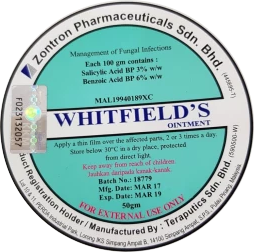
Acidic ointment used for topical treatment of dermatophytosis
Whitfield's ointment is an acidic ointment used for the topical treatment of dermatophytosis, such as athlete's foot. It can have a slight burning effect that goes away after a few minutes. It is named after Arthur Whitfield (1868–1947), a British dermatologist.
The original ointment contains 3% salicylic acid and 6% benzoic acid in a suitable base, such as petrolatum. Alternatively, a short-chain alcohol or fatty alcohol can be used as the base.
Whitfield's ointment is not advised for areas of thinner skin, such as the scrotum or the groin, and in such sites should only be used diluted to half-strength.
A systematic review of the medical literature comparing treatments for ringworm and jock itch was generally critical of the quality of data available. It concluded that there was "insufficient evidence to determine if Whitfield's ointment, a widely used agent, is effective", implying that the studies were of poor quality and therefore effectiveness could not be determined. Individual studies support its use as a cost-effective treatment.
References
References
- (2008). "Antimicrobial Drugs: Chronicle of a twentieth century medical triumph". Oxford University Press.
- (2009). "[[British Pharmacopoeia]]".
- (2006). "United States Pharmacopeia".
- Sauer, Gordon C.. (1957-09-01). "Whitfield's Ointment". Archives of Dermatology.
- (2010). "Rook's Textbook of Dermatology". Wiley-Blackwell.
- El-Gohary, M.. (Aug 4, 2014). "Topical antifungal treatments for tinea cruris and tinea corporis". The Cochrane Database of Systematic Reviews.
- Gooskens V. (1994). "Treatment of superficial mycoses in the tropics: Whitfield's ointment versus clotrimazole". [[International Journal of Dermatology]].
- (1973). "Comparison of clotrimazole cream, Whitfield's ointment and Nystatin ointment for the topical treatment of ringworm infections, pityriasis versicolor, erythrasma and candidiasis". [[British Journal of Dermatology]].
- (1986). "An institutional survey of tinea capitis in Harare, Zimbabwe and a trial of miconazole cream versus Whitfield's ointment in its treatment". Clinical and Experimental Dermatology.
This article was imported from Wikipedia and is available under the Creative Commons Attribution-ShareAlike 4.0 License. Content has been adapted to SurfDoc format. Original contributors can be found on the article history page.
Ask Mako anything about Whitfield's ointment — get instant answers, deeper analysis, and related topics.
Research with MakoFree with your Surf account
Create a free account to save articles, ask Mako questions, and organize your research.
Sign up freeThis content may have been generated or modified by AI. CloudSurf Software LLC is not responsible for the accuracy, completeness, or reliability of AI-generated content. Always verify important information from primary sources.
Report