From Surf Wiki (app.surf) — the open knowledge base
White-chinned jacamar
Species of bird
Species of bird
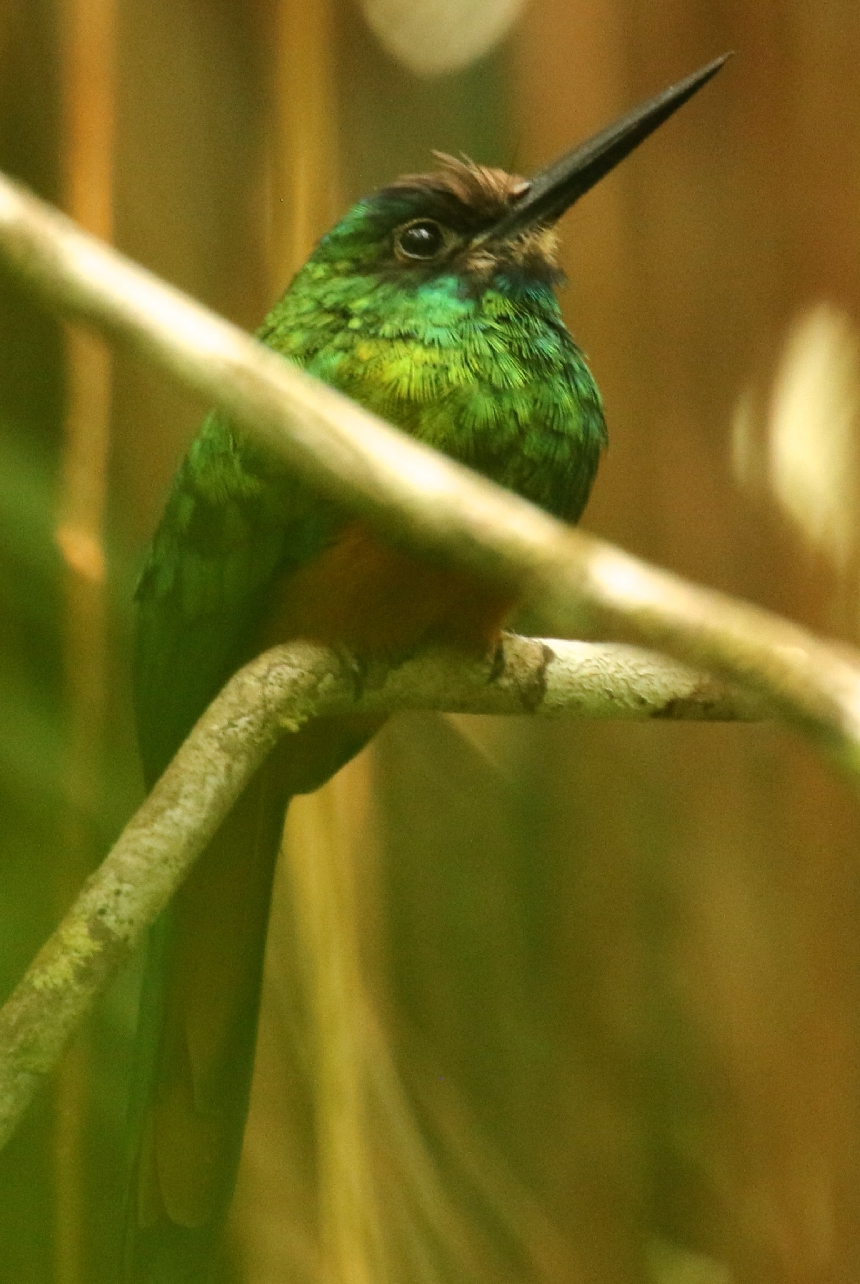
The white-chinned jacamar (Galbula tombacea) is a species of bird in the family Galbulidae. It is found in Brazil, Colombia, Ecuador, and Peru.
Taxonomy and systematics
The white-chinned jacamar and the rufous-tailed (Galbula ruficauda), bluish-fronted (G. cyanescens), coppery-chested (G. pastazae), and green-tailed jacamars (G. galbula) are considered to form a superspecies. The white-chinned jacamar has two subspecies, the nominate Galbula tombacea tombacea and G. t. mentalis.
Description
The white-chinned jacamar is 19 to long and weighs 21.5 to. The nominate male's crown is ash brown and the rest of the upper parts are a dark metallic bronzy green. It has a small white chin spot, a glittery green throat and chest, and a reddish chestnut belly and vent area. The female's belly is paler and ochraceous. G. t. mentalis has a larger white chin spot and the upper parts are a coppery bronze.
Distribution and habitat
The nominate subspecies of white-chinned jacamar is found east of the Andes from Colombia's Meta Department southeast through Ecuador's Napo Province and Peru's Department of Loreto into western Brazil south of the Amazon River as far as the tonantins area of Amazonas state. G. t. mentalis is found further east, along both banks of the Solimões (upper Amazon) River to its confluences with the Negro and Madeira Rivers.
The white-chinned jacamar inhabits shrubby borders and openings in terra firme, várzea, and gallery forest. In lower elevations it is often found along watercourses. In elevation it ranges up to 1200 m.
Behavior
Feeding
Though the white-chinned jacamar's diet is assumed to include a variety of insects, only Hymenoptera have been recorded. It perches by itself or in pairs on exposed branches from which it sallies to catch its flying prey.
Breeding
"No reliable information" is available about the white-chinned jacamar's breeding phenology.
Vocalization
The white-chinned jacamar's song is "an accelerating and rising series of "pee-pee-pee-pee-pe-pe-pe-pe'pe'pe'pe'e'e' notes" ending with a trill https://www.xeno-canto.org/14523. Its call is "keelip" or "peeup", often given in a series https://www.xeno-canto.org/609542.
Status
The IUCN has assessed the white-chinned jacamar as being of Least Concern. Though it is widespread and occurs in several protected areas, it is rare to uncommon in most areas and "deforestation doubtless continues to reduce population size."
References
References
- BirdLife International. (2016). "''Galbula tombacea''".
- (January 2021). "IOC World Bird List (v 11.1)".
- Remsen, J. V., Jr., J. I. Areta, E. Bonaccorso, S. Claramunt, A. Jaramillo, D. F. Lane, J. F. Pacheco, M. B. Robbins, F. G. Stiles, and K. J. Zimmer. Version 19 January 2021. A classification of the bird species of South America. American Ornithological Society. https://www.museum.lsu.edu/~Remsen/SACCBaseline.htm retrieved January 19, 2021
- Tobias, J., T. Züchner, T.A. de Melo Júnior, G. M. Kirwan, and A. Bonan (2020). White-chinned Jacamar (''Galbula tombacea''), version 1.0. In Birds of the World (J. del Hoyo, A. Elliott, J. Sargatal, D. A. Christie, and E. de Juana, Editors). Cornell Lab of Ornithology, Ithaca, NY, USA. https://doi.org/10.2173/bow.whcjac1.01 retrieved May 10, 2021
This article was imported from Wikipedia and is available under the Creative Commons Attribution-ShareAlike 4.0 License. Content has been adapted to SurfDoc format. Original contributors can be found on the article history page.
Ask Mako anything about White-chinned jacamar — get instant answers, deeper analysis, and related topics.
Research with MakoFree with your Surf account
Create a free account to save articles, ask Mako questions, and organize your research.
Sign up freeThis content may have been generated or modified by AI. CloudSurf Software LLC is not responsible for the accuracy, completeness, or reliability of AI-generated content. Always verify important information from primary sources.
Report