From Surf Wiki (app.surf) — the open knowledge base
Westminster Bridge
Bridge over the River Thames in London

Bridge over the River Thames in London
| Field | Value |
|---|---|
| bridge_name | Westminster Bridge |
| image | Westminster Bridge and Palace of Westminster.jpg |
| image_size | 300px |
| carries | A302 road |
| crosses | River Thames |
| locale | London |
| designer | Thomas Page |
| maint | Transport for London |
| spans | 7 |
| length | 250 m |
| width | 26 m |
| open | (first bridge) 18 November 1750 |
| (second bridge) 24 May 1862 | |
| heritage | Grade II* listed structure |
| preceded | Lambeth Bridge |
| followed | Hungerford Bridge & Golden Jubilee Bridges |
| design | Arch bridge |
(second bridge) 24 May 1862
Westminster Bridge is a road-and-foot-traffic bridge crossing over the River Thames in London, linking Westminster on the west side and Lambeth on the east side.
The bridge is painted predominantly green, the same colour as the leather seats in the House of Commons which is on the side of the Palace of Westminster nearest to the bridge, but a natural shade similar to verdigris. This is in contrast to Lambeth Bridge, which is red, the same colour as the seats in the House of Lords and is on the opposite side of the Houses of Parliament.
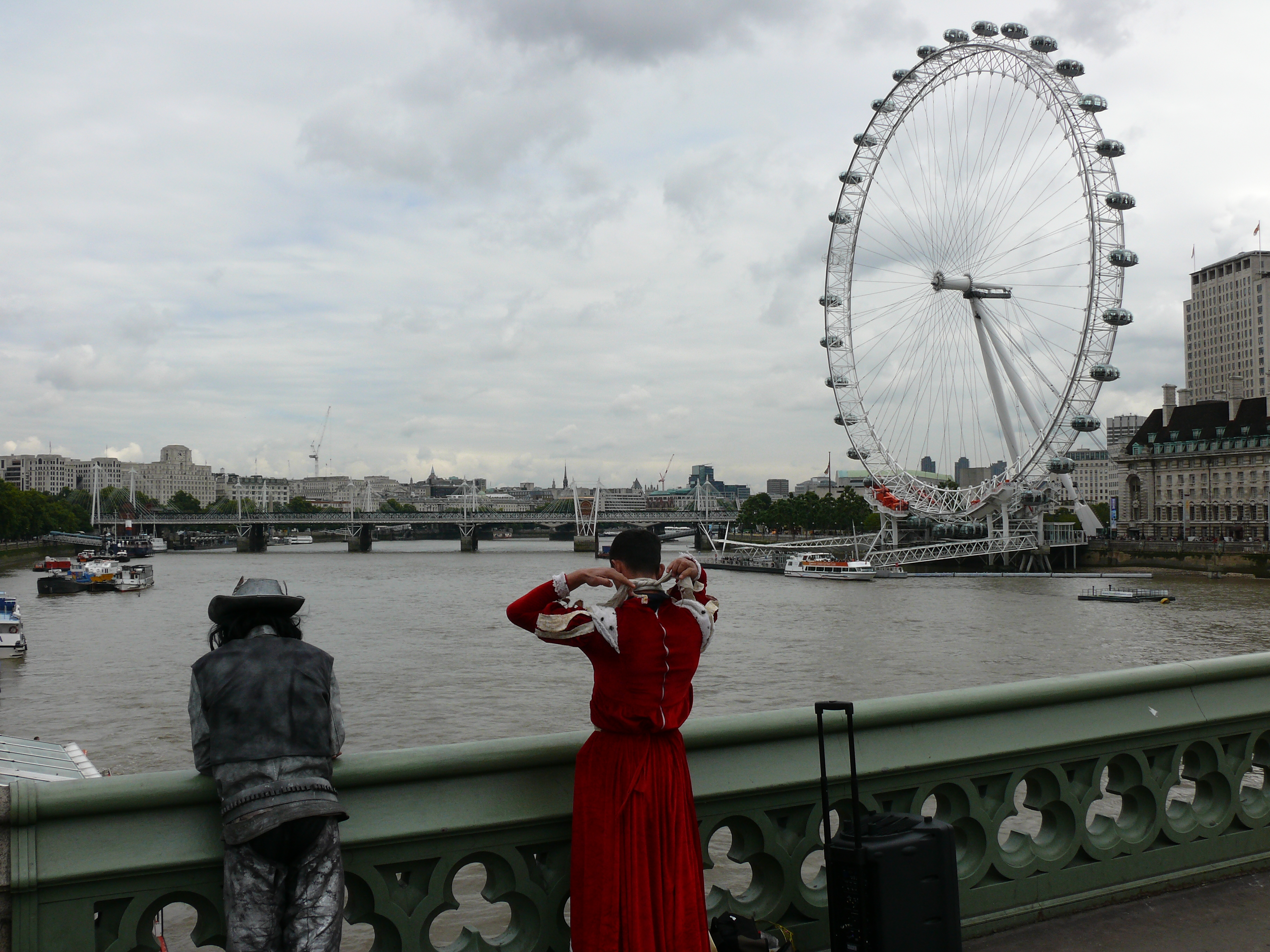
In 2005–2007, it underwent a complete refurbishment, including replacing the iron fascias and repainting the whole bridge. It links the Palace of Westminster on the west side of the river with County Hall and the London Eye on the east and was the finishing point during the early years of the London Marathon.
The next bridge downstream is the Hungerford Bridge & Golden Jubilee Bridges and upstream is Lambeth Bridge. Westminster Bridge was designated a Grade II* listed structure in 1981.
History{{anchor|Westminster Bridge Act 1735|Westminster Bridge Act 1736|Westminster Bridge Act 1737|Westminster Bridge Act 1738|Westminster Bridge Act 1739|Westminster Bridge Act 1740|Westminster Bridge Act 1741|Westminster Bridge Act 1743|Westminster Bridge Act 1744|Westminster Bridge Act 1756|Westminster Bridge Act 1757|Prickard's Estate and Westminster Bridge Commissioners Act 1814|Westminster Bridge Act 1850|Westminster Bridge Act 1853|Westminster Bridge Act 1859|Westminster Bridge Act 1864}}
For over 600 years (at least 1129–1729), the nearest Thames bridge to London Bridge was at Kingston. From late Tudor times congestion in trading hours at London Bridge (for road goods and carriages from Kent, Essex, much of Surrey, Middlesex and beyond) often amounted to more than an hour. A bridge at Westminster was proposed in 1664, but opposed by the Corporation of London and the watermen. Further opposition held sway in 1722. However an intervening bridge (albeit in timber) was built at Putney in 1729 and the scheme received parliamentary approval in 1736. Financed by private capital, lotteries and grants, Westminster Bridge was built between 1739–1750, under the supervision of the Swiss engineer Charles Labelye. The bridge opened on 18 November 1750.
The City of London responded to Westminster Bridge and the population growth by removing the buildings on London Bridge and widening it in 1760–63. With Putney Bridge, the bridge paved the way for four others within three decades: Blackfriars Bridge (1769, built by the City), Kew Bridge (1759), Battersea Bridge (1773), and Richmond Bridge (1777) by which date roads and vehicles were improved and fewer regular goods transported by water.
The bridge assisted the expanding West End to the developing South London as well as goods and carriages from the more estuarine counties and the East Sussex and Kentish ports. Without the bridge, traffic to and from the greater West End would have to negotiate streets often as congested as London Bridge, principally the Strand/Fleet Street and New Oxford Street/Holborn. Roads on both sides of the river were also built and improved, including Charing Cross Road and around the Elephant & Castle in Southwark.
By the mid-19th century the bridge was subsiding badly and expensive to maintain. The current bridge was designed by Thomas Page and opened on 24 May 1862. With a length of 250 m and a width of 26 m, it is a seven-arch, cast-iron bridge with Gothic detailing by Charles Barry (the architect of the Palace of Westminster). The bridge carried a tram line for much of the first half of the twentieth century, from 1906 until 1952. On 5 July that year the last tram made a ceremonial journey across the bridge. Since the removal of Rennie's New London Bridge in 1967 it is the oldest road structure which crosses the Thames in central London.
On 22 March 2017, a terrorist attack started on the bridge and continued into Bridge Street and Old Palace Yard. Five people – three pedestrians, one police officer, and the attacker – died as a result of the incident. A colleague of the officer (who was stationed nearby) was armed and shot the attacker. More than 50 people were injured. An investigation into the attack was conducted by the Metropolitan Police.
Given its proximity to the British Parliament, Westminster Bridge has been a key site for protests in London. For instance, in January 2024, pro-Palestinian demonstrators led by the Free Palestine Coalition (FPC) attempted to occupy the bridge. Scuffles were reported, leading to arrests by the Metropolitan Police, after which protesters moved to occupy the surrounding roads when police restricted access to the bridge.
Image gallery
File:Samuel Scott - The Building of Westminster Bridge - Google Art Project.jpg|The Building of Westminster Bridge by Samuel Scott, 1742 File:Canaletto - Westminster Bridge, with the Lord Mayor's Procession on the Thames - Google Art Project.jpg|The first Westminster Bridge as painted by Canaletto, 1747. Yale Center for British Art, New Haven. File:Canaletto - The City Seen Through an Arch of Westminster Bridge.JPG|London Seen Through an Arch of Westminster Bridge by Canaletto, 1747 File:Samuel Scott, Une arche du pont de Westminster, v. 1750, huile sur toile, 135,7 x 163,8 cm, Londres, Tate Gallery, T0119.jpg|An Arch of Westminster Bridge by Samuel Scott, 1750 File:Westminster Bridge 1750.jpg|Westminster Bridge, around 1750. The proprietors of the bridge had to pay compensation to the operators of the earlier 'Horseferry', and to local watermen File:Rocque Vauxhall and Westminster (cropped).png|Westminster & Lambeth, 1746. Westminster Bridge, opened in 1740, connects Westminster to Lambeth; Huntley Ferry crosses the river on the site of the future Vauxhall Bridge File:Joseph Mallord William Turner, English - The Burning of the Houses of Lords and Commons, October 16, 1834 - Google Art Project.jpg|The Burning of the Houses of Lords and Commons by J. M. W. Turner, 1835, with Westminster Bridge on the right File:Westminster Bridge and Lambeth Bridge 1897.jpg|1897 map, showing Lambeth Palace, Lambeth Bridge, the Houses of Parliament and Westminster Bridge File:London - Lanterns on Westminster Bridge.jpg|Street lamps on the bridge File:Coats of Arms, Westminster Bridge, London - geograph.org.uk - 1404551.jpg|The coats of arms of Queen Victoria and Albert, Prince Consort on the bridge File:Westminster Bridge detail.jpg|The coat of arms of Henry John Temple, 3rd Viscount Palmerston on the bridge. Palmerston was Prime Minister when the current bridge was opened. File:Westminster Bridge By-Laws Notice.jpg|Westminster Bridge By-Laws Notice File:Redlion.jpg|The South Bank Lion at the east end of Westminster Bridge
In popular culture

- In the 1964 Doctor Who serial The Dalek Invasion of Earth, the Daleks are seen moving across it in the 22nd Century.
- In 1807 the famous poem Composed upon Westminster Bridge, September 3, 1802 by William Wordsworth, written while standing on Westminster Bridge, was published in the "Collection of Poems" in two volumes.
- In the 2002 British horror film 28 Days Later, the protagonist awakes from a coma to find London deserted and walks over an eerily empty Westminster Bridge whilst looking for signs of life.
- Westminster Bridge is the start and finish point for the Bridges Handicap Race, a traditional London running race.
- The bridge was the site of a Pit Stop during the fourth season of the Israeli version of The Amazing Race.
- In the finale of the 24th James Bond film Spectre, Blofeld's helicopter crashes into Westminster Bridge.
- In the 2019 mobile game Mario Kart Tour, a track based on London called London Loop is featured in the game and makes an appearance in the Mario Kart 8 Deluxe Booster Course Pass DLC Wave 2. In all three variants of the original track in Mario Kart Tour, the race begins on the bridge, as well as in Mario Kart 8 Deluxe.
Notes
References
References
- Becky Jones,Clare Lewis. (2012). "The Bumper Book of London: Everything You Need to Know About London and More...". Frances Lincoln.
- {{NHLE
- Pierce, Patricia, ''Old London Bridge – The Story of the Longest Inhabited Bridge in Europe'', Headline Books, 2001, {{ISBN. 0-7472-3493-0 at p.45
- (1979). "Old Westminster Bridge: The Bridge of Fools". David & Charles.
- Cookson, Brian. (October 2010). "Westminster Bridge". London Historians.
- John Eade. "Where Thames Smooth Waters Glide". Thames.me.uk.
- Thames Tideway Tunnel. (September 2013). "Tunnel and Bridge Assessments: Central Zone: Westminster Bridge". Thames Water Utilities.
- (1951). "Survey of London". London County Council.
- Marshall, Prince (1972). (2 February 1972). "Wheels of London". The Sunday Times Magazine.
- (27 March 2017). "London attack: What we know so far". BBC.
- (2024-01-06). "Pro-Palestinian protesters block bridge outside UK parliament". Reuters.
- (2024-01-06). "Hundreds of pro-Palestinian protesters block Westminster Bridge with sit-in".
- (27 March 2017). "The Dalek Invasion of Earth: Doctor Who classic episode #2". [[TheGuardian.com]].
- (28 January 2015). "The Race Halts!".
This article was imported from Wikipedia and is available under the Creative Commons Attribution-ShareAlike 4.0 License. Content has been adapted to SurfDoc format. Original contributors can be found on the article history page.
Ask Mako anything about Westminster Bridge — get instant answers, deeper analysis, and related topics.
Research with MakoFree with your Surf account
Create a free account to save articles, ask Mako questions, and organize your research.
Sign up freeThis content may have been generated or modified by AI. CloudSurf Software LLC is not responsible for the accuracy, completeness, or reliability of AI-generated content. Always verify important information from primary sources.
Report