From Surf Wiki (app.surf) — the open knowledge base
Western Sahara War
1975–1991 armed conflict between Morocco and the Polisario Front

1975–1991 armed conflict between Morocco and the Polisario Front
| Field | Value |
|---|---|
| conflict | Western Sahara War |
| partof | the Western Sahara conflict |
| image | Westernsaharamap.png |
| image_size | 300px |
| caption | Map of the Western Sahara; the red line is the military berm built by Morocco |
| date | 30 October 1975 – 6 September 1991 |
| () | |
| place | Western Sahara |
| territory | Morocco controls approximately 80% of the territory, the Polisario Front controls 20% |
| result | Inconclusive |
| * Military stalemate<ref name | "BoukharsRoussellier2013" |
| combatant1 | |
| combatant2 | |
| commander1 | MAR Hassan II |
| MAR Ahmed Dlimi | |
| MAR Abdelaziz Bennani | |
| MAR Housni Benslimane | |
| MRT Mokhtar Ould Daddah | |
| MRT Mustafa Ould Salek | |
| MRT Mohamed Khouna Ould Haidallah | |
| commander2 | SADR Mohamed Abdelaziz |
| SADR El-Ouali Mustapha Sayed | |
| SADR Brahim Ghali | |
| SADR Lahbib Ayoub | |
| SADR Mohamed Ali El Admi | |
| strength1 | Morocco 30,000 (1976) |
| 60,000 (1980) | |
| 150,000 (1988) | |
| 120,000 (1991) | |
| Mauritania 3,000–5,000 (1976) | |
| 12,000 (1977) | |
| 18,000 (1978) | |
| strength2 | 5,000 (1976) |
| 15,000 (1980) | |
| 8,000 (1988) | |
| casualties1 | Morocco Unknown; 2,155–2,300 captured |
| Mauritania 2,000 soldiers killed | |
| casualties2 | Unknown |
| casualties3 | Civilian Casualties: |
| More than 3,000 Sahrawis killed (Eckhardt,1985)<ref name | "Willian Eckhardt" War statistics table by William G. Eckhardt. |
| 3 West German pilots killed<ref name | Polar3 / |
| 853+ (Project Disappeared)<ref name | "desaparecidos.org" – 1,500 (International Federation of Human Rights) Sahrawis missing |
| 40,000 (1976)<ref name | "Red Cross Journal"Asistencia en favor de las víctimas saharauis. Revista Internacional de la Cruz Roja, 1, pp 83–83 (1976) – 80,000 (1977) Sahrawis displaced |
| Estimated death toll: 10,000–20,000<ref name | "lupiga.com"EKSKLUZIVNO ZA LUPIGU: Podupiremo mirno rješenje, ali zadržavamo mogućnost da i silom oslobodimo našu zemlju Lupiga.com, 2 March 2013 |
()
-
Spanish complete withdrawal under the Madrid Accords (1976)
-
Mauritanian retreat and withdrawal of territorial claims and peace agreement with the Polisario Front.
-
Military stalemate
-
Ceasefire agreed on between the Polisario Front and Morocco (1991)
-
Morocco
- Morocco Moroccan Armed Forces
-
Mauritania (1975–1979)
-
France (1977-1978)
-
Sahrawi Republic
- Sahrawi Republic Polisario Front MAR Ahmed Dlimi MAR Abdelaziz Bennani MAR Housni Benslimane MRT Mokhtar Ould Daddah MRT Mustafa Ould Salek MRT Mohamed Khouna Ould Haidallah SADR El-Ouali Mustapha Sayed SADR Brahim Ghali SADR Lahbib Ayoub SADR Mohamed Ali El Admi 60,000 (1980) 150,000 (1988) 120,000 (1991) Mauritania 3,000–5,000 (1976) 12,000 (1977) 18,000 (1978) 15,000 (1980) 8,000 (1988) Mauritania 2,000 soldiers killed
More than 3,000 Sahrawis killed (Eckhardt,1985)
3 West German pilots killed
853+ (Project Disappeared) – 1,500 (International Federation of Human Rights) Sahrawis missing
40,000 (1976) – 80,000 (1977) Sahrawis displaced
Estimated death toll: 10,000–20,000
The Western Sahara War was an armed conflict between the Sahrawi Indigenous Polisario Front and Morocco from 1975 to 1991 (and Mauritania from 1975 to 1979), being the most significant phase of the Western Sahara conflict. The conflict erupted after the withdrawal of Spain from the Spanish Sahara in accordance with the Madrid Accords (signed under the pressure of the Green March), by which it transferred administrative control of the territory to Morocco and Mauritania, but not sovereignty. In late 1975, the Moroccan government organized the Green March of some 350,000 Moroccan citizens, escorted by around 20,000 troops, who entered Western Sahara, trying to establish a Moroccan presence. The war continued in low intensity throughout the 1980s, though Morocco made several attempts to take the upper hand in 1989–1991. A cease-fire agreement was finally reached between the Polisario Front and Morocco in September 1991. Some sources put the final death toll between 10,000 and 20,000 people.
The Western Sahara conflict has since shifted from military to civilian resistance. A peace process, attempting to resolve the conflict has not yet produced any permanent solution to Sahrawi refugees and territorial agreement between Morocco and the Sahrawi Republic. Today most of the territory of Western Sahara is under Moroccan occupation, while the inland parts are governed by the Sahrawi Arab Democratic Republic, managed by the Polisario Front.
Background
Spanish Sahara
Main article: Spanish Sahara
In 1884 Spain claimed a protectorate over the coast from Cape Bojador to Cap Blanc. Later, the Spanish extended their area of control. In 1958 Spain joined the previously separate districts of Saguia el-Hamra (in the north) and Río de Oro (in the south) to form the province of Spanish Sahara.
Raids and rebellions by the indigenous Saharan population kept the Spanish forces out of much of the territory for a long time. Ma al-Aynayn, the Saharan Caïd of Smara, started an uprising against France in the 1910s, at a time when the French had expanded their influence and control in North-West Africa, he died in the same year and his son Ahmed al-Hiba succeeded him. French forces defeated him when he tried to conquer Marrakesh, and in retaliation, severely damaged the holy city of Smara in 1913. Not until the second destruction of Smara in 1934, by joint Spanish and French forces, did the territory finally become subdued. Another uprising in 1956–1958, initiated by the Moroccan Army of Liberation, led to heavy fighting, but eventually the Spanish forces regained control, again with French aid. However, unrest simmered, and in 1967 the Harakat Tahrir arose to challenge Spanish rule peacefully. After the events of the Zemla Intifada in 1970, when Spanish police destroyed the organization and "disappeared" its founder, Muhammad Bassiri, Sahrawi nationalism again took a militant turn.
Conception of the Polisario Front
In 1971 a group of young Sahrawi students began organizing what came to be known as The Embryonic Movement for the Liberation of Saguia el-Hamra and Rio de Oro. After attempting in vain to gain backing from several Arab governments, including both Algeria and Morocco, but only drawing faint notices of support from Libya and Mauritania, the movement eventually relocated to Spanish-controlled Western Sahara to start an armed rebellion.
The beginnings of armed struggle
The Polisario Front was formally constituted on 10 May 1973 in the Mauritanian city of Zouérat, with the express intention of militarily forcing an end to Spanish colonization. Its first Secretary General was El-Ouali Mustapha Sayed. On 20 May he led the Khanga raid, Polisario's first armed action, in which a Spanish post manned by a team of Tropas Nomadas (Sahrawi-staffed auxiliary forces) was overrun and rifles seized. Polisario then gradually gained control over large swaths of desert countryside, and its power grew from early 1975 when the Tropas Nomadas began deserting to the Polisario, bringing weapons and training with them. At this point, Polisario's manpower included perhaps 800 men, but they were backed by a larger network of supporters. A UN visiting mission headed by Simeon Aké that was conducted in June 1975 concluded that Sahrawi support for independence (as opposed to Spanish rule or integration with a neighbouring country) amounted to an "overwhelming consensus" and that the Polisario Front was by far the most powerful political force in the country.
Timeline
Spanish withdrawal
While Spain started negotiating a handover of power in mid 1975, it ceded the administrative control of the territory to Mauritania and Morocco only after signing the Madrid Accords. However, on 31 October 1975, Moroccan troops crossed into the territory from the north-east, advancing towards Mahbes and Farciya.
The Moroccan government organized the Green March of some 350,000 Moroccan citizens, escorted by around 20,000 troops, who entered Western Sahara, trying to establish Moroccan presence. The United Nations did not officially recognize the accord, considering Spain as the administrative power of the territory. In late 1975, as a result of the Moroccan advance, tens of thousands of Sahrawis fled Morocco-controlled cities into the desert, building up improvised refugee camps in Amgala, Tifariti and Umm Dreiga.
Moroccan invasion
Main article: Annexation of Western Sahara
On 11 December 1975, the first Moroccan troops arrived in El Aaiún, and fighting erupted with the Polisario Front.
On 26 February 1976, Spain officially announced its full withdrawal from the area.
Declaration of Sahrawi Republic and guerilla warfare
The Polisario Front proclaimed the Sahrawi Arab Democratic Republic on 27 February 1976 and waged a guerrilla war against both Morocco and Mauritania. The World Court at the Hague had issued its verdict on the former Spanish colony just weeks before, which each party interpreted as confirming its rights on the disputed territory. After the completion of the Spanish withdrawal, and in the application of the Madrid Accords in 1976, Morocco took over the Saguia El Hamra and the northern two-thirds of the territory, while Mauritania took control of the southern third; this was formalized under the Western Sahara partition agreement.
The Polisario Front retaliated to the Moroccan offensive with guerrilla attacks and moved their base to Tindouf in western Algeria, where first refugee camps were established in May 1976. For the next two years the Polisario movement grew tremendously, as Sahrawi refugees flocked to the camps fleeing from the Moroccan and Mauritanian armies, while Algeria and Libya supplied arms and funding.
Within months after the 1975–1976 Moroccan offensive, Polisario had expanded to thousands of armed fighters. The reorganized army was able to inflict severe damage through guerrilla-style hit-and-run attacks against Moroccan forces in Western Sahara but also raided cities and towns in Morocco and Mauritania proper.
Mauritanian and French involvement
Main article: Opération Lamantin
Mauritania, under the regime of President Moktar Ould Daddah, had a weakened army of 3,000 men, which was unable to fend off the attacks. After repeated strikes at the country's principal source of income, the iron mines of Zouerate, the Government was nearly incapacitated by the lack of funds and the ensuing internal disorder. Ethnic unrest in the Mauritanian Armed Forces also strongly contributed to the ineffectiveness of the army: forcibly conscripted black Africans from the south of the country resisted getting involved in what they viewed as a northern intra-Arab dispute, and the tribes of northern Mauritania often sympathized with Polisario, fearing possible Moroccan regional ambitions and presenting perceived increasing dependence of the Daddah regime on Moroccan support.
In 1977, France intervened after a group of French technicians was taken prisoner during a raid on the Zouerate iron mines, codenaming its involvement Opération Lamantin. The French Air Force deployed SEPECAT Jaguar jets to Mauritania in 1978 under the orders of President Valéry Giscard d'Estaing, which repeatedly bombed Polisario columns headed for Mauritania with napalm. The Polisario Front launched a raid on the capital Nouakchott, during which Polisario chief and leader El Ouali was killed, and was replaced by Mohamed Abdelaziz, with no letup in the pace of attacks.
Under continued pressure, the Daddah regime finally fell in summer 1978 to a coup d'état led by war-weary military officers, who immediately agreed to a ceasefire with the Polisario. A comprehensive peace treaty was signed on 5 August 1979, in which the new Mauritanian government recognized Sahrawi rights to Western Sahara and relinquished its own claims. Mauritania withdrew all its forces and would later proceed to formally recognize the Sahrawi Arab Democratic Republic, causing a massive rupture in relations with Morocco. King Hassan II of Morocco immediately claimed the area of Western Sahara evacuated by Mauritania (Tiris al-Gharbiya, roughly corresponding to the southern half of Río de Oro), which was unilaterally annexed by Morocco on 11 August 1979.
Stalemate (1980s)

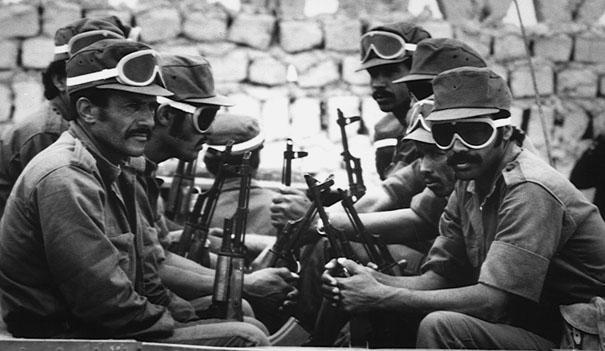
From the mid-1980s Morocco largely had kept Polisario troops off by building a huge berm or sand wall (the Moroccan Wall). The Moroccan army stationed a number of troops roughly the same size as the entire Sahrawi population to defend the wall, enclosing the Southern Provinces, the economically useful parts of Western Sahara (Bou Craa, El-Aaiun, Smara etc.). This stalemated the war, with no side able to achieve decisive gains, but artillery strikes and sniping attacks by the guerrillas continued, and Morocco was economically and politically strained by the war. Morocco faced heavy burdens due to the economic costs of its massive troop deployments along the Wall. Economic and military aid was sent to Morocco by Saudi Arabia, France and the United States to relieve the situation but matters gradually became unsustainable for all parties involved.
Escalation (1989–1991)
On 7 October 1989, Polisario launched a massive attack against Moroccan troops in Guelta Zemmour (Centre of Western Sahara) and Algeria but sustained heavy casualties and withdrawn after leaving more than 18 tanks burning and a dozen more vehicles. This setback led the Polisario to consider a ceasefire. The 1991 Tifariti offensive was the last military operation and successful maneuver in the Western Sahara War launched by Moroccan forces against the Sahrawi guerrilla fighters of the Polisario Front. During August–September 1991 the Royal Moroccan Army (RMA) conducted offensive operations in the areas of Mehaires, Tifariti, and Bir Lahlou and cleared the area of any Polisario presence.
Cease-fire and aftermath

A cease-fire between the Polisario and Morocco, monitored by MINURSO (UN) came into effect on 6 September 1991, with the promise of a referendum on independence the following year. The referendum, however, stalled over disagreements on voter rights, and numerous attempts at restarting the process (most significantly the launching of the 2003 Baker plan) seem to have failed. The prolonged cease-fire has held without major disturbances, but Polisario has repeatedly threatened to resume fighting if no break-through occurs. Morocco's withdrawal from both the terms of the original Settlement Plan and the Baker Plan negotiations in 2003 left the peace-keeping mission without a political agenda: this further increased the risks of renewed war.
In mid-October 2020 tensions deepened between Morocco and the Polisario Front, when the Sahrawi refugees in Tindouf, Algeria, which houses about 100,000 Sahrawi refugees, passing through SADR-controlled territories, camped and blocked the road, creating a large caravan of vehicles and blocking traffic in the region. Morocco, which regards the region as vital to trade with sub-Saharan Africa, accused the Polisario Front of infiltrating the buffer zone and "carrying out acts of banditry" in Guerguerat. On 13 November 2020 clashes between Moroccan and the Polisario Front forces began in Guerguerat, but since has spread along the Moroccan Western Sahara Wall. Morocco claimed that it had acted in self-defence while the Polisario Front accused Morocco of violating the ceasefire by entering the buffer zone, and urged the United Nations to intervene. On 8 April 2021, the head of the Sahrawi National Guard, Addah Al-Bendir, was killed by what reports claim to be a drone strike while attempting a raid on Moroccan positions along the berm sand wall.
International incidents
On 17 January 1980, the Spanish destroyer Almirante Ferrandiz was machine-gunned by a Moroccan Mirage fighter aircraft, 5 mi from the southern coast of Western Sahara. The Spanish destroyer had received an SOS from a Spanish fishing vessel that had been previously detained by a Moroccan patrol boat.
In 1984, Polisario shot down a Belgian airplane as well as two Moroccan aircraft.
On 24 February 1985, the Polar 3, a Dornier 228-type research airplane from the Alfred Wegener Institute was shot down by guerrillas of the Polisario Front over Western Sahara. All three crew members died. Polar 3, together with unharmed Polar 2, was on its way back from Antarctica and had taken off in Dakar, Senegal, to reach Arrecife, Canary Islands. The German government, which did not recognize Morocco's claim to Western Sahara at the time and remained neutral in the conflict, heavily criticized the incident.
References
References
- Jaume Ferrer LLoret. (2022). "Morocco, occupying power of Western Sahara - Spanish Yearbook of International Law". Tirant lo Blanch.
- (18 December 2013). "Perspectives on Western Sahara: Myths, Nationalisms, and Geopolitics". Rowman & Littlefield Publishers.
- Véronique Dudouet. (15 September 2014). "Civil Resistance and Conflict Transformation: Transitions from armed to nonviolent struggle". Routledge.
- Ho-Won Jeong. (4 December 2009). "Conflict Management and Resolution: An Introduction". Routledge.
- "Multinational Monitor, November 1980".
- Lewis, Paul. (31 August 1988). "Sahara foes move to end their war". [[The New York Times]].
- (October 1995). "Keeping it secret – the United Nations operation in Western Sahara". [[Human Rights Watch]].
- (21 July 1977). "Marruecos incrementa su presencia en Mauritania". [[El País]].
- (1976). "With the Polisario Front of Sahara". MERIP Reports.
- Jose Ramón Diego Aguirre, ''Guerra en el Sáhara'', Istmo, Colección Fundamentos, Vol. 124, 1991, p. 193
- (3 January 1977). "North Africa: Shadow war in the Sahara". [[Time (magazine).
- (5 December 1997). "Western Sahara, the facts". [[New Internationalist]] Issue 297.
- (10 September 2006). "El misterio de la guerra del Sáhara". [[El País]].
- J. David Singer, & Melvin Small. (1982). "Resort to Arms: International and Civil Wars, 1816–1980". Sage publications inc..
- (1987). "World Military and Social Expenditures 12th ed. (1987–88)". World priorities.
- "Project Disappeared: Western Sahara".
- Solá-Martín, Andreu. (2007). "The United Nations Mission for the Referendum in Western Sahara". The Edwin Mellen Press.
- es
- "Open Society Foundations".
- hr
- "Retrait de la Mauritanie du Sahara occidental {{!}} Evenements {{!}} Perspective Monde".
- (11 July 2011). "Western Sahara profile". BBC News.
- (1993). "E.J. Brill's first encyclopaedia of Islam : 1913–1936. Vol. 5 L – Moriscos". Brill.
- Mercer, John. (1976). "The Cycle of Invasion and Unification in the Western Sahara". African Affairs.
- "Telquel Online – Online Financial Industry".
- Hollowell, Thomas. (2009). "Allah's garden". Tales Press.
- (January 1998). "The United States and the Western Sahara Peace Process". Middle East Policy Council.
- "Milestones in the Western Sahara Conflict".
- Windisch, Margarita. (23 December 2008). "A brief history of the Western Saharan people's struggle for freedom". Spectrezine.
- San Martin, Pablo. (17 August 2007). "Nationalism, Identity and Citizenship in Western Sahara". The Journal of North African Studies.
- Bhutani, Surendra. (1978). "Conflict on Western Sahara". Strategic Analysis.
- (2002). "La Historia prohibited del Sáhara Español". Colección Imago Mundi.
- "Mauritania: The Armed Forces: Organization and Strength". Library of Congress Country Studies.
- "Mauritania: Fighting the Desert War". Library of Congress Country Studies.
- "Mauritania: Overthrow of the Ould Daddah Regime". Library of Congress Country Studies.
- Branigin, William. (7 August 1979). "Mauritania Ends Role in Sahara War". Washington Post.
- (19 February 2018). "Mauritania profile – Timeline". BBC News.
- Antonio Díaz Fernandez, ''Los Servicios de Inteligencia Españoles'', Alianza Editorial, Madrid, 2005, p. 176.
- (10 October 1979). "Sobre el conflicto del Sahara occidental".
- (10 October 2003). "Morocco and Algeria Should Negotiate Final Settlement of Western Sahara Question, Moroccan Representative Tells Fourth Committee". United Nations.
- (16 July 2019). "Algeria/Western Sahara: Three Dissidents Behind Bars". [[Human Rights Watch]].
- (25 October 2020). "Activistas saharauis bloquean el paso del Guerguerat, principal carretera de conexión con Mauritania". [[Público (Spain).
- (12 November 2020). "Polisario Front threatens to end Morocco ceasefire". [[Middle East Monitor]].
- (13 November 2020). "Rabat deploys army in WSahara border zone after Polisario warnings". [[Radio France Internationale]].
- Karam, Souhail. (13 November 2020). "Military Clashes Erupt in Western Sahara After 30-Year Truce". [[Bloomberg News.
- (17 November 2020). "Morocco PM says Western Sahara wall at centre of dispute completed". Reuters.
- (13 November 2020). "Morocco launches military operation in Western Sahara". [[Associated Press]].
- (22 January 1980). "Un destructor español, ametrallado en aguas del Sahara por un avión marroquí". [[El País]].
- [http://aviation-safety.net/database/record.php?id=19850224-0 Aviation safety network – Report on Polar 3] accessed: 18 April 2009
- de [[Hamburger Abendblatt]], published: 28 February 1985, accessed: 18 April 2009
This article was imported from Wikipedia and is available under the Creative Commons Attribution-ShareAlike 4.0 License. Content has been adapted to SurfDoc format. Original contributors can be found on the article history page.
Ask Mako anything about Western Sahara War — get instant answers, deeper analysis, and related topics.
Research with MakoFree with your Surf account
Create a free account to save articles, ask Mako questions, and organize your research.
Sign up freeThis content may have been generated or modified by AI. CloudSurf Software LLC is not responsible for the accuracy, completeness, or reliability of AI-generated content. Always verify important information from primary sources.
Report