From Surf Wiki (app.surf) — the open knowledge base
Western green mamba
Species of snake
Species of snake
- Leptophis viridis Hallowell, 1844
- Dinophis hammondii Hallowell, 1852
- Dendroaspis viridis hallowelli Yeomans, 1993
- Dendroaspis viridis hallowelli – Barnett & Emms, 2005
The western green mamba (Dendroaspis viridis) is a long, thin, and highly venomous snake species of the mamba genus, Dendroaspis. This species was first described in 1844 by American herpetologist Edward Hallowell. The western green mamba is a fairly large and predominantly arboreal species, capable of navigating through trees swiftly and gracefully. It will also descend to ground level to pursue prey such as rodents and other small mammals.
The western green mamba is a shy and agile snake that lives mainly in the coastal tropical rainforest, thicket, and woodland regions of western Africa. Its venom is a highly potent mixture of rapid-acting presynaptic and postsynaptic neurotoxins (dendrotoxins), cardiotoxins and fasciculins. Some consider this species not to be a particularly aggressive snake, but others have suggested that they are extremely nervous and are prone to attack aggressively when cornered. Conflict with humans is low compared to some other species found in the region. Bites to people by this species are quite uncommon. Their mortality rate, however, is high; many of the recorded bites have been fatal. Rapid progression of severe, life-threatening symptoms are hallmarks of mamba bites. Bites with envenomation can be rapidly fatal.
Taxonomy
The western green mamba was first described by the American herpetologist and physician Edward Hallowell in 1844 as Leptophis viridis, from a specimen collected in Liberia. The specific name viridis is the Latin adjective "green". In 1852, Hallowell described Dinophis hammondii from two specimens of western green mambas collected in Liberia, naming it for his friend Ogden Hammond of South Carolina. These were later deemed the same species by Belgian-British zoologist George Albert Boulenger.
The genus was misspelt as Dendraspis by Dumeril in 1856, and generally uncorrected by subsequent authors. In 1936, Dutch herpetologist Leo Brongersma pointed the correct spelling was Dendroaspis. Analysis of the components of the venom of all mambas places the western green mamba as sister species to Jameson's mamba. In addition to being called the western green mamba, this species is also commonly known as the West African green mamba, and formerly Hallowell's green mamba.
Analysis of the components of the venom of all mambas places the western green mamba sister to Jameson's mamba (Dendroapsis j. jamesoni and j. kaimosae), as shown in the cladogram below.{{clade|{{clade
Description
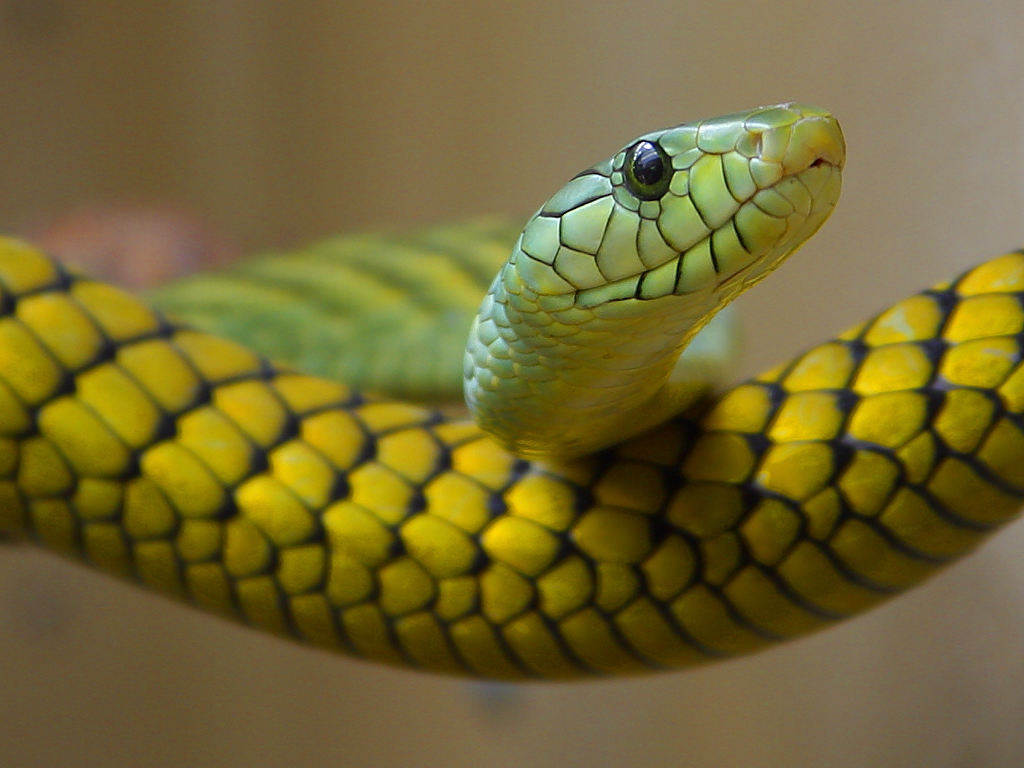
The western green mamba has a long and slender body with a long tapering tail. The average length of an adult is between 1.4 m and 2.1 m, with large approaching 2.4 m long. When threatened or otherwise aroused, the western green mamba is capable of flattening its neck area into a slight hood. The snake is bright green fading to yellow or orange towards the tail. Its scales have prominent black margins, giving the species a networked pattern.
The western green mamba can be mistaken for similar species such as green bushsnakes of the genus Philothamnus or the boomslang (Dispholidus typus).
Scalation
The number and pattern of scales on a snake's body are a key element of identification to species level. The western green mamba has 13 rows of long and thin dorsal scales at midbody, fewer than any similar species. Each is double the length of the ventral scales. There are 211 to 225 ventral scales, 105 to 128 divided subcaudal scales, and a divided anal scale. Its mouth is lined with 7 to 9 supralabial scales above, the fourth and sometimes fifth one located under the eye, and 9–10 sublabial scales below.
Distribution and habitat
The western green mamba is native to West Africa from Gambia and southern Senegal to Benin, including the intervening countries (from west to east) Guinea-Bissau, Guinea, Sierra Leone, Liberia, Côte d'Ivoire (Ivory Coast), Ghana, and Togo. It is common in Togo, found as far north as the Alédjo Wildlife Reserve, though may theoretically be found in Sarakawa and Djamdé forests in the Kara Region. Records from Nigeria are dubious, and reports from the Central African Republic are more likely to be misidentification of Jameson's mamba.
Western green mambas live mainly in the coastal tropical rainforest, thicket, and woodland regions of western Africa. The majority of records of the western green mamba are from within the continuous forest, but the Gambia and Guinea-Bissau records are from isolated forests. The species persists in areas where the tree cover has been removed, providing that sufficient hedges and thicket remain. Found in some suitably vegetated suburbs and towns and parklands therein. In Togo, however, its range extends into the drier open forests of the north, the Guinean savannas of the west, and the littoral zone.
Conservation status
This species is classified as Least Concern (LC) on the IUCN Red List of Threatened Species (v3.1, 2011). The conservation status of this species was last assessed in July 2012 and published in 2013, and it was classed as such due to a wide distribution, fairly generalist habits, stable population and the lack of major threats. However, its habitat and population is highly fragmented. Despite not being listed in the Convention on International Trade in Endangered Species of Wild Fauna and Flora (CITES), the western green mamba is collected and sold internationally, and is one of the more expensive African snake species.
Behaviour and ecology
Mostly diurnal, the western green mamba spends most of its time in the forest canopy, at times at considerable height, though on occasion commonly go to the ground. When it wants to sleep it seeks out tree branches that offer dense cover. It generally retreats if encountered. The oldest recorded western green mamba was a captive specimen that lived 18.7 years.
Breeding
The species lays a clutch of 6 to 14 eggs.
Diet and predators
The western green mamba generally hunts in trees though can also hunt on the ground. It preys on birds and small mammals, including rodents and squirrels.
Venom

The western green mamba is classified as a snake of medical importance in western SubSaharan Africa by the World Health Organization,{{efn|1=Snakes of Medical Importance include those with highly dangerous venom resulting in high rates of morbidity and mortality, or those that are common agents in snakebite. although bites from this species are rare as it is rarely encountered.
Similar to the venom of most other mambas, the western green mamba's contains predominantly three-finger toxin agents. The exception is the black mamba, whose venom lacks the potent alpha-neurotoxin as well. It is thought this may reflect the species' preferred prey—small mammals for the mainly land-dwelling black mamba, versus birds for the other predominantly arboreal mambas. Unlike that of many snake species, the venom of mambas has little phospholipase A2. Overall, the venom of the western green mamba is more potent than that of the eastern green mamba, similar or slightly less potent than that of Jameson's mamba, and much less potent than that of the black mamba.
The venom consists mainly of both pre-synaptic and post-synaptic neurotoxins, cardiotoxins, In another test using mice that were administered the western green mamba's venom via the intraperitoneal (IP) route the LD50 was 0.045 mg/kg. Another experimental IV LD50 toxicity of 0.5 mg/kg has been reported, with an average wet venom yield of 100 mg.
Treatment
The speed of onset of envenomation means that urgent medical attention is needed. Tetanus toxoid is sometimes administered, though the main treatment is the administration of the appropriate antivenom.
Notes
References
References
- Luiselli, L.. (2013). "''Dendroaspis viridis''".
- {{ITIS
- Boulenger, George Albert. (1896). "Catalogue of the Snakes in the British Museum (Natural History), Volume III". Natural History Museum (London) Publications.
- {{NRDB species
- Hallowell, E.. (1844). "Description of new species of African reptiles". Proceedings of the Academy of Natural Sciences of Philadelphia.
- "Definition of "viridis"". Numen — The Latin Lexicon.
- (1852). "On a new genus and two new species of African serpents". Proceedings of the Academy of Natural Sciences of Philadelphia.
- (1936). "Herpetological note XIII". Zoologische Mededelingen.
- Department of the Navy Bureau of Medicine and Surgery. (2013). "Venomous Snakes of the World: A Manual for Use by U.S. Amphibious Forces". Skyhorse Publishing.
- (1955). "Reptiles of West Africa". Penguin Books.
- (2018). "The medical threat of mamba envenoming in sub-Saharan Africa revealed by genus-wide analysis of venom composition, toxicity and antivenomics profiling of available antivenoms". [[Journal of Proteomics]].
- "''Dendroaspis viridis''". University of Adelaide.
- (1965). "Hood-spreading by the mambas of the African genus ''Dendroaspis'' Schlegel". Journal of East African Natural History.
- (19 September 2019). "Western Green Mamba".
- (2018). "Key to the Snakes of South Australia". Government of South Australia.
- "snake scale count search".
- (2019). "Snakes of Central and Western Africa". Johns Hopkins University Press.
- (2006). "Biogeography of the Reptiles of the Central African Republic". African Journal of Herpetology.
- (1995). "The Dangerous Snakes of Africa". Blandford.
- (2011). "The snake fauna of Togo: systematics, distribution and biogeography, with remarks on selected taxonomic problems". Zoosystema.
- (2019). "Exploring the international trade in African snakes not listed on CITES: Highlighting the role of the internet and social media". Biodiversity and Conservation.
- (2020). "The Dangerous Snakes of Africa". Bloomsbury.
- "AnAge entry for Dendroaspis viridis". Human Ageing Genomic Resources.
- "Guidelines for the production, control and regulation of snake antivenom immunoglobulins". WHO Technical Report Series, No. 964.
- (2018). "The medical threat of mamba envenoming in sub-Saharan Africa revealed by genus-wide analysis of venom composition, toxicity and antivenomics profiling of available antivenoms". [[Journal of Proteomics]].
- Shipolin, RA.. (August 1973). "Separation and Characterization of Polypeptides from the Venom of ''Dendroaspis viridis''". European Journal of Biochemistry.
- Gill, DM.. (1982). "Bacterial Toxins: A Table of Lethal Amounts". Microbiological Reviews.
- (November 2013). "Snake Bite: A review of Current Literature". East and Central African Journal of Surgery.
- (2017). "Snakebite envenoming". Nature Reviews Disease Primers.
This article was imported from Wikipedia and is available under the Creative Commons Attribution-ShareAlike 4.0 License. Content has been adapted to SurfDoc format. Original contributors can be found on the article history page.
Ask Mako anything about Western green mamba — get instant answers, deeper analysis, and related topics.
Research with MakoFree with your Surf account
Create a free account to save articles, ask Mako questions, and organize your research.
Sign up freeThis content may have been generated or modified by AI. CloudSurf Software LLC is not responsible for the accuracy, completeness, or reliability of AI-generated content. Always verify important information from primary sources.
Report