From Surf Wiki (app.surf) — the open knowledge base
West Slavs
Subgroup of Slavic peoples

Subgroup of Slavic peoples
| Field | Value | |
|---|---|---|
| group | West Slavs | |
| native_name | Słowianie zachodni (Polish) | |
| Západní Slované (Czech) | ||
| Západní Slovania (Slovak) | ||
| Западни Слованя (Pannonian Rusyn) | ||
| Zôpôdni Słowiónie (Kashubian) | ||
| Pódwjacorne Słowjany (Lower Sorbian) | ||
| Zapadni Słowjenjo (Upper Sorbian) | ||
| Zachodniy Słowjońe (Silesian) | ||
| image | [[File:West Slavic Europe.svg | 300px]] |
| caption | ||
| pop | see :#Population | |
| related | Other Slavs | |
| * Irreligion (majority among Czechs){{Citation needed | date | June 2022}} |
Západní Slované (Czech) Západní Slovania (Slovak) Западни Слованя (Pannonian Rusyn) Zôpôdni Słowiónie (Kashubian) Pódwjacorne Słowjany (Lower Sorbian) Zapadni Słowjenjo (Upper Sorbian) Zachodniy Słowjońe (Silesian)
- Majority: Czech Republic, Poland, Slovakia
- Minority: Austria, Balkan states, Baltic states, Belarus, Germany, Russia, Ukraine
- Catholicism (majority among Poles, Slovaks, Silesians, Kashubians, Moravians, and Sorbs and minority among Czechs)
- Protestantism (minority among Slovaks and Sorbs)
- Irreligion (majority among Czechs)
- Eastern Orthodoxy (minority among Czechs, Poles and Slovaks)
The West Slavs are Slavic peoples who speak the West Slavic languages. They separated from the common Slavic group around the 7th century, and established independent polities in Central Europe by the 8th to 9th centuries. The West Slavic languages diversified into their historically attested forms over the 10th to 14th centuries.
Today, groups which speak West Slavic languages include the Poles, Czechs, Slovaks, Silesians, Kashubians, and Sorbs. From the ninth century onwards, most West Slavs converted to Roman Catholicism, thus coming under the cultural influence of the Latin Church, adopting the Latin alphabet, and tending to be more closely integrated into cultural and intellectual developments in western Europe than the East Slavs, who converted to Eastern Orthodox Christianity and adopted the Cyrillic alphabet.
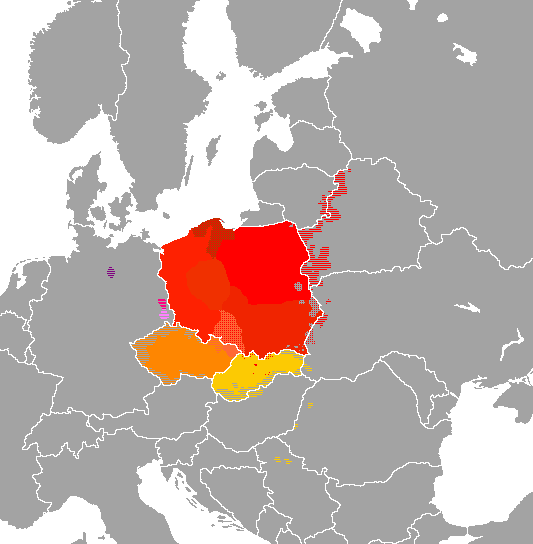
Linguistically, the West Slavic group can be divided into three subgroups: Lechitic, including Polish, Silesian, Kashubian, and the extinct Polabian and Pomeranian languages; Sorbian in the region of Lusatia; and Czecho–Slovak in the Czech lands.
History
Main article: Early Slavs, Polabian Slavs, Wends

In the Early Middle Ages, the name "Wends" (probably derived from the Roman-era Veneti) may have applied to Slavic peoples. However, sources such as the Chronicle of Fredegar and Paul the Deacon are neither clear nor consistent in their ethnographic terminology, and whether "Wends" or "Veneti" refer to Slavic people, pre-Slavic people, or to a territory rather than a population, is a matter of scholarly debate.
The early Slavic expansion reached Central Europe in the 7th century, and the West Slavic dialects diverged from common Slavic over the following centuries. The West Slavic tribes settled on the eastern fringes of the Carolingian Empire, along the Limes Saxoniae. Prior to the Magyar invasion of Pannonia in the 890s, the West Slavic polity of Great Moravia spanned much of Central Europe between what is now Eastern Germany and Western Romania. In the high medieval period, the West Slavic tribes were again pushed to the east by the incipient German Ostsiedlung, decisively so following the Wendish Crusade in the 11th century.
The early Slavic expansion began in the 5th century, and by the 6th century the groups that would become the West, East, and South Slavic groups had probably become geographically separated. One of the distinguishing features of the West Slavic tribes was manifested in the structure of the Pagan sanctuaries of the closed (long) type, while the East Slavic sanctuaries had a round (most often open) shape (see also: Peryn). Early modern historiographers such as Penzel (1777) and Palacky (1827) have claimed Samo's Empire to be first independent Slavic state in history by taking Fredegar's Wendish account at face value. Curta (1997) argued that the text is not as straightforward: according to Fredegar, Wends were a gens, Sclavini merely a genus, and there was no "Slavic" gens. He further states that "Wends occur particularly in political contexts: the Wends, not the Slavs, made Samo their king."
Other such alleged early West Slavic states include the Principality of Moravia (8th century–833), the Principality of Nitra (8th century–833), and Great Moravia (833–c. 907). Christiansen (1997) identified the following West Slav tribes in the 11th century from "the coastlands and hinterland from the aby of Kiel to the Vistula, including the islands of Fehmarn, Poel, Rügen, Usedom and Wollin", namely the Wagrians, Obodrites (or Abotrites), the Polabians, the Liutizians or Wilzians, the Rugians or Rani, the Sorbs, the Lusatians, the Poles, and the Pomeranians (later divided into Pomerelians and Cassubians). They came under the domination of the Holy Roman Empire after the Wendish Crusade in the Middle Ages and had been strongly assimilated by Germans at the end of the 19th century. The Polabian language survived until the beginning of the 19th century in what is now the German state of Lower Saxony.
Groupings
Various attempts have been made to group the West Slavs into subgroups according to various criteria, including geography, historical tribes, and linguistics.
Bavarian Geographer grouping
In 845 the Bavarian Geographer made a list of West Slavic tribes who lived in the areas of modern-day Poland, Czech Republic, Germany and Denmark:
| Pos. | Latin name in 845 | English name | no. of gords |
|---|---|---|---|
| 1 | Nortabtrezi | North Obotrites | 53 |
| 2 | Uuilci | Veleti | 95 |
| 7 | Hehfeldi | Hevellians | 8 |
| 14 | Osterabtrezi | East Obotrites | 100 |
| 15 | Miloxi | Milceni | 67 |
| 16 | Phesnuzi | Besunzane | 70 |
| 17 | Thadesi | Dadosesani | 200 |
| 18 | Glopeani | Goplans | 400 |
| 33 | Lendizi | Lendians | 98 |
| 34 | Thafnezi | / | 257 |
| 36 | Prissani | Prissani | 70 |
| 37 | Uelunzani | Wolinians | 70 |
| 38 | Bruzi | / | |
| 48 | Uuislane | Vistulans | / |
| 49 | Sleenzane | Silesians | 15 |
| 50 | Lunsizi | Sorbs | 30 |
| 51 | Dadosesani | Thadesi | 20 |
| 52 | Milzane | Milceni | 30 |
| 53 | Besunzane | Phesnuzi | 2 |
| 56 | Lupiglaa | Łupigoła | 30 |
| 57 | Opolini | Opolans | 20 |
| 58 | Golensizi | Golensizi | 5 |
Tribal grouping

- Lechitic group
- Poles
- Masovians
- Polans
- Lendians
- Vistulans
- Silesians
- Pomeranians
- Slovincians
- Kashubians
- Polabians
- Obodrites/Abodrites
- Obotrites proper
- Wagrians
- Warnower
- Polabians proper
- Linonen
- Travnjane
- Drevani
- Veleti (Wilzi), succeeded by Lutici (Liutici)
- Kissini (Kessiner, Chizzinen, Kyzziner)
- Circipani (Zirzipanen)
- Tollensians
- Redarier
- Ucri (Ukr(an)i, Ukranen)
- Rani (Rujani)
- Hevelli (Stodorani)
- Volinians (Velunzani)
- Pyritzans (Prissani)
- Obodrites/Abodrites
- Czech–Slovak group
- Czechs
- Moravians
- Slovaks
- Sorbian group
- Milceni (Upper Sorbs)
- Lusatian Sorbs (Lower Sorbs)
Linguistic grouping
Main article: West Slavic languages#Classification
- Lechitic group
- Polans
- Lendians
- Silesians
- Wends
- Sorbs
- Vistulans
- Polabians
- Obodrites
- Slovincians
- Kashubians
- Gorals
- Czech–Slovak group
- Czechs
- Bohemians
- Moravians
- Slovaks
- Czechs
Population
Main article: Slavs#Population
References
Bibliography
References
- Gołąb, Zbigniew. (1992). "The Origins of the Slavs: A Linguist's View". Slavica Publishers.
- Sergey Skorvid. (2015). "Slavic languages". [[Great Russian Encyclopedia]] (in 35 vol.) Vol. 30..
- (2019). "The handbook of cross-border ethnic and religious affinities".
- (2004). "Statecraft : the deeds of Antonio Carafa = (De rebus gestis Antonj Caraphaei)". P. Lang.
- (2003). "The beginner's guide to interpreting ethnic DNA origins for family history : how Ashkenazi, Sephardi, Mizrahi & Europeans are related to everyone else". iUniverse.
- (2013). "Culture and foreign policy : the neglected factor in international relations". Ashgate.
- (2017). "The Catholic Church and Soviet Russia, 1917-39".
- Bohemia and Poland. Chapter 20.pp 512-513. [in:] Timothy Reuter. The New Cambridge Medieval History: {{circa. 900. 1024. 2000
- Ilya Gavritukhin, [[Vladimir Petrukhin]]. (2015). "Slavs". [[Great Russian Encyclopedia]] (in 35 vol.) Vol. 30..
- link. (2023-10-06 . London: Penguin Books. p. 41. {{ISBN). 0-14-026653-4.
- "Polabian language".
- Krzysztof Tomasz Witczak. (2013). "Poselstwo ruskie w państwie niemieckim w roku 839: Kulisy śledztwa w świetle danych Geografa Bawarskiego". Slavia Orientalis.
- Jerzy Strzelczyk. ''Bohemia and Poland: two examples of successful western Slavonic state-formation''. In: Timothy Reuter ed. The New Cambridge Medieval History: c. 900-c. 1024. Cambridge University Press. 1995. p. 514.
This article was imported from Wikipedia and is available under the Creative Commons Attribution-ShareAlike 4.0 License. Content has been adapted to SurfDoc format. Original contributors can be found on the article history page.
Ask Mako anything about West Slavs — get instant answers, deeper analysis, and related topics.
Research with MakoFree with your Surf account
Create a free account to save articles, ask Mako questions, and organize your research.
Sign up freeThis content may have been generated or modified by AI. CloudSurf Software LLC is not responsible for the accuracy, completeness, or reliability of AI-generated content. Always verify important information from primary sources.
Report