From Surf Wiki (app.surf) — the open knowledge base
West Coast Main Line
Principal railway route in Great Britain

Principal railway route in Great Britain
| Field | Value |
|---|---|
| name | West Coast Main Line |
| color | |
| image | WCML and M1.jpg |
| image_width | 300px |
| caption | The West Coast Main Line running alongside the M1 motorway at Watford Gap |
| status | Operational |
| system | National Rail |
| locale | |
| start | |
| end | |
| stations | 46 |
| type | |
| owner | Network Rail |
| operator | |
| open | 1837–1881 |
| linelength | 399 mi |
| tracks | Two, four or six |
| gauge | |
| load_gauge | W10 |
| electrification | |
| speed | |
| map |
The West Coast Main Line (WCML) is a significant railway corridor in the United Kingdom, which connects the major cities of London and Glasgow with branches to Birmingham, Manchester, Liverpool and Edinburgh. It is one of the busiest mixed-traffic railway routes in Europe, carrying a mixture of inter-city rail, regional rail, commuter rail and rail freight traffic. The core route of the WCML runs from London to Glasgow for 399 mi and was opened between 1837 and 1881; this totals a route mileage of 700 mi by including its many branches. The Glasgow–Edinburgh via Carstairs line connects the WCML to Edinburgh; however, the main London–Edinburgh route is the East Coast Main Line via . Several sections of the WCML form part of the suburban railway systems in London, Coventry, Birmingham, Manchester, Liverpool and Glasgow, with many more smaller commuter stations, as well as providing links to more rural towns.
It is one of the busiest rail freight routes in Europe, carrying 40% of all UK traffic. The line is the principal rail freight corridor linking the European mainland (via the Channel Tunnel) through London and South East England to the West Midlands, North West England and Scotland. The line has been declared a strategic European route and designated a priority Trans-European Networks (TENS) route. A number of railway writers refer to it as "The Premier line".
The WCML was not originally conceived as a single route, but was built as a patchwork of local lines by several companies which were linked together. The largest of these amalgamated in 1846 to create the London and North Western Railway (LNWR), which then gradually absorbed most of the others; the exceptions were the Caledonian Railway in Scotland and the North Staffordshire Railway (NSR), which both remained independent until 1923. The core route was mostly built between the 1830s and 1850s, but several cut-off routes and branches were built in later decades. In 1923, the entire route came under the ownership of the London, Midland and Scottish Railway (LMS), when the railway companies were grouped under the Railways Act 1921. The LMS itself was nationalised in 1947 to form part of British Railways (BR).
As the WCML is the most important long-distance railway trunk route in the UK, BR carried out an extensive programme of modernisation of it between the late 1950s and early 1970s, which included full overhead electrification of the route, and the introduction of modern inter-city passenger services at speeds of up to 110 mph. Further abortive modernisation schemes were proposed, including the introduction of the Advanced Passenger Train (APT) in the 1980s; this was an ill-fated high speed train which used tilting technology, which was required to allow faster speeds on the curving route, and the abortive InterCity 250 project in the early 1990s. Further modernisation of the route occurred during the 2000s in the period of privatisation, which saw speeds raised further to 125 mph and the introduction of tilting Class 390 Pendolino trains.
As much of the line has a maximum speed of 125 mph, it meets the European Union's definition of an upgraded high-speed line, although only Class 390 Pendolinos with tilting mechanisms operated by Avanti West Coast travel at that speed. Non-tilting trains are limited to 110 mph.
Geography
The spine between London Euston and is 399 mi long, with principal InterCity stations at , , , , , , , , , , and .
The spine has bypasses serving the major towns and cities of Northampton, Coventry, Birmingham and Wolverhampton. Spurs serve Stoke-on-Trent, Macclesfield, Stockport, Manchester, Runcorn and Liverpool. There is also a branch to Edinburgh, at Carstairs in Scotland, although this is not the most direct route between London and Edinburgh. It provides a direct connection between the WCML and the East Coast Main Line.
Originally, the lines between , and were part of the main spine, until the Trent Valley Line was built in 1847. This line formed a direct connection between Rugby and Stafford becoming the a part of the spine. South of Rugby, there is a bypass loop that serves . There is a spur at Weaver Junction north of to . Weaver Junction on this branch is the oldest flyover-type junction in Britain. A spur branches off from Crewe to serve Manchester. There is also a spur between Colwich Junction in the Trent Valley, south of Stafford to Stoke-on-Trent, with another spur north of Stafford, also to Stoke-on-Trent.
The geography of the route was determined by avoiding large estates and hilly areas, such as the Chilterns (Tring Cutting); the Watford Gap and Northampton uplands, followed by the Trent Valley; the mountains of Cumbria, with a summit at Shap; and Beattock Summit in South Lanarkshire. This legacy means the WCML has limitations as a long-distance main line, with lower maximum speeds than the East Coast Main Line (ECML) route, the other main line between London and Scotland. The principal solution has been the adoption of tilting trains, initially with British Rail's APT and latterly the Pendolino trains constructed by Alstom and introduced by Virgin Trains in 2003. A 'conventional' attempt to raise line speeds as part of the InterCity 250 upgrade in the 1990s would have relaxed maximum cant levels on curves and seen some track realignments; this scheme faltered for lack of funding in the economic climate of the time.
History
Pre-grouping, 1837–1923
The early history of the WCML is complex, as it was not originally conceived as a single trunk route, but was built as a patchwork of separate lines by different companies, mostly during the 1830s and 1840s, but some parts were opened as late as the 1880s. After the completion of the pioneering Liverpool and Manchester Railway in 1830, schemes were mooted to build more inter-city lines. The business practice of the early railway era was for companies to promote individual lines between two destinations, rather than to plan grand networks of lines, as it was considered easier to obtain backing from investors.
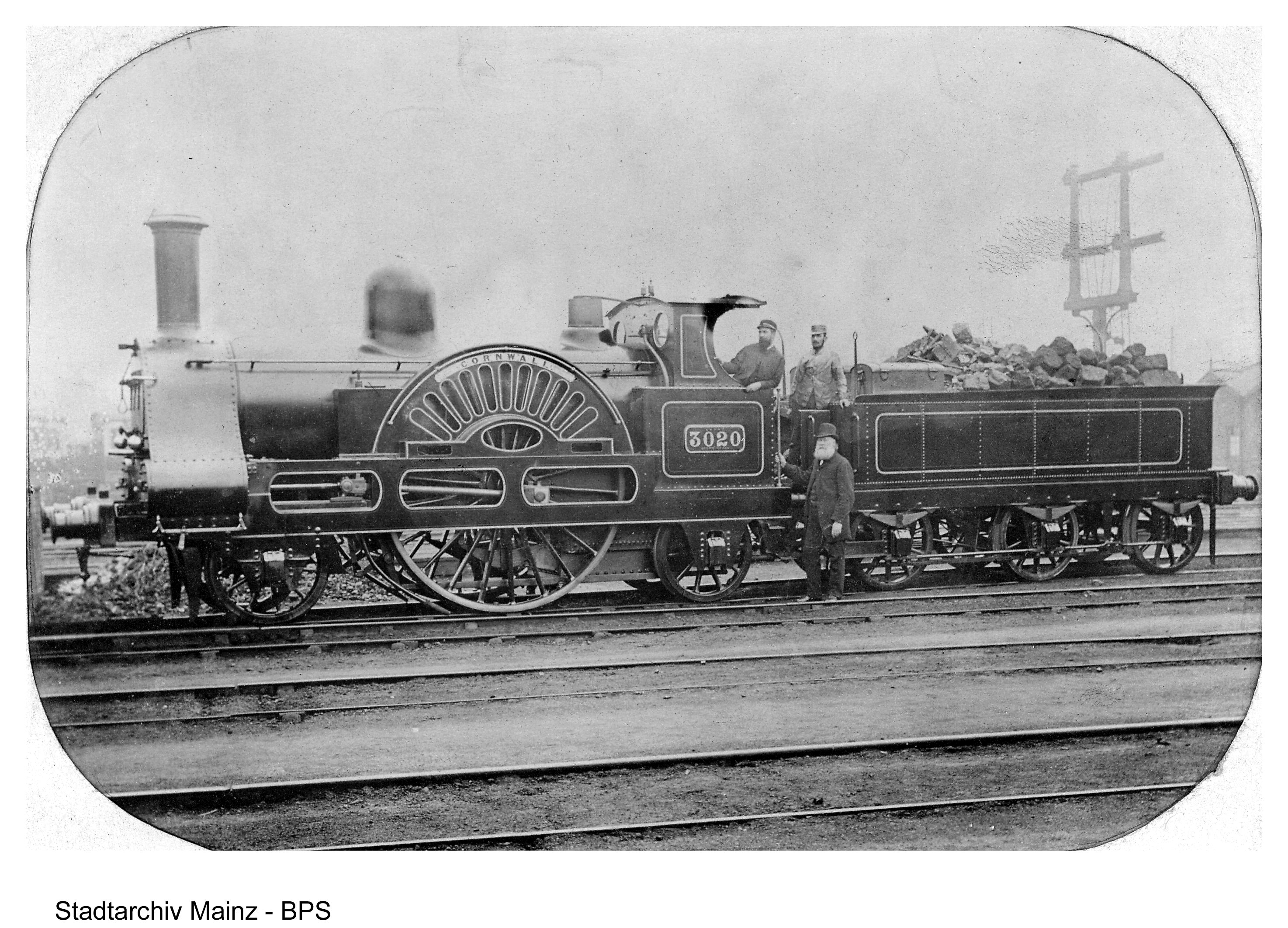
The first stretch of what is now the WCML was the Grand Junction Railway connecting the Liverpool and Manchester Railway to Birmingham, via , , and , opening in 1837. The following year the London and Birmingham Railway was completed, connecting to the capital via , and the Watford Gap. The Grand Junction and London and Birmingham railways shared a Birmingham terminus at Curzon Street station, so that it was now possible to travel by train between London, Birmingham, Manchester and Liverpool. These lines, together with the Trent Valley Railway (between Rugby and Stafford, avoiding Birmingham) and the Manchester and Birmingham Railway (Crewe–Manchester), amalgamated operations in 1846 to form the London and North Western Railway (LNWR). Three other companies, the North Union Railway (Parkside–Wigan–Preston), the Lancaster and Preston Junction Railway and the Lancaster and Carlisle Railway, completed a through route to by the end of 1846, these were later absorbed by the LNWR.
North of Carlisle, the Caledonian Railway remained independent, and opened its main line from Carlisle to on 10 September 1847, connecting to Edinburgh in February 1848, and to Glasgow in November 1849. The route to Scotland was marketed by the LNWR as 'The Premier Line'. Because the cross-border trains ran over the LNWR and Caledonian Railway, through trains consisted of jointly owned "West Coast Joint Stock" to simplify operations. The first direct London to Glasgow trains in the 1850s took 12.5hours to complete the 400 mi journey.
Another important section, the North Staffordshire Railway (NSR), which opened its route in 1848 from (connecting with the LNWR from Manchester) to Stafford and Colwich Junction via , also remained independent. The NSR provided a useful alternative route to Manchester, however poor relations between the LNWR and the NSR meant that through trains did not run until 1867.
The final sections of what is now the WCML were put in place over the following decades. A direct branch to , bypassing the earlier Liverpool and Manchester line, was opened in 1869, from Weaver Junction north of to Ditton Junction via the Runcorn Railway Bridge over the River Mersey.
At the northern end, the Caledonian replaced its original terminus in Glasgow, with the much larger and better located in 1879.
To expand capacity, the line between London and Rugby was widened to four tracks in the 1870s. As part of this work, a new line, the Northampton Loop, was built, opening in 1881, connecting before rejoining the main line at Rugby.
LMS, 1923–1948
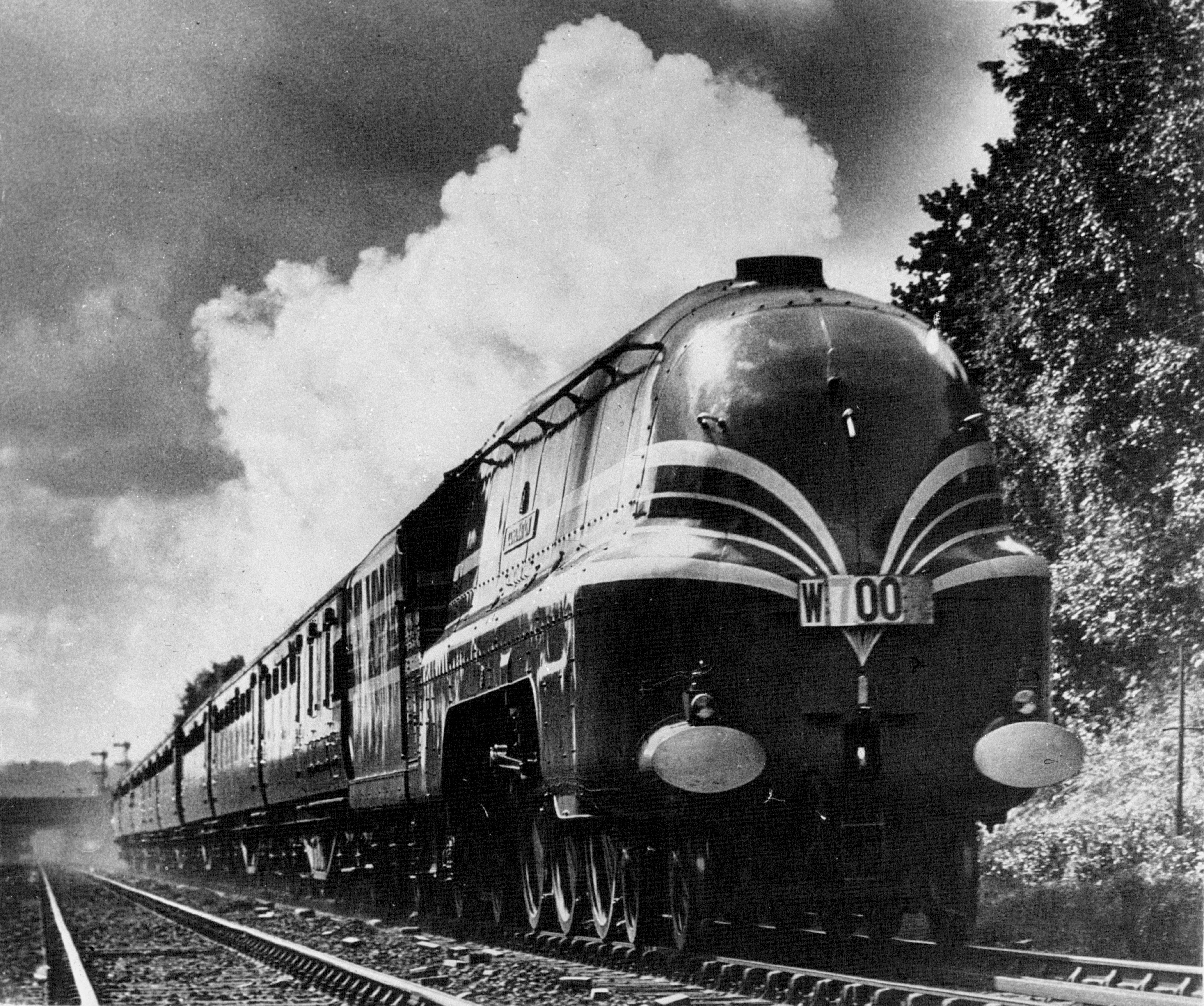
The entire route came under the control of the London, Midland and Scottish Railway (LMS) on 1 January 1923 when the railway companies were grouped, under the Railways Act 1921.
The LMS competed fiercely with the rival LNER's East Coast Main Line for London to Scotland traffic (see Race to the North). Attempts were made to minimise end-to-end journey times for a small number of powerful lightweight trains that could be marketed as glamorous premium crack expresses, especially between London and Glasgow, such as the 1937–39 Coronation Scot, hauled by streamlined Princess Coronation Class locomotives, which made the journey in 6hours 30minutes, making it competitive with the rival East Coast Flying Scotsman (British Railways in the 1950s could not match this, but did achieve a London-Glasgow timing of 7hours 15minutes in the 1959–60 timetable by strictly limiting the number of coaches to eight and not stopping between London and Carlisle.)
British Rail, 1948–1997
In 1948, following nationalisation, the line came under the control of British Railways' London Midland and Scottish Regions, when the term "West Coast Main Line" came into use officially, although it had been used informally since at least 1912.
Modernisation by British Rail

As part of the 1955 modernisation plan, British Rail carried out a large programme of modernisation of the WCML in stages between 1959 and 1974; the modernisation involved upgrading the track and signaling to allow higher speeds, rebuilding a number of stations, and electrification of the route with overhead line equipment. The first stretch to be upgraded and electrified was Crewe to Manchester, completed on 12 September 1960. This was followed by Crewe to Liverpool, completed on 1 January 1962. Electrification was then extended south to London. The first electric trains from London ran on 12 November 1965, with a full public service to Manchester and Liverpool launched on 18 April 1966. Electrification of both the Birmingham branch, and the routes to Manchester via was completed on 6 March 1967, allowing electric services to commence to those destinations. In March 1970 the government approved electrification of the northern half of the WCML, between Weaver Junction (where the branch to Liverpool diverges) and Glasgow, and this was completed on 6 May 1974. The announcement, after five years of uncertainty, was made 48hours before the writ was issued for a by-election in South Ayrshire. The Observer commented that, if the £25 million decision was politically rather than financially motivated, it would have the makings of a major political scandal.
A new set of high-speed long-distance services was introduced in 1966, launching British Rail's highly successful "Inter-City" brand (the hyphen was later dropped) and offering journey times as London to Birmingham in 1 hour 35 minutes, and London to Manchester or Liverpool in 2hours 40minutes (and even 2hours 30minutes for the twice-daily Manchester Pullman). This represented a big improvement on the 3hours 30minutes to Manchester and Liverpool of the fastest steam service. A new feature was that these fast trains were offered on a regular-interval service throughout the day: initially hourly to Birmingham, two-hourly to Manchester, and so on. The service proved to be so popular that in 1972 these InterCity service frequencies were doubled to deal with increased demand. With the completion of the northern electrification in 1974, London to Glasgow journey times were reduced from 6hours to 5. Along with electrification came modern coaches such as the Mark 2 and from 1974 the fully integral, air-conditioned Mark 3 design. These remained the mainstay of express services until the early 2000s. Line speeds were raised to a maximum 110 mph, and these trains, hauled by and electric locomotives, came to be seen as BR's flagship passenger service. Passenger traffic on the WCML doubled between 1962 and 1975.
The modernisation also saw the demolition and redevelopment of several of the key stations on the line: BR was keen to symbolise the coming of the "electric age" by replacing the Victorian-era buildings with new structures built from glass and concrete. Notable examples were , , , and . To enable the latter, the famous Doric Arch portal into the original Philip Hardwick-designed terminus was demolished in 1962 amid much public outcry.
Electrification of the Edinburgh branch was carried out in the late 1980s as part of the East Coast Main Line electrification project in order to allow InterCity 225 sets to access Glasgow via Carstairs Junction.

Modernisation brought great improvements in speed and frequency. However some locations and lines were no longer served by through trains or through coaches from London, such as: ; , and ; , , and (via Stockport); ; (via Stockport); and ; (via ); and . Notable also is the loss of through services between Liverpool and Scotland; however these were restored by TransPennine Express in 2019.
British Rail introduced the Advanced Passenger Train APT project, which proved that London–Glasgow WCML journey times of less than 4hours were achievable and paved the way for the later tilting Virgin Pendolino trains. In the late 1980s, British Rail put forward a track realignment scheme to raise speeds on the WCML; a proposed project called InterCity 250, which entailed realigning parts of the line in order to increase curve radii and smooth gradients in order to facilitate higher-speed running. The scheme, which would have seen the introduction of new rolling stock derived from that developed for the East Coast electrification, was scrapped in 1992.
Privatisation, 1997–present
As part of the privatisation of British Rail in the 1990s, the infrastructure was taken over in 1994 by the private company Railtrack, which later collapsed in 2002, and was replaced by the not-for-profit company Network Rail. WCML's InterCity services became part of the InterCity West Coast franchise, which was won by Virgin Trains who took over in 1997. In 2019, Avanti West Coast won the new West Coast Partnership franchise, taking over from Virgin Trains.
Modernisation by Railtrack and Network Rail
Main article: West Coast Main Line route modernisation

By the dawn of the 1990s, it was clear that further modernisation was required. Initially this took the form of the InterCity 250 project. The modernisation plan unveiled by Virgin and the new infrastructure owner Railtrack involved the upgrade and renewal of the line to allow the use of tilting Pendolino trains with a maximum line speed of 140 mph, in place of the previous maximum of 110 mph. Railtrack estimated that this upgrade would cost £2 billion, be ready by 2005, and cut journey times to 1 hour for London to Birmingham and 1 hr 45 mins for London to Manchester.
However, these plans proved too ambitious and were subsequently scaled back. The upgrade was described as "a classic example of disastrous project management". Central to the implementation of the plan was the adoption of moving block signalling, which had never been proven on anything more than simple metro lines and light rail systems – not on a complex high-speed heavy-rail network such as the WCML. Despite this, Railtrack made what would prove to be the fatal mistake of not properly assessing the technical viability and cost of implementing moving block prior to promising the speed increase to Virgin and the government. By 1999, with little headway on the modernisation project made, it became apparent to engineers that the technology was not mature enough to be used on the line. The bankruptcy of Railtrack in 2001 and its replacement by Network Rail following the Hatfield crash brought a reappraisal of the plans, while the cost of the upgrade soared. Following fears that cost overruns on the project would push the final price tag to £13 billion, the plans were scaled down, bringing the cost down to between £8 billion and £10 billion, to be ready by 2008, with a maximum speed for tilting trains of a more modest 125 mph – equalling the speeds available on the East Coast route, but some way short of the original target, and even further behind BR's original vision of 155 mph speeds planned and achieved with the APT.
The first phase of the upgrade, south of Manchester, opened on 27 September 2004 with journey times of 1hour 21minutes for London to Birmingham and 2hours 6minutes for London to Manchester. The final phase, introducing 125 mph running along most of the line, was announced as opening on 12 December 2005, bringing the fastest journey between London and Glasgow to 4hours 25mins (down from 5hours 10minutes). However, considerable work remained, such as the quadrupling of the track in the Trent Valley, upgrading the slow lines, the second phase of remodelling Nuneaton, and the remodelling of Stafford, Rugby, Milton Keynes and Coventry stations, and these were completed in late 2008. The upgrading of the Crewe–Manchester line via Wilmslow was completed in summer 2006.
In September 2006, a new speed record was set on the WCML – a Pendolino train completed the 401 mi Glasgow Central – London Euston run in a record 3hours 55minutes, beating the APT's record of 4hours 15minutes, although the APT still holds the overall record on the northbound run. The decade-long modernisation project was finally completed in December 2008. This allowed Virgin's VHF (very high frequency) timetable to be progressively introduced through early 2009, the highlights of which are a three-trains-per-hour service to both Birmingham and Manchester during off-peak periods, and nearly all London-Scottish timings brought under the 4hours 30minutes barrier – with one service (calling only at Preston) achieving a London–Glasgow time of 4hours 8minutes.
Some projects that were removed from the modernisation as a result of the de-scoping, such as a flyover at Norton Bridge station, were later restarted. A £250million project to grade-separate the tracks at Norton Bridge that allowed for increased service frequency as well as improved line-speeds was completed in spring 2016. Other projects such as the replacement of a weak bridge in Watford allowed line-speeds to be increased from 90 mph to 125 mph, decreasing journey times.
Infrastructure
Track

The main spine of the WCML is quadruple track on almost all of the route from London to south of Winsford. At Hanslope Junction (near Milton Keynes), the line divides with one pair going direct to and the other pair diverting via to rejoin at Rugby. The spine continues north in quadruple track until Brinklow, where it reduces to triple track. The line between Brinklow and Nuneaton has three tracks, with one northbound track and fast and slow southbound tracks. The line then reverts to quadruple track at Nuneaton. North of Rugeley, there is a short double track stretch through the 777 yd Shugborough Tunnel. The line is then quadruple track most of the way to Acton Bridge railway station, except for a double track section between Winsford and Hartford. The line becomes quadruple again between and , except for a short section via the Golborne cut-off where it has two tracks. There are two more stretches of quadruple track, otherwise the line is double track to Scotland. The first is from Euxton Balshaw Lane to Preston, and the second is between and
The WCML is noted for the diversity of branches served from the spine, notably those to/from the West Midlands and North Wales, Greater Manchester, and Liverpool. These are detailed in the route diagram.
The complete route has been cleared for W10 loading gauge freight traffic, allowing use of higher 9 ft hi-cube shipping containers. The route passes through Nuneaton and the Midlands and this area has been called the "Golden Triangle of Logistics".
Electrification
Nearly all of the WCML is electrified with overhead line equipment at 25 kV AC. Several of the formerly unelectrified branches of the WCML in the North West have recently been electrified such as the to Line on which electric service commenced in May 2018 along with the Preston – line which saw electric service commence in February 2019. Wigan to Liverpool via St Helens Shaw Street and St Helens Junction were also electrified in the 2010-2017 timeframe.
The to branch is also in the process of being electrified.
Rolling stock
The majority of stock used on the West Coast Main Line is new-build, part of Virgin's initial franchise agreement having been a commitment to introduce a brand-new fleet of tilting Class 390 "Pendolino" trains for long-distance high-speed WCML services. The 53-strong Pendolino fleet, plus three tilting SuperVoyager diesel sets, were bought for use on these InterCity services. One Pendolino was written off in 2007 following the Grayrigg derailment. After the 2007 franchise "shake-up" in the Midlands, more SuperVoyagers were transferred to Virgin West Coast, instead of going to the new CrossCountry franchise. The SuperVoyagers are used on London–Chester and Holyhead services because the Chester/North Wales line is not electrified, so they run "under the wires" between London and Crewe. SuperVoyagers were also used on Virgin's London-Scotland via Birmingham services, even though this route is entirely electrified – this situation is, however, changing since the expansion of the Pendolino fleet; from 2013 onward Class 390 sets have been routinely deployed on Edinburgh/Glasgow–Birmingham services.
By 2012, the WCML Pendolino fleet was strengthened by the addition of two coaches to 31 of the 52 existing sets, thus turning them into 11-car trains. Four brand new 11-car sets are also part of this order, one of which replaced the set lost in the Grayrigg derailment. Although the new stock was supplied in Virgin livery, it was not expected to enter traffic before 31 March 2012, when the InterCity West Coast franchise was due to be re-let, though the date for the new franchise was later put back to December 2012, and any effect of this on the timetable for introducing the new coaches remains unclear.
Previous franchisees Central Trains and Silverlink (operating local and regional services partly over sections of the WCML) were given 30 new "Desiro" Class 350s, originally ordered for services in the south-east. Following Govia's successful bid for the West Midlands franchise in 2007, another 37 Class 350 units were ordered to replace its older fleet of s.
The older BR-vintage locomotive-hauled passenger rolling stock still has a limited role on the WCML, with the overnight Caledonian Sleeper services between London Euston and Scotland using Mark 3 and Mark 2 coaches until their replacement with Mark 5 stock in October 2019. Virgin also retained and refurbished one of the original Mark 3 rakes with a Driving Van Trailer and a locomotive as a standby set to cover for Pendolino breakdowns. This set was retired from service on 25 October with a rail tour the following day. In November 2014, the "Pretendolino" was transferred to Norwich Crown Point depot to enter service with Abellio Greater Anglia having come to the end of its agreed lease to Virgin Trains.
In September 2022, following the death of Queen Elizabeth II, locomotive hauled services returned briefly to the WCML once more when incumbent operator Avanti West Coast employed a rake of Mark 3 coaches (hauled by a Class 90 locomotive) to provide additional services to Euston for those wishing to travel to London for the Queen's lying-in-state and subsequent funeral.
The following table lists the rolling stock which forms the core passenger service pattern on the WCML serving its principal termini; it is not exhaustive as many other types use small sections of the WCML as part of other routes.
Commuter and regional trains
| Family | Class | Image | Type | Top speed | Operator | Routes | mph | km/h | |
|---|---|---|---|---|---|---|---|---|---|
| BR Sprinter | [[File:Class 153 at Ty Glas station crop (geograph 6162860).jpg | 150px]] | DMU | 75 | 120 | Transport for Wales Rail | |||
| [[File:Carlisle - ScotRail 156501 Newcastle train.JPG | 150px]] | ScotRail | Glasgow South Western Line | ||||||
| [[File:158752 at Manchester Victoria.jpg | 150px]] | 90 | 145 | ||||||
| Bombardier Turbostar | [[File:170111 near Great Shelford.jpg | 150px]] | 100 | 161 | |||||
| Siemens Desiro | [[File:Class 185 at Manchester Piccadilly.jpg | 150px]] | TransPennine Express | TransPennine North West | |||||
| BR Second Generation | [[File:Hyndland - Abellio 318262 Cumbernauld service.JPG | 150px]] | EMU | 90 | 145 | ScotRail | and | ||
| Class 320/3 | [[File:Hyndland - Abellio 320321 Springburn service.JPG | 150px]] | |||||||
| Class 320/4 | 100 | 161 | |||||||
| [[File:Railways England 2022 03.jpg | 150x150px]] | 90 | 145 | ||||||
| CAF Civity | [[File:331001 approaching Crewe platform 1.jpg | 150x150px]] | 100 | 161 | |||||
| Siemens Desiro | [[File:350232 at Watford Junction.jpg | 150x150px]] | 110 | 180 | London Northwestern Railway | ||||
| Bombardier Electrostar | [[File:Southern 377 at Hemel Hempstead.JPG | 150px]] | 100 | 161 | Southern | ||||
| Siemens Desiro | [[File:Glengarnock - looking towards Glasgow.JPG | 150px]] | ScotRail | ||||||
| Hitachi AT200 | [[File:385003 at Linlithgow.jpg | 150px]] | Shotts Line | ||||||
| Alstom Aventra | Class 730/0 | [[File:730018 AST.jpg | 150x150px]] | 90 | 145 | West Midlands Railway | Birmingham New StreetWolverhampton, and | ||
| Class 730/2 | 110 | 177 | London Northwestern Railway |
High-speed trains
| Family | Class | Image | Type | Top speed | Operator | Routes | mph | km/h | |
|---|---|---|---|---|---|---|---|---|---|
| Bombardier Voyager | [[File:CrossCountry Class 220, 220004, platform 3, Stockport railway station (geograph 4525172).jpg | 150x150px]] | DEMU | 125 | 200 | CrossCountry | |||
| [[File:Dawlish Coastguards - CrossCountry 221115 (GWR 802005).JPG | 150x150px]] | ||||||||
| [[File:CrossCountry Class 221, 221124, platform 5, Manchester Piccadilly railway station (geograph 4512037).jpg | 150x150px]] | ||||||||
| Alstom Pendolino | [[File:Avanti West Coast train arriving at Lancaster (crop), geograph 6606753 by Peter Trimming.jpg | 150x150px]] | EMU | Avanti West Coast | |||||
| CAF Civity | [[File:Transpennine Express 397003 at Wigan North Western April 2019.jpg | 150x150px]] | TransPennine Express | and Liverpool Lime StreetGlasgow Central and Edinburgh Waverley | |||||
| Hitachi AT300 | Class 802 Nova 1 | [[File:Nova 1 in London Kings Cross 20.02.19.jpg | 150px]] | Bi-mode multiple unit | |||||
| Class 805 Evero | [[File:805005_at_Crewe.jpg | 150px]] | Avanti West Coast | ||||||
| [[File:AWC-AT300.jpg | 150px]] | EMU | Avanti West Coast |
Sleeper trains
| Class | Image | Type | Top speed | Operator | Routes | mph | km/h | |
|---|---|---|---|---|---|---|---|---|
| [[File:92038 Wembley Depot to Euston 5S95 (31488231503).jpg | 150px]] | Electric locomotive | 87 | 140 | GB Railfreight, on behalf of Caledonian Sleeper | London EustonGlasgow Central or Edinburgh Waverley | ||
| Mark 5 coach | [[File:CAF mk5 sleeper coach.jpg | 150px]] | 100 | 161 | Caledonian Sleeper | All Caledonian Sleeper services |
Operators
Avanti West Coast
The current principal long distance train operating company on the West Coast Main Line is Avanti West Coast, which runs the majority of long-distance services under the West Coast Partnership rail franchise. In November 2016, the government announced that the (then named) InterCity West Coast franchise would be replaced by a new franchise called 'West Coast Partnership', which includes operating the planned High Speed 2 (HS2) service as well as the existing West Coast Main Line express services. In August 2019, the DfT announced that First Trenitalia West Coast Rail (trading as Avanti West Coast) was the successful bidder. Avanti West Coast commenced operating the franchise on 8 December 2019.
Avanti operates nine trains per hour on the WCML from , with three trains per hour to , two trains per hour to , one train per hour to each of , and via the Trent Valley (one Birmingham New Street train per hour continues to Scotland via alternating between or {Glasgow Central), five trains on a weekday to and three trains on a weekday to . There is also one weekday train in to/from . Additional peak terminating services run between London Euston and , Wolverhampton, , , and . Additional trains during the early morning, late evening, rush hour and night that terminate or start at Birmingham. There are also three daily (Monday to Friday) services between London Euston and .
West Midlands Trains
West Midlands Trains is the current principal commuter and outer suburban operator on the route, and provides some long-distance services which terminate at London Euston. They are all operated under the London Northwestern Railway brand. There are two trains an hour from London to Birmingham; one calling at the majority of stations en route and one calling only at , , , , , , , , , Birmingham International and . There are two return trains per hour from Birmingham New Street to London Euston. These London–Birmingham stopping services are roughly one hour slower, end to end, than the Avanti West Coast fast service. There is also an hourly service from London Euston to Northampton calling at , , Milton Keynes Central and .
West Midlands Trains also operates an hourly service between London Euston and Crewe, serving Watford Junction, Milton Keynes Central, Rugby, , , , , , and Crewe. Some services also call at , , , , Leighton Buzzard and Bletchley. Trains also call at (Sundays only). This service was introduced in 2008 to coincide with the withdrawal of the similar Virgin Trains service. Under 'Project 110' this service was reconfigured in December 2012 and to operate 10 mph faster using enhanced British Rail Class 350/1 units.
A service to Tring is provided half-hourly from Euston; one calling at , , Watford Junction, , , Hemel Hempstead and Berkhamsted and one calling at , Harrow & Wealdstone, Bushey, Watford Junction, Kings Langley, Apsley, Hemel Hempstead and Berkhamstead. An hourly service operates to Milton Keynes Central calling at Watford Junction, Hemel Hempstead, Berkhamstead, Tring, Cheddington, Leighton Buzzard and Bletchley.
West Midlands Trains also operates an hourly stopping train on the Marston Vale Line from Bletchley to as well as a 45-minute service on the Abbey Line to . These are both local branches off the WCML and classified as part of it.
After the Central Trains franchise was revised, London Midland took over services running on the WCML between Birmingham and Liverpool. In August 2017, London Midland lost the West Midlands franchise; West Midlands Trains took over in December 2017. Services on the WCML are all branded London Northwestern Railway services, and all local services around Birmingham are branded West Midlands Railway services.
TransPennine Express
TransPennine Express provides services along the WCML between or Liverpool Lime Street, and Glasgow or Edinburgh (alternating serving each every 2hours).
Southern
Southern provides an hourly service between and Watford Junction, which calls at all stations on the West London Line, then , Harrow & Wealdstone and Watford Junction.
CrossCountry
CrossCountry operates services from , and to Manchester Piccadilly; these trains run along the West Coast Main Line between Coventry and Manchester Piccadilly. Some trains from Manchester Piccadilly to Bristol Temple Meads are extended to and Plymouth, and on summer weekends to and . CrossCountry services between and also use a small portion of the West Coast Main Line between Coventry and Birmingham New Street. CrossCountry also operates occasional services to/from Glasgow Central, which operate to either Penzance, Plymouth, Newcastle upon Tyne, Bristol Temple Meads or Birmingham New Street. On summer weekends trains from Glasgow Central also operate to Paignton, Penzance and Newquay. These services use the West Coast Main Line from Edinburgh to Glasgow Central.
ScotRail
ScotRail operates services on sections of the West Coast Main Line for example near Glasgow with Argyle Line trains running on the section from to before veering off on the short branch to or continuing to . The North Berwick Line runs from Glasgow Central High Level via to Carstairs and on to , Edinburgh Waverley and .
At the Glasgow South Western Line runs for several miles before heading west towards , , and .
Caledonian Sleeper
Caledonian Sleeper operates services down the length of the West Coast Main Line, providing an overnight services each way between London and Scotland.
Recent developments
Felixstowe and Nuneaton freight capacity scheme
Main article: Birmingham to Peterborough Line
A number of items of work are under way or proposed to accommodate additional freight traffic between the Haven ports and the Midlands including track dualling. The 'Nuneaton North Chord' was completed and opened on 15 November 2012. The chord will ease access for some trains between the Birmingham to Peterborough Line and the WCML. The Ipswich chord was opened at the end of March 2014 allowing trains to run without reversing from Felixstowe towards the Midlands.
Stafford Area Improvements Programme
A planned flying junction and 2.5 mi track diversion in the – area. This replaced the previous level junction where the Stafford to Manchester via Stoke-on-Trent line diverges from the trunk route at Norton Bridge, avoiding conflicting train movements to enhance capacity and reduce journey times. This allowed two extra off-peak trains per hour from Euston to the North West, one extra train per hour from Manchester to Birmingham and one additional freight train per hour. Additional freight capacity was also provided around Stafford station. The resignalling work associated with this project was due to be completed in summer 2015 and the Norton Bridge work was complete in December 2016, followed by a new timetable introduced in December 2017.
Weaver Junction to Liverpool signalling
Re-signalling work the WCML spur track from Liverpool to Weaver Junction was underway in 2016. Signal control moved to the Manchester Rail Operating Centre removing five local signal boxes. The signalling improvements are intended to improve journey times on this section of line.
Proposed development

Increased line speed
In 2007, Virgin Trains put forward plans to increase the line speed in places on the WCML – particularly along sections of the Trent Valley Line between Stafford and Rugby from 125 to after the quadrupling of track had been completed. This would permit faster services and possibly allow additional train paths. 135 mi/h was claimed to be achievable by Pendolino trains while using existing lineside signalling without the need for cab signalling via the use of the TASS system (Tilt Authorisation and Speed Supervision) to prevent overspeeding. In practice, regulations introduced by the HMRI (now ORR) at the time of the ECML high-speed test runs in 1991 are still in force prohibiting this. Network Rail was aware of Virgin Trains' aspirations; however, in November 2009 Chris Mole MP (then Parliamentary Under Secretary of State, Transport) announced that there were no plans for this to happen and thus for the foreseeable future the maximum speed will remain at 125 mi/h. In promoting this proposal, Virgin Trains reported that passenger numbers on Virgin West Coast increased from 13.6 million in 1997/98 to 18.7 million in 2005/6, while numbers on CrossCountry grew from 12.6 million to 20.4 million over the same period.
Crossrail extension
In the London & South East Rail Utilisation Strategy (RUS) document published by Network Rail in 2011, a proposal was put forward to extend the Crossrail lines, currently under construction in central London, along the West Coast Main Line as far as and . The scheme would involve the construction of a tunnel in the vicinity of the proposed new station at in West London connecting the Crossrail route to the WCML slow lines with a potential for interchange with the planned High Speed 2 line. Under current plans, a proportion of westbound Crossrail trains will terminate at due to capacity limitations; the RUS recommends the WCML extension as it will enable these services to continue beyond Paddington, maximising the use of the central London tunnels. The RUS also notes that diversion of WCML regional rail services via Crossrail into central London would alleviate congestion at Euston station, and consequently reduce the need for infrastructure work on the London Underground network which would be required to accommodate HS2 passengers arriving at Euston. The Crossrail extension proposal has not been officially confirmed or funded. In August 2014, the government launched a study into the Crossrail extension.
Accidents
| Name | Date | Deaths | Injuries | Notes |
|---|---|---|---|---|
| 2025 Shap derailment | 3 November 2025 | 0 | 4 | |
| Grayrigg derailment | 23 February 2007 | 1 | 89 | Accident occurred at at Lambrigg Crossovers, south of Grayrigg |
| Tebay rail accident | 15 February 2004 | 4 | 5 | Deaths were workers. No public involvement |
| Norton Bridge rail crash | 16 October 2003 | 0 | 1 | |
| Winsford rail crash | 23 June 1999 | 0 | 31 | |
| Watford rail crash | 8 August 1996 | 1 | 69 | |
| Stafford rail crash (1996) | 8 March 1996 | 1 | 22 | |
| Newton rail crash | 21 July 1991 | 4 | 22 | |
| Stafford rail crash (1990) | 4 August 1990 | 1 | 35 | |
| Colwich rail crash | 19 September 1986 | 1 | 60 | |
| Wembley Central rail crash | 11 October 1984 | 3 | 18 | |
| Nuneaton rail crash | 6 June 1975 | 6 | 67 | |
| Watford Junction rail crash | 23 January 1975 | 1 | 11 | |
| Hixon rail crash | 6 January 1968 | 11 | 27 | |
| Stechford rail crash | 28 February 1967 | 9 | 16 | |
| Cheadle Hulme 'bend' derailment | 28 May 1964 | 3 | 0 | |
| Coppenhall Junction railway accident | 26 December 1962 | 18 | 34 | |
| Harrow and Wealdstone railway accident | 8 October 1952 | 112 | 340 | Worst peacetime railway accident in the UK |
| Weedon rail crash (1951) | 21 September 1951 | 15 | 36 | |
| Lambrigg Crossing signal box between Grayrigg and Oxenholme | 18 May 1947 | 0 | 38 | Express hit light engine due to driver missing a signal while looking in his food box. Four hospitalised, 34 minor injuries |
| Lichfield rail crash | 1 January 1946 | 20 | 21 | |
| Bourne End rail crash | 30 September 1945 | 43 | 64 | |
| Winwick rail crash | 28 September 1934 | 12 | 0 | |
| Weedon rail crash | 14 August 1915 | 10 | 21 | |
| Quintinshill rail crash | 22 May 1915 | 227 | 246 | Worst ever rail accident in the United Kingdom. |
| Ditton Junction rail crash | 17 September 1912 | 15 | 0 | |
| Chelford rail accident | 22 December 1894 | 14 | 48 | |
| Wigan rail crash | 1 August 1873 | 13 | 30 (major injuries) | |
| Tamworth rail crash | 14 September 1870 | 3 | 13 | |
| Warrington rail crash | 29 June 1867 | 8 | 33 | |
| Atherstone rail accident | 16 November 1860 | 10 | 0 |
Route
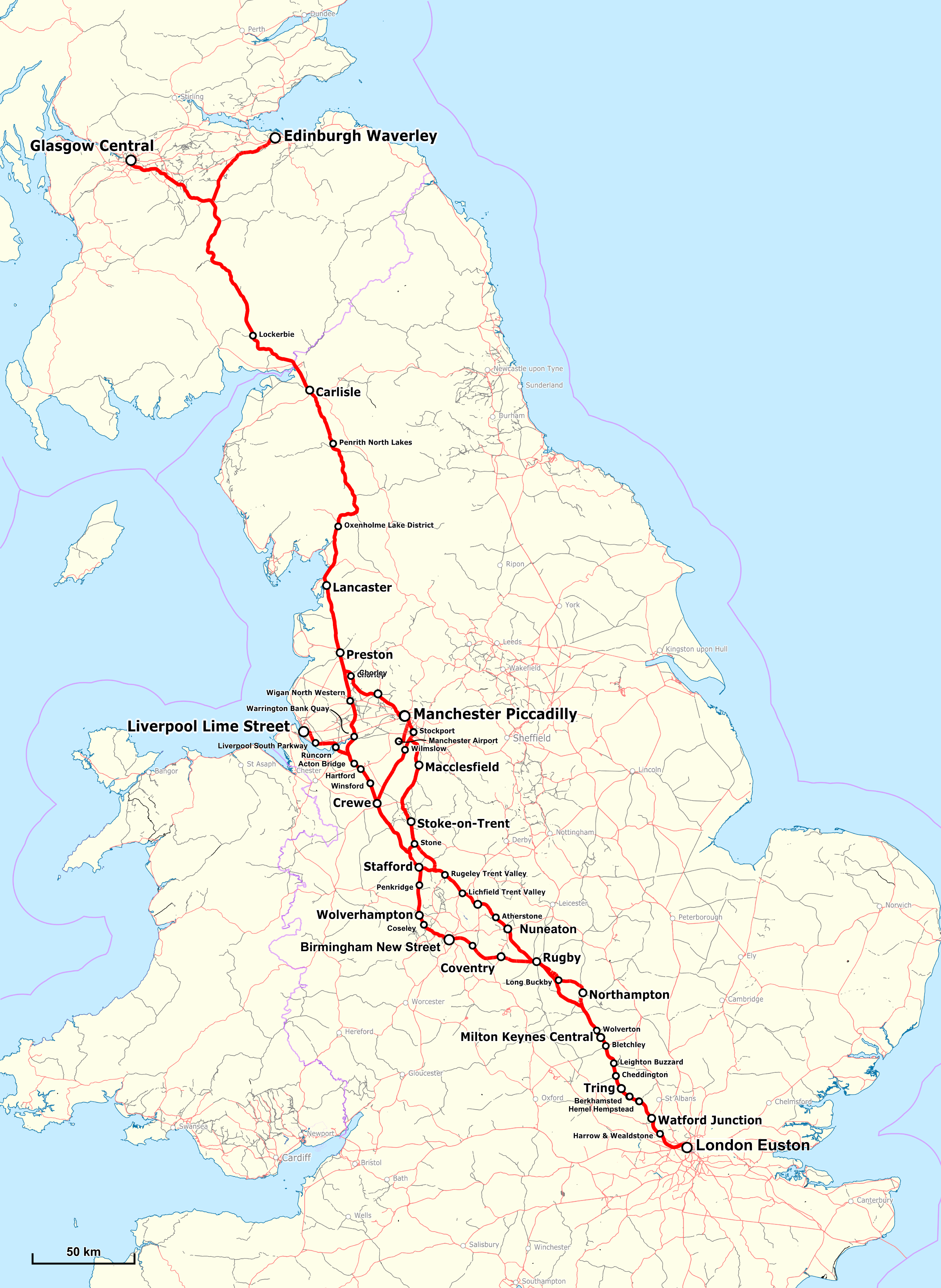
In June 2019 Network Rail formed five regions for helping to support Britain's railways. In August and September 2019, 14 routes responsible for the operation, maintenance and renewal of infrastructure were assigned across these regions. The West Coast Main Line runs through two of these regions ("Scotland's Railway" and "North West and Central") and is a part of 3 routes ("Scotland", "North West" and "West Coast Mainline South").
The cities and towns served by the WCML are listed in the tables below. Stations on loops and branches are marked **. Those stations in italics are not served by inter-city services run by Avanti West Coast but only by local trains. Between Euston and Watford Junction the WCML is largely but not exactly paralleled by the operationally independent Watford DC Line, a local stopping service now part of London Overground, with 17 intermediate stations, including three with additional platforms on the WCML.
The final table retraces the route specifically to indicate the many loops, branches, junctions and interchange stations on the core of the WCML.
The North Wales Coast Line between Crewe and Holyhead is not electrified. Services between London, Chester and Holyhead are operated by Class 805 bi-mode units. Formerly in the case of one of the Holyhead services, a Pendolino set was hauled from Crewe by a Class 57/3 diesel locomotive.
London to Glasgow and Edinburgh
| Town/City | Station | Ordnance Survey | ||
|---|---|---|---|---|
| National Grid Reference | Branches and loops | |||
| London | ||||
| Wembley | ||||
| Harrow | ||||
| Bushey | ||||
| Watford | ||||
| Kings Langley | ||||
| Apsley | ||||
| Hemel Hempstead | ||||
| Berkhamsted | ||||
| Tring | ||||
| Cheddington | ||||
| Leighton Buzzard | ||||
| Milton Keynes (Bletchley area) | ||||
| Milton Keynes (centre) | ||||
| Milton Keynes (Wolverton area) | ||||
| Northampton | ||||
| Long Buckby | ||||
| Rugby | ||||
| Nuneaton | ||||
| Atherstone | ||||
| Polesworth | ||||
| Tamworth | ||||
| Lichfield | ||||
| Rugeley | ||||
| Stafford | ||||
| Stoke-on-Trent | ||||
| Congleton | ||||
| Macclesfield | ||||
| Stockport | ||||
| Manchester | ||||
| Crewe | ||||
| Winsford | ||||
| Northwich | ||||
| Acton Bridge | ||||
| Runcorn | ||||
| Liverpool | ||||
| Liverpool | ||||
| Warrington | ||||
| Wigan | ||||
| Euxton | ||||
| Leyland | ||||
| Preston | ||||
| Lancaster | ||||
| Carnforth | ||||
| Oxenholme (Kendal) | ||||
| Penrith | ||||
| Carlisle | ||||
| Lockerbie | ||||
| Carstairs | ||||
| Carluke | ||||
| Craigneuk | ||||
| Motherwell | ||||
| Uddingston | ||||
| Newton | ||||
| Cambuslang | ||||
| Rutherglen | ||||
| Glasgow | ||||
| Kirknewton | ||||
| Currie | ||||
| Wester Hailes | ||||
| Kingsknowe | ||||
| Slateford | ||||
| Edinburgh (Haymarket/West End) | ||||
| Edinburgh |
Branches and loops
The WCML is noted for the diversity of branches served between the London and Glasgow main line. The adjacent diagram deals with the very complex network of lines in the West Midlands that link the old route via Birmingham with the new WCML route via the Trent Valley (i.e. 1830s versus 1840s).
In the following tables, related to the WCML branches, only the Intercity stations are recorded:
Rugby–Birmingham–Wolverhampton–Stafford
Main article: Rugby–Birmingham–Stafford Line
| City/Town | Station | Ordnance Survey | ||
|---|---|---|---|---|
| grid reference | ||||
| Rugby | ||||
| Coventry | ||||
| Canley | ||||
| Tile Hill | ||||
| Balsall Common | ||||
| Hampton in Arden | ||||
| Birmingham Airport | ||||
| Solihull | ||||
| Birmingham | ||||
| Stechford | ||||
| Adderley Park | ||||
| Birmingham city centre | ||||
| Smethwick | ||||
| Oldbury | ||||
| Tipton | ||||
| Dudley | ||||
| Wolverhampton | ||||
| Penkridge | ||||
| Stafford |
Crewe–Manchester–Preston
| City/Town | Station | Ordnance Survey | ||
|---|---|---|---|---|
| grid reference | ||||
| Crewe | ||||
| Wilmslow | ||||
| Stockport | ||||
| Manchester | ||||
| Bolton | ||||
| Preston |
Tunnels, viaducts and major bridges
Major civil engineering structures on the West Coast Main Line include the following. Many of the engineering features on the southern part of the route are original to the opening of the London and Birmingham Railway in the 1830s and are now listed buildings in recognition of their historic and engineering interest.
| Railway Structure | Length | Distance from Carlisle | ELR | Location | Distance from Lancaster | Distance from Preston | Distance from Newton-le-Willows Junction | Distance from London Euston |
|---|---|---|---|---|---|---|---|---|
| Clyde Bridge | 8 chains | 102 miles 04 chains – 101 miles 76 chains | WCM2 | South of Glasgow Central station | ||||
| Eglinton Street Tunnels | 200 yards (183 m) | 101 miles 22 chains – 101 miles 13 chains | ||||||
| Clyde Viaduct No. 37 | 94 miles 16 chains | West of station | ||||||
| Orbiston Viaduct No. 24 (River Calder) | 5 chains | 90 miles 62 chains – 90 miles 57 chains | Between Uddingston and stations | |||||
| Mouse Water Viaduct | 5 chains | 76 miles 13 chains – 76 miles 08 chains | WCM1 | Between and stations | ||||
| Float Viaduct (River Clyde) | 5 chains | 72 miles 52 chains – 72 miles 47 chains | Between Carstairs South Junction and station | |||||
| Lamington Viaduct (River Clyde) | 6 chains | 62 miles 70 chains – 62 miles 64 chains | ||||||
| Crawford Viaduct (River Clyde) | 5 chains | 55 miles 62 chains – 55 miles 57 chains | ||||||
| Harthorpe Viaduct (Elvan Water) | 6 chains | 47 miles 06 chains – 47 miles 00 chains | ||||||
| Elvan Water Viaduct | 42 miles 78 chains | |||||||
| Cogrie Viaduct (River Annan) | 4 chains | 35 miles 70 chains – 35 miles 66 chains | ||||||
| Dryfe Water Viaduct | 4 chains | 27 miles 32 chains – 27 miles 28 chains | ||||||
| Milk Water Viaduct | 7 chains | 23 miles 75 chains – 23 miles 68 chains | Between Lockerbie and stations | |||||
| Mein Water Viaduct | 17 miles 65 chains | |||||||
| Kirtle Water Viaduct | 15 miles 60 chains | |||||||
| Sark Viaduct (Scotland/England Border) | 8 miles 55 chains | |||||||
| Esk Viaduct | 7 chains | 6 miles 50 chains – 6 miles 43 chains | ||||||
| Eden Viaduct | 3 chains | 1 mile 23 chains – 1 mile 20 chains | ||||||
| Caldew Viaduct | 7 chains | 0 miles 66 chains – 0 miles 59 chains | ||||||
| Eamont Viaduct | 5 chains | 50 miles 12 chains – 50 miles 07 chains | CGJ7 | Between and stations | ||||
| Lowther Viaduct | 7 chains | 48 miles 57 chains – 48 miles 50 chains | ||||||
| Birkbeck Viaduct | 33 miles 28 chains | |||||||
| North Lune Viaduct | 32 miles 20 chains | |||||||
| River Lune | 31 miles 55 chains | |||||||
| Docker Garth's Viaduct | 6 chains | 24 miles 03 chains – 23 miles 77 chains | ||||||
| Beela Viaduct | 13 miles 02 chains | Between Oxenholme and stations | ||||||
| Lune Viaduct | 12 chains | 0 miles 38 chains – 0 miles 26 chains | ||||||
| Lancaster Canal | 20 miles 36 chains | CGJ6 | ||||||
| Conder Viaduct | 16 miles 76 chains | Between Lancaster and stations | ||||||
| Wyre Viaduct | 13 miles 01 chains | |||||||
| Barton Viaduct | 4 miles 30 chains | |||||||
| Fylde Road Viaduct | 0 miles 64 chains | |||||||
| Ribble Viaduct | 12 chains | 21 miles 33 chains – 21 miles 21 chains | CGJ5 | Between Preston and stations | ||||
| River Yarrow Viaduct | 5 chains | 14 miles 55 chains – 14 miles 50 chains | ||||||
| Leeds Liverpool Canal | 4 chains | 6 miles 04 chains – 6 miles 00 chains | Between Wigan North Western and stations | |||||
| 7 chains | 4 miles 24 chains −4 miles 17 chains | |||||||
| River Mersey | 181 miles 25 chains | CGJ2 | South of Warrington Bank Quay station | |||||
| Acton Grange Viaducts (Manchester Ship Canal) | 5 chains | 180 miles 40 chains – 180 miles 35 chains | ||||||
| Preston Brook Tunnel | 78 yards (71 m) | 176 miles 07 chains – 176 miles 04 chains | North of Weaver junction | |||||
| Birdswood Tunnel (Up Liverpool flyover) | 1 chain | 175 miles 44 chains – 175 miles 43 chains | CGJ1 | Weaver junction | ||||
| Dutton Viaduct (River Weaver) | 22 chains | 174 miles 18 chains – 173 miles 76 chains | North of station | |||||
| Vale Royal Viaduct (River Weaver) | 6 chains | 168 miles 72 chains – 168 miles 66 chains | South of Hartford station | |||||
| River Sow | 137 miles 52 chains | LEC4 | Between former and stations | |||||
| Baswich Viaducts (Staffs. & Worc. Canal and River Penk) | 7 chains | 131 miles 57 chains – 131 miles 50 chains | LEC2 | Between Stafford and stations | ||||
| Shugborough Tunnel | 777 yards (710 m) | 129 miles 01 chains – 128 miles 46 chains | ||||||
| Shugborough Viaduct (River Trent) | 3 chains | 127 miles 71 chains – 127 miles 68 chains | ||||||
| Trent & Mersey Canal | 127 mile 22 chains | |||||||
| River Trent Viaduct | 4 chains | 122 miles 18 chains – 122 miles 14 chains | Between Rugeley Trent Valley and stations | |||||
| Trent & Mersey Canal | 121 miles 29 chains | |||||||
| Coventry Canal | 115 miles 18 chains | Between Lichfield Trent Valley and stations | ||||||
| River Tame | 4 chains | 112 miles 36 chains – 112 miles 32 chains | ||||||
| Tamworth Viaduct (River Anker) | 109 miles 70 chains | South of Tamworth station | ||||||
| Polesworth North Viaduct | 4 chains | 106 miles 53 chains – 106 miles 49 chains | North of station | |||||
| Polesworth South Viaduct (River Anker) | 4 chains | 105 miles 75 chains – 105 miles 71 chains | Between Polesworth and stations | |||||
| Coventry Canal | 105 miles 59 chains | |||||||
| 102 miles 05 chains | ||||||||
| River Anker Viaduct | 2 chains | 96 miles 38 chains – 96 miles 36 chains | Between and stations | |||||
| Ashby Canal | 94 miles 61 chains | |||||||
| Oxford Canal | 89 miles 61 chains | |||||||
| 88 miles 10 chains | ||||||||
| 85 miles 54 chains | ||||||||
| Avon Viaduct | 5 chains | 84 miles 09 chains – 84 miles 04 chains | ||||||
| Oxford Canal | 82 miles 16 chains | HNR | Northampton line, between Rugby and stations | |||||
| Crick Tunnel | 595 yards (544 m) | 79 miles 47 chains – 79 miles 20 chains | ||||||
| Grand Union Canal | 78 miles 60 chains | |||||||
| Watford Lodge Tunnel | 115 yards | 78 miles 52 chains – 78 miles 47 | ||||||
| River Nene Viaduct | 5 chains | 67 miles 77 chains – 67 miles 72 chains | Northampton line, between Long Buckby and stations | |||||
| River Nene Viaduct | 5 chains | 66 miles 09 chains – 66 miles 04 chains | ||||||
| Earl Cowpers (River Nene) | 6 chains | 65 miles 19 chains – 65 miles 13 chains | Northampton line, between Northampton and stations | |||||
| Grand Junction Canal | 4 chains | 65 miles 11 chains – 65 miles 07 chains | ||||||
| Hunsbury Hill Tunnel | 1152 yards (1053 m) | 64 miles 54 chains – 63 miles 70 chains | ||||||
| Roade Cutting ‘Birdcage’ support structure | 49 chains | 60 miles 76 chains – 60 miles 27 | ||||||
| Oxford Canal | 79 miles 71 chains | LEC1 | Between Rugby and Wolverton stations | |||||
| Kilsby Tunnel | 1 mile 656 yards (2209 m) | 78 miles 13 chains – 76 miles 64 chains | ||||||
| Leicester Branch Canal | 75 miles 11 chains | |||||||
| Grand Union Canal | 73 miles 09 chains | |||||||
| Weedon Viaduct | 4 chains | 69 miles 15 chains – 69 miles 11 chains | ||||||
| Stowe Hill Tunnel | 491 yards (449 m) | 68 miles 32 chains – 68 miles 09 chains | ||||||
| Grand Union Canal | 62 miles 59 chains | |||||||
| Wolverton Viaduct | 9 chains | 53 miles 01 chains – 52 miles 72 chains | ||||||
| Grand Union Canal | 2 chains | 52 miles 42 chains – 52 miles 40 chains | North of Wolverton station | |||||
| 52 miles 18 chains | South of Wolverton station | |||||||
| Linslade Tunnels | 287 yards (262 m), down fast 283 yards (259 m) | 40 miles 73 chains – 40 miles 60 chains | North of station | |||||
| Grand Union Canal | 34 miles 53 chains | Between and stations | ||||||
| Northchurch Tunnels | 349 yards (319 m) | 29 miles 12 chains – 28 miles 76 chains | North of station | |||||
| Grand Union Canal | 25 miles 21 chains | Between Berkhamsted and stations | ||||||
| Nash Mills railway bridge (crosses the Grand Union Canal) | 22 miles 26 chains | Between and stations | ||||||
| Abbots Langley railway bridge | 27 yards | 22 miles 15 chains | South of Kings Langley station | |||||
| Watford Slow Tunnel | 1 mile 230 yards (1820 m) | 19 miles 44 chains – 18 miles 33 chains | North of station | |||||
| Watford Fast Tunnel | 1 mile 55 yards (1660 m) | 19 miles 40 chains – 18 miles 38 chains | ||||||
| Colne Viaduct | 3 chains | 16 miles 66 chains – 16 miles 63 chains | North of station | |||||
| Bushey Arches Viaduct | 6 chains | 16 miles 11 chains – 16 miles 05 chains | ||||||
| Brent Viaducts | 6 miles 77 chains | West of station | ||||||
| Kensal Green Tunnels | 320 yards (293 m) | 4 miles 59 chains – 4 miles 45 chains | West of station | |||||
| Primrose Hill Tunnel (Fast) | 1182 yards (1081 m) | 2 miles 27 chains – 1 mile 54 chains | North-West of station | |||||
| Primrose Hill Tunnel (Slow) | 1170 yards (1070 m) | 2 miles 27 chains – 1 mile ? chains | ||||||
| Lower Park Street Tunnel | 127 yards (116 m) | 0 miles 68 chains – 0 miles 62 chains | ||||||
| Upper Park Street Tunnel | 162 yards (148 m) | 0 miles 67 chains – 0 miles 60 chains |
WCML branches and junctions
| Location | Type | Route | Details |
|---|---|---|---|
| Camden Jnct | Branch | 18 | Watford DC Line (WDCL) |
| + | Junction | 6 | North London Line from joins WDCL and WCML |
| Willesden Jnct | Junction | 6 | North London Line from joins WDCL and WCML |
| + | Junction | 2 | West London Line from joins WCML |
| + | Junction | 6 | North London Line from joins WCML |
| Interchange | 6 | North London Line with Watford DC Line | |
| Branch | 18 | Watford DC Line terminates at separate bay platforms | |
| + | Branch | 18 | St Albans Branch Line (AC single line single section) to |
| Branch | 18 | Marston Vale Line to | |
| High Level (Denbigh Hall South Jnct) | Branch | 16 | Freight only line to Newton Longville (remnant of mothballed Varsity Line to Oxford) |
| Hanslope Junction | Loop | 18 | Northampton Loop leaves a few miles north of and rejoins just south of |
| Rugby | Junction | 17 | West Midlands Main Line to , , and |
| Junction | 19 | The Birmingham to Peterborough Line from | |
| + | Junction | 17 | The Coventry to Nuneaton Line |
| + | Junction | 17 | The Birmingham to Peterborough Line to Birmingham |
| Interchange | 17 | The Cross Country Route from and Birmingham to and the North East | |
| Interchange | 17 | The Cross-City Line to Lichfield | |
| + | Junction | 17 | north of the station |
| Junction | 17 | The Chase Line from Birmingham to Rugeley | |
| Colwich Junction | Branch | 18 | to and (Route 20 from ) |
| Junction | 17 | West Midlands Main Line from Coventry, Birmingham and Wolverhampton | |
| Branch | 18 | to to join line from Colwich Jnct to Manchester (Route 20 from Cheadle Hulme) | |
| Stoke-on-Trent | Junction | 19 | from Derby |
| Branch | 18 | to and Crewe | |
| Cheadle Hulme | – | 20 | Route 18 London – Manchester Line becomes Route 20 through to Manchester |
| Branch | 18 | from (diesel service from , , , Derby and Stoke-on-Trent) | |
| + | Junction | 14 | The Welsh Marches Line from South Wales, and |
| + | Junction | 22 | to and the North Wales Coast Line |
| + | Junction | 20 | to , , Stockport and Manchester |
| Hartford North | Junction | 20 | (freight only) from |
| Weaver Junction | Branch | 18 | to and Liverpool (Route 20 from ) |
| Liverpool South Parkway | – | 20 | Route 18 London to Liverpool Line becomes Route 20 to |
| Junction | 22 | from and Chester to Manchester | |
| Winwick Jnct | Junction | 20 | to Liverpool, and Manchester |
| Golborne Jnct | Junction | 20 | to Liverpool, and Manchester |
| Ince Moss/Springs Branch Junct | Junction | 20 | The Liverpool to Wigan Line |
| Junction | 20 | from Manchester | |
| Euxton Jnct | Junction | 20 | The Manchester to Preston Line from Manchester |
| Farington Jnct | Junction | 23 | East Lancashire Line and Caldervale Line |
| Farington Curve Jnct | Junction | 23 | Ormskirk Branch Line, East Lancashire Line and Caldervale Line |
| Preston Dock | Junction | 23 | west |
| Junction | 20 | to | |
| Morecambe South Jnct | Junction | 23 | to |
| Hest Bank Jnct | Junction | 23 | from Morecambe |
| Carnforth Jnct | Junction | 23 | Furness Line to and also the Leeds to Morecambe Line to |
| Junction | 23 | to | |
| Junction | 23 | Route 23 uses two junctions to the north of the station | |
| Junction | 23 | Route 23 Settle-Carlisle Railway and Route 9 from | |
| + | Junction | 23 | The Cumbrian Coast Line from Barrow-in-Furness |
| Gretna Jnct | Junction | 26 | to the Glasgow South Western Line |
| Carstairs South Jnct | Junction | 24 | Route 18 West Coast Main Line becomes Route 24 to |
| Carstairs South | – | 26 | Route 18 West Coast Main Line becomes Route 26 to |
Notes
References
Sources
References
- (16 March 2010). "Railways: West Coast Main Line". House of Commons Library.
- (November 2015). "Supplement to the October 2013 Strategic Case for HS2 Technical Annex: Demand and Capacity Pressures on the West Coast Main Line". [[Department for Transport UK.
- (October 2007). "West Coast Main Line". Network Rail.
- (March 2022). "Special Focus - West Coast Main Line Backbone of Britain". Key Publishing.
- Sonagra, Radhika. (18 July 2024). "50 years of electrifying the West Coast Main Line".
- "General definitions of highspeed". [[International Union of Railways]].
- "West Coast Main Line - Question for Department for Transport". UK Parliament.
- "West Coast Main Line Pendolino Tilting Trains, United Kingdom". railway-technology.com.
- (1974). "Electric All The Way - Information booklet". British Railways Board.
- (2 July 2004). "History of the West Coast Main Line". Virgin Trains.
- (2004). "Grand Junction Railway: History of the West Coast Main line". Virgin Trains.
- (2004). "London and Birmingham Railway: History of the West Coast Main line". Virgin Trains.
- (1996). "The London & North Western Railway". Silver Link Publishing Ltd.
- Awdry, Christopher. (1990). "Encyclopaedia of British Railway Companies". Patrick Stephens Ltd.
- "West Coast Joint Stock Railway". Science Museum Group.
- Thomas, John. (1971). "A Regional History of the Railways of Great Britain. Volume VI Scotland: The Lowlands and the Borders (1st ed.)". David & Charles.
- (2004). "The Manchester Lines: History of the West Coast Main line". Virgin Trains.
- (2004). "Lines in Lancashire: History of the West Coast Main line". Virgin Trains.
- "Rail Album – LMS Steam Locos – Streamlined Princess Coronation Class Pacifics – Part 1". railalbum.co.uk.
- (December 1959). "The winter timetables of British Railways: The West Coast speed-up". Ian Allan.
- (27 April 1912). "Auction Announcements of Messrs. Knight, Frank, and Rutley". The Times.
- Marshall, John. (1979). "The Guinness Book Of Rail Facts & Feats". Guinness Superlatives.
- (1983). "A Regional History of the Railways of Great Britain, Volume 7 The West Midlands". David St John Thomas David and Charles.
- (1 March 1970). "£25 million railway scheme shocks economists". [[The Observer]].
- Wolmar, Christian. (2007). "Fire and Steam, A New History of the Railways in Britain". Atlantic.
- "Passenger Timetable 1 May 1972 to 6 May 1973". British Railways Board, London Midland Region.
- (April 1966). "Your New Railway: London Midland Electrification - Information booklet". British Railways Board.
- (1983). "A Regional History of the Railways of Great Britain, Volume 7 The West Midlands". David St John Thomas David and Charles.
- (1986). "Research and development: British Rail's fast trains". Open University Press.
- Stamp, Gavin. (1 October 2007). "Steam ahead: the proposed rebuilding of London's Euston station is an opportunity to atone for a great architectural crime". Apollo: the international magazine of art and antiques.
- Semmens, Peter. (1991). "Electrifying the East Coast Route". Patrick Stephens.
- (20 December 2019). "Direct trains launched between Liverpool Lime Street and Glasgow".
- "'Queasy Rider:' The Failure of the Advanced Passenger Train.".
- "Railways: West Coast Main Line". House of Commons Library.
- (28 August 2002). "West coast rail upgrade expected". BBC News.
- Meek, James. (1 April 2004). "The £10bn Rail Crash". The Guardian.
- "West Coast Main Line". Railway Technology.
- (12 December 2005). "High-speed tilting train on track". BBC News.
- (14 December 2008). "West Coast rail works completed". BBC News.
- (29 March 2016). "First trains use Norton Bridge rail flyover".
- (28 January 2015). "Orphanage Road bridge to be replaced as work to upgrade railway at Watford continues". Network Rail.
- "West coast main line upgrade". Corus rail.
- "Freight Route Utilisation Strategy – March 2007". Network Rail.
- "The rise of the UK warehouse and the "golden logistics triangle"".
- "Railroad/Railway Electric Traction Systems". crbasic.info.
- McDonnell, S.. (12 February 2019). "First electric passenger trains finally entering service in Bolton".
- "North West electrification". Network Rail.
- (21 May 2011). "Virgin Rail Group welcomes West Coast franchise extension discussions". Rail Network.
- (3 September 2014). "The Sleepers are stirring".
- (13 December 2024). "Our high-speed Super Voyager Trains (now retired)".
- (2 June 2024). "Avanti West Coast adds more seats with summer timetable change".
- (27 October 2016). "TransPennine Express coach production begins".
- (14 August 2019). "West Coast marks new partnership model for rail".
- Topham, Gwyn. (27 November 2019). "West coast train services to be rebranded with Avanti logo". The Guardian.
- (15 November 2012). "Nuneaton North Chord freight line now open". Network Rail.
- (10 August 2011). "Work starts on Nuneaton chord".
- (25 March 2014). "The new Ipswich chord will ease a major bottleneck on the Great Eastern main line". Network Rail.
- "Stafford – Crewe rail enhancements". [[Network Rail]].
- "£340m railway upgrade planned for Liverpool City Region". Network Rail.
- "Business plan 2007". Network Rail.
- (4 November 2009). "Hansard". House of Commons.
- Connor, Neil. (25 April 2006). "We won't bid if rail link becomes a 'bus run'". icBirmingham.co.uk.
- (28 July 2011). "8. Potential new lines". Network Rail.
- "Government launches study into potential Crossrail extension".
- (2025-11-03). "West Coast Mainline blocked as train derails in Cumbria".
- "Ministry of Transport Accident Report Between Grayrigg and Oxenholme, L.M.S.R., 18 May 1947".
- "Our routes".
- {{NHLE
- "Primrose Hill Tunnel – CRHT Web site".
- (29 November 2015). "Keeping Track: Primrose Hill and the railway".
- Brailsford, Martyn. (2017). "Railway Track Diagrams Book 1: Scotland & Isle of Man". Trackmaps.
- Bridge, Mike. (2013). "Railway Track Diagrams Book 4 Midlands & North West". Trackmaps.
- "WCM2: W.C.M.L. (ELR Change Law Jn - Glasgow Central Stat.)".
- "WCM1: W.C.M.L.(Carlisle - ELR Change Law Jn)".
This article was imported from Wikipedia and is available under the Creative Commons Attribution-ShareAlike 4.0 License. Content has been adapted to SurfDoc format. Original contributors can be found on the article history page.
Ask Mako anything about West Coast Main Line — get instant answers, deeper analysis, and related topics.
Research with MakoFree with your Surf account
Create a free account to save articles, ask Mako questions, and organize your research.
Sign up freeThis content may have been generated or modified by AI. CloudSurf Software LLC is not responsible for the accuracy, completeness, or reliability of AI-generated content. Always verify important information from primary sources.
Report