From Surf Wiki (app.surf) — the open knowledge base
Wessex Formation
Early Cretaceous geological formation in England

Early Cretaceous geological formation in England
| Field | Value |
|---|---|
| name | Wessex Formation |
| image | West_of_Chilton_Chine_-_geograph.org.uk_-_1378519.jpg |
| caption | Exposure of the Wessex Formation west of Chilton Chine |
| type | Geological formation |
| period | Barremian |
| age | |
| prilithology | mudstone |
| otherlithology | sandstone, ironstone & conglomerate |
| namedfor | Wessex |
| namedby | Daley and Stewart |
| year_ts | 1979 |
| region | Southern England |
| country | United Kingdom |
| unitof | Wealden Group |
| subunits | Coarse Quartz Grit (in Dorset) |
| underlies | Vectis Formation |
| overlies | Durlston Formation |
| thickness | up to 1000 m near Swanage |
| location_ts | Bacon Hole, Mupe Bay |
| extent | Dorset, Isle of Wight, offshore Wessex Basin |
| map | IOW_geology.svg |
| map_caption | Exposure of the Wessex and Vectis Formations on the South Coast of the Isle of Wight, shown in turquoise. |
The Wessex Formation is a fossil-rich English geological formation that dates from the Berriasian to Barremian stages of the Early Cretaceous. It forms part of the Wealden Group and underlies the younger Vectis Formation and overlies the Durlston Formation. The dominant lithology of this unit is mudstone with some interbedded sandstones. It is part of the strata of the Wessex Basin, exposed in both the Isle of Purbeck and the Isle of Wight. While the Purbeck sections are largely barren of vertebrate remains, the Isle of Wight sections are well known for producing the richest and most diverse fauna in Early Cretaceous Europe.
Nomenclatural history
Historically, the Wessex Formation has been called alternately the "Variegated Marls and Sandstones", a name used by W. J. Arkell in his 1947 map of the Isle of Purbeck as well as the "Wealden Marls" It was given its current formal name by Daley and Stewart in 1979.
Stratigraphy and lithology
Introduction
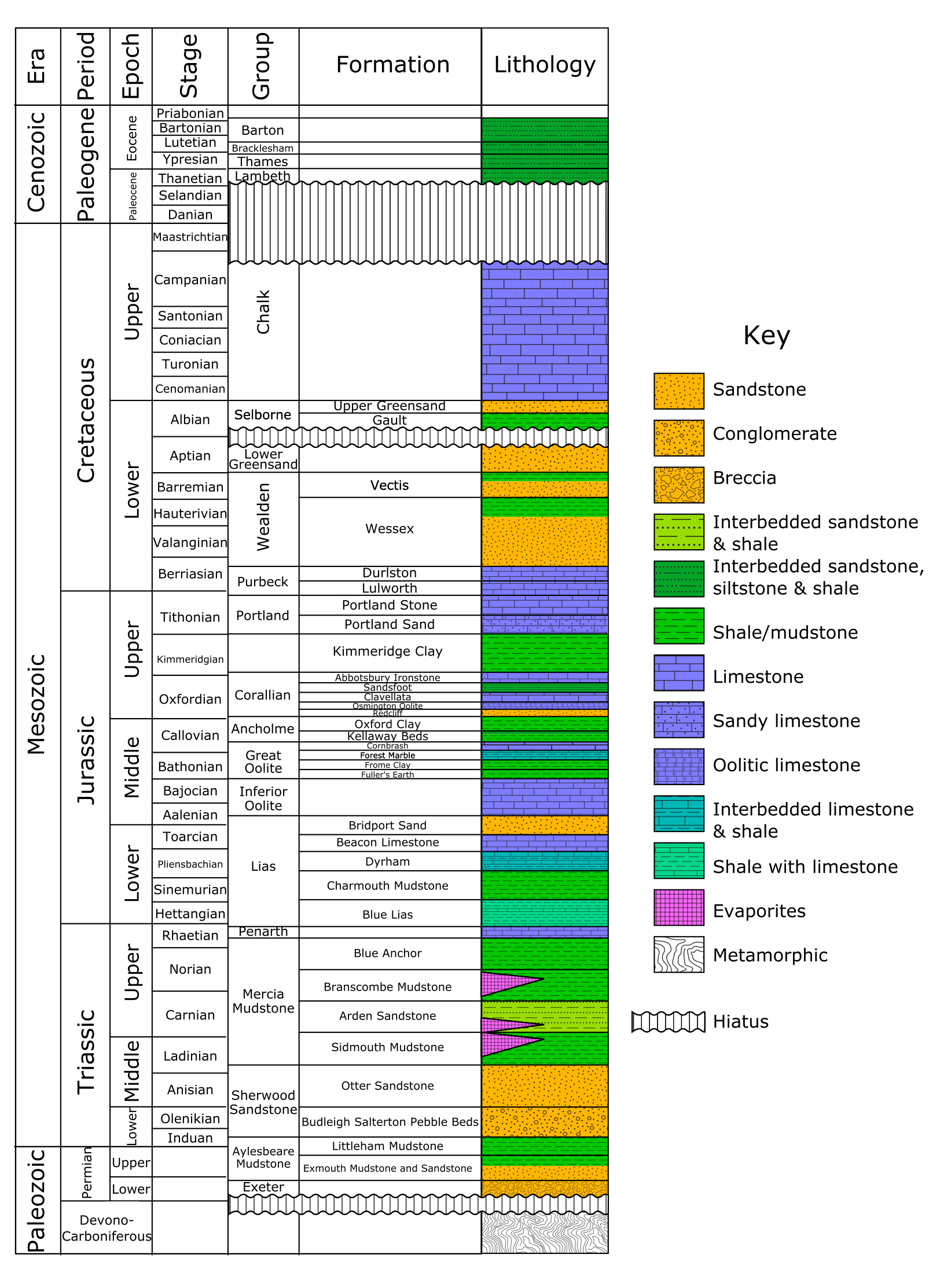
The Wessex Formation forms part of the Wealden Group within the Wessex Basin, an area of subsidence since Permo-Triassic times. The basin is located along southern half of the Isle of Wight and Purbeck, extending offshore into the English Channel. The Wealden Group is also exposed significantly in the Weald Basin, which has a separate stratigraphic succession. The Wealden Group is not widely present elsewhere in Britain, as these areas were tectonic highs where little to no sediment deposition was taking place. The formation has limited exposure as it has been deeply buried beneath the subsequent Lower Greensand. Selbourne and Chalk Groups, as well as being very vulnerable to erosion. It has been exposed at the surface due to the creation of anticlinal structures as a distant effect of the formation of the Pyrenees as part of the Alpine Orogeny during the Paleogene.
The major source rocks for the sediments were from the Cornubian Massif to the west, an upland region roughly equivalent to the extent of Cornwall and Devon, with occasional large dropstones transported in tree roots being found in Wealden sediments over 100 km from where they originated.
The Wessex Formation in the Isle of Purbeck
The exposure in of the Wessex Formation in the Isle of Purbeck is largely confined to a thin belt on the south side of the Purbeck Ridge and is best exposed at Swanage, Lulworth Cove and Worbarrow Bay. One notable persistent horizon within the Purbeck sections of the formation is the "Coarse Quartz Grit", an up to 6 m thick sequence of conglomeratic ironstone, with many beds including numerous centimetre sized subangular to rounded pebbles predominantly of vein derived quartz, hence the name. This horizon is present throughout the Purbeck outcrops of the Wessex Formation. The transition to the Vectis Formation at Swanage is obscured by a landslip.
The Wessex Formation of the Isle of Wight
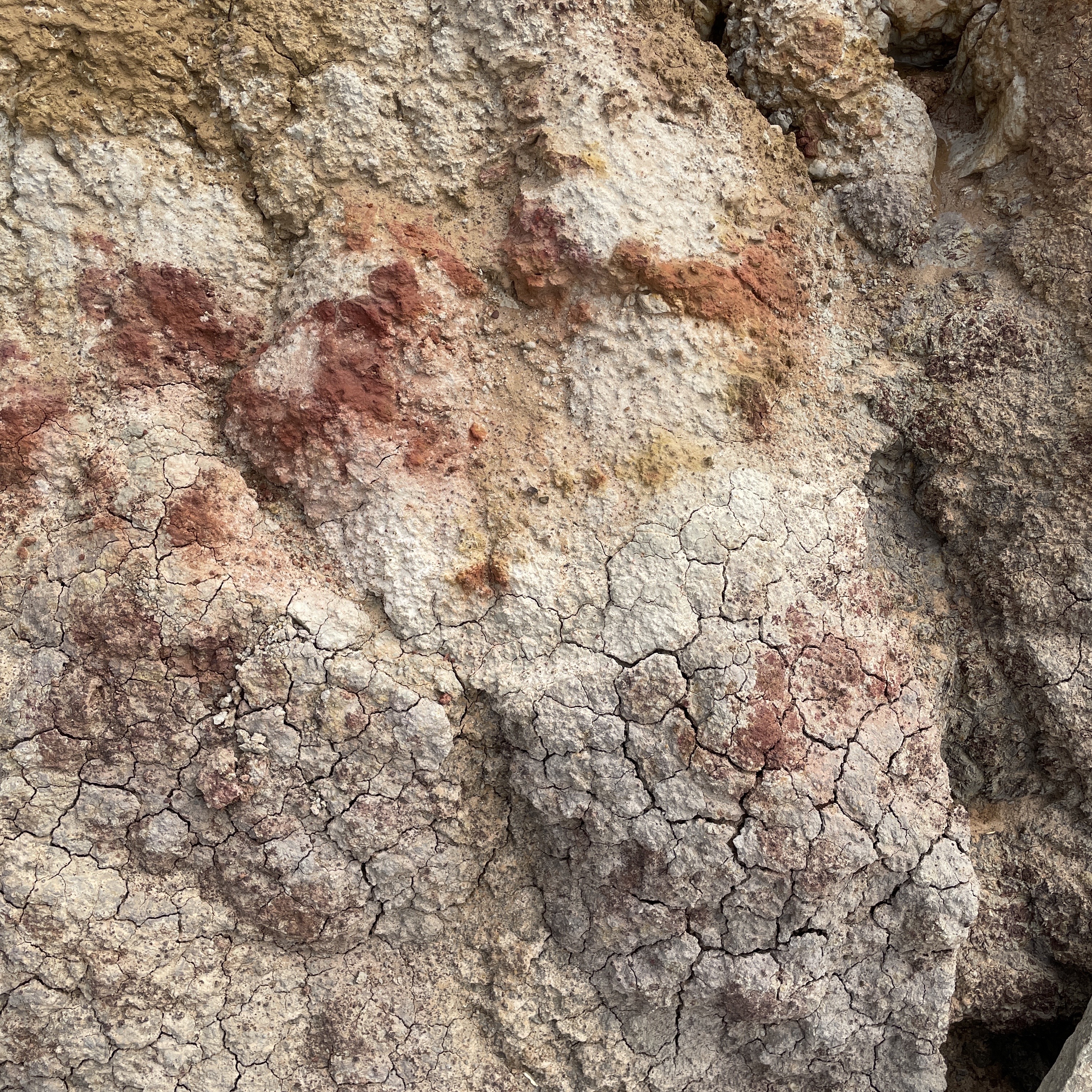
The Isle of Wight succession has two primary exposures, The major one being the several kilometre long section along the South West coastline around Brighstone Bay, and another smaller exposure on the South East coast near Yaverland. While the formation taken as a whole dates from the Berriasian to the Barremian, only the uppermost part of the formation is exposed on the Isle of Wight. With less than 200 m of exposed composite stratigraphic thickness, and which dates from Hauterivian to Barremian. A radiometric date has been obtained from the lower part of the succession, estimated to be 127.3 ± 2.7 million years ago.** This makes the formation coeval with upper portion of the Weald Clay in the Weald Basin. The primary lithology of the exposed portion of the formation on the Isle of Wight consists of featureless purple-red overbank mudstone, interbedded with sandstones. The environment of deposition was a floodplain within a narrow, east–west oriented valley. The climate at the time of deposition is considered to be semi-arid, based on the presence of pedogenic calcrete nodules within the mudstones. The "Pine Raft" horizon found near the base of the exposed portion of the formation includes calcitized conifer trunks up to metre in diameter and 2-3 m long.

Plant debris beds
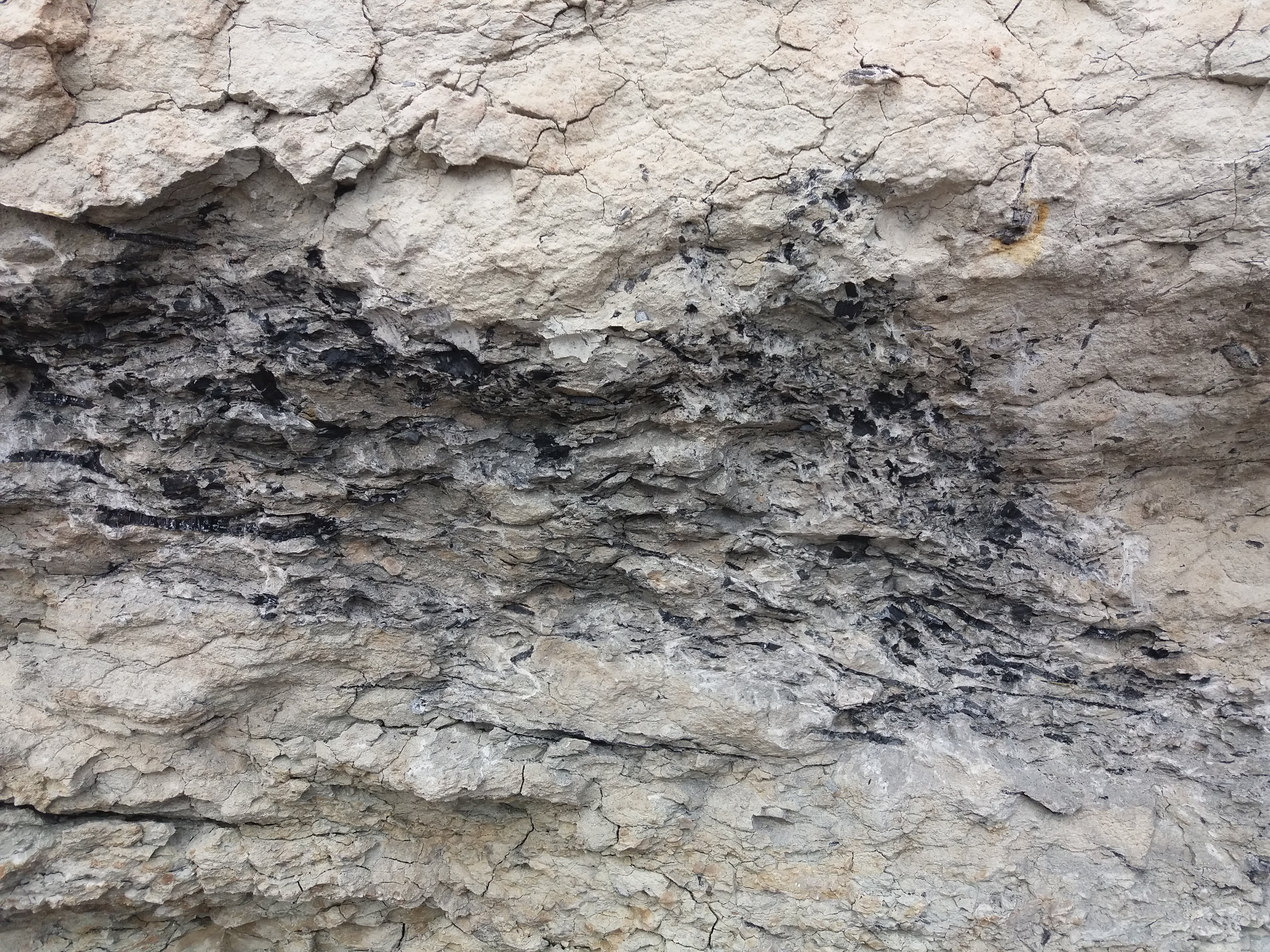
A notable feature of the formation are the so-called "plant debris beds". These consist of a basal matrix supported conglomerate, grading upwards into grey mudstone with lignitic plant debris, including large trunk fragments of the extinct conifer Pseudofrenelopsis present in the upper portion. These were formed by sheet flood deposits induced by storms that filled pre-existing topographic lows like oxbow lakes and abandoned channels in the floodplain depositional environment. The debris beds do not form a continuous horizon throughout the formation, but are laterally extensive over tens of metres. Many of the wood fragments in the debris beds are cemented together with large nodules of pyrite, suggesting depositional conditions were anoxic. Most fossils within the formation are associated with the debris beds. Vertebrate fossils are mostly disarticulated individual bones and teeth, suggesting a long subaerial exposure prior to burial, though the bones lack abrasion, suggesting that they had not been significantly transported. Partial skeletons also sometimes occur, but are uncommon. Autochthonous siderite nodules are also present, which encase some of the fossils. Plant debris beds also exist within the Swanage section, and one of these horizons has yielded microvertebrate remains.
''"Hypsilophodon'' bed"

While most fossils are associated with the plant debris beds, a notable exception is the "Hypsilophodon bed" present near the top of the formation, an up to 1 m thick bed of silty red-green mudstone, with two separate horizons that have produced almost exclusively over a hundred complete and articulated skeletons of the dinosaur Hypsilophodon, sometimes even with preserved tail tendons. The bed is laterally extensive, being persistent for over a kilometre. A 2017 study suggested that the accumulation of skeletons were a mass mortality event caused by a crevasse splay, while a 2025 study contested this assertion, suggesting that the Hypsilophodon individuals gradually accumulated over time and had been exposed for some time prior to burial. Just above the "Hypsilophodon bed" the red mudstones of the Wessex Formation change to the transitional light coloured sandstone "White rock" and overlying laminated grey mudstones of the Vectis Formation, caused by the changing of environmental conditions from that of a floodplain to coastal lagoon conditions.
Palaeoenvironment
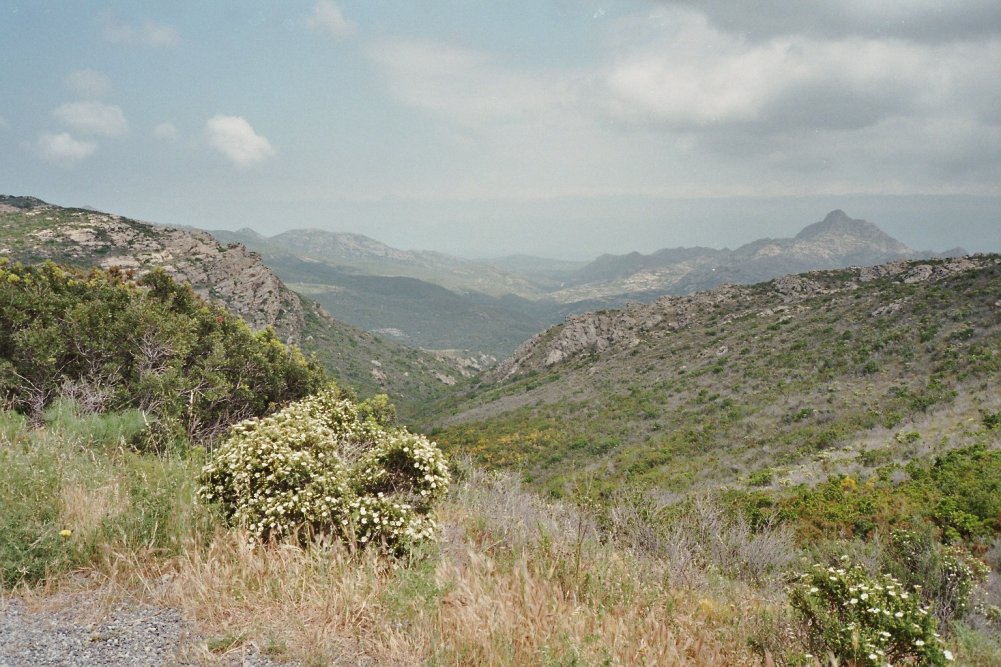
The palaeoenvironment of the Wessex Formation is considered to have been semi-arid, and has variously been compared to chaparral or macchia Mediterranean shrubland. The dominant trees were conifers of the extinct family Cheirolepidiaceae belonging to the genera Pseudofrenelopsis and Watsoniocladus, both of which have reduced xerophytic leaves adapted to arid conditions. Tree cover is thought to have been thin, and concentrated near waterways. The ground cover is thought to have consisted of xerophytic ferns. Wildfires were common occurrences, as evidenced by preserved charred vegetation.
Fauna
The Wessex Formation likely spans several million years of deposition, and not all taxa are likely to have been contemporaneous.
Invertebrates
Invertebrates are commonly preserved in the Wessex Formation. Freshwater bivalves can be found including unionids such as Margaritifera, Nippononaia, and Unio. These bivalves help reconstruct what the freshwater paleoenvironment may have been like during the formation's deposition. Specimens of Viviparus, a genus of freshwater snail, have also been found. While compression fossils of insects are found in the overlying Vectis Formation, all insect fossils in the Wessex Formation are found as inclusions in amber. Amber can be found present as a rare component in plant debris beds in the Wessex formation both on the Isle of Wight and the Isle of Purbeck, however, the only significant concentration and where all of the inclusions have been found is a lag channel in the L6 plant debris horizon just south-east of Chilton Chine. Only four species from the amber have been formally described, Cretamygale chasei a mygalomorph spider, Dungeyella gavini Libanodiamesa simpsoni, both chironomid midges, as well as Embolemopsis maryannae, a embolemid parasitic wasp. However a table of undescribed taxa has been given, and several images of some of the undescribed taxa have been released from various sources, including multiple chironomids, and a therevid dipteran.
Arthropods
| Arthropods of the Wessex Formation | Genus | Species | Location | Stratigraphic Position | Abundance | Note | Images | ||
|---|---|---|---|---|---|---|---|---|---|
| Cypridea | C. wicheri, C. brevirostrata | Dungy Head | Base of the formation | An ostracod belonging to Cypridoidea | |||||
| Chilton Chine | L6 plant debris bed | Single specimen | Mygalomorph spider, has been described from a specimen found in amber. | See article | |||||
| Dungeyella | D. gavini | Chilton Chine | L6 plant debris bed | Multiple specimens | A tiny buchonomyiine chironomid midge | See article | |||
| Embolemopsis | E. maryannae | Chilton Chine | L6 plant debris bed | Single specimen | Embolemid parasitic wasp, genus also known from the Zaza Formation. Specimen previously described as a dryinid in a 2015 conference abstract. | [[File:Wealden Dryinid.jpg | frameless]] | ||
| Protopangu | P. valdensis | Chilton Chine | L6 plant debris bed | Single specimen | A panguid parasitic stinging wasp | ||||
| Libanodiamesa | L. simpsoni | Chilton Chine | L6 plant debris bed | Single specimen | Prodiamesinae chironomid, genus also known from the Lebanese amber | ||||
| Chironomidae | Chilton Chine | L6 plant debris bed | 44% of all arthropod inclusions | Uncertain how many taxa represented, likely at least two. At least one is a tanypodian with a wingspan twice that of Dungeyella. | |||||
| Therevidae | Indeterminate | Chilton Chine | L6 plant debris bed | At least one specimen | At least one specimen figured | [[File:Wealden Therevid.jpg | frameless | 165x165px]] | |
| Diptera | Indeterminate | Chilton Chine | L6 plant debris bed | Multiple specimens | Uncertain how many taxa represented | ||||
| Hymenoptera | Chilton Chine | L6 plant debris bed | Multiple specimens | Uncertain how many taxa represented | |||||
| Blattodea | Chilton Chine | L6 plant debris bed | Single specimen | ||||||
| Coleoptera | Chilton Chine | L6 plant debris bed | Single specimen | ||||||
| Curculionoidea? |
Vertebrates
Dinosaurs
Ornithischians
| Ornithischians reported from the Wessex Formation | Genus | Species | Synonyms | Stratigraphic Position | Material | Notes | Images | ||
|---|---|---|---|---|---|---|---|---|---|
| Brighstoneus | B. simmondsi | L9 | Partial skeleton | A hadrosauriform iguanodontian | [[File:Brighstoneus.png | center | frameless]] | ||
| Comptonatus | C. chasei | Compton Bay | Partial skeleton | An iguanodontian dinosaur | [[File:Comptonatus chasei.png | center | frameless]] | ||
| Hypsilophodon bed | Many partial skeletons | A hypsolophodontid | [[File:Hypsilophodon TD.png | center | frameless]] | ||||
| Yaverland bed 38 | Teeth | Resemble the cheek teeth of the heterodontosaurid Tianyulong. | |||||||
| [[File:Iguanodon TD.png | center | frameless]] | |||||||
| [[File:Istiorachis macarthurae.png | center | frameless]] | |||||||
| A hadrosauroid iguanodontian | [[File:Mantellisaurus atherfieldensis Steveoc.jpg | center | frameless]] | ||||||
| Polacanthus | P. foxii | Dorsal vertebrae, dorsosacral vertebrae, sacral vertebrae, caudosacral vertebra, caudal vertebrae, dorsal ribs, ilia, pubes, ischia, femora, tibia, distal end of fibula, astragalus, metatarsals, ungual phalanx, sacral shield and osteoderms. | An ankylosaur | ||||||
| Recovered from various parts of the formation | Multiple partial skeletons | A dryosaurid | |||||||
| Vectidromeus | V. insularis | Lower part of the formation | Associated elements of the dorsal vertebrae, pelvis, hindlimbs, and tail, from a juvenile specimen | A hypsilophodontid | [[File:Vectidromeus insularis 2.png | center | frameless]] | ||
| Vectipelta | V. barretti | L5 | Partial skeleton | An ankylosaur. Referred to as the "Spearpoint ankylosaur" prior to its original description. Only distantly related to Polacanthus. |
Saurischians
Sauropods
| Sauropods reported from the Wessex Formation | Genus | Species | Location | Stratigraphic Position | Material | Notes | Images | |||
|---|---|---|---|---|---|---|---|---|---|---|
| Chondrosteosaurus | A eusauropod | [[File:Chondrosteosaurus.jpg | center | frameless]] | ||||||
| A macronarian. | [[File:Eucamerotus holotype Hulke 1870.png | center | frameless]] | |||||||
| [[File:Oplosaurus.png | center | frameless]] | ||||||||
| Undescribed Sauropod (Barnes High sauropod) | Indeterminate | title=Field Guide to English Wealden Fossils | publisher=Palaeontological Association | year=2011 | chapter=Sauropod dinosaurs}} | Currently in private collection and unavailable to researchers. Known informally as "the Barnes High sauropod". Possibly the same as Eucamerotus | ||||
| "Angloposeidon" (informal) | Indeterminate | L1 | One cervical vertebra and possible associated centrum | Represents a large animal 20 metres or greater in length. Known informally as "Angloposeidon". Perhaps a somphospondylan? | [[File:Angloposeidon.jpg | center | frameless]] | |||
| Scapula found approximately around L11 |
Theropods
| Theropods reported from the Wessex Formation | Genus | Species | Location | Stratigraphic Position | Material | Notes | Images | |||||||||||||||||
|---|---|---|---|---|---|---|---|---|---|---|---|---|---|---|---|---|---|---|---|---|---|---|---|---|
| Possibly an Enantiornithe and a Hesperornithid present | ||||||||||||||||||||||||
| [[File:Aristosuchus restoration.jpg | center | frameless]] | ||||||||||||||||||||||
| [[File:Calamosaurus.jpg | center | frameless]] | ||||||||||||||||||||||
| [[File:Ceratosuchops inferodios by PaleoGeek.png | center | frameless]] | ||||||||||||||||||||||
| Chilton Chine | A tyrannosauroid | [[File:Eotyrannus 1 NT.jpg | center | frameless]] | ||||||||||||||||||||
| Chilton | ||||||||||||||||||||||||
| [[File:Ornithodesmus cluniculus.jpg | center | frameless]] | ||||||||||||||||||||||
| [[File:Riparovenator milnerae by PaleoGeek v2.png | center | frameless]] | ||||||||||||||||||||||
| Tetanurae | Indeterminate | Chilton Chine | last1=Benson | first1=Roger B. J. | last2=Brusatte | first2=Stephen L. | last3=Hutt | first3=Stephen | last4=Naish | first4=Darren | title=A new large basal tetanuran (Dinosauria: Theropoda) from the Wessex Formation (Barremian) of the Isle Of Wight, England | journal=Journal of Vertebrate Paleontology | volume=29 | issue=2 | year=2009 | pages=612–615 | issn=0272-4634 | doi=10.1671/039.029.0202 | bibcode=2009JVPal..29..612B | s2cid=83869634}} | Distinct from Neovenator and Baryonyx. Currently in private collection. | |||
| [[File:Thecocoelurus.png | center | frameless]] | ||||||||||||||||||||||
| Undescribed coelurosaur | Indeterminate | Partial associated skeleton | last=Darren | first=Naish | date=23 March 2020 | title=Theropod Dinosaurs of the English Wealden, Some Questions (Part 1) | url=https://tetzoo.com/blog/2020/3/23/theropods-of-the-english-wealden-questions-part-1 | access-date=2021-07-06 | website=Tetrapod Zoology | language=en-GB}} | ||||||||||||||
| Coelurosauria | Indeterminate (or possibly C. oweni) | Tibia | Previously referred to Hypsilophodon, Aristosuchus, Calamosaurus, Ornithomimosauria indet. and Coelurosauria indet. | [[File:Calamospondylus oweni tibia.png | frameless | 250x250px]] | ||||||||||||||||||
| [[File:Vectiraptor greeni dorsal vertebra by Nick Longrich.jpg | center | frameless]] | ||||||||||||||||||||||
| Yaverland | Known from a "partial skull roof comprising both frontals and parts of the right postorbital and left orbitosphenoid". A second specimen is known but has not been formally published. | [[File:Yaverlandia skull replica.png | center | frameless]] |
Fish
Cartilaginous fishes
| Cartilaginous fishes of the Wessex Formation | Genus | Species | Location | Stratigraphic Position | Abundance | Note | Images |
|---|---|---|---|---|---|---|---|
| Hybodontid hybodont shark | |||||||
| Hybodus | |||||||
| Lonchidiid hybodont shark | |||||||
| Catshark | |||||||
| Lonchidiid hybodont shark | |||||||
| Shark | |||||||
| Lonchidiid hybodont shark |
Ray-finned fish
| Ray-finned fishes of the Wessex Formation | Genus | Species | Location | Stratigraphic Position | Abundance | Notes | Images | |||
|---|---|---|---|---|---|---|---|---|---|---|
| Aspidorhynchiformes | Known from isolated teeth | [[File:Belonostomus tenuirostris Ob Jura Painten D Ch2.jpg | center | thumb | Full skeleton of the related Belonostomus tenuirostris]] | |||||
| Amiiform fish | [[File:Caturus_NT.jpg | center | frameless]] | |||||||
| Pycnodontid fish | ||||||||||
| Coccolepidid fish | ||||||||||
| Lepidotid fish | [[File:Scheenstia_maximus.jpg | center | frameless]] |
Mammals
| Mammals of the Wessex Formation | Genus | Species | Location | Stratigraphic Position | Material | Notes | Images | |
|---|---|---|---|---|---|---|---|---|
| Multiple debris beds | L9, Yaverland bed 38 and CL3 | Eobaatarid multituberculate | ||||||
| ?Gobiconodon | Indeterminate | Yaverland | Yaverland bed 38 | A lower right premolariform | Gobiconodontid | [[File:GobiconodonDB15.jpg | frameless]] | |
| Eobaatarid multituberculate | ||||||||
| Multiple debris beds | Mandible from Yaverland bed 38, isolated teeth from L2, L9 and L14 | Spalacotheriid | [[File:Yaverlestes.png | frameless]] | ||||
| Multiple debris beds | Yaverland bed 38 and L9 | A lower right molar (NHMUK.M45558) C, an upper left molar (NHMUK.M45564)., a tentatively referred lower left or upper right premolar (NHMUK.M45484) | ||||||
| Eutriconodonta | Indeterminate | Yaverland | Yaverland bed 38 | Lower left molariform |
Lissamphibians
| Amphibians of the Wessex Formation | Genus | Species | Location | Stratigraphic Position | Abundance | Notes | Images | |||
|---|---|---|---|---|---|---|---|---|---|---|
| url=http://www.app.pan.pl/article/item/app20110109.html | title=A new albanerpetontid amphibian from the Barremian (Early Cretaceous) Wessex Formation of the Isle of Wight, southern England - Acta Palaeontologica Polonica | website=www.app.pan.pl | access-date=2017-10-11}} | W.evansae | L2 and Yaverland 38 | Albanerpetontid amphibian | ||||
| Multiple | 1: Yaverland 38 2: L2 and Yaverland 38 3: L2 and Yaverland 38 4: Yaverland 38 5: Yaverland 38 | At least 5 distinct taxa distinguished by characters in their ilium | ||||||||
| Urodela | Indeterminate | Multiple | 1: L2, L14 and Yaverland 33 and 38 2: L9 and Yaverland 38 3: unnamed bed in Compton bay and Yaverland 38 | At least 3 distinct taxa distinguished by their atlas vertebrae |
Reptiles
Squamates
| Squamates of the Wessex Formation | Genus | Species | Location | Stratigraphic Position | Abundance | Notes | Images | ||||||||||||||
|---|---|---|---|---|---|---|---|---|---|---|---|---|---|---|---|---|---|---|---|---|---|
| Meyasaurus | Indeterminate | Yaverland | Yaverland bed 38 | Teeth and a partial lower jaw | Genus also known from Spain | ||||||||||||||||
| Anguimorpha | Multiple plant debris beds | 1st taxon L14 and L2, 2nd L2 and Yaverland bed 38, 3rd Yaverland bed 38 | last=Sweetman | first=Steven C. | date=March 2016 | title=A comparison of Barremian–early Aptian vertebrate assemblages from the Jehol Group, north-east China and the Wealden Group, southern Britain: the value of microvertebrate studies in adverse preservational settings | url=http://link.springer.com/10.1007/s12549-015-0217-9 | journal=Palaeobiodiversity and Palaeoenvironments | language=en | volume=96 | issue=1 | pages=149–167 | doi=10.1007/s12549-015-0217-9 | bibcode=2016PdPe...96..149S | s2cid=129956539 | issn=1867-1594 | url-access=subscription}} | ||||
| Scincomorpha | Multiple plant debris beds | 1: L14 and Yaverland 38 2: Yaverland 38, 3: L2 and Yaverland 38 4,5: Yaverland bed 38 6:L2, L14 and Yaverland 38 7,8,9: Yaverland 38 10: L2, L14 and Yaverland 38 | At least 10 distinct taxa represented by isolated teeth, maxilla and lower jaw fragments, some of which are paramacellodids based on the common occurrence of osteoderms typical of this clade. |
Neosuchians
| Neosuchians of the Wessex Formation | Genus | Species | Location | Stratigraphic Position | Abundance | Notes | Images | |
|---|---|---|---|---|---|---|---|---|
| Disputed, either uppermost Wessex or lowermost Vectis | A goniopholidid | |||||||
| A. epikrator | Hanover Point | Mostly complete skull and partial dentaries and associated postcranial material | [[File:Goniopholis simus 3.jpg | frameless]] | ||||
| Bernissartia | Indeterminate | 40 Isolated teeth | A bernissartiid | |||||
| A well-preserved, nearly complete skull | A goniopholidid | |||||||
| A bernissartiid | ||||||||
| Teeth | An atoposaurid | |||||||
| Vectisuchus | V. leptognathus | Barnes High | Just below the base of the Vectis formation | "Partial semi-articulated skeleton" | A goniopholidid |
Plesiosaurs
| Plesiosaurs of the Wessex Formation | Genus | Species | Location | Stratigraphic Position | Abundance | Notes | Images |
|---|
Turtles
| Turtles of the Wessex Formation | Genus | Species | Location | Stratigraphic Position | Material | Notes | Images | ||||||||||||||||||||||||
|---|---|---|---|---|---|---|---|---|---|---|---|---|---|---|---|---|---|---|---|---|---|---|---|---|---|---|---|---|---|---|---|
| Shell and skull material | Helochelydrid | ||||||||||||||||||||||||||||||
| Shell fragments | Xinjiangchelyid, previously known by the synonyms Plesiochelys brodiei Lydekker, 1889; Plesiochelys valdensis Lydekker, 1889 and Plesiochelys vectensis Hooley, 1900 | ||||||||||||||||||||||||||||||
| last1=Jacobs | first1=M. L. | last2=Pérez-García | first2=A. | last3=Martín-Jiménez | first3=M. | last4=Mottram | first4=C. M. | last5=Martill | first5=D. M. | last6=Gale | first6=A. S. | last7=Mattsson | first7=O. | last8=Wood | first8=C. | year=2023 | title=A well preserved pan-pleurodiran (Dortokidae) turtle from the English Lower Cretaceous and the first radiometric date for the Wessex Formation (Hauterivian-Barremian) of the Isle of Wight, United Kingdom | journal=Cretaceous Research | volume=150 | at=105590 | article-number=105590 | doi=10.1016/j.cretres.2023.105590 | bibcode=2023CrRes.15005590J | doi-access=free }}'' | E. cf. morellana | Partial shell with associated vertebrae and limb bones | A dortokid panpleurodiran turtle. |
Pterosaurs
| Pterosaurs of the Wessex Formation | Genus | Species | Location | Stratigraphic Position | Material | Notes | Images | ||||||
|---|---|---|---|---|---|---|---|---|---|---|---|---|---|
| An ornithocheirid | [[File:Caulkicephalus trimicrodon.jpg | center | thumb | [[Caulkicephalus]]]] [[File:IstiodactylusDB3.jpg | center | thumb | [[Istiodactylus]]]] | ||||||
| An istiodactylid | |||||||||||||
| Ornithocheiridae | Indeterminate | "partial distal left metacarpal IV" | Estimated wingspan of 5.6 metres | ||||||||||
| An ornithocheirid, distinct from Coloborhynchus |
Flora
Spermatophytes
| Spermatophytes reported from the Wessex Formation | Family | Genus | Species | Stratigraphic Position | Material | Notes | Images |
|---|---|---|---|---|---|---|---|
| Araucariaceae | Agathoxylon? | Indeterminate | Wood | Reported as "Dadoxylon" | |||
| Araucariaceae | Brachyphyllum | B. obesum | Leaves | ||||
| Cheirolepidiaceae | Pseudofrenelopsis | P. parceramosa | Leaves and abundant, and occasional segments of the trunk | ||||
| Cheirolepidiaceae | Watsoniocladus | W. valdensis | Leaves | ||||
| Cupressaceae | Sphenolepis | Leaves | "taxodiaceous" | ||||
| Pinaceae | Pityites | P. solmsii |
Pteridophytes
| Pteridophytes reported from the Wessex Formation | Genus | Species | Location | Stratigraphic Position | Material | Notes | Images | ||
|---|---|---|---|---|---|---|---|---|---|
| May actually originate from the underlying Purbeck Group. | [[File:Tempskya sp. - MUSE.jpg | center | frameless]] |
References
- Batten, D. J. (ed.) 2011. English Wealden Fossils. The Palaeontological Association, London.
References
- "Wessex Formation". [[British Geological Survey]].
- Arkell, W. J.. (1947). "The Geology of the country around Weymouth, Swanage, Corfe and Lulworth". Memoir of the Geological Survey of Great Britain.
- Osbourne White, H. J.. (1921). "A short account of the geology of the Isle of Wight". Memoir of the Geological Survey of Great Britain.
- (1979). "Weekend field meeting: The Wealden Group in the Isle of Wight". Proceedings of the Geologists' Association.
- (May 2018). "Vein calcite dating reveals Pyrenean orogen as cause of Paleogene deformation in southern England". Journal of the Geological Society.
- (August 2020). "A remarkable dropstone from the Wessex Formation (Lower Cretaceous, Barremian) of the Isle of Wight, southern England". Proceedings of the Geologists' Association.
- West, Ian. "Swanage Bay and Ballard Cliff".
- West, Ian. "Lulworth Cove, Dorset".
- West, Ian. "Worbarrow Bay".
- (January 1990). "New Wealden correlation for the Wessex Basin". Proceedings of the Geologists' Association.
- (September 1994). "The palaeoecology of the dinosaurs of the Wessex Formation (Wealden Group, Early Cretaceous), Isle of Wight, Southern England". Zoological Journal of the Linnean Society.
- (March 2002). "Atmospheric pCO 2 and depositional environment from stable-isotope geochemistry of calcrete nodules (Barremian, Lower Cretaceous, Wealden Beds, England)". Journal of the Geological Society.
- (April 2012). "The Wealden (non-marine Lower Cretaceous) of the Wessex Sub-basin, southern England". Proceedings of the Geologists' Association.
- (June 2010). "The plant debris beds of the Early Cretaceous (Barremian) Wessex Formation of the Isle of Wight, southern England: their genesis and palaeontological significance". Palaeogeography, Palaeoclimatology, Palaeoecology.
- Radley, Jon D.. (January 1994). "Stratigraphy, palaeontology and palaeoenvironment of the Wessex Formation (Wealden Group, Lower Cretaceous) at Yaverland, Isle of Wight, southern England". Proceedings of the Geologists' Association.
- (2025-01-06). "Palaeoenvironment and taphonomy of the ''Hypsilophodon'' Bed, Lower Cretaceous Wessex Formation, Isle of Wight". Journal of the Geological Society.
- (March 2017). "A Cretaceous calamity? The Hypsilophodon Bed of the Isle of Wight, southern England". Geology Today.
- (November 2020). "The Wessex Formation (Wealden Group, Lower Cretaceous) of Swanage Bay, southern England". Proceedings of the Geologists' Association.
- (April 2012). "The southern English Wealden (non-marine Lower Cretaceous): overview of palaeoenvironments and palaeoecology". Proceedings of the Geologists' Association.
- (2024-12-31). "Comptonatus chasei , a new iguanodontian dinosaur from the Lower Cretaceous Wessex Formation of the Isle of Wight, southern England". Journal of Systematic Palaeontology.
- (2009-04-24). "A new chironomid (Insecta: Diptera) from Wealden amber (Lower Cretaceous) of the Isle of Wight (UK)". Geologica Acta.
- Jarzembowski, E. A.. (27 March 2015). "Fossil resins from England (Conference abstract)". Amberif 2015: SUCCINITE AND SELECTED FOSSIL RESINS OF EUROPE: LOCALITIES, PROPERTIES, ARCHAEOLOGY.
- (March 2023). "Microvertebrate-rich gutter casts from the basal Wessex Formation (Wealden Group, Lower Cretaceous) of Dungy Head, Dorset: Insights into the palaeoecology and palaeoenvironment of a non-marine wetland". Cretaceous Research.
- (26 September 2001). "FIRST BRITISH MESOZOIC SPIDER, FROM CRETACEOUS AMBER OF THE ISLE OF WIGHT , SOUTHERN ENGLAND".
- "Fossil specimen: MIWG IWCMS.1994.99 – Holotype".
- (2020-11-21). "A review of the fossil Embolemidae (Hymenoptera: Chrysidoidea), with description of seven new species and history of the family". Cretaceous Research.
- (2024-02-12). "A new genus of Panguoidea in Lower Cretaceous Wealden amber". Historical Biology.
- (March 2019). "New non-biting midges (Diptera: Chironomidae) from Lower Cretaceous Wealden amber of the Isle of Wight (UK)". Cretaceous Research.
- Legalov, A & A. Jarzembowski, Edmund. (2017). First record of a weevil (Coleoptera: Nemonychidae) from the Lower Cretaceous (Wealden) of southern England. Cretaceous Research. 82. 10.1016/j.cretres.2017.10.006.
- (2021-11-10). "A new hadrosauriform dinosaur from the Wessex Formation, Wealden Group (Early Cretaceous), of the Isle of Wight, southern England". Journal of Systematic Palaeontology.
- (2025-08-21). "The origins of neural spine elongation in iguanodontian dinosaurs and the osteology of a new sail-back styracosternan (Dinosauria, Ornithischia) from the Lower Cretaceous Wealden Group of England". [[Papers in Palaeontology]].
- McDonald, Andrew T. (2011). "The status of Dollodon and other basal iguanodonts (Dinosauria: Ornithischia) from the upper Wealden beds (Lower Cretaceous) of Europe". Cretaceous Research. 33: 1–6. doi:10.1016/j.cretres.2011.03.002.
- (2023-09-13). "Vectidromeus insularis, a new hypsilophodontid dinosaur from the Lower Cretaceous Wessex Formation of the Isle of Wight, England". Cretaceous Research.
- "Table 13.1," in Weishampel, et al. (2004). Page 271.
- Campbell, Amy, Paul Upchurch, and Phillip D. Mannion. The anatomy and relationships of Eucamerotus foxi (Dinosauria, Sauropoda) from the Early Cretaceous of England. No. e3247v1. PeerJ Preprints, 2017.
- "Table 13.1," in Weishampel, et al. (2004). Page 261.
- "Table 13.1," in Weishampel, et al. (2004). Page 266.
- (2011). "Field Guide to English Wealden Fossils". Palaeontological Association.
- (December 2004). "Europe's largest dinosaur? A giant brachiosaurid cervical vertebra from the Wessex Formation (Early Cretaceous) of southern England". Cretaceous Research.
- Larkin, N. R., Green, M., Lomax, D. R., Cocks, A. and Schouten, R. 2019. [https://www.natural-history-conservation.com/RebbachisaurPoster.pdf Making a complete record of early Cretaceous (late Barremian early Aptian) rebbachisaur Sauropoda, Rebbachisauridae) remains found on the Isle of Wight, UK, including unpublished material]. The Annual Symposium of Vertebrate Palaeontology and Comparative Anatomy. Vol 67.
- (December 2011). "New rebbachisaurid (Dinosauria: Sauropoda) material from the Wessex Formation (Barremian, Early Cretaceous), Isle of Wight, United Kingdom". Cretaceous Research.
- "Table 4.1," in Weishampel, et al. (2004). Page 76.
- "Table 4.1," in Weishampel, et al. (2004). Page 78.
- (2021). "New spinosaurids from the Wessex Formation (Early Cretaceous, UK) and the European origins of Spinosauridae". Scientific Reports.
- "Table 5.1," in Weishampel, et al. (2004). Page 112.
- (2009). "A new large basal tetanuran (Dinosauria: Theropoda) from the Wessex Formation (Barremian) of the Isle Of Wight, England". Journal of Vertebrate Paleontology.
- "Table 8.1," in Weishampel, et al. (2004). Page 167.
- Naish, D. (2014, June 3). "Ostrich dinosaurs invade Europe! Or do they?". Retrieved from https://blogs.scientificamerican.com
- Mortimer, M. (2014, May 26). "Is Thecocoelurus an ornithomimosaur?". Retrieved from http://theropoddatabase.blogspot.co.uk
- Darren, Naish. (23 March 2020). "Theropod Dinosaurs of the English Wealden, Some Questions (Part 1)".
- (2010). "Cranial osteology and phylogenetic position of the theropod dinosaur ''Proceratosaurus bradleyi'' (Woodward, 1910) from the Middle Jurassic of England". Zoological Journal of the Linnean Society.
- (November 2014). "A preliminary account of the fishes of the Lower Cretaceous Wessex Formation (Wealden Group, Barremian) of the Isle of Wight, southern England: Wealden Group fishes". Biological Journal of the Linnean Society.
- FOREY, P. and SWEETMAN S. C. 2011. Bony fishes. 225–235. In Batten D. J. (Ed.) Palaeontological Association Field Guide to Fossils, 14. English Wealden fossils. The Palaeontological Association, London, 769 pp.
- Sweetman, Steven C.. (September 2009). "A New Species of the Plagiaulacoid Multituberculate MammalEobaatarfrom the Early Cretaceous of Southern Britain". Acta Palaeontologica Polonica.
- SWEETMAN S. C. and HOOKER, J. J. 2011. Mammals. 560–580. In Batten D. J. (Ed.) Palaeontological Association Field Guide to Fossils, 14. English Wealden fossils. The Palaeontological Association, London, 769 pp.
- SWEETMAN, STEVEN C.. (November 2008). "A Spalacolestine Spalacotheriid (Mammalia, Trechnotheria) from the Early Cretaceous (Barremian) of Southern England and ITS Bearing on Spalacotheriid Evolution". Palaeontology.
- "A new albanerpetontid amphibian from the Barremian (Early Cretaceous) Wessex Formation of the Isle of Wight, southern England - Acta Palaeontologica Polonica".
- Sweetman, S. C. 2006. The tetrapod microbiota of the Wessex Formation (Lower Cretaceous, Barremian) of the Isle of Wight, UK. 127-129. In: Barrett, P. M. and Evans, S. E. (eds.) 2006. Ninth international symposium on Mesozoic terrestrial ecosystems and biota, abstracts and proceedings. 187 pp.
- Sweetman, Steven C.. (March 2016). "A comparison of Barremian–early Aptian vertebrate assemblages from the Jehol Group, north-east China and the Wealden Group, southern Britain: the value of microvertebrate studies in adverse preservational settings". Palaeobiodiversity and Palaeoenvironments.
- (2011). "English Wealden Fossils". The Palaeontological Association.
- (April 2018). "A new species of Anteophthalmosuchus (Crocodylomorpha, Goniopholididae) from the Lower Cretaceous of the Isle of Wight, United Kingdom, and a review of the genus". Cretaceous Research.
- (2014). "A new bernissartiid crocodyliform from the Lower Cretaceous Wessex Formation (Wealden Group, Barremian) of the Isle of Wight, southern England". Acta Palaeontologica Polonica.
- Sweetman, S. C. 2007. [https://pure.port.ac.uk/ws/portalfiles/portal/6060512/SCS_2007_PhD_Thesis.pdf Aspects of the microvertebrate fauna of the Early Cretaceous (Barremian) Wessex Formation of the Isle of Wight, southern England]. PhD thesis, University of Portsmouth, 316 pp.
- KEAR, B. P. and BARRETT, P. M. (2011), Reassessment of the Lower Cretaceous (Barremian) pliosauroid Leptocleidus superstes Andrews, 1922 and other plesiosaur remains from the nonmarine Wealden succession of southern England. Zoological Journal of the Linnean Society, 161: 663–691. doi:10.1111/j.1096-3642.2010.00648.x
- Pérez-García, A.. (August 2012). "High diversity of pancryptodiran turtles in the Lower Cretaceous of Europe". Cretaceous Research.
- (2023). "A well preserved pan-pleurodiran (Dortokidae) turtle from the English Lower Cretaceous and the first radiometric date for the Wessex Formation (Hauterivian-Barremian) of the Isle of Wight, United Kingdom". Cretaceous Research.
- (August 2020). "Additional evidence for very large wing-span pterosaurs in the Wessex Formation (Early Cretaceous, Barremian) of southern England". Proceedings of the Geologists' Association.
- (April 2020). "First tapejarid pterosaur from the Wessex Formation (Wealden Group: Lower Cretaceous, Barremian) of the United Kingdom". Cretaceous Research.
This article was imported from Wikipedia and is available under the Creative Commons Attribution-ShareAlike 4.0 License. Content has been adapted to SurfDoc format. Original contributors can be found on the article history page.
Ask Mako anything about Wessex Formation — get instant answers, deeper analysis, and related topics.
Research with MakoFree with your Surf account
Create a free account to save articles, ask Mako questions, and organize your research.
Sign up freeThis content may have been generated or modified by AI. CloudSurf Software LLC is not responsible for the accuracy, completeness, or reliability of AI-generated content. Always verify important information from primary sources.
Report