From Surf Wiki (app.surf) — the open knowledge base
Wells (UK Parliament constituency)
Parliamentary constituency in the United Kingdom, 1885–2024
Parliamentary constituency in the United Kingdom, 1885–2024
| Field | Value |
|---|---|
| name | Wells |
| parliament | uk |
| map1 | Wells2007 |
| map2 | EnglandSomerset |
| map_entity | Somerset |
| year | 1885 |
| abolished | 2024 |
| type | County |
| type 2 | Borough |
| elects_howmany | Two then one |
| previous | Mid Somerset and East Somerset |
| next | Wells and Mendip Hills |
| Glastonbury and Somerton | |
| Bridgwater | |
| electorate | 79,989 (December 2010) |
| region | England |
| county | Somerset |
| european | South West England |
| year2 | 1295 |
| abolished2 | 1868 |
| type2 | Borough |
| next2 | Mid Somerset |
| elects_howmany2 | Two |
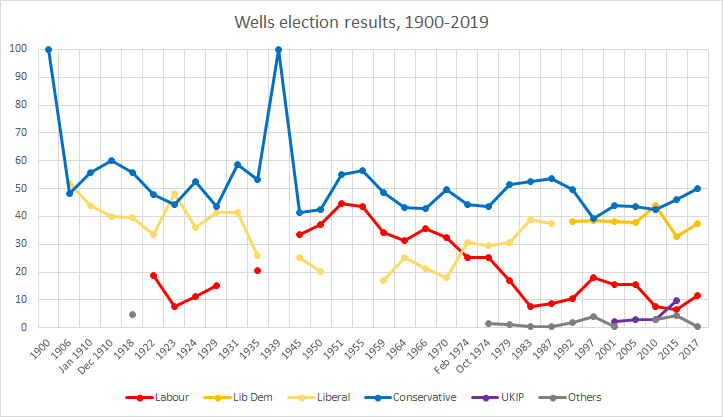
Glastonbury and Somerton Bridgwater Wells was a constituency in Somerset in the House of Commons of the UK Parliament. Apart from between 2010–2015, Wells was represented by members of the Conservative Party since 1924.
Further to the completion of the 2023 Periodic Review of Westminster constituencies, the seat was abolished, with most of it being transferred to the new constituency of Wells and Mendip Hills, to be first contested at the 2024 general election.
History
The original two-member borough constituency was created in 1295, and abolished by the Reform Act 1867 with effect from the 1868 general election. Its revival saw a more comparable size of electorate across the country and across Somerset, with a large swathe of the county covered by this new seat, under the plans of the third Reform Act and the connected Redistribution of Seats Act 1885 which was enacted the following year.
;Political history The seat was largely Conservative-held during the 20th century and has never elected a Labour MP. The only other political party to have been represented is the Liberal Democrats or their predecessor, the Liberal Party, who achieved a marginal victory in 2010, see marginal seat.
;Prominent frontbenchers Sir William Hayter was chief government whip of the Commons under three Liberal Prime Ministers governing from the Lords, (Lord John) Russell, Aberdeen and Palmerston.
So too in this role was Lord Hylton from 1916 to 1922 alongside the Lord Colebrooke in the Conservative-Liberal National coalition.
Robert Sanders was Deputy Chief Whip in the House of Commons, 1918–1919, and Minister of Agriculture and Fisheries, 1922–1924.
Robert Boscawen was a government whip (1988–1989).
David Heathcoat-Amory was Minister for Europe (1993–1994) and later a Shadow Cabinet member (1997–2001).
Boundaries
1885–1918: The Borough of Wells, and the Sessional Divisions of Axbridge and Wells (except the parish of Binegar).
1918–1950: The Boroughs of Glastonbury and Wells, the Urban Districts of Shepton Mallet and Street, the Rural Districts of Shepton Mallet, Wells, and Wincanton, and in the Rural District of Frome the parishes of Cloford, Marston Bigot, Nunney, Wanstrow, Whatley, and Witharn Friary.
1950–1983: The Boroughs of Glastonbury and Wells, the Urban Districts of Frome, Shepton Mallet, and Street, and the Rural Districts of Frome, Shepton Mallet, Wells, and Wincanton.
1983–2010: The District of Mendip wards of Ashwick, Avalon, Chilcompton and Ston Easton, Ebbor, Glastonbury St Benedict's, Glastonbury St Edmund's, Glastonbury St John's, Glastonbury St Mary's, Moor, Nedge, Pylcombe, Rodney, Sheppey, Shepton Mallet, Street North, Street South, Wells Central, Wells St Cuthbert's, and Wells St Thomas, and the District of Sedgemoor wards of Axbridge, Axe Vale, Berrow, Brent, Burnham North, Burnham South, Cheddar, Highbridge, Mark, Shipham, and Wedmore.
2010–2024: The District of Mendip wards of Ashwick and Ston Easton, Avalon, Chilcompton, Glastonbury St Benedict's, Glastonbury St Edmund's, Glastonbury St John's, Glastonbury St Mary's, Knowle, Moor, Nedge, Pylcombe, Rodney and Priddy, St Cuthbert Out North and West, Shepton East, Shepton West, Street North, Street South, Street West, Wells Central, Wells St Cuthbert's, and Wells St Thomas, and the District of Sedgemoor wards of Axbridge, Axe Vale, Berrow, Brent North, Burnham North, Burnham South, Cheddar and Shipham, Highbridge, Knoll, and Wedmore and Mark.
Constituency profile
Aside from energy, transportation, retail, and distribution which are major sectors, agriculture and tourism are still important areas to this central and quite quintessential part of Somerset which includes the coastal resort of Burnham-on-Sea, the city of Wells with its cathedral, and notable natural landmarks such as the Cheddar Gorge and Glastonbury Tor. The site of the Glastonbury Festival also lies within this seat, causing a major influx of visitors in late June. The founder of the festival, Michael Eavis, stood as the Labour candidate for the 1997 election, receiving 10,204 votes, the highest for Labour since 1974.
Workless claimants who were registered jobseekers were in November 2012 significantly lower than the national average of 3.8%, at 2.1% of the population based on a statistical compilation by The Guardian.
Members of Parliament
MPs 1295–1640
| Parliament | First member | Second member | |||
|---|---|---|---|---|---|
| 1386 | Nicholas Cristesham | url = http://www.historyofparliamentonline.org/volume/1386-1421/constituencies/wells | title = Wells 1386–1421 | publisher=History of Parliament Trust | access-date= 2 November 2011}} |
| February 1388 | Richard Ferrour | Nicholas Cristesham | |||
| September 1388 | John Blithe | Thomas Hore | |||
| January 1390 | Nicholas More | Thomas Tanner | |||
| November 1390 | |||||
| 1391 | John Newmaster | Roger Chapman | |||
| 1393 | John Newmaster | John Blithe | |||
| 1394 | John Newmaster | Thomas Hore | |||
| 1395 | Nicholas Cristesham | John Comelond | |||
| January 1397 | Nicholas More | Thomas Wynchester | |||
| September 1397 | Roger Chapman | William Greynton | |||
| 1399 | Thomas Tanner | John Blithe | |||
| 1401 | |||||
| 1402 | John Wycombe | Roger Chapman | |||
| January 1404 | Roger Chapman | Richard Groos | |||
| October 1404 | Walter Dyer | John Bowyer | |||
| 1406 | Thomas Wey | Thomas Jay | |||
| 1407 | Walter Duddesdon | John Newmaster | |||
| 1410 | John Russell | Luke Wilton | |||
| 1411 | |||||
| February 1413 | John Horewode I | John Podmore | |||
| May 1413 | John Horewode I | Luke Wilton | |||
| April 1414 | John Podmore | Thomas Dynt | |||
| November 1414 | John Hynden | Thomas Dynt | |||
| 1415 | |||||
| March 1416 | |||||
| October 1416 | Simon Bailly | John Cutte | |||
| 1417 | Richard Setter | Hildebrand Elwell | |||
| 1419 | Richard Perys | Richard Langford | |||
| 1420 | Richard Setter | Hildebrand Elwell | |||
| May 1421 | Hildebrand Elwell | Richard Perys | |||
| December 1421 | Robert Elwell | John Pedewell | |||
| 1510 | John Welshot | url = http://www.historyofparliamentonline.org/volume/1509-1558/constituencies/wells | title = Wells 1509–1558 | publisher=History of Parliament Trust | access-date= 2 November 2011}} |
| 1512 | Walter Sarger | Richard alias Robert Ruynon | |||
| 1515 | Walter Sarger | Richard alias Robert Ruynon | |||
| 1523 | Walter Sarger | John Mawdley I | |||
| 1529 | John Cutte | John Mawdley II | |||
| 1536 | ? | ||||
| 1539 | John Mawdley II | John Godwin | |||
| 1542 | John Godwin | James Dyer | |||
| 1545 | John Mawdley II | Anthony Gilbert | |||
| 1547 | Thomas Clerke | John Aylworth | |||
| First Parliament of 1553 | John Aylworth | William Godwin | |||
| Second Parliament of 1553 | Thomas Lewis | John Godwin | |||
| Parliament of 1554 | John Mawdley II | ||||
| Parliament of 1554–1555 | William Gedney or Godwin | ||||
| Parliament of 1555 | Maurice Llewellyn | ||||
| Parliament of 1558 | John Aylworth died during the 1572 Parliament | ||||
| In his place Ayshton Aylworth | John Mawdley II | ||||
| Parliament of 1559 | |||||
| Parliament of 1563–1567 | John Hippisley | ||||
| Parliament of 1571 | Henry Newton | ||||
| Parliament of 1572–1581 | William Bowerman | ||||
| Parliament of 1584–1585 | James Bisse | George Upton | |||
| Parliament of 1586–1587 | Thomas Godwyn | William Smith | |||
| Parliament of 1588–1589 | Thomas Purfrey | John Ayshe | |||
| Parliament of 1593 | Richard Goodwin | James Goodwin | |||
| Parliament of 1597–1598 | Leonard Crosse | William Watkins | |||
| Parliament of 1601 | James Kirton | George Upton | |||
| Parliament of 1604–1611 | Sir Robert Stapleton (Edward Forsett) | ||||
| Addled Parliament (1614) | Sidney Montagu | Thomas Southworth | |||
| Parliament of 1621–1622 | Sir Edward Rodney | ||||
| Happy Parliament (1624–1625) | |||||
| Useless Parliament (1625) | Sir Thomas Lake | ||||
| Parliament of 1625–1626 | |||||
| Parliament of 1628–1629 | Sir Ralph Hopton | John Baber | |||
| No Parliament summoned 1629–1640 |
MPs 1640–1832
| Election | First member | First party | Second member | Second party | ||
|---|---|---|---|---|---|---|
| April 1640 | Cavalier}}" | Sir Edward Rodney | Royalist | |||
| November 1640 | Cavalier}}" | Sir Ralph Hopton | Royalist | |||
| August 1642 | Rodney and Hopton disabled from sitting – both seats vacant | |||||
| 1645 | Lislebone Long | Recruiter | ||||
| December 1648 | Walker excluded in Pride's Purge – seat vacant | |||||
| 1653 | Wells was unrepresented in the Barebones Parliament | |||||
| 1654 | Lislebone Long | *Wells had only one seat in the First and | ||||
| Second Parliaments of the Protectorate* | ||||||
| 1656 | John Jenkyn | |||||
| January 1659 | Sir Lislebone Long | |||||
| May 1659 | Not represented in the restored Rump | |||||
| April 1660 | Henry Bull | |||||
| 1661 | Sir Maurice Berkeley | |||||
| 1673 | John Hall | |||||
| 1679 | Edward Berkeley | |||||
| 1680 | John Hall | |||||
| 1685 | Edward Berkeley | |||||
| January 1690 | William Coward | |||||
| February 1690 | Hopton Wyndham | |||||
| 1695 | William Coward | |||||
| 1701 | Henry Seymour Portman | |||||
| 1705 | Maurice Berkeley | |||||
| 1708 | Edward Colston | |||||
| 1710 | Maurice Berkeley | |||||
| 1713 | Tories (British political party)}}" | Sir Thomas Wroth | Tory | |||
| 1715 | Tories (British political party)}}" | Thomas Strangways Horner | Tory | |||
| May 1716 | William Coward | Whigs (British political party)}}" | ||||
| June 1716 | Tories (British political party)}}" | Thomas Strangways Horner | Tory | |||
| 1717 | Whigs (British political party)}}" | John Dodd | Whig | |||
| 1719 | Thomas Edwards | |||||
| 1722 | Francis Gwyn | |||||
| 1727 | Edward Prideaux Gwyn | |||||
| 1729 | William Piers | |||||
| 1734 | George Hamilton | |||||
| 1735 | William Piers | |||||
| 1741 | Francis Gwyn | |||||
| 1747 | George Hamilton | |||||
| 1754 | Lord Digby | |||||
| 1757 | Captain Robert Digby | |||||
| 1761 | Lord Digby | |||||
| 1765 | Peter Taylor | |||||
| 1766 | Robert Child | |||||
| 1782 | John Curtis | |||||
| 1784 | William Beckford | |||||
| 1790 | Henry Berkeley Portman | |||||
| 1796 | Whigs (British political party)}}" | Sir Charles Taylor | Whig | |||
| 1815 | Tories (British political party)}}" | John Paine Tudway | Tory | |||
| 1830 | Tories (British political party)}}" | John Edwards-Vaughan | Tory | Whigs (British political party)}}" |
MPs 1832–1868
| Election | First member | First party | Second member | Second party | ||
|---|---|---|---|---|---|---|
| 1832 | Whigs (British political party)}}" | Norman Lamont | Whig | Whigs (British political party)}}" | ||
| 1834 by-election | Whigs (British political party)}}" | Nicholas Ridley-Colborne | Whig | |||
| 1837 | Conservative Party (UK)}}" | Richard Blakemore | Conservative | Whigs (British political party)}}" | ||
| 1852 | Conservative Party (UK)}}" | Robert Tudway | Conservative | |||
| 1855 by-election | Conservative Party (UK)}}" | Hedworth Jolliffe | Conservative | |||
| 1859 | Liberal Party (UK)}}" | Liberal | ||||
| 1865 | Liberal Party (UK)}}" | Arthur Hayter | Liberal | |||
| 1868 | borough constituency abolished |
MPs 1885–2024
| Election | Member | Party | |
|---|---|---|---|
| Conservative Party (UK)}}" | 1885 | Sir Richard Paget, Bt. | |
| Conservative Party (UK)}}" | 1895 | Hylton Jolliffe | |
| Conservative Party (UK)}}" | 1899 by-election | Robert Edmund Dickinson | |
| Liberal Party (UK)}}" | 1906 | Thomas Ball Silcock | |
| Conservative Party (UK)}}" | January 1910 | George Sandys | |
| Coalition Conservative}}" | 1918 | Harry Greer | |
| Conservative Party (UK)}}" | 1922 | Robert Bruford | |
| Liberal Party (UK)}}" | 1923 | Arthur Hobhouse | |
| Conservative Party (UK)}}" | 1924 | Sir Robert Sanders, Bt. | |
| Conservative Party (UK)}}" | 1929 | Anthony Muirhead | |
| Conservative Party (UK)}}" | 1939 | Lt. Col. Dennis Boles | |
| Conservative Party (UK)}}" | 1951 | Lynch Maydon | |
| Conservative Party (UK)}}" | 1970 | Robert Boscawen | |
| Conservative Party (UK)}}" | 1983 | David Heathcoat-Amory | |
| Liberal Democrats (UK)}}" | 2010 | Tessa Munt | |
| Conservative Party (UK)}}" | 2015 | James Heappey | |
| 2024 | constituency abolished: see Wells and Mendip Hills |
Elections
Elections in the 2010s
| title=General election 2010: Wells{{cite web
Elections in the 2000s
Elections in the 1990s
url=http://www.politicsresources.net/area/uk/ge92/ge92index.htm|title=Politics Resources|date=9 April 1992|work=Election 1992|publisher=Politics Resources|access-date=6 December 2010}}
Elections in the 1980s
Elections in the 1970s
Elections in the 1960s
Elections in the 1950s
Election in the 1940s
Elections in the 1930s
General Election 1939–40: Another general election was required to take place before the end of 1940. The political parties had been making preparations for an election to take place and by the Autumn of 1939, the following candidates had been selected;
- Conservative: Anthony Muirhead
- Liberal: James A Brown
- Labour:
Elections in the 1920s

Election results 1885–1918
Elections in the 1880s
|reg. electors = 9,501
Elections in the 1890s
|reg. electors = 10,230 |reg. electors = 10,771
Joliffe's elevation to the peerage, becoming Lord Hylton, caused a by-election.
Elections in the 1900s

|reg. electors = 11,725
Elections in the 1910s
|reg. electors = 12,642 |reg. electors = 12,642

General Election 1914–15:
Another General Election was required to take place before the end of 1915. The political parties had been making preparations for an election to take place and by July 1914, the following candidates had been selected;
- Unionist: George Sandys
- Liberal: Charles Conybeare |reg. electors = 26,951
Election results 1832–1868
Elections in the 1830s
|reg. electors = 338
- Edwards-Vaughan resigned on the first day of polling
Lamont's death caused a by-election.
|reg. electors = 377
|reg. electors = 402
Elections in the 1840s
|reg. electors = 346
|reg. electors = 375
Hayter was appointed Judge Advocate General of the Armed Forces, requiring a by-election.
Elections in the 1850s
|reg. electors = 325
Tudway's death caused a by-election.
|reg. electors = 380
|reg. electors = 343
|reg. electors = 327
Elections in the 1860s
|reg. electors = 274
Elections before 1832
Elections in the 1830s
|reg. electors =
|reg. electors =
Notes
References
Sources
- D Brunton & D H Pennington, Members of the Long Parliament (London: George Allen & Unwin, 1954)
- Cobbett's Parliamentary history of England, from the Norman Conquest in 1066 to the year 1803 (London: Thomas Hansard, 1808) titles A-Z
- Henry Stooks Smith, The Parliaments of England from 1715 to 1847, Volume 2 (London: Simpkin, Marshall & Co, 1845) The Parliaments of England: From 1st George I., to the Present Time
References
- (4 March 2011). "Electorate Figures – Boundary Commission for England". Boundary Commission for England.
- "The 2023 Review of Parliamentary Constituency Boundaries in England – Volume one: Report – South West {{!}} Boundary Commission for England".
- [https://www.theguardian.com/news/datablog/2010/nov/17/unemployment-and-employment-statistics-economics Unemployment claimants by constituency] ''[[The Guardian]]''
- "Wells 1386–1421". History of Parliament Trust.
- "Wells 1509–1558". History of Parliament Trust.
- "''Forsett, Edward (c.1554–1630), of Marylebone, Mdx. and Charing Cross House, Westminster''". History of Parliament Online.
- Cassidy, Irene. "Wells 1660–1690". The History of Parliament Trust.
- (1845). "The Parliaments of England, from 1st George I., to the Present Time. Vol II: Oxfordshire to Wales Inclusive". Simpkin, Marshall, & Co..
- (1838). "The Parliamentary Guide: a concise history of the Members of both Houses, etc".
- (1837). "The Spectator, Volume 10". F.C. Westley.
- (24 July 1837). "Bell's Weekly Messenger".
- "Results of the UK Parliamentary General Election – Wells Constituency".
- (June 2021)
- "Wells". BBC.
- "Election Data 2015". [[Electoral Calculus]].
- "Wells". BBC.
- (5 March 2015). "Highbridge singer Gypsy Watkins to stand as MP candidate in May". Weekly News.
- "Election Data 2010". [[Electoral Calculus]].
- "BBC NEWS – Election 2010 – Wells". BBC News.
- "Election Data 2005". [[Electoral Calculus]].
- "Election Data 2001". [[Electoral Calculus]].
- "Election Data 1997". [[Electoral Calculus]].
- "Election Data 1992". [[Electoral Calculus]].
- "Election Data 1987". [[Electoral Calculus]].
- "Election Data 1983". [[Electoral Calculus]].
- The Liberal Magazine, 1939
- The Liberal Year Book, 1907
- Debrett's House of Commons & Judicial Bench, 1886
- (1974). "British Parliamentary Election Results: 1885–1918". Macmillan Press.
- Debrett's House of Commons & Judicial Bench, 1901
- Debrett's House of Commons & Judicial Bench, 1916
- (1 November 1855). "Wells Election". Bath Chronicle and Weekly Gazette.
- (13 November 1855). "Sherborne Mercury".
- (1977). "British Parliamentary Election Results 1832–1885". Macmillan Press.
- "Wells".
This article was imported from Wikipedia and is available under the Creative Commons Attribution-ShareAlike 4.0 License. Content has been adapted to SurfDoc format. Original contributors can be found on the article history page.
Ask Mako anything about Wells (UK Parliament constituency) — get instant answers, deeper analysis, and related topics.
Research with MakoFree with your Surf account
Create a free account to save articles, ask Mako questions, and organize your research.
Sign up freeThis content may have been generated or modified by AI. CloudSurf Software LLC is not responsible for the accuracy, completeness, or reliability of AI-generated content. Always verify important information from primary sources.
Report