From Surf Wiki (app.surf) — the open knowledge base
Wellington Zoo
,_F_T_series_no_1019._Printed_in_Saxony_(1904-1914)_(21481776729).jpg)
| Field | Value |
|---|---|
| logo | Wellington_Zoo_logo.jpg |
| date_opened | 1906 |
| location | 200 Daniell Street, Newtown, Wellington, New Zealand |
| coordinates | |
| area | 13 ha |
| num_animals | 500+ |
| num_species | ≈80 |
| annual_visitors | 261,943 |
| members | ZAA |
| website |
Wellington Zoo () is a 13 ha zoo in the green belt of Wellington, New Zealand.
History


Wellington Zoo was opened in 1906 by the late prime minister Richard Seddon after he was given a young lion – later named King Dick – by the Bostock and Wombwell's Circus. Over time the zoo was expanded and upgraded.
Historically, Wellington Zoo operated under the auspices of the Wellington City Council. However, in June 2003. the zoo became a charitable trust and is now governed by a board of six trustees, with the Wellington City Council as the principal source of funds.
1960s
.jpg)
Wellington Zoo's current group of chimpanzees originate from a male named Tom and two females named Yoka and Sarah. Yoka gave birth to three daughters: Bebe in 1962, Jodie in 1977 and Jessie in 1978 while Sarah gave birth to a son, Sam, in 1977. Bebe then bred with Tom to produce two sons, Boyd in 1978 and Marty in 1987. Wellington Zoo also used to hold chimpanzee tea parties which were phased out during the early 1960s.
On 18 March 1967 a zookeeper failed to properly secure a tiger enclosure leading to the escape of two tigers named Napoleon and Josephine. The tigers were reportedly seen walking the streets in the suburb of Newtown where the zoo is located. The two animals were tracked down overnight and eventually killed after advancing aggressively toward police and a group of circus performers who were attempting to contain Josephine with a net. There was considerable public outrage at the killing of the animals particularly as Josephine had already been shot with two tranquilizer darts. Police justified their actions were necessary to ensure public safety.
1990s
In 1990, Wellington Zoo received its first Sumatran tiger, a two-year-old male named Jambi, from Taronga Zoo. He was joined in 1992 by a two-year-old female, Toba, from Rotterdam Zoo. Toba died in 1993 and was replaced by a two-year-old female, Cantic, from Arnhem Zoo in 1994. Cantic gave birth to a litter of three cubs in 1996. The male, Rokan, remained at the zoo, while the females, Nisha and Malu, were sent to Auckland Zoo in 1998.
In 1992, three female chimpanzees were brought from Taronga Zoo, 11-year-old Cara, 9-year-old Samantha and 7-year-old Sally. Jodie gave birth to a son, Gombe, in 1993. In 1994, Cara gave birth to a daughter Chima, while Samantha gave birth to a son, Temba. In 1996, Sally gave birth to a son, Mahinga. In 1998, Samantha gave birth to a daughter Keza, while Cara gave birth to a son, Alexis.
In 1992, two Malayan sun bears were brought from San Diego Zoo. They were originally named Stanley and Spot but were renamed Bakti and Chomel. In May 1997, Chomel gave birth to twins which died at birth. She gave birth again in December 1997 but the cub shortly died after birth. Chomel gave birth again to male twins in April 1999. The cubs were named Arataki and Madu.
In 1998, giraffes Ricki and Tisa, had their first surviving calf, Ndoki. The male calf was sent to Hamilton Zoo the following year.
2000s
In January 2000, a Sumatran tigress named Cantic gave birth to her second litter. The three cubs were named Jaka, Molek and Mencari and were sent to Hamilton Zoo in January 2001. In October 2001, Jambi died after eating contaminated meat. Cantic also ate the meat but recovered. His death left Wellington Zoo without a breeding male.
In January 2000, a chimpanzee, Sally, gave birth to a son named Bahati. In 2002, a chimpanzee, Josie, died of cancer, followed by the death of her elder sister Bebe in 2003. In 2003, Cara gave birth to a son, Hasani, who died at three months of age. Sally gave birth to an unnamed son in 2005 who was euthanized after Sally rejected him. That same year, Sally's two sons, nine-year-old Mahinga, and five-year-old Bahati died following illnesses. Bahati had developed pneumonia and, for a time before his death, was also looked after by the adult Intensive Care doctors from nearby Wellington Hospital. In 2007, Sally gave birth to a son, Beni. In 2009, Boyd and Gombe left for Monarto Zoo in Australia.
In May 2001, arrangements were made for the Malayan sun bear Madu to be sent to the National Zoo in Australia, however, he died following surgery on a broken tooth. An autopsy revealed he had a hole in his heart. His twin, Arataki, was sent instead. Bakti died in August 2001, leaving the zoo without a breeding male. In September 2004, a seven-year-old male named Sean was brought from Perth Zoo. He had been rescued as a cub from outside a restaurant in Cambodia by the Free the Bears Foundation. Chomel gave birth to a female cub in September 2006, named Sasa. At that time, Wellington Zoo was the only zoo in Australasia to successfully breed a sun bear. Chomel died in September 2009, following a stroke.
In September 2001, giraffe Tisa gave birth to her second surviving offspring, a female named Rukiya. She was transferred to Auckland Zoo in September 2002 and has had several calves there. In March 2004, Tisa gave birth to her seventh calf, and third surviving calf, a female named Zahara. She has remained at Wellington Zoo. In November 2007, the zoo's breeding male, 20-year-old Ricky, died. A new male, Seun, arrived in April 2008, from Orana Wildlife Park, where he was born in late 2006.
2010s
In October 2010, chimpanzee Samantha gave birth to a daughter, Malika. Sally gave birth to a son, Bakari, in 2012.


In March 2012, giraffe Zahara went into labour with her first calf. The labour did not progress and a caesarean was needed to remove the female calf, which was already dead. Zahara recovered well and is thought to breed again in the future, despite the death of a breeding male, Seun, in September 2012. The zoo, now left with Tisa and Zahara, is currently looking to import a new male giraffe or use artificial insemination on the younger female, Zahara.
In September 2012, Wellington Zoo opened a new enclosure for their Malayan sun bears, Sean and Sasa. The zoo is currently awaiting the arrival of a new male sun bear for breeding with Sasa. She is currently on a contraceptive implant to prevent breeding with her father, Sean. Sean died in December 2018 aged 22, however Sasa his daughter remains a well-loved resident at the zoo.
In August 2013, 21-year-old Sumatran tiger Cantic died. She was one of the oldest tigers in captivity. In June 2014, a 3-year-old Sumatran tigress, Senja, was brought from Mogo Zoo. She is the second cousin of Rokan so a new male will be imported later in the year.
In September 2014, Wellington Zoo opened its newest exhibit, Grassland Cats, home to the zoo's servals and newly arrived caracals, the first ones in the country for a long time (no longer held by the zoo).
In February 2019, the zoo decided to euthanize all of their four baboons, after a breakdown in their social structure which meant they were injuring themselves by fighting and were suffering from anxiety.
2020s
Tahi the one-legged brown kiwi, famous for 15 years at the zoo, died in June 2021.
On 12 April 2023, Wellington Zoo welcomed snow leopard sisters Asha and Manju from Melbourne Zoo. The custom-built habitat cost $6 million NZD and took 18 months to build.
In November 2023 a giraffe was born in Wellington Zoo for the first time in 20 years. Her name is Nia.
The zoo's name was officially changed to 'Te Nukuao Tūroa o Te Whanganui a Tara Wellington Zoo Trust' on 27 March 2024. This new name can be shortened to Te Nukuao Wellington Zoo or Wellington Zoo. The change was made to reflect a continuing commitment towards 'becoming bi-cultural.'
Amphibians
- Aquatic :Axolotls :Southern bell frogs
Birds
- Aquatic :Brolgas :Cape Barren geese :Little black cormorants :Little penguins :Pericanas
- Parrots :Kākā :Keas :Red-fronted macaws :Red-tailed black cockatoos :Sulphur crested cockatoos :Sun conures
- Pigeons :Crested pigeons :Emerald doves :Kererū
- Predatory :Moreporks :Tawny frog mouths
- Terrestrial :Bantams :Brown kiwis :Buff-banded rails :Chickens :Emus :Helmeted guinea fowls :Himalayan monals :Ostriches
Fish
:Inangas
Insects
:Goliath stick insects :Honey bees :New Zealand praying mantises :Wellington tree wētās
Mammals
- Carnivores :Asian small-clawed otters :Dingos :Lions :Snow leopards :Sumatran tigers :Tasmanian devils
- Herbivores :Black-and-white ruffed lemurs :Brazilian agoutis :Capybara :Eastern grey kangaroos :Giraffes :Kunekunes :Nyalas :Sheep :Swamp wallabies :Tammar wallabies
- Omnivores :Black-handed spider monkeys :Brown capuchins :Chimpanzees :Cotton-top tamarins :Golden lion tamarins :Malayan sun bear :Meerkats :Northern white-cheeked gibbons :Pygmy marmosets :Red pandas :Ring-tailed lemurs :Variegated spider monkey
Reptiles
- Aquatic
:Australian water dragons :Red-eared slider :
- Terrestrial
:Auckland green geckos :Chatham Islands skinks :Coastal bearded dragons :Common blue-tongued skinks :Common geckos :Cunningham's spiny-tailed skinks :Duvaucel's geckos :Forest geckos
: : :Grand skinks :Green iguanas :Inland bearded dragons :Lace monitor :Madagascan giant day geckos :Otago skinks :Sheltopusiks :Shingleback skinks :Tuataras
Spiders
:Chilean rose tarantulas :Costa-rican zebra tarantulas :Goliath birdeater spiders :King baboon spiders :Mexican redknee tarantulas :Peruvian pinktoe tarantulas
Conservation and sustainability
Wellington Zoo is committed to the welfare of animals and wildlife both within the zoo and around the world. As well as caring for their animals, Wellington Zoo participates in breeding programs both locally and internationally, and contributes to conservation and research programs both within the zoo, around the country and even overseas.
It works cooperatively with other zoos around the world through studbook keepers, who are responsible for maintaining relevant data on a particular species within a programme to ensure genetic diversity. Wellington Zoo is a full institutional member of the Zoo and Aquarium Association (ZAA).
In addition to breeding programmes, the zoo is also involved in several community conservation projects. The Kererū Discovery Project is a cooperative effort with Zealandia: Karori Wildlife Sanctuary, Te Papa and Pukaha (Mount Bruce). This project aims to make Wellington a better place for kererū, the native wood pigeon. Places for Penguins is a cooperative effort with the Royal Forest and Bird Protection Society of New Zealand to identify and protect nesting areas used by blue penguins around Wellington coastal areas. The zoo has also embarked on the Whitaker's Skink Recovery Programme, an initiative dedicated to breeding and managing Whitaker's skinks. The skinks are considered locally extinct in the Wellington region and the zoo currently cares for 1/6th of the entire surviving population.
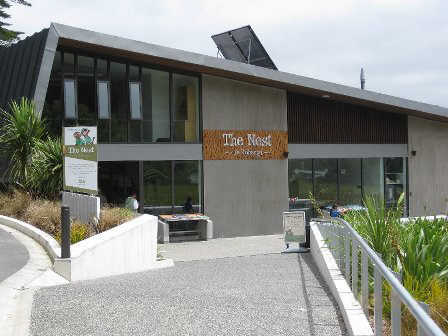
Te Kohanga The Nest is an animal hospital dedicated to assisting injured wildlife. The hospital contains a salt-water pool designed for rehabilitating injured seabirds. Te Kohanga The Nest opened on 9 December 2009, and has since treated over 5,000 native animals. Patients are brought to the hospital by members of the SPCA, the Department of Conservation, Zealandia, and local members of the community.
Interaction
A variety of talks and demonstrations are held on a day-to-day basis.
The Nest – Te Kōhanga animal hospital allows the public to watch the wildlife vets at work, narrating as they handle check-ups and surgeries and answering questions through an incorporated intercom system. More will be unfolding over the next few years, including the Asia Precinct and The Roost native bird care and breeding facility.
Meet the Locals He Tuku Aroa opened in 2015 as a collaboration between landscape architects Isthmus Group and the Zoo. It took six years of planning and 18 months to build, and takes a fifth of the Zoo's footprint. It is a series of zones simulating a journey from the sea to the mountains with stops along the way at farmland and native forest and is dedicated to local fauna and conservation. The area includes Pōhutukawa Farm, where traditional farming may be observed.
Gallery
Wellington Zoo Elephant House.JPG|Historical Elephant House Otters_wiki.jpg|Two of the zoo's otters GiraffeFeeding_wiki.jpg|Giraffe Wellington Zoo Giraffe6.JPG|Giraffes Chimps_wiki.JPG|The zoo's chimpanzee troop Panda roux aux aguets..jpg|Red panda BeardedDragon.jpg|An inland bearded dragon being held by visitor during a reptile contact encounter JakeCockatoo.jpg|Jake the (female) cockatoo, lives at the zoo's reception office WildTheatre.jpg|The Wild Theatre Rokio_wiki.jpg|One of zoo's Sumatran tigers Merkatska nastamba u Wellingtonu.jpg|Meerkats Zoološki vrt u novozelandskome glavnom gradu Wellingtonu.jpg|Nyalas and ostriches
Incidents
2006 Lion mauling
In 2006 zookeeper Bob Bennett was mauled by two lions, Malaik and Zulu, when an unlocked gate allowed them entry into the area where he was laying out their food. He was rescued by zookeepers with relatively minor injuries. The incident was also featured in an episode of Untamed and Uncut.
2018 Squirrel monkey break-in
On 7 April 2018, A man broke into the zoo overnight with the intent to steal a squirrel monkey for his girlfriend. He entered the zoo through an unsecured gate, and used bolt-cutters to break through two padlocks to enter the enclosure. Several monkeys suffered injuries from the break-in; one had haematoma on its elbow and many others had scratch marks from fighting back. All of the monkeys were distressed following the break-in, and one continued suffering from stress months afterward. The man suffered from a broken leg, two fractured teeth, a sprained ankle, and multiple bruises from the incident.
The attempt to steal a monkey failed, and no monkeys escaped; two were found in the neighbouring golden lion tamarin enclosure, and one female, initially feared to be stolen, was found injured and still frightened hiding in the enclosure.
References
References
- "Annual Report 2023". Wellington Zoo.
- Vivian, Melanie Vivian. (2008). "Operant Methodology Out of the Lab and Applied to Enrichment with Captive Chimpanzees (Pan Troglodytes)".
- (20 March 1967). "Shots End Dramatic Hunt – Tigers prowl streets". [[The Dominion (Wellington).
- Hunt, Tom. (16 March 2013). "Flashback: Surreal tiger hunt in streets of Newtown". [[The Dominion Post (Wellington).
- (7 July 2009). "New tigeress planned at Wellington Zoo [Wellington Zoo]".
- (May 1999). "International Zoo News Vol. 46/3 (No. 292)".
- "Wellington Zoo news".
- (12 July 2008). "Hamilton Zoo – Hamilton Zoo".
- Hamilton City Council. (7 January 2010). "Hamilton Zoo tiger siblings to celebrate their 10th birthday – infonews.co.nz New Zealand's local news community".
- (5 November 2001). "Tiger death still a mystery".
- (April 2008). "Intensive care in an unusual setting: Management of pneumonia in a chimpanzee". Journal of the Australasian Academy of Critical Care Medicine.
- (30 October 2008). "DNA Test Confirms Sammy's the Man".
- (13 June 2011). "Wellington Zoo Staff Head to Free the Bears".
- (2007). "Wellington Zoo Trust {{!}} 2006-07 Annual Report".
- [[Wellington City Council]]. (1 October 2009). "Wellington Zoo: Chomel the sun-bear dies after stroke".
- (12 December 2006). "Viable/non viable species".
- (17 November 2007). "Wellington Zoo – giraffe death".
- (10 April 2008). "Orana Wildlife Park's young male giraffe, Seun, departs for Wellington Zoo this evening".
- "Chimpanzees".
- Wellington Zoo. (8 August 2014). "Our youngest chimp Bakari had his eye on the prize at lunch time. Luckily his mum Sally doesn't mind sharing!".
- Jackman, Amy. (16 August 2012). "Zoo's history-making surgery".
- (13 September 2012). "Wellington Zoo giraffe dies after operation". [[The New Zealand Herald]].
- McBride, Kerry. (23 September 2012). "New homes for tigers and sun bears".
- McBride, Kerry. (2 September 2011). "Sun bear breeding program advances".
- (28 August 2013). "Wellington Zoo Devastated by Passing of Sumatran Tiger Cantik".
- (19 June 2014). "Female Sumatran Tiger Arrives at Wellington Zoo".
- (18 September 2014). "Small Cats with Big Ears Arrive at Wellington Zoo".
- Townshend, Katie. (23 February 2019). "Wellington Zoo euthanises four male baboons".
- "Wellington Zoo's last resident kiwi, one-legged Tahi, dies – the third kiwi death in just a few months".
- (12 April 2023). "Snow Leopard sisters touch down at Wellington Zoo".
- "Giraffe born at Wellington Zoo for first time in nearly 20 years".
- (9 February 2024). "Friday Five: Fun facts about Wellington Zoo's newest giraffe". [[Wellington City Council]].
- "FTe Reo Māori name for Te Nukuao Wellington Zoo".
- "Find ZAA-Accredited Zoos and Aquariums".
- "Welcome to Kererū Discovery Project - Partners".
- "Kererū Discovery - Home".
- "Te Nukuao Wellington Zoo Commits to Whitaker's Skink Recovery Programme".
- "Saving wildlife in The Nest Te Kōhanga".
- "Meet the Locals".
- "Isthmus group".
- "Meet the locals".
- (14 December 2015). "Resene red is a zoo centrepiece".
- (11 January 2006). "Wellington Zoo investigates lion mauling".
- Williams, Katarina. (9 April 2018). "Monkeys recovering well after attempted theft at Wellington Zoo".
- Nightingale, Melissa. (7 April 2018). "Man tried to steal monkey for girlfriend".
- (9 April 2018). "Wellington Zoo break-in suggests theft motive".
- Bedo, Stephanie. (15 June 2025). "Wellington monkey thief 'did it for love'".
- "ZAA Accreditation".
This article was imported from Wikipedia and is available under the Creative Commons Attribution-ShareAlike 4.0 License. Content has been adapted to SurfDoc format. Original contributors can be found on the article history page.
Ask Mako anything about Wellington Zoo — get instant answers, deeper analysis, and related topics.
Research with MakoFree with your Surf account
Create a free account to save articles, ask Mako questions, and organize your research.
Sign up freeThis content may have been generated or modified by AI. CloudSurf Software LLC is not responsible for the accuracy, completeness, or reliability of AI-generated content. Always verify important information from primary sources.
Report