From Surf Wiki (app.surf) — the open knowledge base
Well poisoning
Malicious manipulation of potable water resources
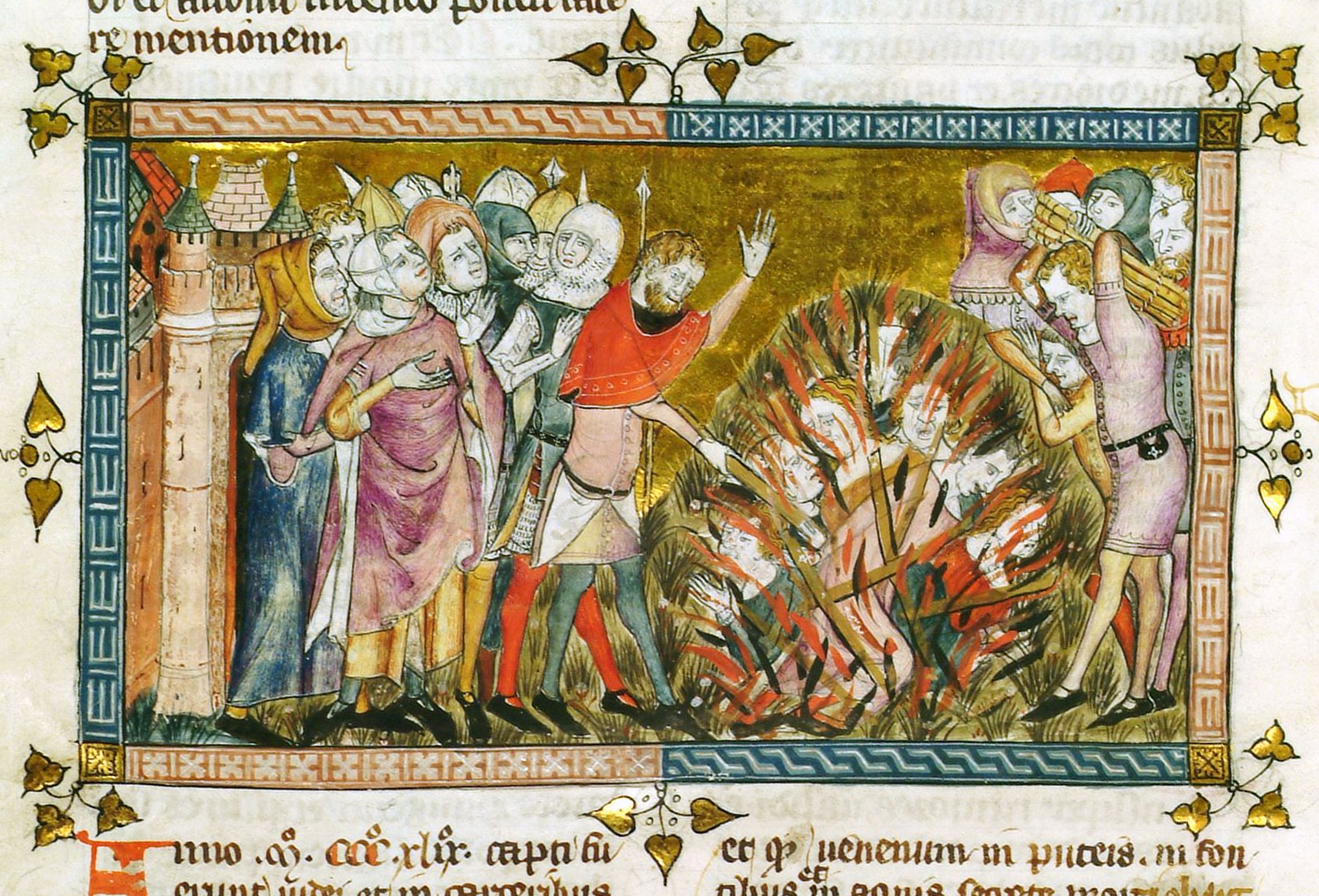
Malicious manipulation of potable water resources
Well poisoning is the act of malicious manipulation of potable water resources in order to cause illness or death, or to deny an opponent access to fresh water resources.
Well poisoning has been historically documented as a strategy during wartime since antiquity, and was used both offensively (as a terror tactic to disrupt and depopulate a target area) and defensively (as a scorched earth tactic to deny an invading army sources of clean water). Rotting corpses (both animal and human) thrown down wells were the most common implementation; in one of the earliest examples of biological warfare, corpses known to have died from common transmissible diseases of the Pre-Modern era such as bubonic plague or tuberculosis were especially favored for well-poisoning.
History of implementation
Instances of medieval usage
Well poisoning has been used as an important scorched earth tactic at least since medieval times. In 1462, for example, Prince Vlad III the Impaler of Wallachia utilized this method to delay his pursuing adversaries. Nearly 500 years later during the Winter War, the Finns rendered wells unusable by putting animal carcasses or feces in them in order to passively combat invading Soviet forces.
Instances of modern usage
During the 20th century, the practice of poisoning wells has lost most of its potency and practicality against an organized force as modern military logistics ensure secure and decontaminated supplies and resources. Nevertheless, German forces during World War I poisoned wells in France as part of Operation Alberich.
After World War II, Nakam, a paramilitary organisation of about fifty Holocaust survivors, sought revenge for the murder of six million Jews during the Holocaust. The group's leader Abba Kovner went to Mandatory Palestine in order to secure large quantities of poison for poisoning water mains to kill large numbers of Germans. His followers infiltrated the water system of Nuremberg. However, Kovner was arrested upon arrival in the British zone of occupied Germany and had to throw the poison overboard.
Israel poisoned the wells and water supplies of certain Palestinian towns and villages as part of their biological warfare program during the 1948 Palestine war, including an operation that caused a typhoid epidemic in Acre in early May 1948, and an unsuccessful attempt in Gaza that was foiled by the Egyptians in late May.; ; ; ; ; ; ; ; ; ;
In the late 20th century, accusations of well-poisoning were brought up, most notoriously in relation to the Kosovo War. In the 21st century, Israeli settlers have been condemned due to suspicions of poisoning wells of villages in the occupied Palestine.
As an antisemitic trope
Medieval accusations against Jews

Despite some vague understanding of how diseases could spread, the existence of viruses and bacteria was unknown in medieval times, and the outbreak of disease could not be scientifically explained. Any sudden deterioration of health was often blamed on poisoning. Europe was hit by several waves of the Black Death throughout the late Middle Ages. Crowded cities were especially hard hit by the disease, with death tolls as high as 50% of the population. In their distress, emotionally distraught survivors searched desperately for an explanation. The city-dwelling Jews of the Middle Ages, living in walled-up, segregated ghetto districts, aroused suspicion. An outbreak of plague thus became the trigger for Black Death persecutions, with hundreds of Jews burned at the stake, or rounded up in synagogues and private houses that were then set aflame.
Walter Laqueur writes in his book The Changing Face of Anti-Semitism: From Ancient Times to the Present Day:
There were no mass attacks against "Jewish poisoners" after the period of the Black Death, but the accusation became part and parcel of antisemitic dogma and language. It appeared again in early 1953 in the form of the "doctors' plot" in Stalin's last days, when hundreds of Jewish physicians in the Soviet Union were arrested and some of them killed on the charge of having caused the death of prominent Communist leaders... Similar charges were made in the 1980s and 1990s in radical Arab nationalist and Muslim fundamentalist propaganda that accused the Jews of spreading AIDS and other infectious diseases.
References
Works cited
References
- Trotter, William R.. (2003). "The Winter War, the Russo-Finnish War of 1939–40". Aurum Press Ltd.
- "The Making of Peace: Rulers, States, and the Aftermath of War". [[Cambridge University Press]].
- (27 March 1998). "Survivor reveals 1945 plan to kill 6 million Germans".
- "050228IT".
- "International Criminal Tribunal for the former Yugoslavia – United Nations International Criminal Tribunal for the former Yugoslavia".
- Rohde, David. "Bosnian Serbs Poisoned Streams To Capture Refugees, Muslims Say".
- (13 July 2004). "Settlers suspected of well attack". [[BBC News]].
- "Settlers suspected of polluting wells".
- Pearce, Fred. (1 March 2006). "Running on empty". [[The Guardian]].
- Barzilay, Tzafrir. ''Poisoned Wells: Accusation, Persecution and Minorities in Medieval Europe, 1321-1422,'' Philadelphia: University of Pennsylvania Press, 2022.
- Laqueur, Walter. (2006). "The Changing Face of Antisemitism: From Ancient Times to the Present Day". [[Oxford University Press]].
This article was imported from Wikipedia and is available under the Creative Commons Attribution-ShareAlike 4.0 License. Content has been adapted to SurfDoc format. Original contributors can be found on the article history page.
Ask Mako anything about Well poisoning — get instant answers, deeper analysis, and related topics.
Research with MakoFree with your Surf account
Create a free account to save articles, ask Mako questions, and organize your research.
Sign up freeThis content may have been generated or modified by AI. CloudSurf Software LLC is not responsible for the accuracy, completeness, or reliability of AI-generated content. Always verify important information from primary sources.
Report