From Surf Wiki (app.surf) — the open knowledge base
Weierstrass elliptic function
Class of mathematical functions
Class of mathematical functions
In mathematics, the Weierstrass elliptic functions are elliptic functions that take a particularly simple form. They are named for Karl Weierstrass. This class of functions is also referred to as ℘-functions and they are usually denoted by the symbol ℘, a uniquely fancy script p. They play an important role in the theory of elliptic functions, i.e., meromorphic functions that are doubly periodic. A ℘-function together with its derivative can be used to parameterize elliptic curves and they generate the field of elliptic functions with respect to a given period lattice.
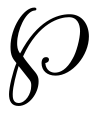
Symbol for Weierstrass \wp-function

Motivation
A cubic of the form C_{g_2,g_3}^\mathbb{C}={(x,y)\in\mathbb{C}^2:y^2=4x^3-g_2x-g_3} , where g_2,g_3\in\mathbb{C} are complex numbers with g_2^3-27g_3^2\neq0, cannot be rationally parameterized. Yet one still wants to find a way to parameterize it.
For the quadric K=\left{(x,y)\in\mathbb{R}^2:x^2+y^2=1\right}; the unit circle, there exists a (non-rational) parameterization using the sine function and its derivative the cosine function: \psi:\mathbb{R}/2\pi\mathbb{Z}\to K, \quad t\mapsto(\sin t,\cos t). Because of the periodicity of the sine and cosine \mathbb{R}/2\pi\mathbb{Z} is chosen to be the domain, so the function is bijective.
In a similar way one can get a parameterization of C_{g_2,g_3}^\mathbb{C} by means of the doubly periodic \wp -function and its derivative, namely via (x,y)=(\wp(z),\wp'(z)). This parameterization has the domain \mathbb{C}/\Lambda , which is topologically equivalent to a torus.
There is another analogy to the trigonometric functions. Consider the integral function a(x)=\int_0^x\frac{dy}{\sqrt{1-y^2}} . It can be simplified by substituting y=\sin t and s=\arcsin x : a(x)=\int_0^s dt = s = \arcsin x . That means a^{-1}(x) = \sin x . So the sine function is an inverse function of an integral function.
Elliptic functions are the inverse functions of elliptic integrals. In particular, let: u(z)=\int_z^\infin\frac{ds}{\sqrt{4s^3-g_2s-g_3}} . Then the extension of u^{-1} to the complex plane equals the \wp -function. This invertibility is used in complex analysis to provide a solution to certain nonlinear differential equations satisfying the Painlevé property, i.e., those equations that admit poles as their only movable singularities.
Definition

Let \omega_1,\omega_2\in\mathbb{C} be two complex numbers that are linearly independent over \mathbb{R} and let \Lambda:=\mathbb{Z}\omega_1+\mathbb{Z}\omega_2:={m\omega_1+n\omega_2: m,n\in\mathbb{Z}} be the period lattice generated by those numbers. Then the \wp-function is defined as follows: :\weierp(z,\omega_1,\omega_2):=\wp(z) = \frac{1}{z^2} + \sum_{\lambda\in\Lambda\setminus{0}}\left(\frac 1 {(z-\lambda)^2} - \frac 1 {\lambda^2}\right). This series converges locally uniformly absolutely in the complex torus \mathbb{C} / \Lambda.
It is common to use 1 and \tau in the upper half-plane \mathbb{H}:={z\in\mathbb{C}:\operatorname{Im}(z) 0} as generators of the lattice. Dividing by \omega_1 maps the lattice \mathbb{Z}\omega_1+\mathbb{Z}\omega_2 isomorphically onto the lattice \mathbb{Z}+\mathbb{Z}\tau with \tau=\tfrac{\omega_2}{\omega_1}. Because -\tau can be substituted for \tau, without loss of generality we can assume \tau\in\mathbb{H}, and then define \wp(z,\tau) := \wp(z, 1,\tau). With that definition, we have \wp(z,\omega_1,\omega_2) = \omega_1^{-2}\wp(z/\omega_1,\omega_2/\omega_1).
Properties
- \wp is a meromorphic function with a pole of order 2 at each period \lambda in \Lambda.
- \wp is a homogeneous function in that: ::\wp(\lambda z , \lambda\omega_{1}, \lambda\omega_{2}) = \lambda^{-2} \wp (z, \omega_{1},\omega_{2}).
- \wp is an even function. That means \wp(z)=\wp(-z) for all z \in \mathbb{C} \setminus \Lambda, which can be seen in the following way: ::\begin{align} \wp(-z) & =\frac{1}{(-z)^2} + \sum_{\lambda\in\Lambda\setminus{0}}\left(\frac{1}{(-z-\lambda)^2}-\frac{1}{\lambda^2}\right) \ & =\frac{1}{z^2}+\sum_{\lambda\in\Lambda\setminus{0}}\left(\frac{1}{(z+\lambda)^2}-\frac{1}{\lambda^2}\right) \ & =\frac{1}{z^2}+\sum_{\lambda\in\Lambda\setminus{0}}\left(\frac{1}{(z-\lambda)^2}-\frac{1}{\lambda^2}\right)=\wp(z). \end{align} :The second last equality holds because {-\lambda:\lambda \in \Lambda}=\Lambda. Since the sum converges absolutely this rearrangement does not change the limit.
- The derivative of \wp is given by: \wp'(z)=-2\sum_{\lambda \in \Lambda}\frac1{(z-\lambda)^3}.
- \wp and \wp' are doubly periodic with the periods \omega_1 and \omega_2. This means: \begin{aligned} \wp(z+\omega_1) &= \wp(z) = \wp(z+\omega_2),\ \textrm{and} \[3mu] \wp'(z+\omega_1) &= \wp'(z) = \wp'(z+\omega_2). \end{aligned} It follows that \wp(z+\lambda)=\wp(z) and \wp'(z+\lambda)=\wp'(z) for all \lambda \in \Lambda.
Laurent expansion
Let r:=\min{{|\lambda}|:0\neq\lambda\in\Lambda}. Then for 0 the \wp-function has the following Laurent expansion \wp(z)=\frac1{z^2}+\sum_{n=1}^\infin (2n+1)G_{2n+2}z^{2n} where G_n=\sum_{0\neq\lambda\in\Lambda}\lambda^{-n} for n \geq 3 are so called Eisenstein series.
Differential equation
Set g_2=60G_4 and g_3=140G_6. Then the \wp-function satisfies the differential equation \wp'^2(z) = 4\wp ^3(z)-g_2\wp(z)-g_3. This relation can be verified by forming a linear combination of powers of \wp and \wp' to eliminate the pole at z=0. This yields an entire elliptic function that has to be constant by Liouville's theorem.
Invariants
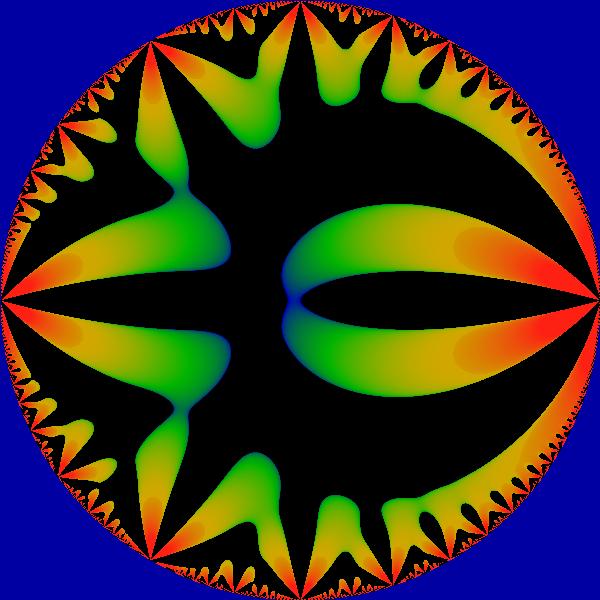

The coefficients of the above differential equation g_2 and g_3 are known as the invariants. Because they depend on the lattice \Lambda they can be viewed as functions in \omega_1 and \omega_2.
The series expansion suggests that g_2 and g_3 are homogeneous functions of degree -4 and -6. That is g_2(\lambda \omega_1, \lambda \omega_2) = \lambda^{-4} g_2(\omega_1, \omega_2) g_3(\lambda \omega_1, \lambda \omega_2) = \lambda^{-6} g_3(\omega_1, \omega_2) for \lambda \neq 0.
If \omega_1 and \omega_2 are chosen in such a way that \operatorname{Im}\left( \tfrac{\omega_2}{\omega_1} \right)0 , g_2 and g_3 can be interpreted as functions on the upper half-plane \mathbb{H}:={z\in\mathbb{C}:\operatorname{Im}(z)0}.
Let \tau=\tfrac{\omega_2}{\omega_1}. One has: g_2(1,\tau)=\omega_1^4g_2(\omega_1,\omega_2), g_3(1,\tau)=\omega_1^6 g_3(\omega_1,\omega_2). That means g2 and g3 are only scaled by doing this. Set g_2(\tau):=g_2(1,\tau) and g_3(\tau):=g_3(1,\tau). As functions of \tau\in\mathbb{H}, g_2 and g_3 are so called modular forms.
The Fourier series for g_2 and g_3 are given as follows: g_2(\tau)=\frac43\pi^4 \left[ 1+ 240\sum_{k=1}^\infty \sigma_3(k) q^{2k} \right] g_3(\tau)=\frac{8}{27}\pi^6 \left[ 1- 504\sum_{k=1}^\infty \sigma_5(k) q^{2k} \right] where \sigma_m(k):=\sum_{d\mid{k}}d^m is the divisor function and q=e^{\pi i\tau} is the nome.
Modular discriminant

The modular discriminant \Delta is defined as the discriminant of the characteristic polynomial of the differential equation \wp'^2(z) = 4\wp ^3(z)-g_2\wp(z)-g_3 as follows: \Delta=g_2^3-27g_3^2. The discriminant is a modular form of weight 12. That is, under the action of the modular group, it transforms as \Delta \left( \frac {a\tau+b} {c\tau+d}\right) = \left(c\tau+d\right)^{12} \Delta(\tau) where a,b,d,c\in\mathbb{Z} with ad-bc = 1.
Note that \Delta=(2\pi)^{12}\eta^{24} where \eta is the Dedekind eta function.
For the Fourier coefficients of \Delta, see Ramanujan tau function.
The constants ''e''1, ''e''2 and ''e''3
e_1, e_2 and e_3 are usually used to denote the values of the \wp-function at the half-periods. e_1\equiv\wp\left(\frac{\omega_1}{2}\right) e_2\equiv\wp\left(\frac{\omega_2}{2}\right) e_3\equiv\wp\left(\frac{\omega_1+\omega_2}{2}\right) They are pairwise distinct and only depend on the lattice \Lambda and not on its generators.
e_1, e_2 and e_3 are the roots of the cubic polynomial 4\wp(z)^3-g_2\wp(z)-g_3 and are related by the equation: e_1+e_2+e_3=0. Because those roots are distinct the discriminant \Delta does not vanish on the upper half plane. Now we can rewrite the differential equation: \wp'^2(z)=4(\wp(z)-e_1)(\wp(z)-e_2)(\wp(z)-e_3). That means the half-periods are zeros of \wp'.
The invariants g_2 and g_3 can be expressed in terms of these constants in the following way: g_2 = -4 (e_1 e_2 + e_1 e_3 + e_2 e_3) g_3 = 4 e_1 e_2 e_3 e_1, e_2 and e_3 are related to the modular lambda function: \lambda (\tau)=\frac{e_3-e_2}{e_1-e_2},\quad \tau=\frac{\omega_2}{\omega_1}.
Relation to Jacobi's elliptic functions
For numerical work, it is often convenient to calculate the Weierstrass elliptic function in terms of Jacobi's elliptic functions.
The basic relations are: \wp(z) = e_3 + \frac{e_1 - e_3}{\operatorname{sn}^2 w} = e_2 + ( e_1 - e_3 ) \frac{\operatorname{dn}^2 w}{\operatorname{sn}^2 w} = e_1 + ( e_1 - e_3 ) \frac{\operatorname{cn}^2 w}{\operatorname{sn}^2 w} where e_1,e_2 and e_3 are the three roots described above and where the modulus k of the Jacobi functions equals k = \sqrt\frac{e_2 - e_3}{e_1 - e_3} and their argument w equals w = z \sqrt{e_1 - e_3}.
Relation to Jacobi's theta functions
The function \wp (z,\tau)=\wp (z,1,\omega_2/\omega_1) can be represented by Jacobi's theta functions: \wp (z,\tau)=\left(\pi \theta_2(0,q)\theta_3(0,q)\frac{\theta_4(\pi z,q)}{\theta_1(\pi z,q)}\right)^2-\frac{\pi^2}{3}\left(\theta_2^4(0,q)+\theta_3^4(0,q)\right) where q=e^{\pi i\tau} is the nome and \tau is the period ratio (\tau\in\mathbb{H}). This also provides a very rapid algorithm for computing \wp (z,\tau).
Relation to elliptic curves
Consider the embedding of the cubic curve in the complex projective plane :\bar C_{g_2,g_3}^\mathbb{C} = {(x,y)\in\mathbb{C}^2:y^2=4x^3-g_2x-g_3}\cup{O}\subset \mathbb{C}^{2} \cup \mathbb{P}_1(\mathbb{C}) = \mathbb{P}_2(\mathbb{C}).
where O is a point lying on the line at infinity \mathbb{P}1(\mathbb{C}). For this cubic there exists no rational parameterization, if \Delta \neq 0. In this case it is also called an elliptic curve. Nevertheless there is a parameterization in homogeneous coordinates that uses the \wp-function and its derivative \wp': : \varphi(\wp,\wp'): \mathbb{C}/\Lambda\to\bar C{g_2,g_3}^\mathbb{C}, \quad z \mapsto \begin{cases} \left[\wp(z):\wp'(z):1\right] & z \notin \Lambda \ \left[0:1:0\right] \quad & z \in \Lambda \end{cases}
Now the map \varphi is bijective and parameterizes the elliptic curve \bar C_{g_2,g_3}^\mathbb{C}.
\mathbb{C}/\Lambda is an abelian group and a topological space, equipped with the quotient topology.
It can be shown that every Weierstrass cubic is given in such a way. That is to say that for every pair g_2,g_3\in\mathbb{C} with \Delta = g_2^3 - 27g_3^2 \neq 0 there exists a lattice \mathbb{Z}\omega_1+\mathbb{Z}\omega_2, such that
g_2=g_2(\omega_1,\omega_2) and g_3=g_3(\omega_1,\omega_2) .
The statement that elliptic curves over \mathbb{Q} can be parameterized over \mathbb{Q}, is known as the modularity theorem. This is an important theorem in number theory. It was part of Andrew Wiles' proof (1995) of Fermat's Last Theorem.
Addition theorem
The addition theorem states that if z,w, and z+w do not belong to \Lambda, then \det\begin{bmatrix}1 & \wp(z) & \wp'(z) \ 1 & \wp(w) & \wp'(w) \ 1 & \wp(z+w) & -\wp'(z+w)\end{bmatrix}=0. This states that the points P=(\wp(z),\wp'(z)), Q=(\wp(w),\wp'(w)), and R=(\wp(z+w),-\wp'(z+w)) are collinear, the geometric form of the group law of an elliptic curve.
This can be proven by considering constants A,B such that \wp'(z) = A\wp(z) + B, \quad \wp'(w) = A\wp(w) + B. Then the elliptic function \wp'(\zeta) - A\wp(\zeta) - B has a pole of order three at zero, and therefore three zeros whose sum belongs to \Lambda. Two of the zeros are z and w, and thus the third is congruent to -z-w.
Alternative form
The addition theorem can be put into the alternative form, for z,w,z-w,z+w\not\in\Lambda: \wp(z+w)=\frac14 \left[\frac{\wp'(z)-\wp'(w)}{\wp(z)-\wp(w)}\right]^2-\wp(z)-\wp(w).
As well as the duplication formula: \wp(2z)=\frac14\left[\frac{\wp''(z)}{\wp'(z)}\right]^2-2\wp(z).
Proofs
This can be proven from the addition theorem shown above. The points P=(\wp(u),\wp'(u)), Q=(\wp(v),\wp'(v)), and R=(\wp(u+v),-\wp'(u+v)) are collinear and lie on the curve y^2=4x^3-g_2x-g_3. The slope of that line is m=\frac{y_P-y_Q}{x_P-x_Q}=\frac{\wp'(u)-\wp'(v)}{\wp(u)-\wp(v)}. So x=x_P=\wp(u), x=x_Q=\wp(v), and x=x_R=\wp(u+v) all satisfy a cubic (mx+q)^2=4x^3-g_2x-g_3, where q is a constant. This becomes 4x^3-m^2x^2-(2mq+g_2)x-g_3-q^2=0. Thus x_P+x_Q+x_R=\frac{m^2}4 which provides the wanted formula \wp(u+v)+\wp(u)+\wp(v)=\frac14 \left[ \frac{\wp'(u)-\wp'(v)}{\wp(u)-\wp(v)} \right]^2.
A direct proof is as follows. Any elliptic function f can be expressed as: f(u)=c\prod_{i=1}^n \frac{\sigma(u-a_i)}{\sigma(u-b_i)} \quad c \in \mathbb{C} where \sigma is the Weierstrass sigma function and a_i , b_i are the respective zeros and poles in the period parallelogram. Considering the function \wp(u)-\wp(v) as a function of u, we have \wp(u)-\wp(v)=c\frac{\sigma(u+v)\sigma(u-v)}{\sigma(u)^2}. Multiplying both sides by u^2 and letting u\to 0, we have 1 = -c\sigma(v)^2, so c=-\frac1{\sigma(v)^2} \implies\wp(u)-\wp(v)=-\frac{\sigma(u+v)\sigma(u-v)}{\sigma(u)^2\sigma(v)^2}.
By definition the Weierstrass zeta function: \frac{d}{dz}\ln \sigma(z)=\zeta(z) therefore we logarithmically differentiate both sides with respect to u obtaining: \frac{\wp'(u)}{\wp(u)-\wp(v)}=\zeta(u+v)-2\zeta(u)-\zeta(u-v) Once again by definition \zeta'(z)=-\wp(z) thus by differentiating once more on both sides and rearranging the terms we obtain -\wp(u+v)=-\wp(u)+\frac12 \frac{ \wp''(v)[\wp(u)-\wp(v) ]-\wp'(u)[\wp'(u)-\wp'(v)] }{ [\wp(u)-\wp(v) ]^2 } Knowing that \wp* has the following differential equation 2\wp*=12\wp^2-g_2 and rearranging the terms one gets the wanted formula \wp(u+v)=\frac14 \left[\frac{\wp'(u)-\wp'(v)}{\wp(u)-\wp(v)}\right]^2-\wp(u)-\wp(v).
Typography
The Weierstrass's elliptic function is usually written with a rather special, lower case script letter ℘, which was Weierstrass's own notation introduced in his lectures of 1862–1863.{{refn | group=footnote | This symbol was also used in the version of Weierstrass's lectures published by Schwarz in the 1880s. The first edition of A Course of Modern Analysis by E. T. Whittaker in 1902 also used it. }} It should not be confused with the normal mathematical script letters P: 𝒫 and 𝓅.
In computing, the letter ℘ is available as \wp in TeX. In Unicode the code point is , with the more correct alias .{{refn|group="footnote" |
The Unicode Consortium has acknowledged two problems with the letter's name: the letter is in fact lowercase, and it is not a "script" class letter, like , but the letter for Weierstrass's elliptic function.
Unicode added the alias as a correction.
|2118|name1=Script Capital P / Weierstrass Elliptic Function
Footnotes
References
- N. I. Akhiezer, Elements of the Theory of Elliptic Functions, (1970) Moscow, translated into English as AMS Translations of Mathematical Monographs Volume 79 (1990) AMS, Rhode Island
- Tom M. Apostol, Modular Functions and Dirichlet Series in Number Theory, Second Edition (1990), Springer, New York (See chapter 1.)
- K. Chandrasekharan, Elliptic functions (1980), Springer-Verlag
- Konrad Knopp, Funktionentheorie II (1947), Dover Publications; Republished in English translation as Theory of Functions (1996), Dover Publications
- Serge Lang, Elliptic Functions (1973), Addison-Wesley,
- E. T. Whittaker and G. N. Watson, A Course of Modern Analysis, Cambridge University Press, 1952, chapters 20 and 21
References
- (2006). "Funktionentheorie 1". Springer.
- (2015). "Real and the complex: a history of analysis in the 19th century".
- (2006). "Funktionentheorie 1". Springer.
- (2003). "Complex Variables: Introduction and Applications". Cambridge University Press.
- (1976). "Modular functions and Dirichlet series in number theory". Springer-Verlag.
- Apostol, Tom M.. (1976). "Modular functions and Dirichlet series in number theory". Springer-Verlag.
- (1976). "Modular functions and Dirichlet series in number theory". Springer-Verlag.
- Apostol, Tom M.. (1990). "Modular functions and Dirichlet series in number theory". Springer-Verlag.
- Apostol, Tom M.. (1976). "Modular functions and Dirichlet series in number theory". Springer-Verlag.
- Chandrasekharan, K. (Komaravolu), 1920-. (1985). "Elliptic functions". Springer-Verlag.
- Busam, Rolf. (2006). "Funktionentheorie 1". Springer.
- Apostol, Tom M.. (1976). "Modular functions and Dirichlet series in number theory". Springer-Verlag.
- (1985). "Elliptic functions". Springer-Verlag.
- Korn GA, [[Theresa M. Korn. (1961). "Mathematical Handbook for Scientists and Engineers". McGraw–Hill.
- "Weierstrass Elliptic and Modular Functions".
- (2012). "Elementare Algebraische Geometrie : Grundlegende Begriffe und Techniken mit zahlreichen Beispielen und Anwendungen". Vieweg+Teubner Verlag.
- (2012). "Elementare Algebraische Geometrie : Grundlegende Begriffe und Techniken mit zahlreichen Beispielen und Anwendungen". Vieweg+Teubner Verlag.
- (2012). "Elementare Algebraische Geometrie : Grundlegende Begriffe und Techniken mit zahlreichen Beispielen und Anwendungen". Vieweg+Teubner Verlag.
- (1927). "A course in modern analysis". Cambridge University Press.
- (1927). "A course in modern analysis". Cambridge University Press.
- (2006). "Funktionentheorie 1". Springer.
- Akhiezer. (1990). "Elements of the theory of elliptic functions". AMS.
- teika kazura. (2017-08-17). "The letter ℘ Name & origin?". [[MathOverflow]].
- (2017-04-10). "Known Anomalies in Unicode Character Names". Unicode, Inc..
- (2017-05-06). "NameAliases-10.0.0.txt". Unicode, Inc..
This article was imported from Wikipedia and is available under the Creative Commons Attribution-ShareAlike 4.0 License. Content has been adapted to SurfDoc format. Original contributors can be found on the article history page.
Ask Mako anything about Weierstrass elliptic function — get instant answers, deeper analysis, and related topics.
Research with MakoFree with your Surf account
Create a free account to save articles, ask Mako questions, and organize your research.
Sign up freeThis content may have been generated or modified by AI. CloudSurf Software LLC is not responsible for the accuracy, completeness, or reliability of AI-generated content. Always verify important information from primary sources.
Report