From Surf Wiki (app.surf) — the open knowledge base
Webbing stretcher
Upholstery tool
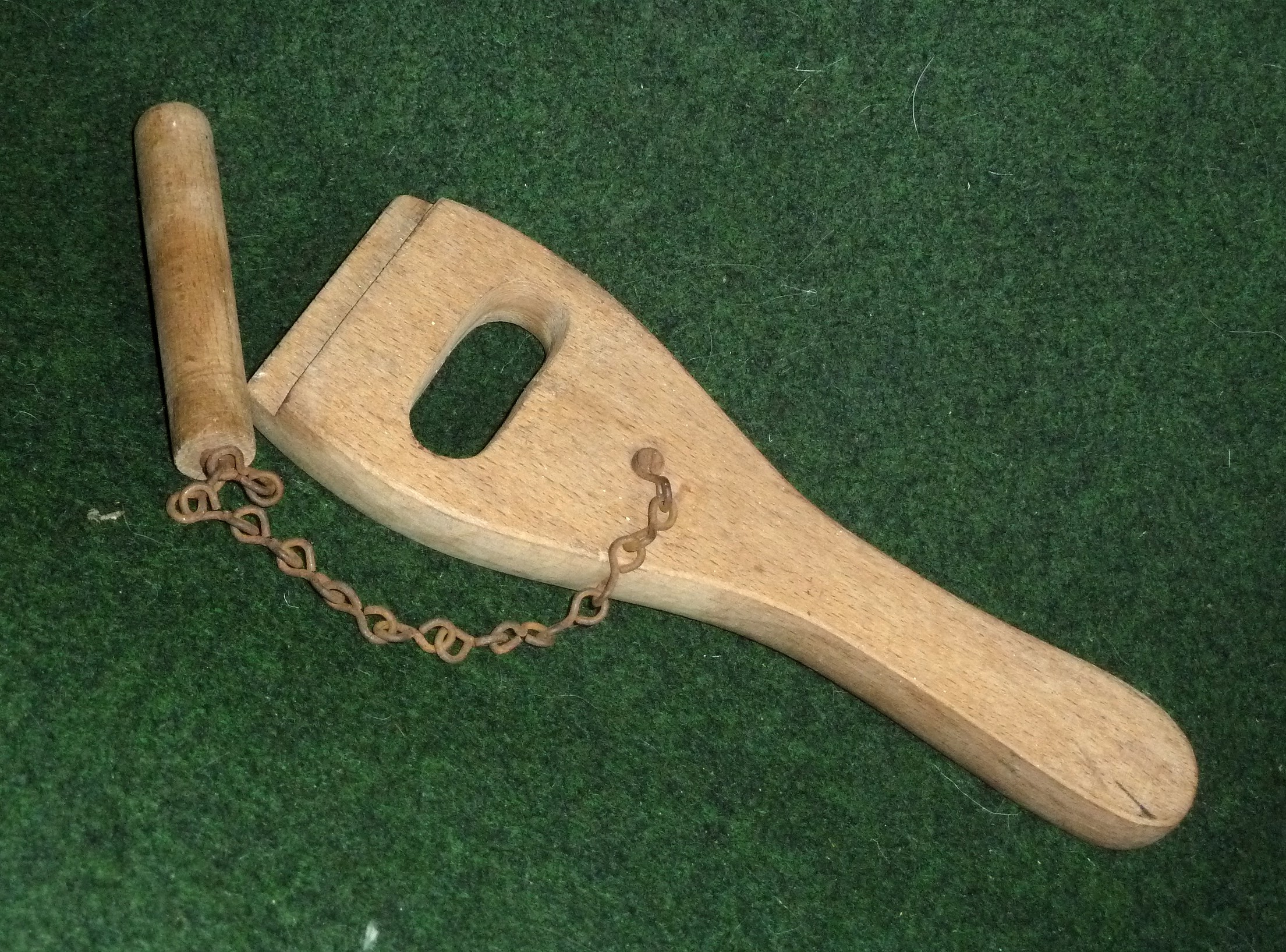
Upholstery tool
A webbing stretcher is an upholstery tool used to stretch webbing.
Chair upholstery
Traditional chairs are constructed of an open wooden frame, with their seat often supported by interwoven jute or cotton herringbone webbing.{{Cite web
Modern webbings
In the 1950s, an elastic rubber or 'Pirelli' webbing became popular. This is made of black rubber, with an internal canvas reinforcement. This webbing is applied by hand and is not tensioned, the elasticity of the rubber being sufficient. It is attached by metal clips, fitting into grooves in the frame. As the webbing is elastic it is only used in parallel strips, rather than being interweaved: friction between these elastic webs moving over each other would soon abrade their edges.
Stretchers
Traditional stretchers
When the webbing is attached, it is fastened at one end, stretched into place and then held in place with tacks.
Tensioning is done with a simple wooden lever, the webbing stretcher. This looks like a bat or paddle with a simple handle, a locating groove along the opposing edge and a slot in the centre. The webbing is held in place by placing a loop through the slot and locking it with a wooden dowel pin. This pin is usually attached to the stretcher with a short chain or string. Using chain avoids the inconvenient twisting tendency of string.
In use, the grooved edge is located over a convenient edge of the frame to act as the fulcrum of a lever and the stretcher is levered outwards. As the handle is further away from the fulcrum than the slot, there is a mechanical advantage of about 3:1 in the tensioning force that can be generated, compared to simply pulling.{{Cite web
Stretchers are sold commercially, usually made of beech.{{Cite web
Stretcher pliers
Plier-type stretchers are sometimes used, particularly with leather strapping that is too short to allow a loop through a traditional stretcher. These have wide ridged jaws to grip the end of a webbing. A protrusion on one jaw acts as the fulcrum of a lever, to give a powerful tensioning force.{{Cite web
American or 'gooseneck' stretchers
These are mostly used by direct pulling, rather than levering. A wooden or plastic block has a row of sharp raised point to grip the webbing by piercing it. The block is either held and pushed to tension the webbing, or a turned wooden handle on a gooseneck wire is used to pull it.{{Cite web
References
This article was imported from Wikipedia and is available under the Creative Commons Attribution-ShareAlike 4.0 License. Content has been adapted to SurfDoc format. Original contributors can be found on the article history page.
Ask Mako anything about Webbing stretcher — get instant answers, deeper analysis, and related topics.
Research with MakoFree with your Surf account
Create a free account to save articles, ask Mako questions, and organize your research.
Sign up freeThis content may have been generated or modified by AI. CloudSurf Software LLC is not responsible for the accuracy, completeness, or reliability of AI-generated content. Always verify important information from primary sources.
Report