From Surf Wiki (app.surf) — the open knowledge base
Watt's curve
Algebraic curve
Algebraic curve


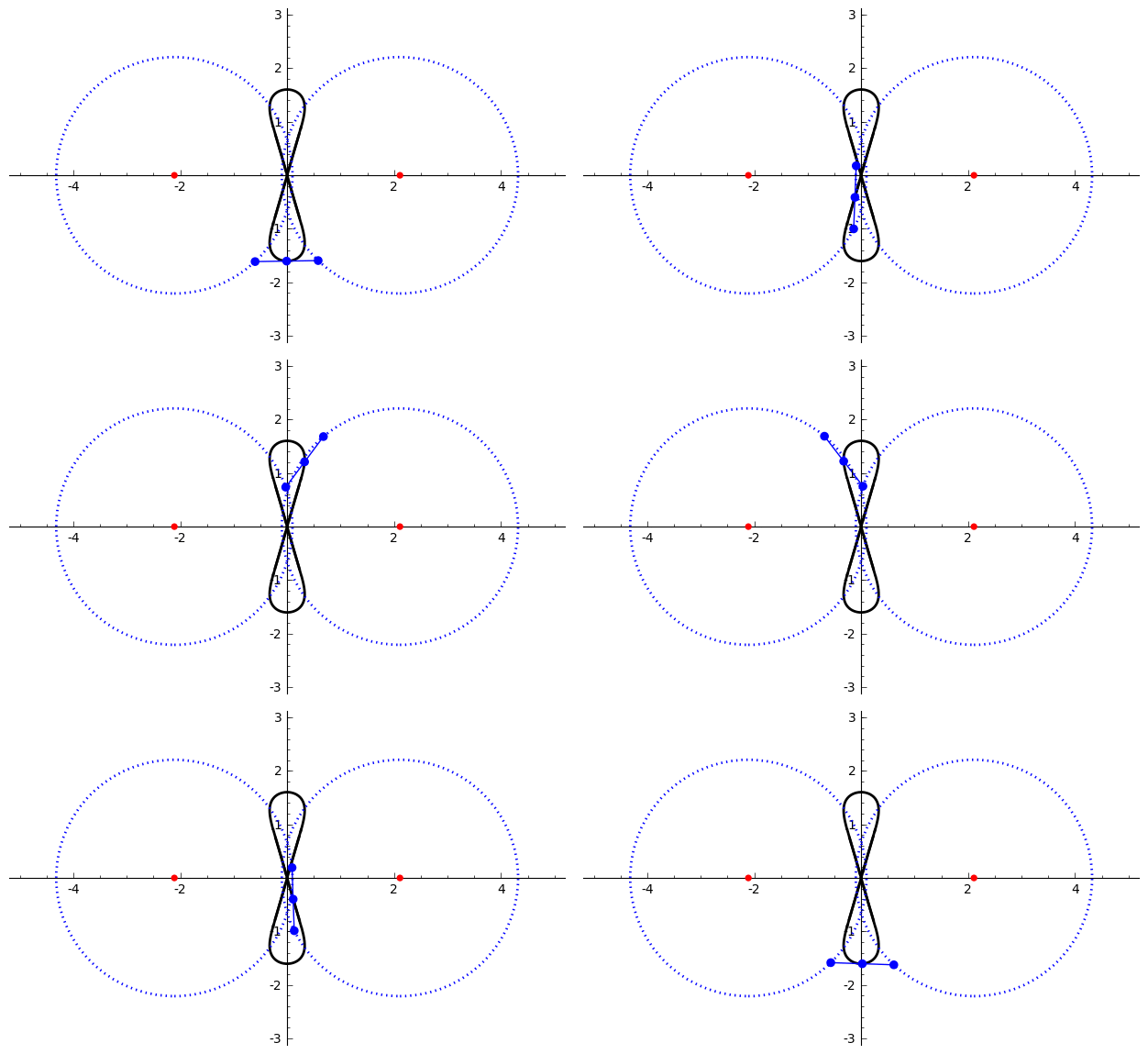
In mathematics, Watt's curve is a tricircular plane algebraic curve of degree six. It is generated by two circles of radius b with centers distance 2a apart (taken to be at (±a, 0)). A line segment of length 2c attaches to a point on each of the circles, and the midpoint of the line segment traces out the Watt curve as the circles rotate partially back and forth or completely around. It arose in connection with James Watt's pioneering work on the steam engine.
The equation of the curve can be given in polar coordinates as :r^2=b^2-\left[a\sin\theta\pm\sqrt{c^2-a^2\cos^2\theta}\right]^2.
Derivation
Polar coordinates
The polar equation for the curve can be derived as follows: Working in the complex plane, let the centers of the circles be at a and −a, and the connecting segment have endpoints at −a+be**i λ and a+be**i ρ. Let the angle of inclination of the segment be ψ with its midpoint at re**i θ. Then the endpoints are also given by re**i θ ± ce**i ψ. Setting expressions for the same points equal to each other gives :a+be^{i\rho}=re^{i\theta}+ce^{i\psi}., :-a+be^{i\lambda}=re^{i\theta}-ce^{i\psi}, Add these and divide by two to get :re^{i\theta}=\tfrac{b}{2}(e^{i\rho}+e^{i\lambda})=b\cos(\tfrac{\rho-\lambda}{2})e^{i\tfrac{\rho+\lambda}{2}}. Comparing radii and arguments gives :r=b\cos\alpha,\ \theta=\tfrac{\rho+\lambda}{2}\ \mbox{where}\ \alpha=\tfrac{\rho-\lambda}{2}. Similarly, subtracting the first two equations and dividing by 2 gives :ce^{i\psi}-a=\tfrac{b}{2}(e^{i\rho}-e^{i\lambda})=i b\sin\alpha e^{i\theta}. Write :a=a\cos\theta\ e^{i\theta} - i a\sin\theta\ e^{i\theta}., Then :ce^{i\psi}=i b\sin\alpha e^{i\theta}+a\cos\theta\ e^{i\theta} - i a\sin\theta\ e^{i\theta}=(a\cos\theta\ +i(b\sin\alpha-a\sin\theta))e^{i\theta}, :c^2=a^2\cos^2\theta+(b\sin\alpha-a\sin\theta)^2,, :b\sin\alpha=a\sin\theta\pm\sqrt{c^2-a^2\cos^2\theta},, :r^2=b^2\cos^2\alpha=b^2-b^2\sin^2\alpha=b^2-\left[a\sin\theta\pm\sqrt{c^2-a^2\cos^2\theta}\right]^2.,,
Cartesian coordinates
Expanding the polar equation gives :r^2=b^2-(a^2\sin^2\theta\ + c^2-a^2\cos^2\theta \pm 2a\sin\theta\sqrt{c^2-a^2\cos^2\theta}),, :r^2-a^2-b^2+c^2+2a^2\sin^2\theta=\pm 2a\sin\theta\sqrt{c^2-a^2\cos^2\theta}),, :(r^2-a^2-b^2+c^2)^2+4a^2(r^2-a^2-b^2+c^2)\sin^2\theta+4a^4\sin^4\theta=4a^2\sin^2\theta(c^2-a^2\cos^2\theta),, :(r^2-a^2-b^2+c^2)^2+4a^2(r^2-b^2)\sin^2\theta=0,, :(x^2+y^2)(x^2+y^2-a^2-b^2+c^2)^2+4a^2y^2(x^2+y^2-b^2)=0., Letting d 2=a2+b2–c2 simplifies this to :(x^2+y^2)(x^2+y^2-d^2)^2+4a^2y^2(x^2+y^2-b^2)=0.,
Form of the curve
The construction requires a quadrilateral with sides 2a, b, 2c, b. Any side must be less than the sum of the remaining sides, so the curve is empty (at least in the real plane) unless a
The curve has a crossing point at the origin if there is a triangle with sides a, b and c. Given the previous conditions, this means that the curve crosses the origin if and only if b
Given b2+b2 2 then the curve has the form of a figure eight. If d is 0 then the curve is a figure eight with two branches of the curve having a common horizontal tangent at the origin. If 0b then the points ±d are still solutions to the Cartesian equation of the curve, but the curve does not cross these points and they are acnodes. The curve again has a figure eight shape though the shape is distorted if d is close to b.
Given b**a+c, the shape of the curve is determined by the relative sizes of a and c. If a**c then the curve does not cross the x-axis at all and consists of two flattened ovals.
Watt's linkage
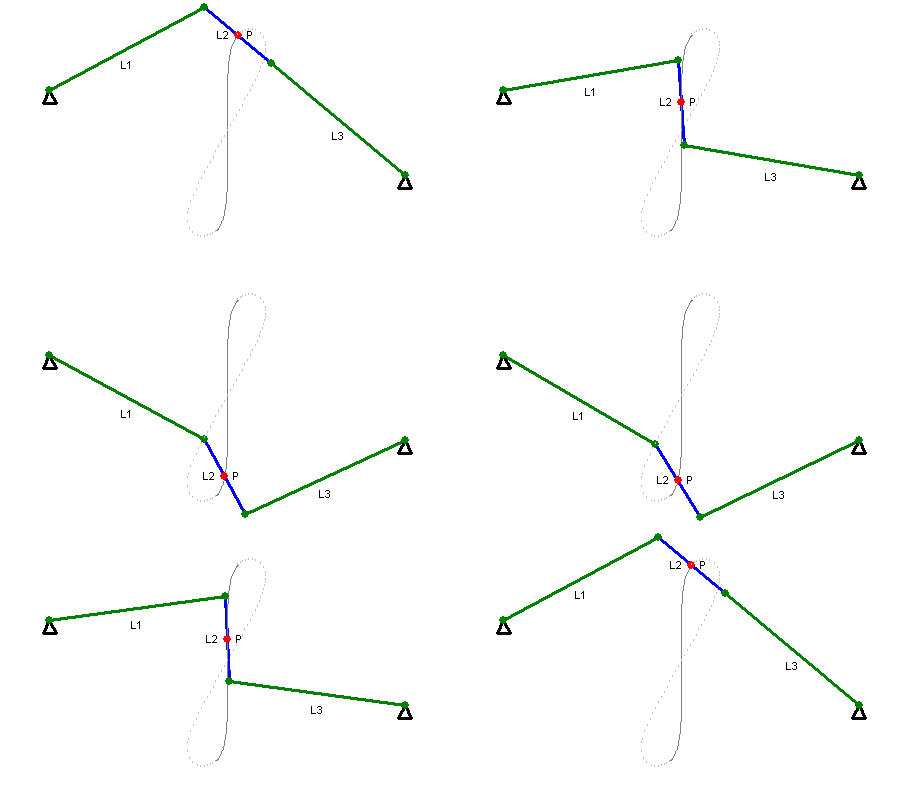
Main article: Watt's linkage
When the curve crosses the origin, the origin is a point of inflection and therefore has contact of order 3 with a tangent. However, if a^2=b^2+c^2 (which is the case if the triangle with sides a, b and c is a right triangle) then tangent has contact of order 5 with the tangent, in other words the curve is a close approximation of a straight line. This is the basis for Watt's linkage.
References
References
- See Catalan and Rutter
- Encyclopédie des Formes Mathématiques Remarquables page for section.
This article was imported from Wikipedia and is available under the Creative Commons Attribution-ShareAlike 4.0 License. Content has been adapted to SurfDoc format. Original contributors can be found on the article history page.
Ask Mako anything about Watt's curve — get instant answers, deeper analysis, and related topics.
Research with MakoFree with your Surf account
Create a free account to save articles, ask Mako questions, and organize your research.
Sign up freeThis content may have been generated or modified by AI. CloudSurf Software LLC is not responsible for the accuracy, completeness, or reliability of AI-generated content. Always verify important information from primary sources.
Report