From Surf Wiki (app.surf) — the open knowledge base
Water landing
Aircraft landing intentionally on a body of water
.jpg)
Aircraft landing intentionally on a body of water
In aviation, a water landing is, in the broadest sense, an aircraft landing on a body of water. Seaplanes, such as floatplanes and flying boats, land on water as a normal operation. Ditching is a controlled emergency landing on the water surface in an aircraft not designed for the purpose, and it is a very rare occurrence. Controlled flight into the surface and uncontrolled flight ending in a body of water (including a runway excursion into water) are generally not considered water landings or ditching, but are considered accidents. Most times, ditching results in aircraft structural failure.
Aircraft water landings
By design
Seaplanes, flying boats, and amphibious aircraft are designed to take off and land on water. Water-landing can be supported by a hull-shaped fuselage and/or pontoons. The availability of a long effective runway was historically important on lifting size restrictions on aircraft, and their freedom from constructed strips remains useful for transportation to lakes and other remote areas. The ability to loiter on water is also important for marine rescue operations and fire fighting. One disadvantage of water alighting is that it is dangerous in the presence of waves. Furthermore, the necessary equipment compromises the craft's aerodynamic efficiency and speed.
Spacecraft
Main article: Splashdown
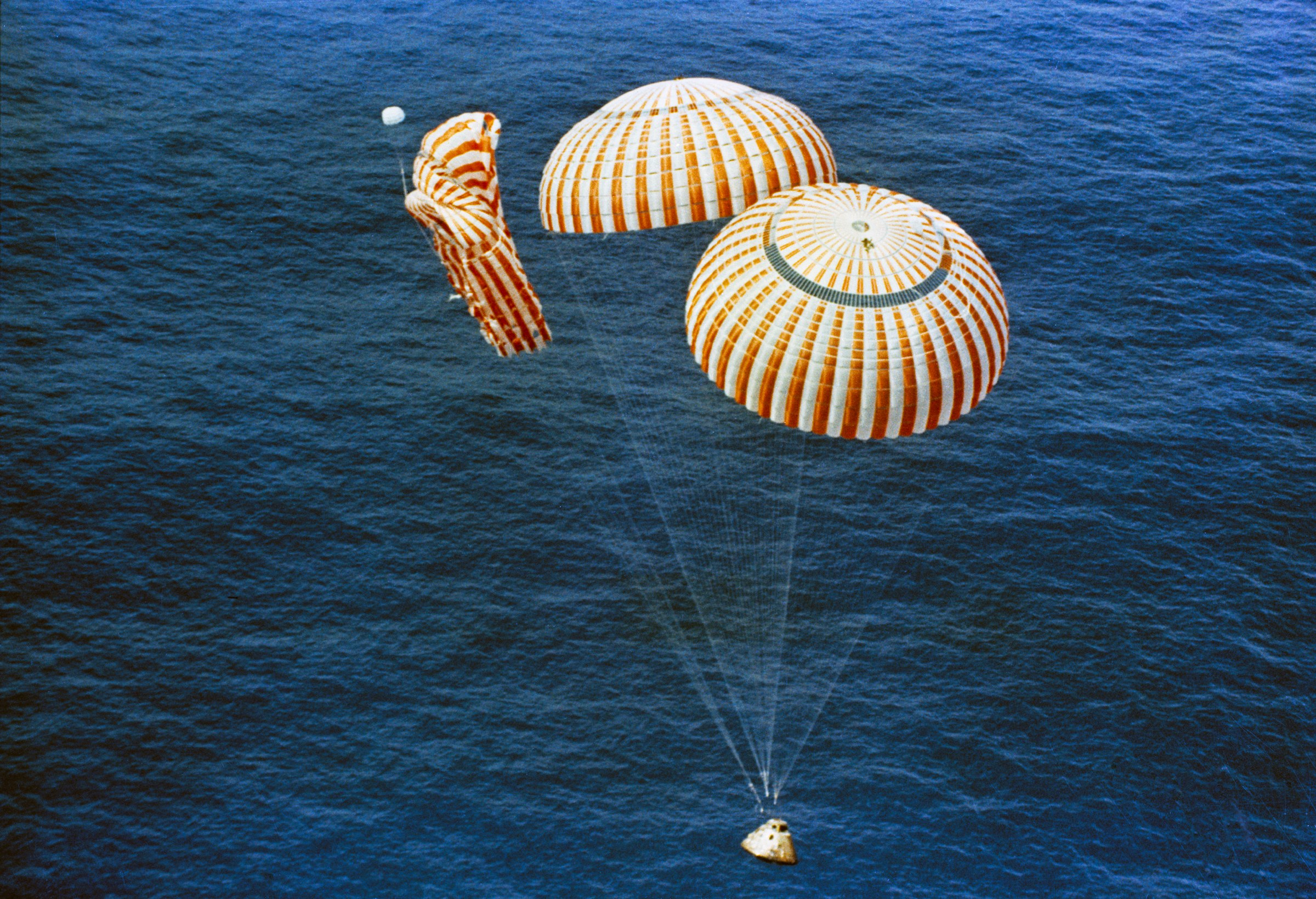
Early crewed spacecraft launched by the United States were designed to alight on water by the splashdown method. The craft would parachute into the water, which acted as a cushion to bring the craft to a stop. Alighting over water rather than land made braking rockets unnecessary, but its disadvantages included difficult retrieval and the danger of drowning. The NASA Space Shuttle design was intended to land on a runway instead. The SpaceX Dragon uses water landings, and has carried crew since 2020.
In distress
_after_crashing_into_the_Hudson_River_(crop_1).jpg)

While ditching is extremely uncommon in commercial passenger travel, small aircraft tend to ditch slightly more often because they usually have only one engine and their systems have fewer redundancies. According to the National Transportation Safety Board, there are about a dozen ditchings per year. Reasons for ditching vary, but the most common are engine failure, flat spin, and pilot error.
General aviation
General aviation includes all fields of aviation outside of military or scheduled (commercial) flights. This classification includes small aircraft, e.g., training aircraft, airships, gliders, helicopters, and corporate aircraft, including business jets and other for-hire operations. General aviation has the highest accident and incident rate in aviation, with 16 deaths per million flight hours, compared to 0.74 deaths per million flight hours for commercial flights (North America and Europe).
Commercial aircraft
In the United States, the FAA does not require commercial pilots to train to ditch but airline cabin personnel must train on the evacuation process. In addition, the FAA implemented rules under which circumstances (kind of operator, number of passengers, weight, route) an aircraft has to carry emergency equipment including floating devices such as life jackets and life rafts.
Some aircraft are designed with the possibility of a water landing in mind. Airbus aircraft, for example, feature a "ditching button" which, if pressed, closes valves and openings underneath the aircraft, including the outflow valve, the air inlet for the emergency RAT, the avionics inlet, the extract valve, and the flow control valve. It is meant to slow flooding in a water landing.
Airplane water ditchings
| Date | Aircraft | Occupants | Fatalities | Details | |
|---|---|---|---|---|---|
| 13 January 1923 | Aeromarine 75 | 9 | 4 | An Aeromarine Airways Aeromarine 75 had to ditch into the Atlantic Ocean when the flying boat suffered engine issues. 5 of the 9 people on board survived. | |
| 21 October 1926 | Handley Page W.10 | 12 | 0 | An Imperial Airways Handley Page W.10 (G-EBMS) ditched into the English Channel after suffering an engine failure. All 12 people on board survived. | |
| 17 June 1929 | Handley Page W.10 | 13 | 7 | An Imperial Airways Handley Page W.10 (G-EBMT) ditched into the English Channel after suffering an engine failure. 6 of the 13 people on board the plane survived. | |
| 21 January 1939 | Short S.23 Empire | 13 | 3 | An Imperial Airways Short S.23 Empire (G-ADUU) ditched into the Atlantic Ocean after suffering a loss of power to its engines. 10 of the 13 people on board survived. | |
| 10 February 1945 | Douglas C-47 | 12 | 0 | A lost U.S. Air Force Douglas C-47 was attempting to make an emergency landing at a nearby airfield since it was running on low fuel. Unbeknownst to the crew, they were heading towards a Japanese airfield. A P-51, piloted by Louis Edward Curdes, conducting an air attack over the Japanese airfield spotted the C-47. He was unable to contact the crew of the C-47 as the radio on the C-47 stopped working, so he shot down both engines of the C-47 to prevent the occupants of the C-47 to be captured by the Japanese upon landing at the airfield. The C-47 was then forced to ditch into the sea. All 12 people on board survived and were eventually rescued. | |
| 11 April 1952 | Douglas DC-4 | 69 | 52 | Pan Am Flight 526A ditched 11.3 miles northwest of Puerto Rico due to engine failure after take off. Many survived the initial ditching but panicking passengers refused to leave the sinking wreck and drowned. 52 passengers were killed, 17 passengers and crew members were rescued by the USCG. After this accident it was recommended to implement pre-flight safety demonstrations for over-water flights. | |
| 16 April 1952 | de Havilland Australia DHA-3 Drover | 3 | 0 | url=https://web.archive.org/web/20160821132102/http://aviation-safety.net/wikibase/wiki.php?id=71738 | date=21 August 2016 }} Retrieved 2 August 2010 with 3 occupants was ditched in the Bismarck Sea between Wewak and Manus Island. The port propeller failed, a propeller blade penetrated the fuselage and the single pilot was rendered unconscious; a passenger performed the ditching; all 3 occupants survived. |
| 3 August 1953 | Lockheed L-749A Constellation | 42 | 4 | Air France Flight 152, a Lockheed L-749A Constellation ditched 6 miles from Fethiye Point, Turkey 1.5 miles offshore into the Mediterranean Sea on a flight between Rome, Italy and Beirut, Lebanon. The propeller had failed due to blade fracture. Due to violent vibrations, engine number three broke away and control of engine number four was lost. The crew of eight and all but four of the 34 passengers were rescued; the other 4 passengers died. | |
| 8 May 1954 | Antonov An-2 | 5 | 0 | After mistakenly enabling reverse thrust, the Antonov An-2 Registered CCCP-N140 sunk after attempting to land on a chunk of floating ice. No occupants were injured and they were rescued by another aircraft. | |
| 19 June 1954 | Convair CV-240 HB-IRW | 9 | 3 | Swissair Convair CV-240 (HB-IRW) ditched into the English Channel because of fuel starvation, which was attributed to pilot error. All three crew and five passengers survived the ditching and could escape the plane. However, three of the passengers could not swim and eventually drowned, because there were no life jackets on board, which was not prescribed at the time. | |
| 23 July 1954 | Douglas C-54A-10-DC Skymaster | 18 | 10 | Cathay Pacific VR-HEU ditched into the South China Sea after being shot by two Lavochkin La-11 fighters of the 85th Fighter Regiment, People's Liberation Army Air Force (PLAAF). While ten passengers and crew were killed by bullets and the subsequent ditching, eight others survived and escaped from the sinking plane, including both pilots. | |
| 26 March 1955 | Boeing 377 Stratocruiser | 23 | 4 | Pan Am Flight 845/26 ditched 35 miles from the Oregon coast after an engine tore loose. Despite the tail section breaking off during the impact the aircraft floated for twenty minutes before sinking. 4 died but 19 survivors were rescued after a further 90 minutes in the water. | |
| 2 April 1956 | Boeing 377 | 38 | 5 | Northwest Orient Airlines Flight 2 (a Boeing 377) ditched into Puget Sound after severe buffeting and altitude loss that was later determined to have been caused by the failure of the crew to close the cowl flaps on the plane's engines. All aboard escaped the aircraft after a textbook landing, but four passengers and one flight attendant succumbed either to drowning or to hypothermia before being rescued. | |
| 16 October 1956 | Boeing 377 | 31 | 0 | Pan Am Flight 6 (also a Boeing 377) ditched northeast of Hawaii, after losing two of its four engines. The aircraft circled around until daybreak, when it ditched; all 31 on board survived. | |
| 14 July 1960 | DC-7C | 57 | 1 | Northwest Orient Airlines Flight 1-11 (A DC-7C) with 7 crew and 51 passengers made a successful ditching in shark-infested waters at 4:05am, 11 miles from Magdalo barrio, Polillo Island about 80 miles from Manila, Philippines. Capt. David Hall was forced to make an emergency water landing after a fire broke out in the no. 2 engine when it did not feather followed by its propeller spinning off. In darkness and rough seas, the crew were able to evacuate all passengers and eventually get them aboard the life rafts as the aircraft sank nose first into the Pacific Ocean. There was only 1 loss of life, caused by a heart attack. The 57 passengers and crew were rescued five hours later by Coast Guard Grumman amphibian and a US Navy PBM from Sangley Point Naval Base in Cavite, Philippines. | |
| 23 September 1962 | Lockheed 1049H-82 Super Constellation | 76 | 28 | Flying Tiger Line Flight 923, a Lockheed 1049H-82 Super Constellation registered as N6923C, passenger aircraft, on a military (MATS) charter flight, with a crew of 8 and 68 U.S. civilian and military (paratrooper) passengers ditched in the North Atlantic about 500 miles west of Shannon, Ireland after losing three engines on a flight from Gander, Newfoundland to Frankfurt, West Germany. 45 of the passengers and 3 crew were rescued, with 23 passengers and 5 crew members being lost in the storm-swept seas. All occupants evacuated the airplane. Those who were lost succumbed in the rough seas. | |
| 22 October 1962 | DC-7C | 58 | 0 | Northwest Airlines Flight 293, a DC-7C with 7 crew and 95 passengers made a successful water landing in Sitka Sound. The military charter flight was en route to Elmendorf Air Force Base from McChord Air Force Base and, prior to the ditching at just before 1 p.m. local time, the crew had been struggling with a propeller problem for about 45 minutes. The plane stayed afloat for 24 minutes after coming to rest in the water, giving the occupants ample time to evacuate into life-rafts. Only 6 minor injuries were reported; all passengers and crew were quickly rescued by U.S. Coast Guard ships. The accident report called the ditching "an outstanding feat", citing several key factors in this water landing's success: pilots' skill, ideal conditions (calm seas, favorable weather, daylight), time to prepare for the ditching and the military passengers' ease with following orders. Pilots who flew over the scene also praised the Northwest crew, calling it the "finest ditching they had ever seen". | |
| 21 August 1963 | Tupolev Tu-124 | 52 | 0 | Aeroflot Flight 366 ditched into the Neva River in Leningrad (now St. Petersburg) after running out of fuel. A nearby tugboat pulled the plane to shore where the passengers disembarked onto the tug; all 52 on board escaped without injuries. | |
| 23 April 1966 | Ilyushin Il-14 | 33 | 33 | Aeroflot Flight 2723 (an Ilyushin Il-14 registered as CCCP-61772) suffered a dual-engine failure several minutes after taking off from Bina International Airport. The pilots were unable to return to Bina and ended up ditching into the Caspian Sea. The wreckage and occupants were not found until a few months later. All 33 people on board died. | |
| 16 September 1966 | C-47A | 27 | 1 | , operated by Spantax on a Douglas DC-3/C-47A-75-DL registered as EC-ACX, was forced to ditch in the Atlantic Ocean due to an engine problem 2 minutes after takeoff. This domestic flight was en route from Tenerife to La Palma in the Canary Islands, Spain. One passenger died during the evacuation. | |
| 2 May 1970 | McDonnell Douglas DC-9-33CF | 63 | 23 | ALM Flight 980 (a McDonnell Douglas DC-9-33CF), ditched in mile-deep water after running out of fuel during multiple attempts to land at Princess Juliana International Airport on the island of Sint Maarten in the Netherlands Antilles under low-visibility weather. Insufficient warning to the cabin resulted in several passengers and crew still either standing or with unfastened seat belts as the aircraft struck the water. Of 63 occupants, 40 survivors were recovered by U.S. military helicopters. | |
| 17 July 1972 | Tupolev Tu-134 | 5 | 0 | A GosNIIAS Tupolev Tu-134 (CCCP-65607) was conducting a test flight when both of its engines shut down and the crew were unable to restart the engines. The plane was low on altitude and had to ditch on the Ikshinskoye reservoir. All 5 people on board survived with no injuries. | |
| 11 September 1990 | Boeing 727 | 16 | 16 (presumed) | A Faucett Perú Boeing 727 (OB-1303) was running out of fuel and the pilots sent a out a distress message that was picked up by TWA Flight 851 and American Airlines Flight 35, stating that they were preparing to ditch into the Atlantic Ocean. Nothing else was ever heard from the pilots again and the wreckage and occupants were never found. Officials from the Transportation Safety Board of Canada (TSB) believed the plane had in fact ditched into the Atlantic Ocean. | |
| 24 April 1994 | Douglas DC-3 | 25 | 0 | A DC-3 (VH-EDC), operated by South Pacific Airmotive, suffered a failure of the left engine at approximately 200 ft after taking off from Sydney Airport (Australia) . The power of the right engine was insufficient to climb or maintain height, so the pilot carried out a successful ditching. All 25 on board survived with only one minor physical injury. | |
| 25 March 1995 | Lockheed P-3 Orion | 11 | 0 | A US Navy Lockheed P-3 Orion had to ditch into the Arabian Sea 200 miles east of Oman when the Lockheed P-3 Orion suffered a catastrophic loss of the number 4 engine propeller. The catastrophic loss of the propeller resulted in propeller fragments passing through the aircraft fuselage and severing fuel lines and control cables for the remaining 3 engines resulting in a no power water landing. All onboard survived. | |
| 23 November 1996 | Boeing 767-260ER | 175 | 125 | ||
| 29 July 1998 | Embraer EMB-110P1 Bandeirante | 27 | 12 | 29 July 1998: A Selva Taxi Aéreo Embraer EMB-110P1 Bandeirante (PT-LGN) had an oil pressure issue on the number 2 engine twenty minutes after taking off from Manaus-Eduardo Gomes International Airport and had to be shut down later on. Due to this, the crew decided to turn back to Manaus. The plane could not maintain flight with only one engine since the plane was severely overweight and thus unable to reach Manaus, so the plane had to ditch on the Manacapuru River. 12 out of the 27 people on board the plane were killed. | |
| 13 January 2000 | Short 360 | 41 | 22 | 13 January 2000: An Avisto Short 360 (HB-AAM) suffered a dual-engine failure after the melting of ice accumulated in both engines. The plane ditched into the Mediterranean Sea, 5 km off Marsa Brega Airport. Out of the 41 people on board, 19 had survived, 21 were killed and 1 was missing and is presumed dead. | |
| 31 May 2000 | Piper PA-31 | 8 | 8 | ||
| 27 February 2001 | Shorts 360-100 | 2 | 2 | 27 February 2001: Loganair Flight 670A, a Shorts 360-100, took off from Edinburgh Airport, United Kingdom. Shortly thereafter, the plane suffered a dual engine failure from an accumulation of large volumes of snow or slush in both engines and ditched in the Firth of Forth. Both pilots, who were the only people on board, were killed. | |
| 16 January 2002 | Boeing 737 | 60 | 1 | ||
| 21 May 2002 | Douglas DC-3 | 3 | 0 | May 21, 2002: A Douglas DC-3 registered as X-JBR operated by Aero JBR crashed after performing a regular maintenance flight. The crew had conducted multiple touch and go landing when both engines lost power. The crew successfully ditched it in Lake Casa Blanca and were rescued by a boat. The aircraft sunk in 6 feet (1.8 meters) of water | |
| 11 November 2002 | Fokker F27 Friendship | 34 | 19 | ||
| 6 August 2005 | ATR 72 | 39 | 16 | ||
| 4 January 2008 | Let L-410 Turbolet | 14 | 14 | 4 January 2008: At altitude 7,500 the Let L-410 Turbolet airliner operated by Transaven crashed near the Los Roques Archipelago. The aircraft had suffered a double engine flameout and ditched into the ocean. All 14 occupants on board were killed after it sunk to the seafloor. | |
| 15 January 2009 | Airbus A320 | 155 | 0 | ||
| 22 October 2009 | Britten-Norman Islander | 10 | 1 | ||
| 18 November 2009 | Westwind II | 6 | 0 | 18 November 2009: A Pel-Air West conducting an air ambulance flight using a Westwind II (VH-NGA) ditched into the sea 3 km south-west of Norfolk Island due to the flight crew being unable to land at Norfolk Island in poor weather conditions and not having enough fuel to divert to another airport. All 6 people on board survived. | |
| 6 June 2011 | Antonov An-26 | 3 | 0 | ||
| 11 July 2011 | Antonov An-24 | 37 | 7 | ||
| 11 December 2013 | Cessna 208B Grand Caravan | 9 | 1 | 11 December 2013: A Makani Kai Air Cessna 208B Grand Caravan (N687MA) ditched shortly after takeoff from Kalaupapa Airport, Hawaii due to engine failure. The plane sustained substantial damage from the impact. Of the 9 people on board, one passenger was fatally injured, the pilot and two passengers were seriously injured, and five passengers received minor injuries. | |
| 26 February 2016 | CASA/IPTN CN-235 | 8 | 0 | 26 February 2016: While performing routine training exercises, a Casa CN-235M operated by the Royal Malaysian Air Force had its left engine catch aflame. The aircraft subsequently crashed on the beaches of Taman Malawati Utama. 7 of the 8 occupants escaped unharmed with the only injured person being the copilot, who escaped with a broken arm. | |
| 22 November 2017 | Grumman C-2 Greyhound | 11 | 3 | 22 November 2017: A Grumman C-2 Greyhound belonging to supercarrier Ronald Reagan (CVN-76) Landed just short of the carrier deck after losing power in both engines, three occupants were killed. | |
| 21 June 2019 | Basler BT-67 | 2 | 0 | 21 June 2019: A North Star Air Basler BT-67 (C-FKGL) lost power to both engines after the pilot in the left seat, who was not flying the plane, accidentally moved the fuel condition levers while retracting the landing gear. The plane, flying in pitch-black conditions, had to ditch into Eabamet Lake, Ontario. Both pilots evacuated the plane without injuries. | |
| 18 October 2019 | Douglas DC-3 | 2 | 0 | 18 October 2019: A Douglas DC-3 registered N437GB crashed 2.87 miles (4.61 km) short of runway 13 at Lynden Pindling International Airport in Nassau, Bahamas the DC-3 was being operated by Atlantic Air Cargo and was on a flight to Lynden Pindling from Miami International Airport, the pilot reported that the aircraft lost power in the left engine 25-30 nautical miles from MYNN. He also stated that while under single engine operation after the failure the aircraft's performance was not optimal, which is what coerced him to make the ditching. The ATC of MYNN was notified by both crew members of N437GB that they would make the ditching. Air Traffic Control at MYNN notified the Royal Bahamas Defense Forces. Upon landing rescue efforts were implemented and both the co-pilot and pilot were rescued with no injuries. The aircraft was written off and a limited-scope investigation into the crash was initiated. | |
| 2 July 2021 | Boeing 737 | 2 | 0 | 2 July 2021: On Transair Flight 810, one engine on the Boeing 737-200 cargo aircraft failed en route from Honolulu to the neighboring Hawaiian island of Maui. The crew attempted to turn back to Honolulu's Daniel K. Inouye International Airport, but the plane's second engine overheated, forcing the two pilots on board to ditch the airplane about 4 miles off the southern coast of Oahu. Both pilots were rescued by the United States Coast Guard. | |
| 15 December 2022 | Pilatus PC-6 Porter | 2 | 1 | 15 December 2022: PK-SNF (Nicknamed "Franz"), the last Pilatus PC-6 Porter produced by Pilatus Aircraft crashed in the water shortly after taking off from Heraklion International Airport after reporting electrical problems. The plane was on a delivery flight with 1 pilot and one passenger from Buochs Airport to Hurghada International Airport with stops in Maribor Edvard Rusjan Airport and Podgorica Airport along the way in that chronological order. After taking off from Heraklion International Airport PK-SNF reported unspecified electrical problems and while on a turn back to Heraklion, lost large amounts of airspeed, stalled and ditched in the water, killing the 68 year-old Indonesian passenger and slightly injuring the 28 year-old pilot. The aircraft floated upside down for an extended period of time before being recovered by emergency services, it was on delivery to its new owner Smart Cakrawala Aviation based in Indonesia. | |
| 27 January 2026 | 13 | 0 | Cessna 208B Grand Caravan | 27 january 2026: PK-SNS, a Cessna 208B Grand Caravan, operated by Smart Air on a commercial regional flight in Indonesia, suffered a loss of engine power shortly after take off from Douw Aturure Airport, headed to Utarom Airport. The pilots couldn't return to the airport and ditched off the coast of Nabire. All 13 people on board the aircraft survived. |
Aircraft landing on water for other reasons

Aircraft also sometimes end up in water by running off the ends of runways, landing in water short of the end of a runway, or even being forcibly flown into the water during suicidal/homicidal events. Twice at LaGuardia Airport, an aircraft has rolled into the East River (USAir Flight 5050 and USAir Flight 405).
- 5 September 1954: KLM Flight 633, a Lockheed L-1049C-55-81 Super Constellation, suffered a re-extension of the landing gear shortly after taking off from Shannon Airport, which the flight crew was not aware. This caused the plane to descend and ditch into the River Shannon. 28 of the 56 people on board survived.
- 13 January 1969: Scandinavian Airlines System Flight 933, a McDonnell Douglas DC-8-62, ditched in Santa Monica Bay while on approach to runway 07R of Los Angeles International Airport, California. Out of the 45 people on board the plane, 4 drowned, 11 are missing and presumed dead, 17 were injured, and 13 sustained no injuries.
- 28 February 1984: Scandinavian Airlines System Flight 901, a McDonnell Douglas DC-10-30, overran the runway shortly after landing at John F. Kennedy International Airport and ended up with its nose in shallow water. All 177 occupants on board survived with 12 of them sustaining injuries.
- 31 August 1988: CAAC Flight 301, a Hawker Siddeley Trident, overran the runway at Kai Tak international Airport and ended up in Kowloon Bay, breaking into two pieces. 7 of the 89 occupants on board perished and 15 others sustained injuries.
- 26 September 1988: Aerolineas Argentinas Flight 648, a Boeing 737, landed hard and overran the runway at Ushuaia Airport and ended up in shallow water. All 62 people aboard survived.
- 3 May 2019: Miami Air International Flight 293, a Boeing 737-800, hydroplaned and experienced a runway excursion upon landing at Naval Air Station Jacksonville. The airplane came to rest in the shallow waters of St. Johns River, sustaining substantial damage. All 143 passengers and crew on board the plane survived, although twenty-one people on board suffered minor injuries.
Military aircraft
A limited number of pre-World War II military aircraft, such as the Grumman F4F Wildcat and Douglas TBD Devastator, were equipped with flotation bags that kept them on the surface in the event of a ditching.
The "water bird" emergency landing is a technique developed by the Canadian Forces to safely land the Sikorsky CH-124 Sea King helicopter if one engine fails while flying over water. The emergency landing technique allows the boat-hull equipped aircraft to land on the water in a controlled fashion.
Space launch vehicle water landings
Beginning in 2013 and continuing into 2014 and 2015, a series of ocean water landing tests were undertaken by SpaceX as a prelude to bringing booster rockets back to the launch pad in an effort to reuse launch vehicle booster stages. Seven test flights with controlled-descents have been conducted by April 2015.
Prior to 2013, successful water landings of launch vehicles were not attempted, while periodic water landings of space capsules have been accomplished since 1961. The vast majority of space launch vehicles take off vertically and are destroyed on falling back to earth. Exceptions include suborbital vertical-landing vehicles (e.g., Masten Xoie or the Armadillo Aerospace' Lunar Lander Challenge vehicle), and the spaceplanes that use the vertical takeoff, horizontal landing (VTHL) approach (e.g., the Space Shuttle, or the USAF X-37) which have landing gear to enable runway landings. Each vertical-takeoff spaceflight system to date has relied on expendable boosters to begin each ascent to orbital velocity. This is beginning to change.
Recent advances in private space transport, where new competition to governmental space initiatives has emerged, have included the explicit design of recoverable rocket technologies into orbital booster rockets. SpaceX has initiated and funded a multimillion-dollar program to pursue this objective, known as the reusable launch system development program.
The orbital-flight version of the SpaceX design was first successful at accomplishing a water landing (zero velocity and zero altitude) in April 2014 on a Falcon 9 rocket and was the first successful controlled ocean soft touchdown of a liquid-rocket-engine orbital booster. Seven test flights with controlled-descent test over-water landings, including two with failed attempts to land on a floating landing platform, have been conducted by April 2015.
In October 2024 the upper stage of SpaceX's Starship spacecraft performed a controlled, high accuracy water landing in the Indian Ocean near a pre-positioned buoy that captured footage of the splashdown.
Techniques for water landings
- Glassy water landings: Glassy water conditions, characterized by little to no wind, pose unique challenges for pilots. In such scenarios, visual cues for altitude are minimized, making it difficult to judge the aircraft's height above the water. Pilots are advised to maintain a controlled descent rate of no more than 150 feet per minute and to establish a pitch attitude before reaching the water. It's crucial to avoid turning during the final approach to prevent wingtip contact with the water.
- Pre-landing assessment: Before landing, pilots should conduct a thorough assessment of the landing area. This includes checking for obstacles, wave height, and wind direction. A common practice is to fly over the intended landing area first to gauge conditions. Adjustments to flaps and descent rates should be made accordingly to ensure a smooth touchdown.
References
References
- "Ditching light aircraft on Water".
- National Transportation Safety Board. (December 1998). "NTSB Aviation Coding Manual".
- "Jet Airliner Ditching Events".
- (October 28, 2024). "Making a Splash".
- (October 28, 2024). "Amphibious {{sic".
- "The science behind splashdown—aerospace engineer explains how NASA and SpaceX get spacecraft safely back".
- Tous, Marcos Fernandez. (2024-06-27). "The science behind splashdown − an aerospace engineer explains how NASA and SpaceX get spacecraft safely back on Earth".
- Bertorelli, Paul. (1999). "Ditching Myths Torpedoed!".
- (2020-07-21). "Richard G. McSpadden Report Figure View".
- link. (25 June 2010)
- "Airbus Overhead Panel". smartcockpit.com.
- Ranter, Harro. "ASN Aircraft accident Aeromarine 75 registration unknown Havana, Cuba".
- Ranter, Harro. "ASN Aircraft accident Handley Page W.10 G-EBMS English Channel".
- Ranter, Harro. "ASN Aircraft accident Handley Page W.10 G-EBMT Dungeness".
- Ranter, Harro. "ASN Aircraft accident Short S.23 Empire Flying Boat Mk II G-ADUU Port Washington, Long Island, NY".
- (2016-08-23). "The American WWII Ace Who Shot Down 7 German, 1 Italian, 1 Japanese, And 1 American Plane".
- Staff, Rich Buhler &. (28 June 2016). "Bad Angel Pilot Lt. Louis E. Curdes Shot Down His Girlfriend in WWII-Truth! & Fiction! - Truth or Fiction?".
- Ranter, Harro. "ASN Aircraft accident Douglas DC-4 N88899 San Juan-Isla Grande Airport (SIG)".
- link. (21 August 2016 Retrieved 2 August 2010)
- [http://www.airwaysmuseum.com/DHA%20Drover%20VH-DHA%202.htm Loss of Drover VH-DHA] {{webarchive. link. (20 September 2016 Retrieved 2 August 2007)
- "Accident Lockheed L-749A Constellation F-BAZS, Monday 3 August 1953".
- "Accident Antonov An-2T CCCP-N140, Saturday 8 May 1954".
- Ranter, Harro. "ASN Aircraft accident Convair CV-240-4 HB-IRW Folkestone".
- Ranter, Harro. "ASN Aircraft accident Douglas C-54A-10-DC (DC-4) VR-HEU Hainan Island".
- Ranter, Harro. "ASN Aircraft accident Boeing 377 Stratocruiser 10-26 N1032V Oregon, USA".
- link. (27 April 2018 from the Department of Transport's Special Collections)
- ''Air Disaster, Vol. 4: The Propeller Era'', by [[Macarthur Job]], Aerospace Publications Pty. Ltd. (Australia), 2001 {{ISBN. 1-875671-48-X
- Kebabjian, Richard. "1956/1956-27.htm". PlaneCrashInfo.com.
- Hokom, Wayne. "Ditch and rescue". Jack's Joint.
- (1975). "2 Airliners Crash; 87 Rescued, 1 Killed". Manila Bulletin.
- Ranter, Harro. "Crash-aerien 14 JUL 1960 d'un Douglas DC-7C N292 - Polillo Island".
- [http://www.flyingtigerline.org/Memoriam/N6923C.htm "Aviation Safety Network: N6923C"] {{webarchive. link. (23 April 2016 . Flying Tiger Line Pilots Association. Retrieved 3 February 2014.)
- [http://www.planecrashinfo.com/1962/1962-53.htm "Accident Details"] {{webarchive. link. (3 March 2016 . PlaneCrashInfo.com. Retrieved 3 February 2014.)
- Frederick C. Caruso. (2007). "Born Again Irish: A Story of Disaster at Sea, the Joy of Ireland, and the Vortex of Fate". CGI Books Inc..
- (19 September 1963). "Aircraft Accident Report: Douglas DC-7C, N285 Northwest Airlines, Inc. Ditching in Sitka Sound, Alaska October 22, 1962". Civil Aeronautics Board.
- (22 October 1962). "DC-7 Ditches in Sea Near Sitka; All Safe". The Seattle Daily Times.
- (23 October 1962). "102 Saved As Plane Ditches". Seattle Post Intelligencer.
- (19 September 1963). "Aircraft Accident Report: Douglas DC-7C, N285 Northwest Airlines, Inc. Ditching in Sitka Sound, Alaska October 22, 1962". Civil Aeronautics Board.
- AirSafe.com. (28 March 2002). "Jet Airliner Ditching Events".
- Ranter, Harro. "ASN Aircraft accident Ilyushin Il-14 CCCP-61772 Boyuk Zira".
- "ASN Aircraft accident C-47A EC-ACX off El Sauzal".
- Aviation Safety Network. "McDonnell Douglas DC-9-33CF N935F – St. Croix, Virgin Islands".
- "Tuesday 11 September 1990".
- Claiborne, Harro. (12 September 1990). "Peruvian Airliner Lost in Atlantic off Canada". [[Washington Post]].
- "Boeing 727 ditches in Atlantic".
- "Investigation: 199401043 - Douglas Aircraft Co Inc DC3C-S1C3G, VH-EDC, Botany Bay, NSW, 24 April 1994".
- Ranter, Harro. "ASN Aircraft accident Douglas C-47A-20-DK (DC-3) VH-EDC Sydney-Kingsford Smith International Airport, NSW (SYD)".
- Harrison, Jeff. "They Said It Would Never Happen: A P-3C Ditches with Four Engines Out, All Survive!".
- Ranter, Harro. "ASN Aircraft accident Boeing 767-260ER ET-AIZ Mitsamiouli, Grande Comore".
- Ranter, Harro. "ASN Aircraft accident Embraer EMB-110P1 Bandeirante PT-LGN Manaus, AM".
- Ranter, Harro. "ASN Aircraft accident Shorts 360-300 HB-AAM Marsa el-Brega".
- (19 December 2001). "Collision with water – Piper PA31-350 Chieftain, VH-MZK, Spencer Gulf, S.A, 31 May 2000". [[Australian Transport Safety Bureau]].
- Ranter, Harro. "ASN Aircraft accident Shorts 360-100 G-BNMT Granton Harbour".
- {{usurped
- Mark V. Rosenker. "NTSB Safety Recommendation".
- Ranter, Harro. "ASN Aircraft accident Fokker F-27 Friendship 600 RP-C6888 Manila-Ninoy Aquino International Airport (MNL) [Manila Bay]".
- Ranter, Harro. "ASN Aircraft accident ATR 72-202 TS-LBB Palermo-Punta Raisi Airport (PMO)".
- "Crash of a Let L-410UVP-E3 off Los Roques: 14 killed {{!}} Bureau of Aircraft Accidents Archives".
- Robbins, Liz. (15 January 2009). "Jet Ditches in Hudson; All Are Said Safe". The New York Times.
- "Accident Britten-Norman BN-2A-26 Islander PJ-SUN, Thursday 22 October 2009".
- Ranter, Harro. "ASN Aircraft accident IAI 1124A Westwind II VH-NGA Norfolk Island Airport (NLK)".
- Hradecky, Simon. (7 June 2011). "Accident: Solenta AN26 near Libreville on Jun 6th 2011, ditched in the sea". The Aviation Herald.
- "Accident: Angara AN24 near Nizhnevartovsk on Jul 11th 2011, water landing after engine fire".
- Ranter, Harro. "ASN Aircraft accident Cessna 208B Grand Caravan N687MA Kalaupapa Airport, HI (LUP)".
- "Crash of a Casa CN-235M near Kuala Selangor {{!}} Bureau of Aircraft Accidents Archives".
- "Crash of a Grumman C-2A(R) Greyhound in the Philippines Sea: 3 killed {{!}} Bureau of Aircraft Accidents Archives".
- Ranter, Harro. "ASN Aircraft accident Basler BT-67 Turbo 67 (DC-3T) C-FKGL Fort Hope Airport, ON (YFH)".
- "Crash of a Douglas DC-3C off Nassau {{!}} Bureau of Aircraft Accidents Archives".
- (July 2, 2021). "2 pilots alive after plane crashes few miles off coast of Hawaii". [[ABC News (United States).
- "Crash of a Pilatus PC-6/B2-H4 Turbo Porter off Heraklion: 1 killed {{!}} Bureau of Aircraft Accidents Archives".
- "Accident Cessna 208B Grand Caravan PK-SNS, Tuesday 27 January 2026".
- Ranter, Harro. "ASN Aircraft accident Lockheed L-1049C-55-81 Super Constellation PH-LKY Shannon Airport (SNN)".
- Ranter, Harro. "ASN Aircraft accident McDonnell Douglas DC-8-62 JA8032 San Francisco Bay, CA".
- Ranter, Harro. "ASN Aircraft accident McDonnell Douglas DC-8-62 LN-MOO Los Angeles, CA [Santa Monica Bay]".
- [http://amelia.db.erau.edu/reports/ntsb/aar/AAR78-13.pdf Aircraft Accident Report AAR-78-13 (PDF)] {{webarchive. link. (21 September 2006)
- Ranter, Harro. "ASN Aircraft accident Tupolev Tu-154B-1 YR-TPH Nouadhibou Airport (NDB)".
- Ranter, Harro. "ASN Aircraft accident Boeing 737-222 N62AF Washington-National Airport, DC (DCA) [Potomac River]".
- {{usurped
- {{usurped
- link. (2 May 2008 ," ''[[The New York Times]]''. 14 February 1982. Retrieved on 10 November 2011.)
- (1 March 1982). "Troubled Pilot".
- Ranter, Harro. "ASN Aircraft accident McDonnell Douglas DC-10-30 LN-RKB New York-John F. Kennedy International Airport, NY (JFK)".
- (1985-06-27). "Airliner Plunges Into Swamp".
- Ranter, Harro. "ASN Aircraft accident McDonnell Douglas DC-10-10 N129AA San Juan-Luis Munoz Marin International Airport (SJU)".
- Ranter, Harro. "ASN Aircraft accident Hawker Siddeley HS-121 Trident 2E B-2218 Hong Kong-Kai Tak International Airport (HKG)".
- Ranter, Harro. "ASN Aircraft accident Boeing 737-287 LV-LIU Ushuaia Airport, TF (USH)".
- Smith, Patrick. (2002). "Ask the pilot #4: Do seat cushions actually save lives?". [[Salon.com]].
- Aviation Safety Network. "Boeing 747-428 F-GITA Papeete-Faaa Airport (PPT), Tahiti".
- Aviation Safety Network. "Boeing 747-409 B-165 – Hong Kong-Kai Tak International Airport (HKG)".
- Aviation Safety Net. "ST-APY".
- Ranter, Harro. "ASN Aircraft accident McDonnell Douglas DC-10-30F N800WR Entebbe Airport (EBB)".
- (13 April 2013). "Lion Air Passenger Plane Crashes in Bali".
- (2 October 2018). "Air Niugini plane crash turns fatal after divers find missing passenger's body". ABC News.
- Ranter, Harro. "ASN Aircraft accident Boeing 737-81Q (WL) N732MA Jacksonville Naval Air Station, FL (NIP)".
- (2019-05-04). "Boeing 737 Skids Into St. Johns River in Jacksonville". The New York Times.
- (2017). "Grumman F4F Wildcat". Schiffer Publishing.
- (2005). "The Unknown Battle of Midway: The Destruction of the American Torpedo Squadrons". Yale University Press.
- (4 July 2011). "Prince performs 'waterbird' landing, but what is it?".
- Boyle, Alan. (18 April 2014). "Cargo Launch and Rocket Test Add Up to 'Happy Day' for SpaceX". NBC News.
- Hanlon, Michael. (11 June 2013). "Roll up for the Red Planet". The Telegraph.
- Foust, Jeff. (18 October 2013). "SpaceX wrapping up Falcon 9 second stage investigation as it moves on from Grasshopper". NewSpace Journal.
- Klotz, Irene. (17 October 2013). "SpaceX Retires Grasshopper, New Test Rig To Fly in December". Space News.
- Leone, Dan. (13 May 2013). "SpaceX Leases Pad in New Mexico for Next Grasshopper Tests". SpaceNews.
- (12 April 2013). "Landing Legs". SpaceX News.
- Belfiore, Michael. (22 April 2014). "SpaceX Brings a Booster Safely Back to Earth". MIT Technology Review.
- Norris, Guy. (28 April 2014). "SpaceX Plans For Multiple Reusable Booster Tests". Aviation Week.
- (3 April 2015). "SpaceX preparing for a busy season of missions and test milestones". NASASpaceFlight.com.
- McDowell, Jonathan. (October 25, 2024). "Jonathan's Space Report No. 838".
- (2017-01-01). "Technique: Glassy water landings".
- "Glassy Water Takeoff/Landing -".
This article was imported from Wikipedia and is available under the Creative Commons Attribution-ShareAlike 4.0 License. Content has been adapted to SurfDoc format. Original contributors can be found on the article history page.
Ask Mako anything about Water landing — get instant answers, deeper analysis, and related topics.
Research with MakoFree with your Surf account
Create a free account to save articles, ask Mako questions, and organize your research.
Sign up freeThis content may have been generated or modified by AI. CloudSurf Software LLC is not responsible for the accuracy, completeness, or reliability of AI-generated content. Always verify important information from primary sources.
Report