From Surf Wiki (app.surf) — the open knowledge base
Water crane
Device for providing a locomotive with water

Device for providing a locomotive with water

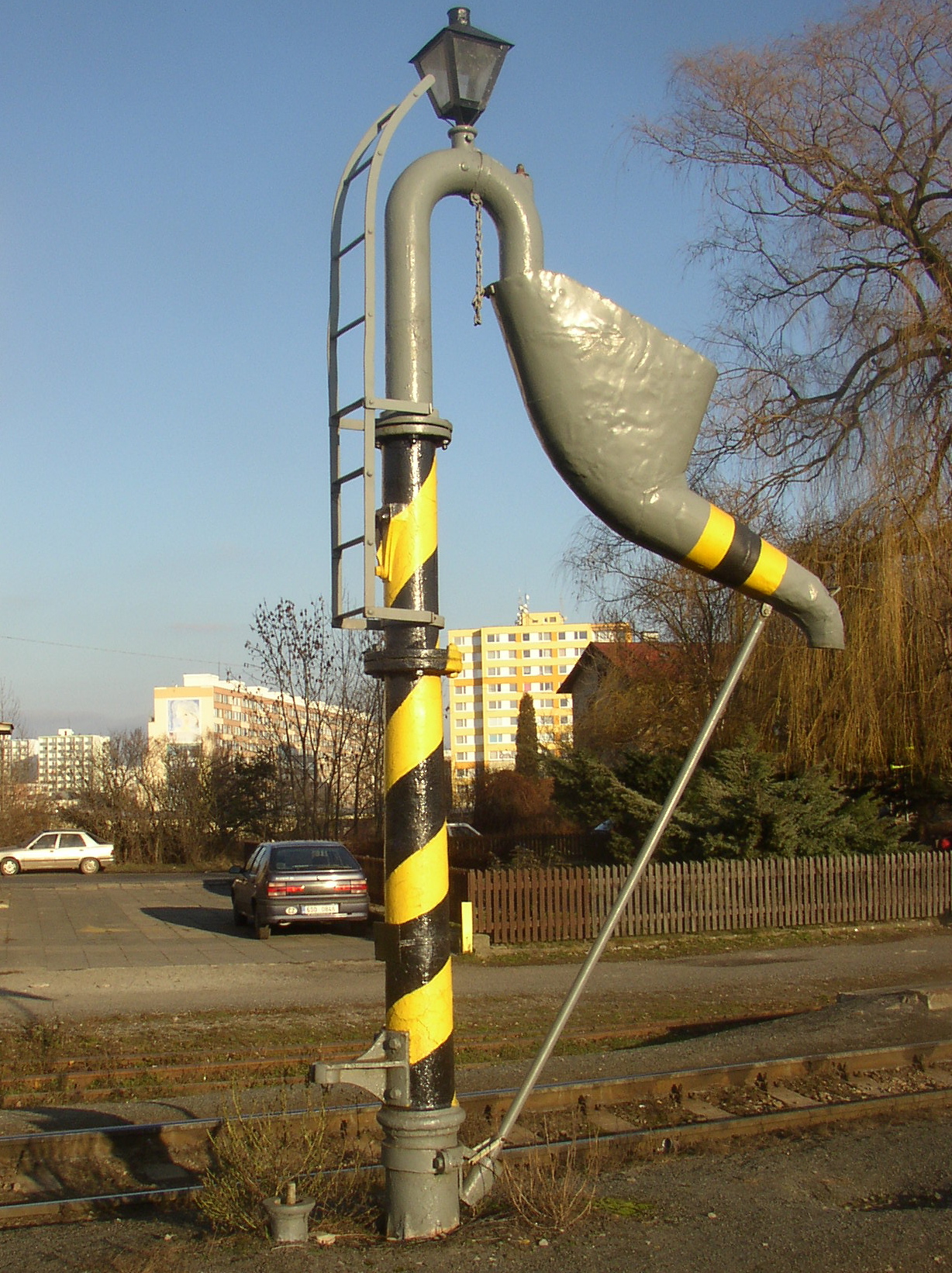
A water crane is a device used for delivering a large volume of water into the tank or tender of a steam locomotive. The device is also called a water column in the United States and Australia. As a steam locomotive consumes large quantities of water, water cranes were a vital part of railway station equipment, often situated at the end of a platform, so that water could be refilled during a stop at the station.
Overview
Generally, water cranes consist of an upright steel pipe about 8 to in diameter with a horizontal, pivoting pipe connected to its upper end so as to form a swinging arm. Water cranes may be able to deliver up to 10 m3 of water per minute.
Water supply
In hilly country, natural streams can be dammed and water fed by gravity to the water crane. In flatter country this arrangement is not always possible, so water may be supplied by a tank next to the crane. Water tanks may vary in volume from 190 m3 to greater than 757 m3.
Depending on the quality of the water under supply, it may need to be treated chemically to eliminate hardness which induces scale buildup on the inside of the locomotive boiler. The scale which builds up on heat transfer surfaces forms a layer of insulation between the metal of the firebox and the boiler water. This causes metal to overheat or corrode and eventually fail.
References
References
- "Stand-pipe for railway uses".
- "Railway stand-pipe".
- "Stand-pipe for railway water-supply".
- Railway and Locomotive Historical Society, Marietta, GA (2008). [http://rlhs.org/Publications/Quarterly/PDF/nl28-4.pdf "The Railroad Station Water Column."] {{Webarchive. link. (2021-02-11 ''Railway and Locomotive Historical Society Quarterly,'' Vol. 28, No. 4 - Vol. 29, No 1. p.6.)
- Webb, Walter Loring. (1917). "Railroad Construction, Theory and Practice". John Wiley & Sons, Inc.
- Cleemann, Thomas M.. (1880). "The Railroad Engineer's Practice". George H. Frost, Publisher.
- Tratman, Edward Ernest Russell. (1901). "Railway Track and Track Work". Engineering News Publishing Company.
- Wrinn, Jim. (January 2012). "What's in the water?". Kalmbach Publishing Company.
This article was imported from Wikipedia and is available under the Creative Commons Attribution-ShareAlike 4.0 License. Content has been adapted to SurfDoc format. Original contributors can be found on the article history page.
Ask Mako anything about Water crane — get instant answers, deeper analysis, and related topics.
Research with MakoFree with your Surf account
Create a free account to save articles, ask Mako questions, and organize your research.
Sign up freeThis content may have been generated or modified by AI. CloudSurf Software LLC is not responsible for the accuracy, completeness, or reliability of AI-generated content. Always verify important information from primary sources.
Report