From Surf Wiki (app.surf) — the open knowledge base
Wat
Buddhist or Hindu temple in Asia
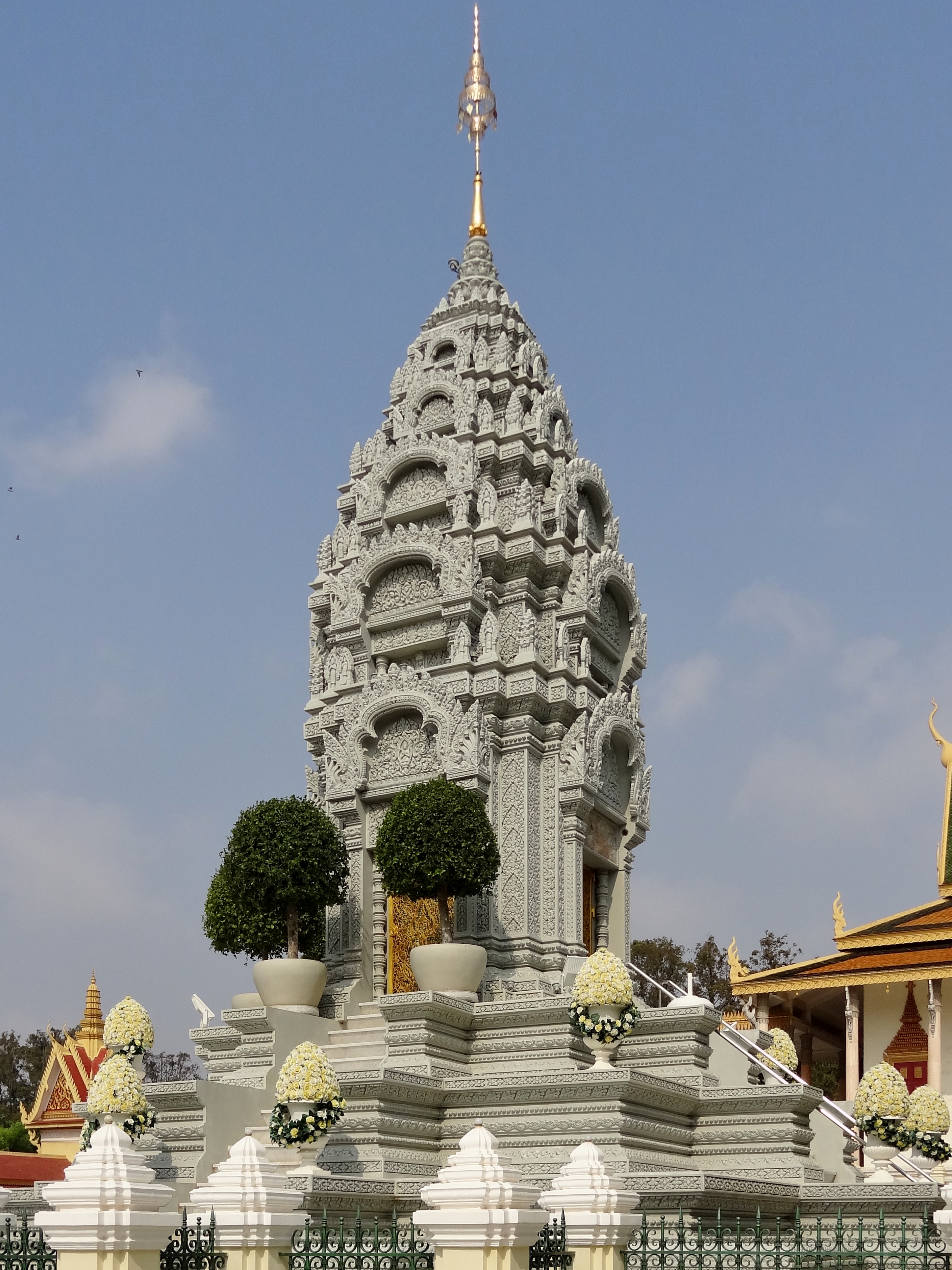
Buddhist or Hindu temple in Asia
Bangkok, Thailand Luang Prabang, Laos Phnom Penh, Cambodia Chiang Rai, Thailand
A wat (, km ; , vat ; , ; ; , ) is a type of Buddhist and Hindu temple in Cambodia, Laos, East Shan State (Myanmar), Yunnan (China), the Southern Province of Sri Lanka, and Thailand.
Etymology
The word wat is borrowed from the Sanskrit vāṭa (Devanāgarī: वाट), meaning "enclosure". The term has varying meanings in each region, sometimes referring to a specific type of government-recognised or large temple, other times referring to any Buddhist or Hindu temple.
Overview
In Buddhism, a wat is a Buddhist sacred precinct with vihara, a temple, an edifice housing a large image of Buddha and a facility for lessons. A site without a minimum of three resident bhikkhus cannot correctly be described as a wat although the term is frequently used more loosely, even for ruins of ancient temples. As a transitive or intransitive verb, wat means to measure, to take measurements; compare templum, from which temple derives, having the same root as template.
In Cambodia, a wat is any place of worship. "Wat" generally refers to a Buddhist place of worship, but the precise term is vôtt pŭtthsasnéa (វត្តពុទ្ធសាសនា) meaning "Buddhist pagoda". "Angkor Wat" (អង្គរវត្ត km) means 'city of temples'.
In everyday language in Thailand, a "wat" is any place of worship except a mosque (; ; or ; ) or a synagogue (; ). Thus, a wat chin (วัดจีน; ) or san chao (ศาลเจ้า; ) is a Chinese temple (either Buddhist or Taoist), wat khaek (วัดแขก; ) or thewasathan (เทวสถาน; from ) is a Hindu temple, wat sik (; is a Gurdwara, and bot khrit (โบสถ์คริสต์) or wat farang (วัดฝรั่ง; ) is a Christian church, though Thai โบสถ์ () may be used descriptively as with mosques.
Types
According to Thai law, there are two types of Thai Buddhist temples:
- Wats (วัด; wat) are temples which have been endorsed by the state and have been granted Visungkhamsima (วิสุงคามสีมา), or the land for establishing central hall, by the king. These temples are divided into:
- Royal temples (; ): established or patronised by the king or his family members.
- Public temples (; ): established by private citizens. Despite the term "private", private temples are open to the public and are sites of public religious activities.
- Samnak song (): are temples or monasteries without state endorsement and wisungkhamasima. For example, Wat Tham Krabok in Phra Phutthabat was established as a samnak song in 1975 and was granted a wat status in 2012.
Structure
Main article: Thai temple art and architecture


A typical Buddhist wat consists of the following buildings:
- Bell tower (, pâm chuŏng ; ; )
- Bot () or ubosot (; ; from Pali uposatha) or sim (): the holiest prayer room, also called the "ordination hall" as it is where new monks take their vows. Architecturally it is similar to the vihara. The main difference is the eight cornerstones placed around the bot to ward off evil. The bot is usually more decorated than the wihan. In Cambodia nowadays, this type of building is considered to be Vihear. It was previously called Ubaosathakea or Rorng Ubaosoth ().
- Chedei () or Chedi (; ) from Sanskrit: chaitya, temple or that (): It is also known as a Stupa (). Usually conical or bell-shaped buildings, but many Cambodian stupas are constructed in the style of temple shrine. They often contain relics of Buddha. The urns containing the ashes of the cremated dead are kept here and serve as memorials for those ancestors.
- Chantakhara (): a room in which fire and water are kept.
- Drum tower (; ; )
- Hong Song Nam (): toilet.
- Ho trai (; ; ): library where Buddhist texts are kept.
- Kappapiya Kudi () utility and storage room.
- Kod (), Kut, Kutti, Kuti or Kati (; ): the living quarters of monks (bhikkhus) separated from the sacred buildings.
- Mondop (; ; from Sanskrit: Mandapa): usually an open, square building with four arches and a pyramidal roof, used to worship religious texts or objects.
- Pond ( - Srah; Sa Nam; Sa Nam): is rectangular in shape and sometimes decorated with lotus flowers, the emblematic flower of Buddhism. In addition, some wats illustrate the figure of Buddha being sheltered by a seven headed naga, named Mucalinda (), in the middle of the pond. The pond itself is called Mucalinda Pond.
- Sala (; ; ; from the Sanskrit word शाला (IAST: śālā), cognate of Hindi शाल, meaning hall, large room or shed.{{cite web
|access-date= 11 June 2012
- Oupadthan Sala or Sala Bonn () or Sala Wat (): a hall for people gathering together to make a donation or for ceremonies.
- Sala Baley or Sala Putthikakseksa (): literally means 'Pali school' or 'Buddhist educational school', is the place to teach Buddhist Dharma and other subjects in both Pali and Khmer languages. Sala Baley is divided into three levels. They are: Buddhist elementary school ( Putthikakpathamaseksa); Buddhist high school ( - Putthikakvityealay); and Buddhist university ( Putthikaksakalvityealay). Beside Buddhist Dharma, Buddhist university includes subjects such as philosophy, science, information technology, Sanskrit, and other foreign languages. These schools may be constructed outside the wat and laypersons are also permitted to study there.
- Sala Chhann (), Sala Bat (), or Ho Chan (): cafeteria for monks.
- Sala Chhatean (), Sala Klang Yan () or Sala Rong Tham (; ): is usually smaller than other halls and can be built outside the wat, especially along the roads or even in the center of villages. It is used to celebrate Buddhist events as well as for dining and relaxation.
- Sala Kan Parian () or Ho Chaek (; ): study hall,
- Sala Song (): the room where monks receive holy water blessings.
- Sala Thormmasaphear or Thormmasala (), Sala Fang Tham (): Dharma assembly pavilion, however some assume this hall to be Sala Bonn.
- Sala Tha Nam (): pier pavilion.
- Vihear () or wihan (; ) from Sanskrit: vihara: a meeting and prayer room.
- Wachak Kod () or Watcha Kudi () or than (; ): toilet.
Almost all Buddhist temples in Cambodia were built in Khmer architectural style. Most temples were finely decorated with a spiked tower (bosbok) ()(some temples have three or five spiked towers; some have none) on the rooftop along with pediments, naga heads, and chovear () (a decorative ridge-piece that is placed at each topmost edge of the roof, just above the tip of each pediment). Below the edge of the roof and at the top of external columns, garuda or kinnari figures are depicted supporting the roof. There are a pair of guardian lions and one head or several (three, five, seven, or nine). naga sculptures are beside each entrance of the temple. Inside the main temple (vihara) and the multipurpose hall (lunch hall), mural paintings depict the life of Gautama Buddha and his previous life.
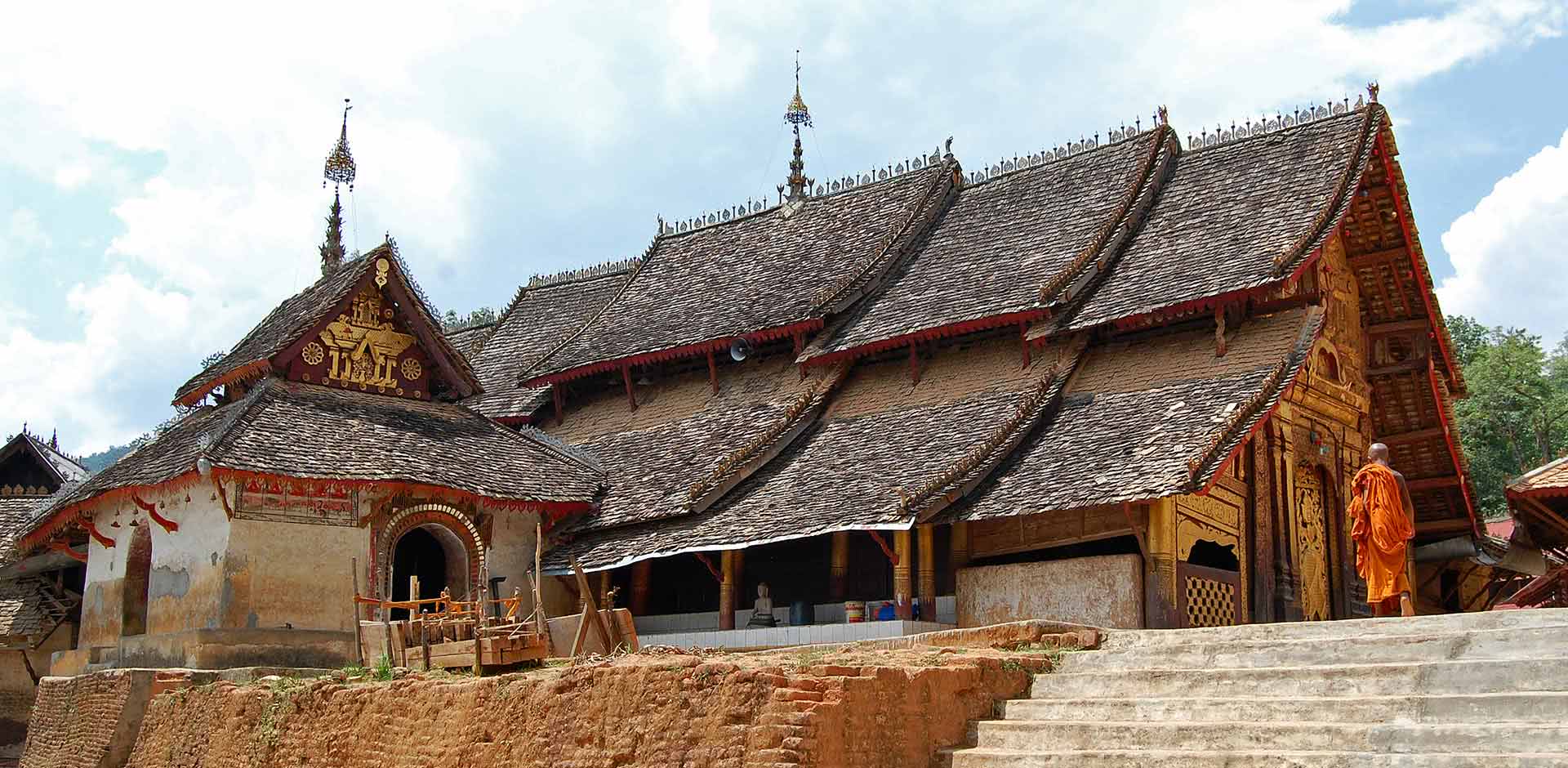
The roofs of Thai temples are often adorned with chofas.
Examples
Some well-known wats include:
Cambodia
Main article: List of Buddhist temples in Cambodia
At the end of 2017, there were 4,872 wats with 69,199 Buddhist monks supporting Buddhism in Cambodia. By 2019, it was illustrated that 97.1 percent of the Cambodian population was Buddhist, making Cambodia to be one of the most predominant Buddhist nations in the world.
- Angkor Wat, Siem Reap
- Wat Preah Keo, Phnom Penh
- Wat Botum Vattey, Phnom Penh
- Wat Moha Montrey, Phnom Penh
- Wat Ounalaom, Phnom Penh
- Wat Phnom, Phnom Penh
- Wat Bakan, Pursat
Laos
- Wat Si Saket, Vientiane
- Wat Xieng Thong, Luang Prabang
- Wat Mai Suwannaphumaham, Luang Prabang
- Wat Manorom, Luang Prabang
Malaysia
Main article: List of Buddhist temples in Malaysia
- Wat Buppharam, Penang
- Wat Chayamangkalaram, Penang
- Wat Chetawan, Selangor
- Wat Phothivihan, Kelantan
Despite having only 3.8 percent Buddhists in Kelantan, the northern Malaysian state of Kelantan has numerous Thai wats.
Singapore
Main article: List of Buddhist temples in Singapore
- Wat Ananda
- Wat Palelai
Thailand
Main article: List of Buddhist temples in Thailand
Thailand had 39,883 wats. Three hundred-ten were royal wats, the remainder were private (public). There were 298,580 Thai Buddhist monks, 264,442 of the Maha Nikaya order and 34,138 of the Dhammayuttika Nikaya order. There were 59,587 Buddhist novice monks.
- Wat Suthat, Bangkok
- Wat Benchamabophit (The Marble Temple)
- Wat Ratchanatdaram
- Wat Phra Kaew
- Wat Arun
- Wat Bowonniwet Vihara
- Wat Pho
- Wat Saket
- Wat Phra That Doi Suthep, Chiang Mai
- Wat Chiang Man, Chiang Mai
- Wat Chedi Luang, Chiang Mai
- Wat Phra Singh, Chiang Mai
- Wat Phra That Lampang Luang, Lampang
- Wat Phumin, Nan
- Phra Pathommachedi, Nakhon Pathom
- Wat Pah Nanachat (International Forest Monastery), Ubon Ratchathani
Gallery
Cambodia
Angkor Wat.jpg|Angkor Wat VatNokor 08.jpg|Wat Nokor, Kompong Cham, Cambodia 2016 Phnom Penh, Pałac Królewski, Srebrna Pagoda (05).jpg|Silver Pagoda Wat Peapahd.Battambang.2009.jpg|Vihear of Wat Peapet, Battambang, Cambodia 2016 Phnom Penh, Wat Botum (09).jpg|Vihear of Wat Botum Wattey, Phnom Penh, Cambodia Phnom Penh Wat Unalom 01.jpg|Wat Ounalom 2016 Phnom Penh, Wat Langka (22).jpg|Wat Langka
Laos
Wat Xieng Thong (Luang Prabang, Laos).JPG|Wat Xieng Thong, Luang Prabang Wat Si Saket side view, Vientiane, Laos.jpg|Wat Sisaket
Thailand
File:กลุ่มอาคารบนฐานไพที วัดพระศรีรัตนศาสดาราม.jpg|Wat Phra Kaew File:เจดีย์ประธานทรงปรางค์วัดอรุณ2.jpg|Wat Arun File:โลหะปราสาทวัดราชนัดดาราม.jpg|Wat Ratchadatdaram File:พระวิหารหลวงพระพุทธชินราช.jpg|Wat Phra Si Rattana Mahathat, Phitsanulok File:พระอุโบสถวัดนิเวศธรรมประวัติราชวรวิหาร.jpg|Wat Niwet Thammaprawat, Ayutthaya File:Wat Phra That Chang Kham, bôt, chedi et viharn, Nan.jpg|Two wihans and a chedi at Wat Phra That Chang Kham, Nan File:Phra That Doi Suthep 01.jpg|Wat Phra That Doi Suthep, Chiang Mai
Other countries
Wat Buddhapadipa, Buddhist Temple 02.jpg|Wat Buddhapadipa in Wimbledon, London, UK Buddharama Nukari.jpg|Interior of the Thai Buddhist wat in Nukari, Nurmijärvi, Finland
- Some Tai Khun monasteries in East Shan State, Myanmar are in wat-style but may be called kyaung, while some may be called wat but in kyaung style.
References
References
- "wat". [[Oxford University Press]].
- {{Cite Merriam-Webster. wat
- ราชกิจจานุเบกษา,[https://web.archive.org/web/20111109221110/http://www.ratchakitcha.soc.go.th/DATA/PDF/2458/A/284.PDF ประกาศกระทรวงธรรมการ แผนกกรมสังฆการี เรื่อง จัดระเบียบพระอารามหลวง], เล่ม ๓๒, ตอน ๐ ก, ๓ ตุลาคม พ.ศ.๒๔๕๘, หน้า ๒๘๔
- Baird, Ian G.. (2013). "The monks and the Hmong: The special relationship between the Chao Fa and the Tham Krabok Buddhist Temple in Saraburi Province, Thailand. In Vladimir Tikhonov and Torkel Brekke (eds.), Violent Buddhism – Buddhism and Militarism in Asia in the Twentieth Century.". Routledge.
- 26th annual Buddhist monk summit of Cambodia in Chaktomuk conference hall, Phnom Penh, December 2017.
- (2019). "Percentage distribution of population by religion, area, and province, Cambodia, 2008-2019 (General population census of Cambodia in 2019).".
- "Thai temples that can be found in The State of Kelantan Darul Naim, Malaysia".
- "Educational Statistics 2016".
This article was imported from Wikipedia and is available under the Creative Commons Attribution-ShareAlike 4.0 License. Content has been adapted to SurfDoc format. Original contributors can be found on the article history page.
Ask Mako anything about Wat — get instant answers, deeper analysis, and related topics.
Research with MakoFree with your Surf account
Create a free account to save articles, ask Mako questions, and organize your research.
Sign up freeThis content may have been generated or modified by AI. CloudSurf Software LLC is not responsible for the accuracy, completeness, or reliability of AI-generated content. Always verify important information from primary sources.
Report