From Surf Wiki (app.surf) — the open knowledge base
Washer (hardware)
Thin plate with a hole, normally used to distribute the load of a threaded fastener
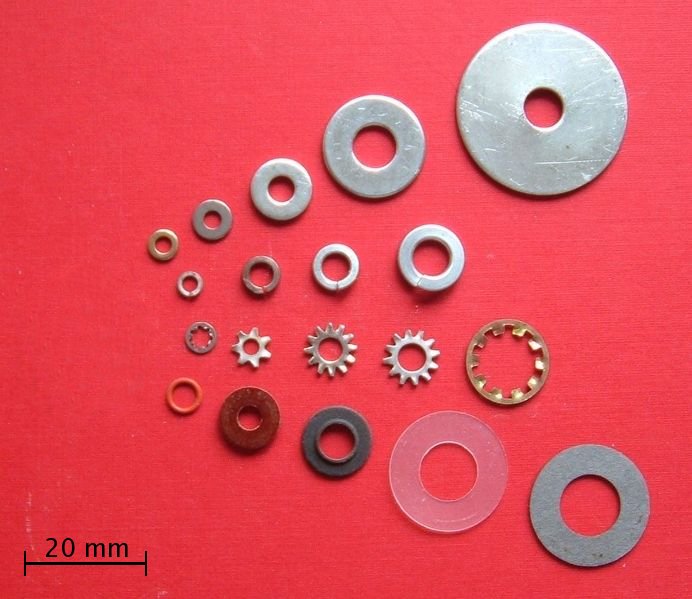
Thin plate with a hole, normally used to distribute the load of a threaded fastener
A washer is a thin plate (typically disk-shaped, but sometimes square) with a hole (typically in the middle) that is normally used to distribute the load of a threaded fastener, such as a bolt or nut. Other uses are as a spacer, spring (Belleville washer, wave washer), wear pad, preload indicating device, locking device, and to reduce vibration (rubber washer).
Washers are usually metal or plastic. High-quality bolted joints require hardened steel washers to prevent the loss of pre-load due to brinelling after the torque is applied. Washers are also important for preventing galvanic corrosion, particularly by insulating steel screws from aluminium surfaces. They may also be used in rotating applications, as a bearing. A thrust washer is used when a rolling element bearing is not needed either from a cost-performance perspective or due to space restraints. Coatings can be used to reduce wear and friction, either by hardening the surface or by providing a solid lubricant (i.e. a self-lubricating surface).
Rubber or fiber gaskets used in taps (or faucets, valves, and other piping connections) as seal against water leaks are sometimes referred to colloquially as washers; but, while they may look similar, washers and gaskets are usually designed for different functions and made differently.
Etymology
The origin of the word is unknown. The first recorded use of the word was in 1346; however, the first time its definition was recorded was in 1611.
Washer types
Most washers can be categorized into three broad types;
- Plain washers, which spread a load, and prevent damage to the surface being fixed, or provide some sort of insulation such as electrical
- Spring washers, which have axial flexibility and are used to prevent fastening or loosening due to vibrations
- Locking washers, which prevent fastening or loosening by preventing unscrewing rotation of the fastening device; locking washers are usually also spring washers.
Plain washers
| Name(s) | Image | Description | ||||||
|---|---|---|---|---|---|---|---|---|
| Plain washer (or "flat washer") | [[File:Plain_washer1.jpg | 100px]] | A flat annulus or ring, often of metal, used to spread the load of a screwed fastening. Additionally, a plain washer may be used when the hole is a larger diameter than the fixing nut. | |||||
| Fender washer (US), penny washer, mudguard washer, or "repair washer" (UK) | [[File:Fender_washer.tif | 100px]] | A flat washer with a particularly large outer diameter in proportion to its central hole. These are commonly used to spread the load on thin sheet metal, and are named after their use on automobile fenders. They can also be used to make a connection to a hole that has been enlarged by rust or wear. In the UK, the name originally comes from the size of the old British penny. In the UK, most industries refer to all large OD washers as penny washers, even when the OD is as much as twice the size of the old penny. | |||||
| Spherical washer nut and screw | Part of a self-aligning nut; it is a washer with one radiused surface, which is designed to be used in conjunction with a mating nut in order to allow for up to several degrees of misalignment between parts. | |||||||
| Anchor plate or wall washer | [[File:Anchor_2_(PSF).png | 100px]] | title=Dictionary of Building Preservation | last=Bucher | first=Ward | year=1996 | publisher=Preservation Press | pages=576}} |
| Torque washer | Used in woodworking in combination with a carriage bolt; it has a square hole in the centre into which the carriage bolt square fits. Teeth or prongs on the washer bite into the wood, preventing the bolt from spinning freely when a nut is being tightened. |
Spring and locking washers
| Name(s) | Image | Description | |||||||
|---|---|---|---|---|---|---|---|---|---|
| Belleville washer, also called cupped spring washer or conical washer | [[File:Belleville washer.jpg | 100px]] | title=Fastener Design Manual | publisher=NASA | date=1990 | pages=9–10 | url=https://ntrs.nasa.gov/archive/nasa/casi.ntrs.nasa.gov/19900009424_1990009424.pdf | archive-url=https://web.archive.org/web/20100515043710/https://ntrs.nasa.gov/archive/nasa/casi.ntrs.nasa.gov/19900009424_1990009424.pdf | archive-date=15 May 2010}} |
| Curved disc spring | [[File:Curved spring washer.jpg | 100px]] | Similar to a Belleville, except the washer is curved in only one direction, therefore there are only four points of contact. Unlike Belleville washers, they exert only light pressures. | ||||||
| Wave washers | [[File:Wave washer 22mm-43mm 2016-03-03.jpg | 100px]] | A washer with a "wave" in the axial direction, which provides spring pressure when compressed. Wave washers, of comparable size, do not produce as much force as Belleville washers. In Germany, they are sometimes used as lock washers but they are less effective than other choices. | ||||||
| Split washer or spring lock washer | [[File:Grower01.jpg | 100px]] | A ring split at one point and bent into a helical shape. This causes the washer to exert a spring force between the fastener's head and the substrate, which maintains the washer hard against the substrate and the bolt thread hard against the nut or substrate thread, creating more friction and resistance to rotation. Applicable standards are ASME B18.21.1, DIN 127 B, and United States Military Standard NASM 35338 (formerly MS 35338 and AN-935). | ||||||
| Toothed lock washer, serrated washer or star washer | [[File:External tooth lock washer.tif | Toothed lock washer with external teeth | 100px]] | ||||||
| [[File:Federringep.jpg | Internal and external star washers | 100px]] | title=Specifications for Internal Tooth Lock Washers ASME B18.21.1-1999 | url=http://www.aspenfasteners.com/v/vspfiles/files/docs/internal_tooth_lockwasher_specification.pdf | website=Aspen Fasteners }} The external style has the serrations around the outer edge, which provides better holding power, because of the greater circumference. The combination style has serrations about both edges, for maximum holding power. The countersunk style is designed to be used with countersunk screws. | ||||
| Tab washer | [[File:ARFISA 27.jpg | 100px]] | A locking washer that works by having a side tab that can be bent into place against a nut. Metallic or non-metallic, the tab washer notch prevents rotation relative to the shaft or fastener. Variations include single, multiple, formed and flat. | ||||||
| Wedge lock washer | [[File:Wedge Locking Washer.jpg | 120x120px]] | A hardened two-piece washer with radial teeth on the outside to grip both the fastener and mounting surface. The two halves of this washer form a wedge seam, which requires additional tension to be placed on the fastener in order for them to separate after tightening. While generally more expensive per piece, these washers provide the highest amount of vibrational loosening prevention. |
Lock washers, locknuts, jam nuts, and thread-locking fluid are ways to prevent vibration from loosening a bolted joint.
Gaskets
The term washer is often applied to various gasket types such as those used to seal the control valve in taps.
| Name | Image | Description |
|---|---|---|
| Shoulder washer | A plain washer type with integral cylindrical sleeve. Used as a barrier between differing metals and as a seal. This term is also used for electrically insulating grommets. | |
| Crush washer | A washer made of soft metal such as aluminium or copper. Used to seal fluid or gas connections such as those found in hydraulic systems and in internal combustion engines. |
Specialised types
| Name(s) | Image | Description | |
|---|---|---|---|
| Keps nut or K-lock nut | [[File:Keps_nuts_from_Ace_Hardware,_Concord_MA.jpg | 100px]] | A nut with an integral free spinning washer; assembly is easier because the washer is captive. |
| Self-aligning washer | A two-part washer: one part has one convex spherical surface, which mates with a concave surface on the other part, to allow tightening to a surface which is not perpendicular to the axis of the screw or nut fastener, in a similar manner to a spherical washer and self-aligning nut | ||
| Top hat washer | A shoulder washer type used in plumbing for tap fitting. | ||
| Insulating shoulder washer | Used to electrically isolate a mounting screw from the surface it secures. Often made of nylon, these are also made of teflon, PEEK or other plastics to withstand higher temperatures. | ||
| Keyed washer | A washer with a key to prevent rotation, and is used to lock two nuts in place, without allowing the torque applied to the top nut to cause the bottom nut to also rotate (such as in a threaded headset on a bicycle). | ||
| Torque-limiting washer | A type of washer used in a variety of torque sensitive applications, designed to limit torque to a predetermined level and not beyond. | ||
| Dowty washer | Has a central rubber ring to provide a strong seal against high pressure liquid or gas. |
The DIN 125 metric washer standard refers to subtypes A and B. ISO 7089 calls these Form A and ISO 7090 calls them Form B. They are all the same overall size, but Form B is chamfered on one side.
Materials
Washers can be fabricated from a variety of materials including, but not limited to:
- Steel – Carbon steel, spring steel, A2 (304) stainless steel, and A4 (316/316L) stainless steel
- Non-ferrous metal – Copper, brass, aluminium, titanium, iron, bronze, and zinc
- Alloy – Silicon bronze, Inconel, Monel, and Hastelloy
- Plastic – Thermoplastics and thermosetting polymers such as polyethylene, PTFE (Teflon)
- Nylon – Nylon 6, Nylon 66, Nylatron, and Tecamid MDS
- Specialty – Fibers, ceramics, rubber, felt, leather, bimetals, and mica
- Phenolic – The material has good electrical insulation, is lightweight, tough, has low moisture absorption, is heat resistant, and is resistant to chemicals and corrosion. Phenolic washers are substitutes for flat metallic washers in cases where electrical insulation is required. Phenolic washers are stamped out of large sheets of the phenolic material. The term "phenolic washer" is sometimes used for stamped washers from laminated materials such as paper, canvas, and Mylar.
Corrosion resistance
A number of techniques are used to enhance the corrosion resistant properties of certain washer materials:
- Metallic coatings – Typical coatings used to produce corrosion resistant washers are zinc, cadmium, and nickel. Zinc coating acts as a sacrificial surface layer that falls victim to corrosive materials before the washer's material can be harmed. Cadmium produces a high-quality protective surface but is toxic, both biologically and environmentally. Nickel coatings add protection from corrosion only when the finish is dense and non-porous.
- Electroplating – This method involves coating the washer by electrolytic deposition using metals such as chromium or silver.
- Phosphating – A resilient, but abrasive surface is achieved by incorporating a zinc-phosphate layer and corrosion-protective oil.
- Browning or bluing – Exposing the washer (typically steel) to a chemical compound or alkali salt solution causes an oxidizing chemical reaction, which results in the creation of a corrosion-resistant, colored surface. The integrity of the coating can be improved by treating the finished product with a water-displacing oil.
- Chemical plating – This technique utilizes a nickel-phosphor alloy that is precipitated onto the washer surface, creating an extremely corrosion- and abrasive-resistant surface.
Type and form

The American National Standards Institute (ANSI) provides standards for general use flat washers. Type A is a series of steel washers at broad tolerances, where precision is not critical. Type B is a series of flat washers with tighter tolerances where outside diameters are categorized as "narrow", "regular" or "wide" for specific bolt sizes.
"Type" is not to be confused with "form" (but often is). The British Standard for Metric Series Metal Washers (BS4320), written in 1968, coined the term "form". The forms go from A to G and dictate the outside diameter and thickness of the flat washers.
- Form A: Normal diameter, normal thickness
- Form B: Normal diameter, light thickness
- Form C: Large diameter, normal thickness
- Form D: Large diameter, light thickness
- Form E: Normal diameter, normal thickness
- Form F: Large diameter, normal thickness
- Form G: Largest diameter, larger thickness. Washer 'form' when comparing different washer material types is used quite freely by stockists. In relation to BS4320 specifically, washer forms 'A' to 'D' inclusive are designated 'bright metal' washers and are supplied self-finished in various metals including: steel alloys, brass, copper, etc. Whereas, BS4320 washer forms 'E' to 'G' inclusive are designated 'black' (uncoated) mild steel washers, which normally are specified with a supplementary protective coating supply condition.
Standard metric flat washers sizes
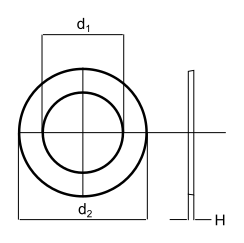
Washers of standard metric sizes equivalent to BS4320 Form A are listed in the table below. Measurements in the table refer to the dimensions of the washers as described by the drawing. Specifications for standard metric flat washers were known as DIN 125 (withdrawn) and replaced with ISO 7089. DIN (Deutsches Institut für Normung - German Institute for Standardization) standards are issued for a variety of components including industrial fasteners as Metric DIN 125 Flat Washers. The DIN standards remain common in Germany, Europe and globally even though the transition to ISO standards is taking place. DIN standards continue to be used for parts which do not have ISO equivalents or for which there is no need for standardization.
| Nominal screw | |||||||||
|---|---|---|---|---|---|---|---|---|---|
| sizes, M (mm) | Screw pitch | ||||||||
| thread, P (mm) | Diameter (mm) | Thickness, | |||||||
| H (mm) | 1st | ||||||||
| choice | 2nd | ||||||||
| choice | Coarse | Fine | Internal | ||||||
| hole, d1 | External, | ||||||||
| d2 | |||||||||
| 1 | 0.25 | 1.1 | 3 | 0.3 | |||||
| 1.2 | 0.25 | 1.3 | 3.5 | 0.3 | |||||
| 1.4 | 0.3 | 1.5 | 4 | 0.3 | |||||
| 1.6 | 0.35 | 1.7 | 4 | 0.3 | |||||
| 1.7 | 1.8 | 4.5 | 0.3 | ||||||
| 1.8 | 0.35 | ||||||||
| 2 | 0.4 | 2.2 | 5 | 0.3 | |||||
| 2.5 | 0.45 | 2.7 | 6 | 0.5 | |||||
| 2.6 | 2.8 | 7 | 0.5 | ||||||
| 3 | 0.5 | 3.2 | 7 | 0.5 | |||||
| 3.5 | 0.6 | 3.7 | 8 | 0.5 | |||||
| 4 | 0.7 | 4.3 | 9 | 0.8 | |||||
| 5 | 0.8 | 5.3 | 10 | 1 | |||||
| 6 | 1 | 0.75 | 6.4 | 12 | 1.6 | ||||
| 7 | 1 | 7.4 | 14 | 1.6 | |||||
| 8 | 1.25 | 1 | 8.4 | 16 | 1.6 | ||||
| 10 | 1.5 | 1.25 or 1 | 10.5 | 20 | 2 | ||||
| 12 | 1.75 | 1.5 or 1.25 | 13 | 24 | 2.5 | ||||
| 14 | 2 | 1.5 | 15 | 28 | 2.5 | ||||
| 16 | 2 | 1.5 | 17 | 30 | 3 | ||||
| 18 | 2.5 | 2 or 1.5 | 19 | 34 | 3 | ||||
| 20 | 2.5 | 2 or 1.5 | 21 | 37 | 3 | ||||
| 22 | 2.5 | 2 or 1.5 | 23 | 39 | 3 | ||||
| 24 | 3 | 2 | 25 | 44 | 4 | ||||
| 27 | 3 | 2 | 28 | 50 | 4 | ||||
| 30 | 3.5 | 2 | 31 | 56 | 4 | ||||
| 33 | 3.5 | 2 | 34 | 60 | 5 | ||||
| 36 | 4 | 3 | 37 | 66 | 5 | ||||
| 39 | 4 | 3 | 40 | 72 | 6 | ||||
| 42 | 4.5 | 3 | 43 | 78 | 7 | ||||
| 45 | 4.5 | 3 | 46 | 85 | 7 | ||||
| 48 | 5 | 3 | 50 | 92 | 8 | ||||
| 52 | 5 | 4 | 54 | 98 | 8 | ||||
| 56 | 5.5 | 4 | 58 | 105 | 9 | ||||
| 60 | 5.5 | 4 | 62 | 110 | 9 | ||||
| 64 | 6 | 4 | 66 | 115 | 9 | ||||
| 68 | 70 | 120 | 10 | ||||||
| 72 | 74 | 125 | 10 | ||||||
| 76 | 78 | 135 | 10 | ||||||
| 80 | 82 | 140 | 12 | ||||||
| 85 | 87 | 145 | 12 | ||||||
| 90 | 93 | 160 | 12 | ||||||
| 100 | 104 | 175 | 14 |
Notes
References
References
- (28 June 2005). "The Straight Dope: What's the purpose of washers (the round metal things)?".
- Paul Green. (2007). "The Mechanical Engineering Drawing Desk Reference: Creating and Understanding ISO Standard Technical Drawings". Lulu.com / CreateSpace.
- Nikolas Davies. (2008). "Dictionary of architecture and building construction". Architectural Press.
- Bucher, Ward. (1996). "Dictionary of Building Preservation". Preservation Press.
- John Holloway. (2010). "Illustrated Theatre Production Guide". Focal Press.
- (1990). "Fastener Design Manual". [[NASA]].
- "McMaster-Carr catalog". McMaster-Carr.
- Smith, Carroll. (1990). "Carroll Smith's Nuts, Bolts, Fasteners, and Plumbing Handbook". MotorBooks/MBI Publishing Company.
- "McMaster-Carr catalog". McMaster-Carr.
- "Helical Spring Washers".
- IS 3063 : 1994 Fasteners - Single coil rectangular section spring lock washers - Specification
- Bickford. John H. "An Introduction to the Design and Behavior of Bolted Joints" 3rd Ed 1995. p561 {{ISBN. 978-0824792978
- "Specifications for Internal Tooth Lock Washers ASME B18.21.1-1999".
- "Specifications for External Tooth Lock Washers ASME B18.21.1-1999".
- "Specifications for Internal/External Tooth Lock Washers ASME B18.21.1-1999".
- "Specifications for Countersunk External Tooth Lock Washers ASME B18.21.1-1999".
- (23 January 2012). "Improved Bonding and Grounding Methods for Electrical / Electronic Equipment".
- "What’s With Washers?". Assembly Magazine.
- [https://fasteners.sherex.com/category/wedge-locking-technology--vibrational-loosening-pr "Vibrational Loosening Prevention - Wedge Locking Technology"], Sherex Fastening Solutions, retrieved January 25, 2019.
- (2008). "Alloy boat corrosion: how to prevent it". Ripple Industries Pty Ltd.
- (June 1965). "Fluorescent light". Bonnier Corporation.
- "Stampings & Washers {{!}} Accutrex".
- [http://www.newprocess.com/ptfe-washers Teflon PTFE Washers], New Process, retrieved May 10, 2016
- "Nylon Spacers And Washers - New Process Fibre".
- "Washers Information {{!}} IHS Engineering360".
- "Standard Washers - Boker's, Inc.".
- "Metric DIN 125 Flat Washers".
This article was imported from Wikipedia and is available under the Creative Commons Attribution-ShareAlike 4.0 License. Content has been adapted to SurfDoc format. Original contributors can be found on the article history page.
Ask Mako anything about Washer (hardware) — get instant answers, deeper analysis, and related topics.
Research with MakoFree with your Surf account
Create a free account to save articles, ask Mako questions, and organize your research.
Sign up freeThis content may have been generated or modified by AI. CloudSurf Software LLC is not responsible for the accuracy, completeness, or reliability of AI-generated content. Always verify important information from primary sources.
Report