From Surf Wiki (app.surf) — the open knowledge base
Washburn's equation
Equation describing the penetration length of a liquid into a capillary tube with time
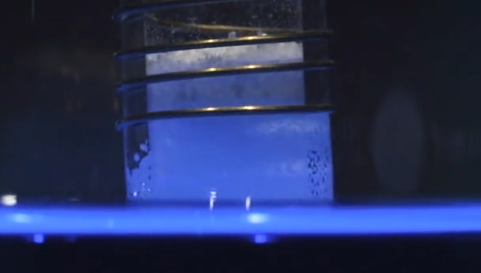
Equation describing the penetration length of a liquid into a capillary tube with time
In physics, Washburn's equation describes capillary flow in a bundle of parallel cylindrical tubes; it is extended with some issues also to imbibition into porous materials. The equation is named after Edward Wight Washburn; also known as Lucas–Washburn equation, considering that Richard Lucas wrote a similar paper three years earlier, or the Bell-Cameron-Lucas-Washburn equation, considering J.M. Bell and F.K. Cameron's discovery of the form of the equation in 1906.
Derivation
In its most general form the Lucas Washburn equation describes the penetration length (L) of a liquid into a capillary pore or tube with time t as L=(Dt)^{\frac{1}{2}}, where D is a simplified diffusion coefficient.{{cite journal| last1= Liu| first1=M. |display-authors=etal |title= Evaporation limited radial capillary penetration in porous media | journal= Langmuir | year=2016 | volume=32 |issue=38 | pages= 9899–9904|url=http://drgan.org/wp-content/uploads/2014/07/040_Langmuir_2016.pdf | doi=10.1021/acs.langmuir.6b02404 | pmid=27583455 A liquid having a dynamic viscosity \eta and surface tension \gamma will penetrate a distance L into the capillary whose pore radius is r following the relationship:
L=\sqrt{\frac{\gamma rt\cos(\phi)}{2\eta}}
Where \phi is the contact angle between the penetrating liquid and the solid (tube wall).
Washburn's equation is also used commonly to determine the contact angle of a liquid to a powder using a force tensiometer.
In the case of porous materials, many issues have been raised both about the physical meaning of the calculated pore radius r and the real possibility to use this equation for the calculation of the contact angle of the solid. The equation is derived for capillary flow in a cylindrical tube in the absence of a gravitational field, but is sufficiently accurate in many cases when the capillary force is still significantly greater than the gravitational force.
In his paper from 1921 Washburn applies Poiseuille's Law for fluid motion in a circular tube. Inserting the expression for the differential volume in terms of the length l of fluid in the tube dV=\pi r^2 dl, one obtains
:\frac{\delta l}{\delta t}=\frac{\sum P}{8\eta l}(r^2 +4 \epsilon r)
where \sum P is the sum over the participating pressures, such as the atmospheric pressure P_A, the hydrostatic pressure P_h and the equivalent pressure due to capillary forces P_c. \eta is the viscosity of the liquid, and \epsilon is the coefficient of slip, which is assumed to be 0 for wetting materials. r is the radius of the capillary. The pressures in turn can be written as
:P_h=h g \rho - l g \rho\sin\psi :P_c=\frac{2\gamma}{r}\cos\phi
where \rho is the density of the liquid and \gamma its surface tension. \psi is the angle of the tube with respect to the horizontal axis. \phi is the contact angle of the liquid on the capillary material. Substituting these expressions leads to the first-order differential equation for the distance the fluid penetrates into the tube l:
:\frac{\delta l}{\delta t}=\frac{[P_A+g \rho (h-l\sin\psi)+\frac{2\gamma}{r}\cos\phi](r^2 +4 \epsilon r)}{8\eta l}
Washburn's constant
The Washburn constant may be included in Washburn's equation.
It is calculated as follows: : \frac{10^4 \left[ \mathrm{\frac{\mu m}{cm}} \right] \left[ \mathrm{\frac{N}{m^2}} \right]}{68947.6 \left[ \mathrm{\frac{dynes}{cm^2}} \right]} = 0.1450(38)
Fluid inertia
In the derivation of Washburn's equation, the inertia of the liquid is ignored as negligible. This is apparent in the dependence of length L to the square root of time, L \propto \sqrt{t}, which gives an arbitrarily large velocity dL/dt for small values of t. An improved version of Washburn's equation, called Bosanquet equation, takes the inertia of the liquid into account.
Applications
Inkjet printing
The penetration of a liquid into the substrate flowing under its own capillary pressure can be calculated using a simplified version of Washburn's equation: : l = \left[ \frac{r\cos\theta}{2} \right]^{\frac{1}{2}} \left[ \frac{\gamma}{\eta} \right]^{\frac{1}{2}} t^{\frac{1}{2}} where the surface tension-to-viscosity ratio \left[ \tfrac{\gamma}{\eta} \right]^{\frac{1}{2}} represents the speed of ink penetration into the substrate. In reality, the evaporation of solvents limits the extent of liquid penetration in a porous layer and thus, for the meaningful modelling of inkjet printing physics it is appropriate to utilise models which account for evaporation effects in limited capillary penetration.
Food
According to physicist and Ig Nobel prize winner Len Fisher, the Washburn equation can be extremely accurate for more complex materials including biscuits. Following an informal celebration called national biscuit dunking day, some newspaper articles quoted the equation as Fisher's equation.
Novel capillary pump
The flow behaviour in traditional capillary follows the Washburn's equation. Recently, novel capillary pumps with a constant pumping flow rate independent of the liquid viscosity were developed, which have a significant advantage over the traditional capillary pump (of which the flow behaviour is Washburn behaviour, namely the flow rate is not constant). These new concepts of capillary pump are of great potential to improve the performance of lateral flow test.
References
References
- Edward W. Washburn. (1921). "The Dynamics of Capillary Flow". Physical Review.
- Lucas, R.. (1918). "Ueber das Zeitgesetz des Kapillaren Aufstiegs von Flussigkeiten". Kolloid Z..
- (1906). "The flow of liquids through capillary spaces". J. Phys. Chem..
- (2016). "Techniques for determining contact angle and wettability of powders". Powder Technology.
- Dullien, F. A. L.. "Porous Media: Fluid Transport and Pore Structure.". New York: Academic Press.
- (2006). "Contact Angle, Wettability and Adhesion". Mass. VSP.
- Micromeritics, "Autopore IV User Manual", September (2000). Section B, Appendix D: Data Reduction, page D-1. ''(Note that the addition of 1N/m2 is not given in this reference, merely implied)''
- (1970). "A new method of interpolation and smooth curve fitting based on local procedures". Journal of the ACM.
- (2000). "Influence of inertia on liquid absorption into paper coating structures". Nordic Pulp & Paper Research Journal.
- (1982). "Colloids and Surfaces in Reprographic Technology".
- (2008). "Surface-modified and micro-encapsulated pigmented inks for ink jet printing on textile fabrics". Progress in Organic Coatings.
- . ["The 1999 Ig Nobel Prize Ceremony"](http://www.improbable.com/ig/miscellaneous/ig-99.html). *Improbable Research*.
- (25 November 1998). "No more flunking on dunking". BBC News.
- (11 February 1999). "Physics takes the biscuit". Nature.
- (2016). "Viscosity Independent Paper Microfluidic Imbibition". MicroTAS 2016, Dublin, Ireland.
- (2016). "Capillary Pumping Independent of Liquid Sample Viscosity". Langmuir.
- (2017). "2017 IEEE 30th International Conference on Micro Electro Mechanical Systems (MEMS)". IEEE MEMS 2017, Las Vegas, USA.
- (2018). "Capillary pumping independent of the liquid surface energy and viscosity". Microsystems & Nanoengineering.
This article was imported from Wikipedia and is available under the Creative Commons Attribution-ShareAlike 4.0 License. Content has been adapted to SurfDoc format. Original contributors can be found on the article history page.
Ask Mako anything about Washburn's equation — get instant answers, deeper analysis, and related topics.
Research with MakoFree with your Surf account
Create a free account to save articles, ask Mako questions, and organize your research.
Sign up freeThis content may have been generated or modified by AI. CloudSurf Software LLC is not responsible for the accuracy, completeness, or reliability of AI-generated content. Always verify important information from primary sources.
Report