From Surf Wiki (app.surf) — the open knowledge base
Wasco County, Oregon
County in Oregon, United States

County in Oregon, United States
| Field | Value |
|---|---|
| county | Wasco County |
| state | Oregon |
| founded date | January 11 |
| founded year | 1854 |
| seat wl | The Dalles |
| largest city wl | The Dalles |
| area_total_sq_mi | 2395 |
| area_land_sq_mi | 2382 |
| area_water_sq_mi | 14 |
| area percentage | 0.6% |
| population_as_of | 2020 |
| population_total | 26670 |
| pop_est_as_of | 2024 |
| population_est | 26507 |
| density_sq_mi | auto |
| ex image | Wasco County Courthouse, The Dalles - DPLA - 0dc6fab0ed646a53030ee9214c538c43.jpg |
| ex image size | 240 |
| ex image cap | Wasco County Courthouse in The Dalles |
| web | co.wasco.or.us |
| time zone | Pacific |
| named for | Wasco people |
| district | 2nd |
Wasco County is one of the 36 counties in the U.S. state of Oregon. As of the 2020 census, the population was 25,213. Its county seat is The Dalles. The county is named for a local tribe of Native Americans, the Wasco, a Chinook tribe who live on the south side of the Columbia River. It is near the Washington state line. Wasco County comprises The Dalles Micropolitan Statistical Area.
History
Celilo Falls on the Columbia River served as a gathering place and major trading center for the local Native Americans, including the Wasco, Paiute, and Warm Springs tribes, for thousands of years. These rapids came to be named Les Grandes Dalles de la Columbia or "The Great Falls of the Columbia" by the French Canadian fur traders.
The Dalles initially served as a way station on the Oregon Trail as it approached the Willamette Valley. The construction of the Barlow Road over the Cascade Range in 1845, and the Donation Land Claim Act of 1850 encouraged families to settle in the area. Over the following years, Wasco County was a major transportation hub for both river and inland traffic.
The Oregon Territorial Legislature created Wasco County on January 11, 1854, from the parts of Clackamas, Lane, Linn and Marion counties, that were east of the Cascade Range. At the time of its creation, it was the largest county in the United States, consisting of 130000 sqmi that stretched clear to the Rocky Mountains. Its northern border was the Washington Territory line (the Columbia River). When Dakota Territory (including present-day Wyoming) was created in 1861, Idaho Territory in 1863, and Montana Territory in 1864, the parts of Wasco County east of the present Oregon boundaries were ceded to those territories. Other Oregon counties were split away, and Wasco was reduced to its current size.
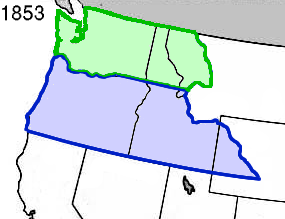
| Hood River | June 23, 1908 |
|---|
The Dalles was designated the county seat with the creation of the county, and has been its only location.
The river traffic on the Columbia River was profoundly affected in 1935 by the building of Bonneville Dam in Multnomah County and by The Dalles Dam in 1957 in Wasco County (which submerged Celilo Falls).
Wasco County attracted international attention in the 1980s, when Bhagwan Shree Rajneesh established the Rajneeshpuram movement at a marginal ranch originally called "The Big Muddy". Disagreements with the county government and other residents over zoning rules and building codes escalated, while his followers, known as Rajneeshees, settled en bloc in Antelope, Oregon and were able to elect a majority of the town councillors. When the Rajneeshees subsequently recruited homeless people from across the United States to settle at Rajneeshpuram, it was widely seen as an attempt to use the ballot box to seize control of the county. An intentional outbreak of salmonella in salad bars at ten restaurants in The Dalles in 1984 was traced to the acts of Rajneeshees.
Rajneesh was arrested as he was fleeing the U.S. in 1985 and he was subsequently indicted along with seven followers for immigration crimes by a federal grand jury. A separate grand jury in Wasco County charged three Rajneeshees of attempted murder, while Rajneesh entered an Alford plea and was given a suspended sentence on condition that he leave the country.
The former Rajneesh ranch is now known as "Washington Family Ranch". It is owned and operated by Young Life Ministries, a Christian organization providing camp services for youth.
Geography
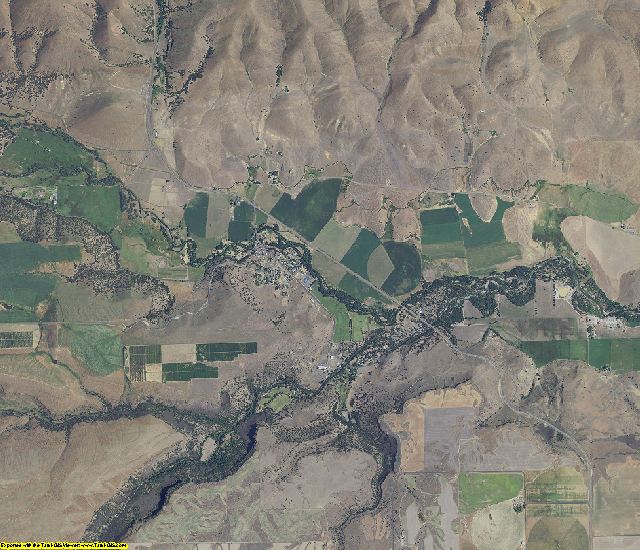
According to the United States Census Bureau, the county has a total area of 2395 sqmi, of which 2382 sqmi is land and 14 sqmi (0.6%) is water. The northern boundary with Washington is the Columbia River (the state line).
Adjacent counties
- Klickitat County, Washington - north
- Sherman County, Oregon - east
- Gilliam County, Oregon - east
- Wheeler County, Oregon - southeast
- Jefferson County, Oregon - south
- Marion County, Oregon - southwest
- Clackamas County, Oregon - west
- Hood River County, Oregon - west
National protected area
- Mount Hood National Forest
Demographics
|align-fn=center 1790–1960 1900–1990 1990–2000 2010–2020
2020 census
| Race / Ethnicity (NH = Non-Hispanic) | title=1980 Census of Population - General Population Characteristics - Oregon - Table 58 - Persons by Race and Table 59 - Total Persons and Spanish Origin Persons by Type of Spanish Origin and Race (p. 39/24-39/32) | url=https://www2.census.gov/library/publications/decennial/1980/volume-1/oregon/1980a_orabc-05.pdf | website=United States Census Bureau | page=}} | title=1990 Census of Population - General Population Characteristics - Oregon - Table 5 - Race and Hispanic Origin | url=https://www2.census.gov/library/publications/decennial/1990/cp-1/cp-1-39.pdf | website=United States Census Bureau | page=9-30}} | title=P004: Hispanic or Latino, and Not Hispanic or Latino by Race – 2000: DEC Summary File 1 – Wasco County, Oregon | url=https://data.census.gov/table?g=050XX00US41065&tid=DECENNIALSF12000.P004 | website=United States Census Bureau | access-date= }} | title=P2: Hispanic or Latino, and Not Hispanic or Latino by Race – 2010: DEC Redistricting Data (PL 94-171) – Wasco County, Oregon | url=https://data.census.gov/cedsci/table?q=p2&g=050XX00US41065&tid=DECENNIALPL2010.P2 | website=United States Census Bureau | access-date= }} | Pop 2020 | % 1980 | % 1990 | % 2000 | % 2010 | % 2020 |
|---|---|---|---|---|---|---|---|---|---|---|---|---|---|---|---|---|---|---|---|---|---|---|
| White alone (NH) | 20,434 | 19,474 | 19,967 | 19,556 | 18,703 | 94.03% | 89.81% | 83.93% | 77.56% | 70.13% | ||||||||||||
| Black or African American alone (NH) | 63 | 59 | 65 | 85 | 115 | 0.29% | 0.27% | 0.27% | 0.34% | 0.43% | ||||||||||||
| Native American or Alaska Native alone (NH) | 617 | 844 | 845 | 1,018 | 983 | 2.84% | 3.89% | 3.55% | 4.04% | 3.69% | ||||||||||||
| Asian alone (NH) | 114 | 235 | 189 | 191 | 248 | 0.52% | 1.08% | 0.79% | 0.76% | 0.93% | ||||||||||||
| Native Hawaiian or Pacific Islander alone (NH) | x | x | 116 | 142 | 185 | x | x | 0.49% | 0.56% | 0.69% | ||||||||||||
| Other race alone (NH) | 18 | 6 | 19 | 16 | 110 | 0.08% | 0.03% | 0.08% | 0.06% | 0.41% | ||||||||||||
| Mixed race or Multiracial (NH) | x | x | 376 | 462 | 1,309 | x | x | 1.58% | 1.83% | 4.91% | ||||||||||||
| Hispanic or Latino (any race) | 486 | 1,065 | 2,214 | 3,743 | 5,017 | 2.24% | 4.91% | 9.31% | 14.85% | 18.81% | ||||||||||||
| Total | 21,732 | 21,683 | 23,791 | 25,213 | 26,670 | 100.00% | 100.00% | 100.00% | 100.00% | 100.00% |
As of the 2020 census, the county had a population of 26,670. Of the residents, 21.4% were under the age of 18 and 22.7% were 65 years of age or older; the median age was 42.3 years. For every 100 females there were 99.5 males, and for every 100 females age 18 and over there were 96.4 males. 65.2% of residents lived in urban areas and 34.8% lived in rural areas.
The racial makeup of the county was 74.3% White, 0.5% Black or African American, 4.2% American Indian and Alaska Native, 0.9% Asian, 0.7% Native Hawaiian and Pacific Islander, 8.1% from some other race, and 11.2% from two or more races. Hispanic or Latino residents of any race comprised 18.8% of the population.
There were 10,553 households in the county, of which 28.7% had children under the age of 18 living with them and 26.1% had a female householder with no spouse or partner present. About 28.1% of all households were made up of individuals and 13.9% had someone living alone who was 65 years of age or older.
There were 11,996 housing units, of which 12.0% were vacant. Among occupied housing units, 65.3% were owner-occupied and 34.7% were renter-occupied. The homeowner vacancy rate was 1.9% and the rental vacancy rate was 5.5%.
2010 census
As of the 2010 census, there were 25,213 people, 10,031 households, and 6,540 families living in the county. The population density was 10.6 PD/sqmi. There were 11,487 housing units at an average density of 4.8 /mi2. The racial makeup of the county was 86.1% white, 4.4% American Indian, 0.8% Asian, 0.6% Pacific islander, 0.4% black or African American, 5.2% from other races, and 2.5% from two or more races. Those of Hispanic or Latino origin made up 14.8% of the population. In terms of ancestry, 19.8% were German, 14.0% were English, 10.6% were Irish, 6.4% were American, and 5.0% were Swedish.
Of the 10,031 households, 29.3% had children under the age of 18 living with them, 49.4% were married couples living together, 10.9% had a female householder with no husband present, 34.8% were non-families, and 28.8% of households were made up of individuals. The average household size was 2.44 and the average family size was 2.98. The median age was 41.7 years.
The median household income was $42,133 and the median family income was $50,279. Males had a median income of $40,658 versus $27,996 for females. The per capita income for the county was $21,922. About 11.1% of families and 15.5% of the population were below the poverty line, including 20.1% of those under age 18 and 7.6% of those age 65 or over.
2000 census
As of the 2000 census, there were 23,791 people, 9,401 households, and 6,505 families living in the county. The population density was 10 /mi2. There were 10,651 housing units at an average density of 4 /mi2. The racial makeup of the county was 86.58% White, 3.81% Native American, 0.80% Asian, 0.50% Pacific Islander, 0.30% Black or African American, 5.65% from other races, and 2.36% from two or more races. 9.31% of the population were Hispanic or Latino of any race. 17.8% were of German, 11.8% English, 9.8% American, 9.5% Irish and 5.0% Norwegian ancestry of the 9,401 households 30.20% had children under the age of 18 living with them, 54.80% were married couples living together, 9.90% had a female householder with no husband present, and 30.80% were non-families. 26.10% of households were one person and 11.50% were one person aged 65 or older. The average household size was 2.47 and the average family size was 2.96.
The age distribution was 25.40% under the age of 18, 7.40% from 18 to 24, 25.20% from 25 to 44, 25.40% from 45 to 64, and 16.70% 65 or older. The median age was 40 years. For every 100 females there were 97.90 males. For every 100 females age 18 and over, there were 95.10 males.
The median household income was $35,959 and the median family income was $42,412. Males had a median income of $36,051 versus $21,575 for females. The per capita income for the county was $17,195. About 10.30% of families and 12.90% of the population were below the poverty line, including 17.70% of those under age 18 and 7.30% of those age 65 or over.
Government and infrastructure
The Northern Oregon Regional Corrections Facility (Norcor), a short-term jail, serves Wasco, Gilliam, Hood River, and Sherman counties.
Politically, Wasco is a swing county. No presidential candidate has won more than 55% of the county's vote since Ronald Reagan in 1984. From 1972 to 2008, it voted for the election's national winner every time except the drought and farm crisis-influenced 1988 election; Obama lost here by just 18 votes or 0.2% of the popular vote in 2012.
Wasco County is currently one of 11 counties in Oregon in which therapeutic psilocybin is legal.
Economy
_(wascDA0037b).jpg)
The county's economy is based upon agriculture (orchards, wheat farming, livestock ranching), lumber, manufacturing, electric power, transportation, and tourism. Aluminum production was previously a major support of the local economy, but electrical price fluctuations and a slump in global aluminum prices has forced the closing of a number of local aluminum foundries.
Communities
Incorporated cities
- Antelope, previously known as Rajneesh
- Dufur
- Maupin
- Mosier
- Shaniko
- The Dalles (county seat)
Census-designated places
- Chenoweth
- Pine Grove
- Pine Hollow
- Rowena
- Sportsmans Park
- Tygh Valley
- Wamic
Unincorporated communities
- Bakeoven
- Boyd
- Celilo Village
- Criterion
- Endersby
- Fairbanks
- Friend
- Kingsley
- Nansene
- Ortley
- Rice
- Simnasho
- South Junction
- Wapinitia
References
References
- "State & County QuickFacts". United States Census Bureau.
- "Find a County". National Association of Counties.
- (August 22, 2012). "2010 Census Gazetteer Files". United States Census Bureau.
- "County Population Totals and Components of Change: 2020-2024". United States Census Bureau.
- "U.S. Decennial Census". United States Census Bureau.
- "Historical Census Browser". University of Virginia Library.
- (March 27, 1995). "Population of Counties by Decennial Census: 1900 to 1990". United States Census Bureau.
- (April 2, 2001). "Census 2000 PHC-T-4. Ranking Tables for Counties: 1990 and 2000". United States Census Bureau.
- "1980 Census of Population - General Population Characteristics - Oregon - Table 58 - Persons by Race and Table 59 - Total Persons and Spanish Origin Persons by Type of Spanish Origin and Race (p. 39/24-39/32)".
- "1990 Census of Population - General Population Characteristics - Oregon - Table 5 - Race and Hispanic Origin".
- "P004: Hispanic or Latino, and Not Hispanic or Latino by Race – 2000: DEC Summary File 1 – Wasco County, Oregon".
- "P2: Hispanic or Latino, and Not Hispanic or Latino by Race – 2010: DEC Redistricting Data (PL 94-171) – Wasco County, Oregon".
- "P2: Hispanic or Latino, and Not Hispanic or Latino by Race – 2020: DEC Redistricting Data (PL 94-171) – Wasco County, Oregon".
- included in the Asian category in the 1980 Census
- included in the Asian category in the 1990 Census
- not an option in the 1980 Census
- not an option in the 1990 Census
- (2023). "2020 Decennial Census Demographic and Housing Characteristics (DHC)".
- (2021). "2020 Decennial Census Demographic Profile (DP1)".
- (2021). "2020 Decennial Census Redistricting Data (Public Law 94-171)".
- "DP-1 Profile of General Population and Housing Characteristics: 2010 Demographic Profile Data". [[United States Census Bureau]].
- "Population, Housing Units, Area, and Density: 2010 - County". [[United States Census Bureau]].
- "DP02 SELECTED SOCIAL CHARACTERISTICS IN THE UNITED STATES – 2006-2010 American Community Survey 5-Year Estimates". [[United States Census Bureau]].
- "DP03 SELECTED ECONOMIC CHARACTERISTICS – 2006-2010 American Community Survey 5-Year Estimates". [[United States Census Bureau]].
- "[http://www.norcor.co.wasco.or.us/ Norcor Home] {{webarchive. link. (November 24, 2011." Northern Oregon Regional Corrections Facility. Retrieved on November 22, 2011.)
- Leip, David. "Dave Leip's Atlas of U.S. Presidential Elections".
This article was imported from Wikipedia and is available under the Creative Commons Attribution-ShareAlike 4.0 License. Content has been adapted to SurfDoc format. Original contributors can be found on the article history page.
Ask Mako anything about Wasco County, Oregon — get instant answers, deeper analysis, and related topics.
Research with MakoFree with your Surf account
Create a free account to save articles, ask Mako questions, and organize your research.
Sign up freeThis content may have been generated or modified by AI. CloudSurf Software LLC is not responsible for the accuracy, completeness, or reliability of AI-generated content. Always verify important information from primary sources.
Report