From Surf Wiki (app.surf) — the open knowledge base
Wales Millennium Centre
Arts centre in Cardiff Bay, Wales
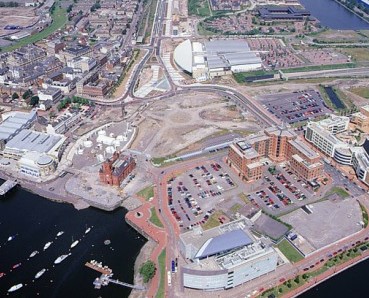
Arts centre in Cardiff Bay, Wales
| Field | Value | |
|---|---|---|
| name | Wales Millennium Centre | |
| nickname | The Armadillo | |
| logo_image | WMC logo (2019).png | |
| logo_caption | Logo used since 2019 | |
| image | Wales Millennium Centre September 2023 03.jpg | |
| caption | Main entrance to the Wales Millennium Centre on Roald Dahl Plass | |
| location | Bute Place, Cardiff Bay, Cardiff, Wales | |
| coordinates | ||
| broke_ground | February 2002 | |
| opened | Phase 1: 26–28 November 2004 | |
| Phase 2: 31 January 2009 | ||
| owner | Phase 1: Wales Millennium Centre | |
| Phase 2: Lime Property Fund (Aviva Investors) | ||
| operator | Phase 1: Wales Millennium Centre | |
| Phase 2: BBC | ||
| construction_cost | Phase 1: £106.2 million | |
| Phase 2: £18 million | ||
| Phase 1 Refurbishment: £4 million | ||
| architect | Phase 1: Jonathan Adams (Percy Thomas Partnership) | |
| Phase 2: Tim Green and Keith Vince (Capita Percy Thomas) | ||
| Phase 1 Refurbishment: Richard H Powell (interior designers) | ||
| main_contractors | Sir Robert McAlpine | |
| structural_engineer | Arup Group | |
| renovated | 2022/3 (Phase 1 Refurbishment) | |
| tenants | {{plainlist | |
| *BBC National Orchestra of Wales<ref name | "Tenants"/}} | |
| seating_capacity | Donald Gordon Theatre: 1,897 | |
| BBC Hoddinott Hall: 350 | ||
| Weston Studio Theatre: 250 | ||
| Cabaret: 140 | ||
| Grace Williams Studio: 60 | ||
| embedded | {{Infobox building | |
| embed | yes | |
| mapframe | no | |
| floor_area | 37000 sqm | |
| floor_count | 6 | |
| public_transit | ||
| Baycar | ||
| Cardiff Waterbus | ||
| elevator_count | 2 | |
| material | 4,500 tonnes of structural steel | |
| 2,000 tonnes of recycled Welsh slate (cladding) | ||
| website | ||
| type | Company limited by guarantee |
Phase 2: 31 January 2009 Phase 2: Lime Property Fund (Aviva Investors) Phase 2: BBC Phase 2: £18 million Phase 1 Refurbishment: £4 million Phase 2: Tim Green and Keith Vince (Capita Percy Thomas) Phase 1 Refurbishment: Richard H Powell (interior designers)
- Arts Council of Wales
- Literature Wales
- National Dance Company Wales
- Hijinx Theatre
- Two Rhythms
- Tŷ Cerdd – Music Centre Wales
- Urdd Gobaith Cymru
- Welsh National Opera
- BBC National Orchestra of Wales}} BBC Hoddinott Hall: 350 Weston Studio Theatre: 250 Cabaret: 140 Grace Williams Studio: 60 Baycar Cardiff Waterbus 2,000 tonnes of recycled Welsh slate (cladding)
Wales Millennium Centre () is Wales's national arts centre located in the Cardiff Bay area of Cardiff, Wales. The site covers a total area of 7.5 acre. Phase 1 of the building was opened during the weekend of 26–28 November 2004 and phase 2 opened on 22 January 2009 with an inaugural concert.
The centre is Cardiff's principal receiving venue for large-scale opera, ballet, contemporary dance and musicals. It comprises a large theatre and a smaller hall with a shop, bars and a café. It houses the BBC National Orchestra and Chorus of Wales and opera, dance, theatre and literature companies, with a total of eight arts organisations in residence.
In 2012 the Centre announced that it would also be a producing company. Its productions across the genres have been performed in London, Edinburgh and Australia. In 2021 and 2024 it was in co-production with the Royal National Theatre.
The main theatre, the Donald Gordon Theatre, has 1,896 seats, and is the second-largest stage in Europe. The BBC Hoddinott Hall seats 350 and the Weston Studio Theatre seats 250.
In 2001 Lord Rowe-Beddoe was appointed chair of Wales Millennium Centre, a company limited by guarantee. Peter Swinburn is the current chair of Wales Millennium Centre.
Background
The failed Cardiff Bay Opera House project
Main article: Cardiff Bay Opera House
Wales Millennium Centre replaced an earlier project for the site, the Cardiff Bay Opera House, a plan supported by the Cardiff Bay Development Corporation to construct a permanent home for the Welsh National Opera.
An international design competition attracted 268 international applicants, and was won by Iraq-born architect Zaha Hadid. Her avant-garde design was so radical that she and a selection of other applicants were asked to submit revised designs for a second round of competition—which she again won with "a sleek and dazzling complex of sharp lines and surfaces that she compared to an 'inverted necklace'".
In December 1995 the Millennium Commission, the body which distributed funds from the UK National Lottery, decided against lottery funding for the project. It was suggested that the bid failed because of "the unpopular Conservative government's fear of controversy", favouring the funding of projects perceived as more populist, such as the Millennium Stadium.
Origins of Wales Millennium Centre
After the Cardiff Bay Opera House project was rejected, a new project was conceived that included more than opera and was felt to be a better reflection of Welsh culture. The change of name symbolised this, but the project still had to overcome many hurdles. Funding from the Welsh Assembly and Millennium Commission took years to obtain. Cardiff Council had to buy the land after the previous owner, Grosvenor Waterside (the property division of Associated British Ports) threatened to build a retail centre there due to the delays. Further boosts were given by large donations from South African businessman Donald Gordon and a loan from the international bank, HSBC. The £20 million donation from Donald Gordon was split evenly between the Royal Opera House and Wales Millennium Centre and was spread over five years. This is believed to be the largest single private donation ever made to the arts in the UK.{{cite web |access-date=12 April 2008 |url-status=dead |archive-url=https://web.archive.org/web/20080516132314/http://www.donaldgordon.org/projects/royalop.htm |archive-date=16 May 2008
Phase 1 {{endash}} Donald Gordon Theatre and Weston Studio Theatre
In addition to the two main theatres, the Donald Gordon Theatre and the Weston Studio, the 37000 m2 phase 1 of Wales Millennium Centre has several function rooms. Urdd Gobaith Cymru has a hostel with overnight accommodation for 153 people in en suite bedrooms, called the Urdd City Sleepover. It also has a performance and teaching space in the Urdd Hall/Theatre, with 153 retractable seats.
The building also includes rehearsal rooms, orchestral facilities for the Welsh National Opera, dance studios and the Blue Room, with seating for up to 100, for National Dance Company Wales in the Dance House.
There are three bars: the Awen Bar on level 2, the Horizons Bar on level 4, and the Stones Bar on level 5. The café-bar Ffwrnais is situated in the foyer, along with the wine bar One. Free performances occasionally take place in the foyer on the Glanfa stage.
Design and construction

Wales Millennium Centre was designed by Jonathan Adams of local practice Percy Thomas Architects (taken over by Capita Group in 2004), with Arup Acoustics as the acoustic designer and building engineer. His first concept drawings were made in early 1998, and by 1999 his design had started to look more like the building it is today.
Construction began on 25 February 2002. The main contractor was Sir Robert McAlpine Ltd,{{cite web |access-date=7 February 2008 |url-status=dead |archive-url=https://web.archive.org/web/20090223211759/http://www.newswales.co.uk/index.php?section=Culture&F=1&id=5348 |archive-date=23 February 2009
The architect's concept was a building that expressed "Welshness" and was instantly recognisable. The building was designed to reflect many different parts of Wales with local Welsh materials that dominate its history: slate, metal, wood and glass. Many of the materials used come from Wales, including 1,350 tonnes of Welsh slate. A million metres of electric cable and 300,000 concrete blocks were also used in construction.
Slate

The exterior of the building is clad in multi-coloured slate collected from Welsh quarries. Narrow windows are built into the layers of slate to give the impression of rock strata in sea cliffs. The purple slate came from the Penrhyn Quarry, the blue from Cwt y Bugail Quarry, the green from the Nantlle Valley, the grey from Llechwedd quarry, and the black from the Corris Quarry.
I always loved going to Ogmore and Southerndown. I thought the cliffs there looked like a building anyway. A building capable of withstanding the roughest weather for hundreds of years. The older they get, the better they look. I wondered if it would be possible to make a building which had the same qualities as these magnificent cliffs. To do that I needed a lot of stone. Normal stone for buildings has to be specially cut into blocks; it takes a long time to make and costs a fortune. But in north Wales the historic slate industry has left behind whole mountains of waste stone that no-one wants. This was stone cut from the mountainside for nearly two hundred years but which wasn't good enough to make roof slates. Over 90% was thrown away. But it was ideal for making walls like the one I had in mind... —architect Jonathan Adams
Metal
Wales Millennium Centre's main feature, the bronze coloured dome which covers the Donald Gordon Theatre, is clad in stainless steel. The light bronze colour is an optical effect, rather than an applied colour, and is created by the 'Rimex' chemical process which thickens the transparent oxide coating of the metal to cause light interference, as occurs in natural iridescence. It was designed to withstand the weather conditions on the Cardiff Bay waterfront and to look increasingly better with age. The architect, Jonathan Adams, decided not to use copper and aluminium as they would both change colour with age and weather conditions.
We all know that steel making has been important to south Wales, just as slate making has changed the landscape of the north. We have to use a special type of steel that won't go rusty near to the salt-laden, maritime air of Cardiff Bay. This stainless steel will be made near to Pontypool. For the Wales Millennium Centre I thought it was important that the materials should have a "natural" texture, and that they should be instantly recognisable to anyone seeing them, even from a distance. For this reason I felt it was important that the steel of the shell should have the rough grain and the riveted pattern that we think of as more typical of old industrial structures, such as those that used to be commonplace around the landscape of the industrial south. —Jonathan Adams{{cite web |access-date=2 March 2009 |url-status=dead |archive-url=https://web.archive.org/web/20071025101015/http://www.wmc.org.uk/index.cfm?UUID=15263D53-B634-D71B-B78F0C0F2E64AF9D |archive-date=25 October 2007 }}
Wood
_(cropped).jpg)
Both the inside and outside of the building – including the main Donald Gordon Theatre, the balconies and the rear of the building – are dominated by bands of hardwood lining the walls.
Like the exterior of the building, the principal internal spaces are designed to make the best use of natural materials in their natural state. The structure and detail of the concourse galleries echo the form of the exterior, with the curving strata formed in native hardwoods. Oak, ash, beech, sycamore, alder, birch, chestnut and cherry woods from renewable sources in mid-Wales will be used together in proportions that reflect their relative availability from the forest. The design of the concourse galleries is intended to evoke the image of the edge of the forest, partly as a counterpoint to the coastal nature of the exterior, and partly because the edge of the forest in folklore and mythology represents a line between the real world and the magical world, a line which resembles the front edge of the theatre stage. The form of trees is created by the interweaving curvature of the gallery edges, and by the random positioning of the supporting columns. —Jonathan Adams
Glass

Glass was used to incorporate into the bands of slate. It is 15 cm thick and was cut and installed by the Architectural Glass Department at Swansea Institute of Higher Education. Glass is not used in the contemporary British architectural style of the glass curtain.
Jonathan Adams said, "The glass veins in the external walls of the Wales Millennium Centre make use of conventional glass in a unique way: the sheets of glass are stacked together and fused in a kiln to form solid blocks."
Calligraphy
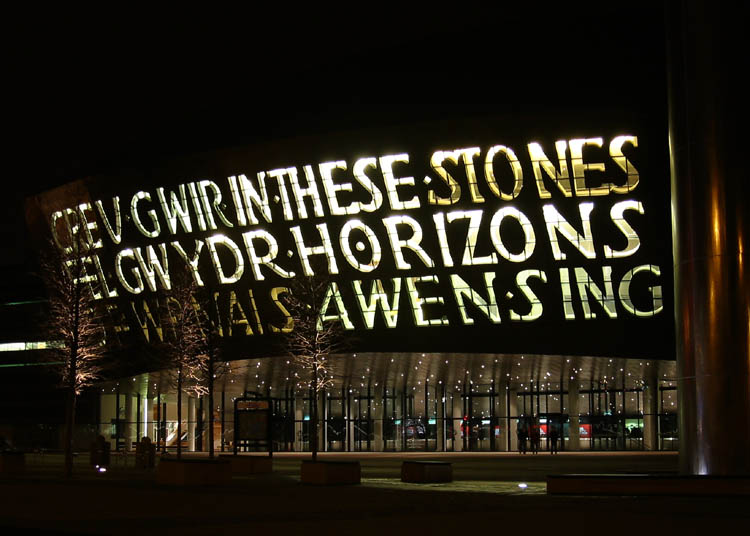
Inscribed on the front of the dome, above the main entrance are two lines written by Welsh poet Gwyneth Lewis in Welsh and English. The lettering is formed by windows in the upstairs bar areas and is internally illuminated at night.
The idea of this monumental inscription comes from Roman classical architecture. The Romans brought Christianity to these islands, along with the custom of engraving stone. The form of the Celtic cross embodies the cross-fertilisation of indigenous and Roman cultures, from which the Welsh nation first emerged. The monumental inscription is a familiar feature of Roman architecture. The inscription over the entrance of the Wales Millennium Centre is a revival of this classical tradition, and also a recognition of the formative influence of Roman culture upon our nation. We're lucky to have two languages: one that we share with half the world and one which belongs just to us. Words in songs, stories and poems have helped to make Wales the proud country that it is. —Jonathan Adams
Gwyneth Lewis said of the inscription:
I wanted the words to reflect the architecture of the building. Its copper dome reminded me of the furnaces from Wales's industrial heritage and also Ceridwen's cauldron, from which the early poet Taliesin received his inspiration ('awen'). Awen suggests both poetic inspiration and the general creative vision by which people and societies form their aspirations. [...] It was important to me that the English words on the building should not simply be a translation of the Welsh, that they should have their own message. The strata of the slate frontage of the Wales Millennium Centre reminded me of the horizons just beyond Penarth Head. The sea has, traditionally, been for Cardiff the means by which the Welsh export their best to the world and the route by which the world comes to Cardiff. The stones inside the theatre literally sing with opera, musicals and orchestral music, and I wanted to convey the sense of an international space created by the art of music. —Gwyneth Lewis
In These Stones Horizons Sing is also an orchestral work, composed by Karl Jenkins and commissioned by Wales Millennium Centre for the building's opening.
Opening weekend ceremony
The building was officially opened on the weekend of 26–28 November 2004. Bryn Terfel organised the ceremony and was the creative director of the weekend.
Day 1 26 November 2004

The day started with a speech from Wales Millennium Centre chairman Lord Rowe-Beddoe, who declared that the proceedings were underway. This was followed by a speech from Rhodri Morgan, the First Minister, who stressed that the new arts centre belonged to the whole nation, that it was for all of the people of Wales and not just for the elite.
The building was opened by Janet Thickpenny, a young mother from Barry, who was chosen because her 40th birthday coincided with the opening day. A human chain delivered the symbolic key, designed and cast by Ann Catrin Evans, to Janet. This was accompanied by a fanfare from the National Youth Brass Band of Wales to Karl Jenkins's specially commissioned work In These Stones Horizons Sing, and Wales Millennium Centre was open.
The evening celebrations began with Cymru for the World, which celebrated the achievements of five leading Welsh artists: Gwyneth Jones, Shirley Bassey, Siân Phillips, Alun Hoddinott and Richard Burton, represented by his daughter Kate Burton. This included tributes from Robert Hardy, Jonathan Pryce, Derek Jacobi, Nana Mouskouri, Catrin Finch, Ruth Madoc and Ian McKellen. The concert was directed by Ken Caswell and conducted by David Charles Abell.
Bryn Terfel started with a short speech and introduced the Wales Millennium Centre singers and dancers, who in hard hats and donkey jackets sang and danced the story of the building's construction. They were later joined by all 322 participants in a chorus, including Gwyn Hughes Jones and Bryn Terfel. Dennis O'Neill sang a duet from Pearl Fishers. Diversions performed a new ballet based on one of Alun Hoddinott's works. The Welsh National Opera performed the final scene of Beethoven's Fidelio in their new home. The evening ranged included many types of music, from popular to classical.
Day 2 27 November 2004
On the second day, the doors opened for the public to explore the building. A continuous stream of people filled through the building during the day, which concluded with a fireworks display in the Roald Dahl Plass.
Day 3 28 November 2004
The final day of the opening weekend began with the arrival of Queen Elizabeth II, Prince Philip and the Prince of Wales, who met First Minister Rhodri Morgan and Lord Rowe-Beddoe, and marked the event by unveiling a plaque. A key was presented to the Queen by Richard Burton's granddaughter, Charlotte Frances. Philip Madoc, Siân Phillips, Gaby Roslin, Michael Ball, Charlotte Church, Catrin Finch and Only Men Aloud! were among the artists that entertained the audience during the first act. The second act was opened by Welsh National Opera and later the Kirov Ballet and Cirque Éloize entertained the audience. Bryn Terfel ended the celebrations.
2022/23 Refurbishment of Phase 1 {{endash}} Cabaret and Bocs

The 2022/23 refurbishment of Wales Millennium Centre started with the opening of an immersive theatre space called Bocs (Welsh for box) on 27 August 2022. It has a programme of 360° films and projections, as well as extended reality experiences, including augmented reality, mixed reality and virtual reality. It was announced in September 2022 that a £4 million refurbishment of Wales Millennium Centre would take place and would include an area for cabaret acts, a redesigned foyer and new ticketing office, a 12 m long bar, a members’ bar and lounge, and bespoke seating areas. The new 140-seat cabaret venue, which replaced Ffresh restaurant/bar, is simply called Cabaret. It presents drag, comedy, burlesque, and gig theatre performances and opened in February 2023. The refurbishment was carried out by interior designers Richard H Powell trading as Powell.
Awards for Phase 1
- 2005 Gold Medal for Architecture at the National Eisteddfod of Wales
- 2005 RIBA Wales award
- 2005 MIPIM Awards (Hotels & Tourism resorts)
- Sustainability and Environmental Impact award from the British Institute of Facilities Management
- 2005 Interior of the Year award from FX
Phase 2 {{endash}} BBC Hoddinott Hall and Grace Williams Studio

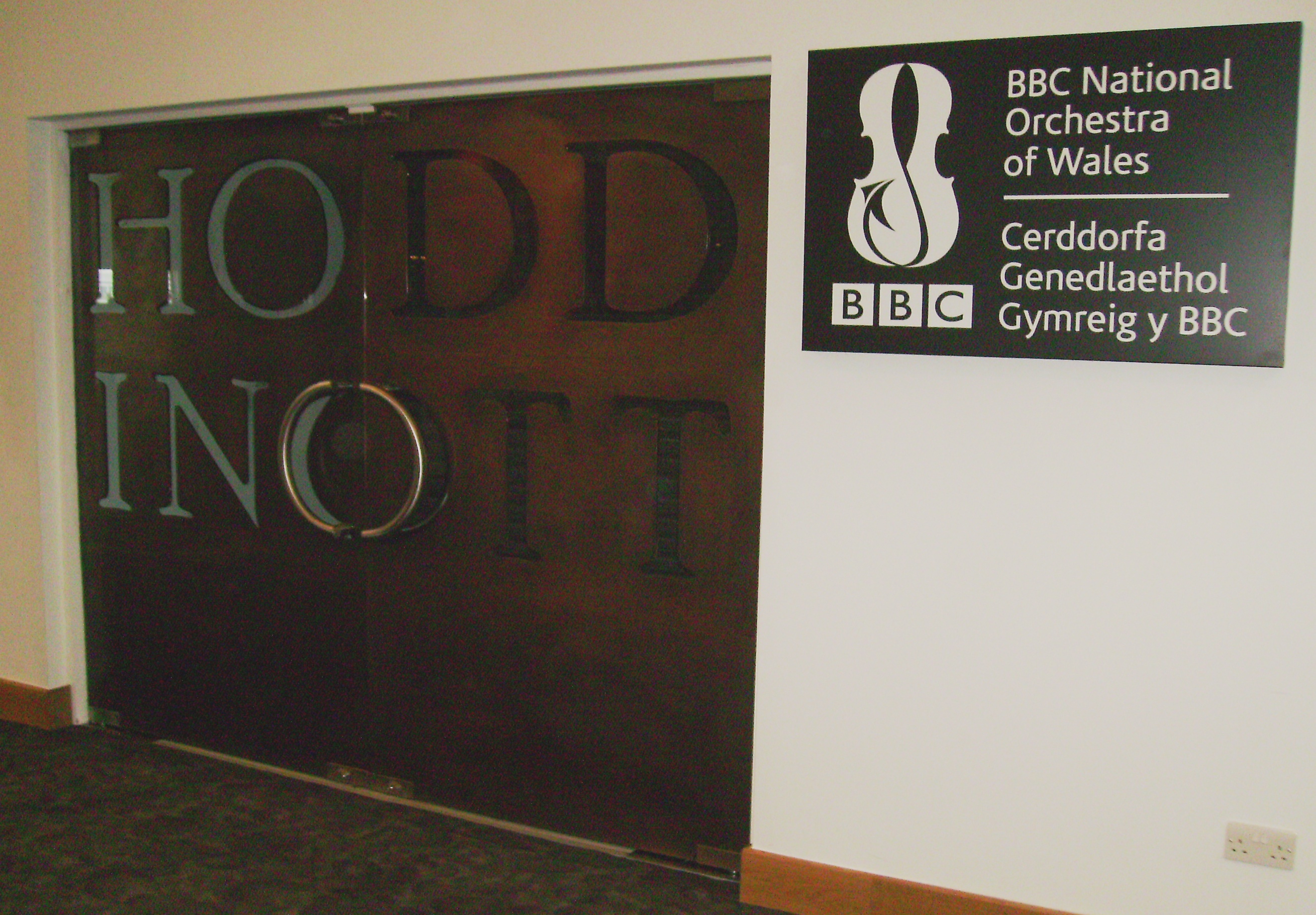
Phase 2 of Wales Millennium Centre is home to the BBC National Orchestra of Wales (BBC NOW) and the BBC National Chorus of Wales. BBC NOW moved from Studio 1 at Broadcasting House in Llandaff, which the orchestra had outgrown since the late 1960s. Phase 2 opened on 22 January 2009 with an inaugural concert performed by the BBC NOW and conducted by Thierry Fischer. Phase 2 includes the 350-seater BBC Hoddinott Hall (), also known simply as Hoddinott Hall, which is named after the late Welsh classical composer Alun Hoddinott (11 August 1929 – 12 March 2008), and the Grace Williams Studio, which is named after another Welsh composer, Grace Williams (19 February 1906 – 10 February 1977), and is used as a centre for education and outreach work. Phase 2 also has space for practice rooms, a music library and backstage facilities, and provides a four-storey office space.
Design and construction
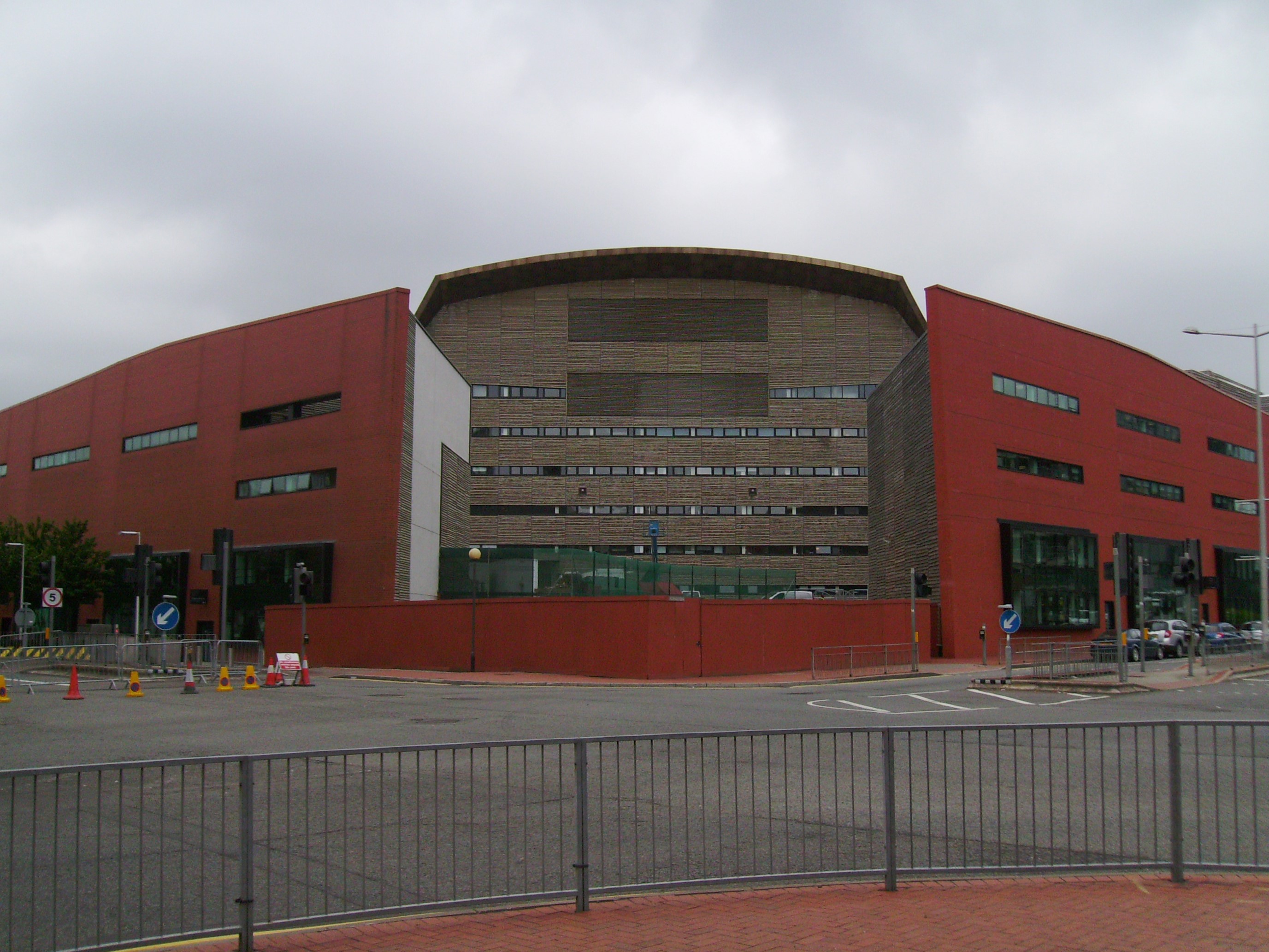
The original plans for Wales Millennium Centre were that it would have a concert hall, but the final design of phase 1 did not include one. Instead, space was left for a concert hall to be built after phase 1 opened in 2004, and construction on phase 2 was then due to begin early in 2005. However, phase 2 construction did not actually begin until April 2007. Phase 2 was designed to fit into Wales Millennium Centre's curved slate frontage, with an upper part constructed from timber.
Phase 2 of Wales Millennium Centre was designed by the then newly qualified Tim Green and Keith Vince of Capita Architecture, formerly called Capita Percy Thomas and now part of Capita Symonds, with Arup Acoustics again providing the acoustic design. The main contractor was again Sir Robert McAlpine Ltd, with MJN Colston Ltd responsible for the design and installation of all the mechanical, electrical and public health services in the building. Other subcontractors on the project included URS Corporation, Davis Langdon and Hulley & Kirkwood.
Tim Green said that the exterior of phase 2 was designed to be in keeping with phase 1, while the interior had its own theme, that of a traditional Welsh chapel. He said that "The timber treatment at low level is very reminiscent of Victorian chapels and the masonry above. The stonework you would normally get in a stone chapel has been replaced by concrete."
During the design and construction period, the project name for phase 2 was C Bay. Construction began in April 2007. It ended when the keys to the building were handed over at an official ceremony in September 2008, and BBC Wales began to fit out the interior of the Hoddinott Hall.
Phase 2 also includes the 60 seat Grace Williams Studio, which is used by BBC NOW and Chorus for workshops and rehearsals for its outreach work.
Opening Festival
To commemorate the opening of BBC Hoddinott Hall, an inaugural concert took place on 22 January 2009. It was part of an opening festival which took place between 22 January and 1 February 2009. The concert was performed by the BBC National Orchestra of Wales and was conducted by Thierry Fischer. It included the world premiere of St Vitus in the Kettle by Simon Holt, the orchestra's composer in association, who took over from Michael Berkeley. BBC Hoddinott Hall was officially opened by the Prince of Wales on 31 January 2009, where he unveiled a plaque.
Awards for Phase 2
- Engineering Excellence Award from the Association for Consultancy and Engineering.
- 2009 Special Award: Best Use of Panel Products from the Wood Awards
Phase 3 {{endash}} The planned ''digital and immersive arts'' theatre
_new_build.jpg)
The third phase of the development of Wales Millennium Centre is a proposed new stand-alone 550-seater theatre and facilities for production, rehearsal and training, opposite the existing main building (phase 1 and 2). It will be an "immersive" arts theatre and will be located next to the proposed new 15,000-seater indoor arena for Cardiff. Cardiff Council has appointed Goldbeck Construction as the building contractor for the new development. The new theatre will be located in the car park of the Atlantic Wharf and part of the parking area of Cardiff Council’s County Hall. The building will incorporate the council's new modern headquarters, which will replace the ageing County Hall.
Resident organisations
Wales Millennium Centre is home to eight arts organisations:
- Literature Wales – Welsh national literature promotion agency and society for writers
- National Dance Company Wales – previously known as Diversions
- Hijinx Theatre – one of Europe’s leading inclusive theatre companies
- Two Rhythms – providing multi-sensory, therapeutic arts programmes to people with profound disabilities and autism. Previously known as Touch Trust
- Tŷ Cerdd – music information centre for amateur and professional musicians, including the Welsh Music Information Centre, Welsh Amateur Music Federation, National Youth Arts Wales and Cyfansoddwyr Cymru (Composers of Wales)
- Urdd Gobaith Cymru – Wales's largest youth organisation
- Welsh National Opera – an international touring opera company
- BBC National Orchestra of Wales – the only professional national symphony orchestra for Wales
Corporate financing and rebranding
The total cost of phase 1 of the project was £106.2 million. The National Lottery Millennium Fund provided £31.7 million, a further £37 million came from The National Assembly for Wales and £10.4 million was donated by the Arts Council of Wales. In addition, a private investor, South African businessman Donald Gordon, donated £20 million to be shared equally between the Royal Opera House and Wales Millennium Centre. The Wales Millennium Centre also received a £13.5 million loan from HSBC. The remaining funds for the project came from a major sponsorship deal with the Principality Building Society. The Weston Studio is named after the Garfield Weston Foundation, and is located on Level 1 of the building. Many other corporations and public bodies provide sponsorship to Wales Millennium Centre.
The National Assembly for Wales announced on 6 November 2007 that it was to pay off the outstanding loan of £13.5 million from HSBC and also increase its annual funding. From April 2008, the Assembly gave an annual grant of £3.5 million to Wales Millennium Centre for 3 years. This was intended only to repay the capital debt and not any ongoing operating loss as the organisation remained profitable. The money came from unallocated funds from the Assembly's previous budget and the then Minister for Heritage, Rhodri Glyn Thomas, said that it would not come at the expense of other art projects in Wales.
The cost of phase 2 of the project was approximately £18 million. The BBC does not own the building, but has leased it for 25 years from the Lime Property Fund, a subsidiary of Aviva Investors. Phase 2 was built by Concert Bay Ltd, a subsidiary of Sir Robert McAlpine Enterprises Ltd, which co-funded the scheme along with Lime Property Fund.
In November 2006, Wales Millennium Centre announced that it would begin a two-phase rebranding project. The project was won by a local Cardiff company, Sweet. The first phase of the project involved a new corporate logo; the second phase included the redesign of other marketing tools, such as brochures and advertisements.{{cite web |access-date=3 June 2008 |url-status=dead |archive-url=https://archive.today/20080723130648/http://www.sweetcreative.co.uk/news2.html |archive-date=23 July 2008
In popular culture
''Doctor Who'' and ''Torchwood''
Wales Millennium Centre has made numerous appearances in film and television, including in Doctor Who (modern-era episodes of which are produced locally by BBC Wales). It has appeared 7 times : as itself from outside in the episode "Boom Town"; its marquee momentarily at the end of the episode "Bad Wolf"; its lobby as a hospital lobby in the far future in the episode "New Earth", and again in "The Girl Who Waited";{{cite web |url= http://www.doctorwholocations.net/stories/girlwhowaited |access-date= 22 February 2009 |archive-date= 12 March 2008 |archive-url= https://web.archive.org/web/20080312190854/http://www.bbc.co.uk/doctorwho/episodes/2007/photostories/s3_13/22.html |url-status= dead
The spin-off series Torchwood has its headquarters, known as "The Hub", set underneath the Water Tower in Roald Dahl Plass, with Wales Millennium Centre's frontage featuring heavily through the show.
''Jones Jones Jones''
Main article: Jones Jones Jones
On 3 November 2006, a record-breaking attempt to gather the most people with the same surname, Jones, took place at Wales Millennium Centre under the show banner Jones Jones Jones, filmed for television by S4C. The record was broken with 1,224 Joneses filling the Donald Gordon Theatre. The previous record was set in Sweden in 2004 when 583 people gathered who had the same surname of Norberg.
''Gavin & Stacey''
The airport scene from episode 1 of the second series of the BBC TV show Gavin & Stacey was filmed in Wales Millennium Centre.
References
Notes
References
- "Wales Millennium Centre – A landmark building for the performing arts in Wales". [[National Assembly for Wales]].
- (30 September 2022). "Design Unveiled for £4 Million Major Refurb at Wales Millennium Centre".
- (16 March 2005). "Wales Millennium Centre (WMC), Cardiff, Wales".
- Phillips, Lauren. (5 October 2022). "First look inside Wales Millennium Centre's huge multi-million pound refurbishment".
- Gavin. (1 August 2022). "Wales Millennium Centre Launch Immersive And Extended Reality Arts Venue". [[GTFM]].
- "Resident Organisations – Organisations working within Wales Millennium Centre". Wales Millennium Centre.
- Somerset, Adam. (8 June 2024). "A Look-back and Guide".
- "Function rooms". Wales Millennium Centre.
- (21 February 2009). "Former boss of one of the world's biggest brewing firms the new chair of the Wales Millennium Centre". Media Wales.
- "Entertainment". [[American Airlines]].
- Barber, Lynn. (9 March 2008). "Zaha Hadid". [[Guardian Media Group]].
- "A monumental spot of local trouble". [[CNET Networks]], Inc..
- "Diva Zaha steals the show in Cardiff Bay". Building Design.
- Darnton, John. (25 December 1995). "Britain Rejects Welsh Opera's Plea for Financing". [[The New York Times]].
- "Opera House Lottery: Zaha Hadid and the Cardiff Bay Project by Nicholas Crickhowell".
- (2 November 2000). "Plans to sell Millennium Centre site". [[BBC]].
- (29 September 2000). "Wales Millennium Centre site 'saved'". BBC.
- "The Centre". [[Urdd Gobaith Cymru]].
- "Theatrical Productions". Wales Millennium Centre.
- "Eat, drink, shop". Wales Millennium Centre.
- "Enjoy free performances". Wales Millennium Centre.
- "Building for the Nation". [[BBC Wales]].
- Gates, C. ''PFI fells Welsh giant'' Building Design, Issue 1630, 18 June 2004, p.1
- "Wales Millennium Centre roof windload analysis". Ramboll Whitbybird Limited.
- "Wales Millennium Centre". SPG Media Limited.
- "Vision – Unmistakably Welsh and internationally outstanding". Wales Millennium Centre.
- Kennedy, Maev. (27 November 2004). "Arts opening is moment of national pride for Wales". [[The Guardian]].
- "Stone". Wales Millennium Centre.
- "Wood". Wales Millennium Centre.
- "Glass". Wales Millennium Centre.
- "Calligraphy". Wales Millennium Centre.
- "In These Stones Horizons Sing". www.gwynethlewis.com.
- "Arts opening is moment of national pride for Wales". The Guardian.
- (26 November 2004). "Arts lovers' key role in opening". [[BBC News]].
- (27 November 2004). "Beginning at the beginning". BBC News.
- "Wales Millennium Centre launches dedicated immersive and extended reality arts venue". [[Nation.Cymru]].
- (20 June 2024). "Wales Millennium Centre (WMC), Cardiff, Wales".
- (28 September 2022). "First look at Wales Millennium Centre's major £4m renovation project".
- "Wales Millennium Centre's new Cabaret room opens with Luke Hereford's Queerway".
- Lewis, Ffion. (7 February 2023). "First look inside Wales Millennium Centre's new inclusive cabaret bar".
- "Gold Medal for Architecture Winners". [[National Eisteddfod of Wales]].
- (23 June 2005). "RIBA Awards / Wales". [[Architects' Journal]].
- "MIPIM Awards 2005". MIPIM.
- "The Sustainable Development Charter congratulates...". Cynnal Cymru - Sustain Wales.
- "Wales Millennium Centre". [[Capita]].
- "New BBC concert hall broadcasts inaugural performance". [[Arup Group Limited.
- (September 2010). "Inaugural Concert". Wales Millennium Centre.
- "Alun Hoddinott (1929–2008)". Music & Vision.
- "Alun Hoddinott (Composer)". The Bach Cantatas Website.
- "Pupils help to launch BBC Orchestra's new home". Media Wales.
- (September 2010). "BBC Cymru Wales Annual Review 2006/2007". BBC.
- "BBC Hoddinott Hall". [[Sir Robert McAlpine]].
- Driver, Paul. (September 2024). "Hoddinott Hall is new patriotic music venue". [[The Times]].
- "Official opening of the Wales Millennium Centre". [[Capita Symonds]].
- "BBC National Orchestra gets new home". [[Capita Symonds]].
- "Work underway on WMC's new addition". [[Capita Symonds]].
- "Project Title: C Bay (Recording & Rehearsal Concert Hall)". Hulley & Kirkwood.
- (23 January 2009). "In pictures: BBC Hoddinott Hall (picture 5)". [[BBC]].
- (22 January 2009). "BBC orchestra moves into new home". [[BBC]].
- "C Bay, Cardiff". MJN Colston.
- (12 September 2008). "Orchestra gets keys to new home". [[BBC]].
- "Orchestra's New Home Complete". [[Sir Robert McAlpine]].
- "New BBC concert hall broadcasts inaugural performance". [[Arup Group Limited.
- "About the Orchestra - Find out all about BBC National Orchestra of Wales". [[BBC]].
- "BBC National Orchestra of Wales Announce Opening at New Venue.". [[Arts Council of Wales]].
- (1 February 2009). "Prince hails new hall a 'triumph'". [[BBC]].
- (26 May 2009). "BBC Hoddinott Hall wins UK engineering award". [[BBC]].
- "Hoddinott Hall". [[Wood Awards]].
- (6 November 2024). "New 550-capacity theatre planned for capital". [[BBC]].
- (5 November 2007). "The new theatre Wales Millennium Centre wants to build in Cardiff Bay". Wales Online.
- (12 February 2025). "Goldbeck to build new £50m Cardiff County Hall".
- "About Us "To support, promote and provide an information resource for the music of Wales."". Welsh Music Information Centre.
- "Weston Studio". Wales Millennium Centre.
- "Corporate Support". Wales Millennium Centre.
- "Wales Millennium Centre". [[Welsh Assembly Government]].
- "The Wales Millennium Centre, Rhodri Glyn Thomas, the Minister for Heritage". [[Welsh Assembly Government]].
- Morrison}}{{dead link, Richard. (September 2024). "Hoddinott Hall, a playground in finest oak". [[The Times]].
- "UK: Lime Fund acquires Bath University student accommodation". [[Aviva]].
- "Boom Town – location guide". [[BBC]].
- "Doctor Who New Earth location guide". [[BBC]].
- "'The Hub' – Roald Dahl Plass". [[BBC]].
- "1,224 Joneses have broken the world record!". UHMedia*.
- (4 November 2006). "Joneses break same surname record". [[BBC]].
- (15 January 2009). "In pictures: Gavin and Stacey (picture 10)". [[BBC]].
This article was imported from Wikipedia and is available under the Creative Commons Attribution-ShareAlike 4.0 License. Content has been adapted to SurfDoc format. Original contributors can be found on the article history page.
Ask Mako anything about Wales Millennium Centre — get instant answers, deeper analysis, and related topics.
Research with MakoFree with your Surf account
Create a free account to save articles, ask Mako questions, and organize your research.
Sign up freeThis content may have been generated or modified by AI. CloudSurf Software LLC is not responsible for the accuracy, completeness, or reliability of AI-generated content. Always verify important information from primary sources.
Report