From Surf Wiki (app.surf) — the open knowledge base
Wadcutter
Type of bullet

Type of bullet
A wadcutter is a special-purpose flat-fronted bullet specifically designed for shooting paper targets, usually at close range and at subsonic velocities typically under approximately 270 m/s. Wadcutters have also found favor for use in self-defense guns, such as .38 caliber snubnosed revolvers, due to shorter barrel lengths, lower bullet velocities, and improved lethality. Wadcutters are often used in handgun and airgun competitions.
Bullet profile
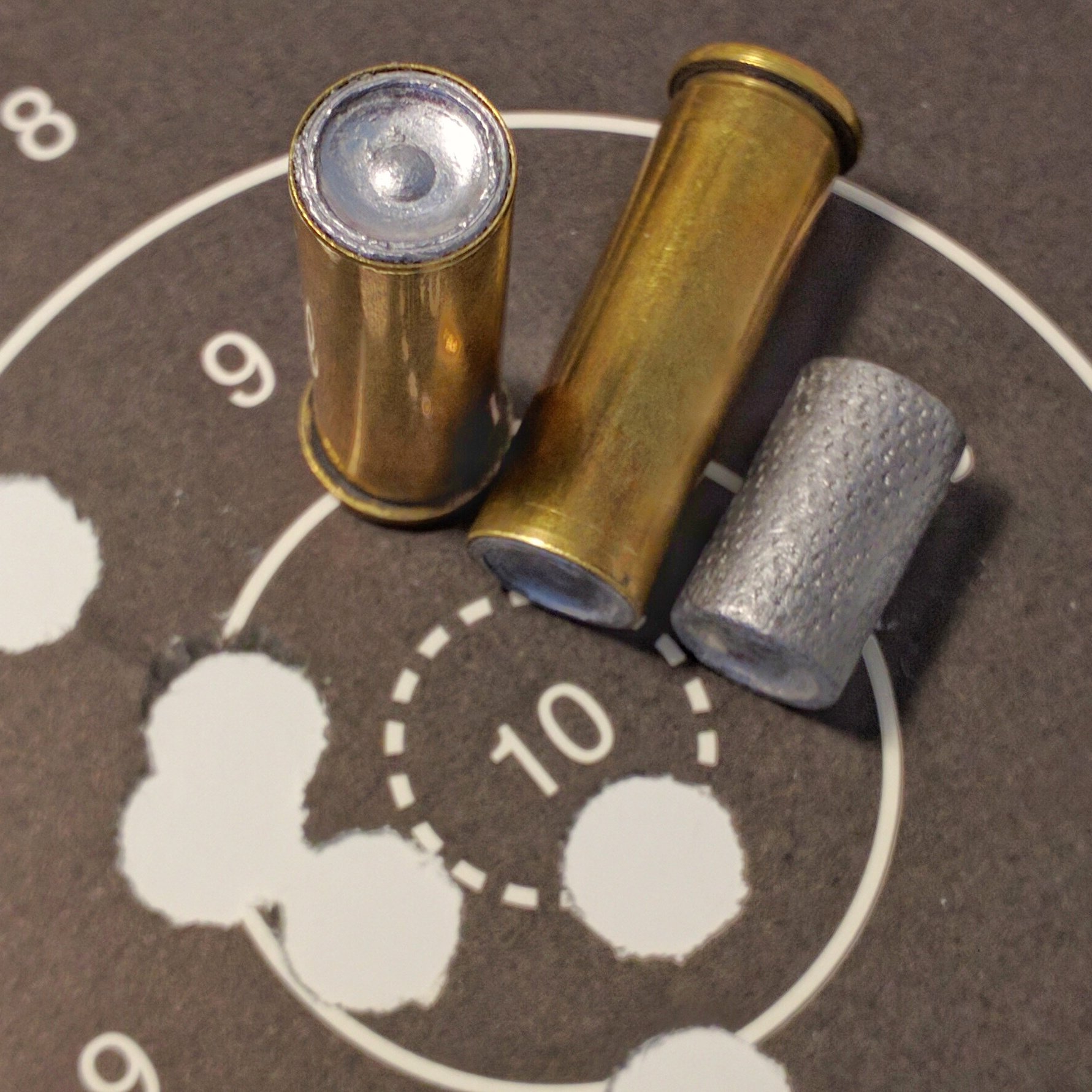
A wadcutter has a flat or nearly flat front that is typically as wide as the caliber size or only slightly smaller in diameter than caliber size. For target shooting, a wadcutter cuts a very clean hole through the paper target, making it easier to score and ideally reducing errors in scoring the target in the favor of the shooter. Because the flat nosed bullet is not well suited for feeding out of a magazine, wadcutters are normally used in revolvers or in specially designed semi-automatic pistols, such as the Smith & Wesson Model 52. Although this is not always the case, as some wadcutters may have rounded bullet nose profiles.
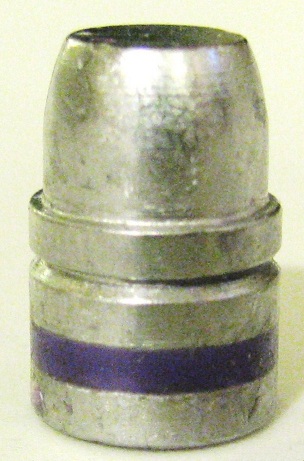
Types of firearm wadcutters
Accuracy
The maximum accurate distance of wadcutters varies considerably with the shape of the front of the bullet. Full caliber diameter wadcutters are suitable for use only at short ranges, typically not being used at ranges exceeding 25 yd where accuracy is especially desirable. At distances beyond 50 yd, full caliber diameter wadcutters become highly inaccurate. On the other hand, SWC bullets can maintain high accuracy at ranges exceeding 100 yd. In general, semi-wadcutters having a partially rounded nose are more accurate than wadcutters having a flat-front profile. In contrast, flat-front profile wadcutters tend to have improved lethality for hunting or self-defense purposes.
Lubrication and bullet crimping
Lead wadcutters require proper lubrication to prevent leading (buildup of lead deposits) of rifling and forcing cones when used in firearms. With proper lubrication, no leading for solid lead wadcutters occurs until velocities exceed approximately 940 ft/s. Without proper lubrication, however, severe leading can occur quickly, in as few as a couple of rounds. Most DEWC, BBWC, HBWC, and SWC bullets have 1, 2, or 3 lubrication grooves, with or without an additional 1 or 2 crimping grooves. (Having two crimping grooves is sometimes seen in dual-use bullets, such as intended for use with both .38 Special and .357 Magnum cartridges, or, similarly, for use with both .44 Special and .44 Magnum cartridges, in instances where overall cartridge lengths may need to be set differently so as to achieve the highest accuracy.) Used in revolvers, wadcutters must be roll crimped. Used in semi-automatic pistols, wadcutters must be taper crimped. Used in single-shot firearms (e.g., Thompson Center Contender or Encore), no crimping is absolutely required, but higher velocities may be achieved with either a roll or taper crimp, depending on cartridge, to permit pressure to rise higher before the bullet is released from the brass case.
Indoor wadcutters
Wadcutter bullets for center-fire firearms often have a modified profile with a reduced-diameter central point or rounded section. This was developed to allow the use of wadcutter bullets without causing excessive damage to the rubber anti-splashback curtain on indoor ranges. This profile produces a clean cut without tearing of the paper on the paper target for scoring but will only partially deform a rubber curtain and rebound before penetrating enough to cut the surface of the rubber mat.
Bullet loading techniques
Wadcutters can be loaded flush with the brass case opening or they may be set to extend out of the brass case, depending on what provides the most accuracy; the desired powder capacity of the case; or other desired criteria. Both varieties of wadcutters (flush, or non-flush) are commercially available. Although primarily intended for target practice, wadcutters can be used for close-in self-defense and hunting because their sharp edges and close-range accuracy are claimed to increase lethality.
Leading effects
Wadcutters are typically made from lead. Deposition of lead into the rifling grooves of barrels and into the forcing cones of revolvers limits the maximum usable velocity of wadcutters to less than about 900 ft/s. A modern solution to leading at higher velocities is powder coating the lead projectile, encasing it in a protective shell. Shots fired at higher velocities may cause severe leading of the rifling and of the forcing cone, introducing a potentially dangerous condition from overpressure if full metal jacket bullets are subsequently fired without first removing the lead buildup. Mechanical and/or chemical means may be employed to remove the lead buildup caused by shooting wadcutters at excessive velocity.
Air rifle and pistol wadcutters
_match_air_gun_pellet.jpg)
Target airguns used for 10 metre air rifle and 10 metre air pistol competitions generally shoot wadcutter pellets at muzzle velocities around 570 ft/s. The use of wadcutter match diabolo pellets is nearly universal in airgun target shooting where paper targets are used, at distances of 25 m or less.
References
References
- M.D., Vincent J.M. DiMaio. (30 December 1998). "Gunshot Wounds: Practical Aspects of Firearms, Ballistics, and Forensic Techniques, SECOND EDITION". CRC Press.
- Cunningham, Grant. (13 October 2011). "Gun Digest Book of the Revolver". Krause Publications.
- Taffin, John. (12 October 2005). "Single Action Sixguns". Krause Publications.
- Carmichel, Jim. (1986). "Guns and Shooting, 1986". Times Mirror Magazines, Incorporated, Book Division.
This article was imported from Wikipedia and is available under the Creative Commons Attribution-ShareAlike 4.0 License. Content has been adapted to SurfDoc format. Original contributors can be found on the article history page.
Ask Mako anything about Wadcutter — get instant answers, deeper analysis, and related topics.
Research with MakoFree with your Surf account
Create a free account to save articles, ask Mako questions, and organize your research.
Sign up freeThis content may have been generated or modified by AI. CloudSurf Software LLC is not responsible for the accuracy, completeness, or reliability of AI-generated content. Always verify important information from primary sources.
Report