From Surf Wiki (app.surf) — the open knowledge base
Voyager 2
NASA space probe launched in 1977

NASA space probe launched in 1977
| Field | Value | ||||
|---|---|---|---|---|---|
| name | Voyager 2 | ||||
| image | Voyager spacecraft model.png | ||||
| image_caption | Artist's rendering of the Voyager spacecraft design | ||||
| image_alt | Artist's rendering of the Voyager spacecraft, a small-bodied spacecraft with a large, central dish and multiple arms and antennas extending from the dish | ||||
| mission_type | Planetary exploration | ||||
| operator | NASA / JPL | ||||
| website | |||||
| COSPAR_ID | 1977-076A | ||||
| SATCAT | 10271 | ||||
| mission_duration | {{plainlist | ||||
| * {{time interval | 20 August 1977 14:29:00 | sep | ,}} elapsed | ||
| * Planetary mission: {{time interval | 20 August 1977 | 2 October 1989 | show | ymd | sep=,}} |
| * Interstellar mission: {{time interval | October 2, 1989 | show | ymd | sep=,}} elapsed | |
| manufacturer | Jet Propulsion Laboratory | ||||
| launch_mass | 721.9 kg | ||||
| power | 470 watts (at launch) | ||||
| launch_date | UTC | ||||
| launch_rocket | Titan IIIE | ||||
| launch_site | Cape Canaveral LC-41 | ||||
| last_contact | |||||
| type | flyby | ||||
| object | Jupiter | ||||
| distance | 570000 km | ||||
| arrival_date | July 9, 1979}} | ||||
| type | flyby | ||||
| object | Saturn | ||||
| distance | 101000 km | ||||
| arrival_date | August 26, 1981}} | ||||
| type | flyby | ||||
| object | Uranus | ||||
| distance | 81500 km | ||||
| arrival_date | January 24, 1986}} | ||||
| type | flyby | ||||
| object | Neptune | ||||
| distance | 4951 km | ||||
| arrival_date | August 25, 1989}} | ||||
| instruments_list | {{Infobox spaceflight/Instruments | ||||
| acronym1 | ISS | name1 = Imaging Science System | |||
| acronym2 | RSS | name2 = Radio Science System | |||
| acronym3 | IRIS | name3 = Infrared interferometer spectrometer and radiometer | |||
| acronym4 | UVS | name4 = Ultraviolet Spectrometer | |||
| acronym5 | MAG | name5 = Triaxial Fluxgate Magnetometer | |||
| acronym6 | PLS | name6 = Plasma Spectrometer | |||
| acronym7 | LECP | name7 = Low Energy Charged Particle Instrument | |||
| acronym8 | CRS | name8 = Cosmic Ray System | |||
| acronym9 | PRA | name9 = Planetary Radio Astronomy Investigation | |||
| acronym10 | PPS | name10 = Photopolarimeter System | |||
| acronym11 | PWS | name11 = Plasma Wave Subsystem | |||
| programme | Large Strategic Science Missions | ||||
| Planetary Science Division | |||||
| previous_mission | Viking 2 | ||||
| next_mission | Voyager 1 | ||||
| programme2 | Voyager program |
- elapsed
- Planetary mission:
- Interstellar mission: elapsed Planetary Science Division
Voyager 2 is a space probe launched by NASA on August 20, 1977, as a part of the Voyager program. It was launched on a trajectory towards the gas giants (Jupiter and Saturn) and enabled further encounters with the ice giants (Uranus and Neptune). The only spacecraft to have visited either of the ice giant planets, it was the third of five spacecraft to achieve Solar escape velocity, which allowed it to leave the Solar System. Launched 16 days before its twin Voyager 1, the primary mission of the spacecraft was to study the outer planets and its extended mission is to study interstellar space beyond the Sun's heliosphere.
Voyager 2 successfully fulfilled its primary mission of visiting the Jovian system in 1979, the Saturnian system in 1981, Uranian system in 1986, and the Neptunian system in 1989. The spacecraft is currently in its extended mission of studying the interstellar medium. It is at a distance of 142.60 AU from Earth .
The probe entered the interstellar medium on November 5, 2018, at a distance of 119.7 AU from the Sun and moving at a velocity of 15.341 km/s relative to the Sun. Voyager 2 has left the Sun's heliosphere and is traveling through the interstellar medium, though still inside the Solar System, joining Voyager 1, which reached the interstellar medium in 2012. Voyager 2 has begun to provide the first direct measurements of the density and temperature of the interstellar plasma.
Voyager 2 is in contact with Earth through the NASA Deep Space Network. Communications are the responsibility of Australia's DSS 43 communication antenna, near Canberra.
History
Background
Main article: Mariner Jupiter-Saturn
In the early space age, it was realized that a periodic alignment of the outer planets would occur in the late 1970s and enable a single probe to visit Jupiter, Saturn, Uranus, and Neptune by taking advantage of the then-new technique of gravity assists. NASA began work on a Grand Tour, which evolved into a massive project involving two groups of two probes each, with one group visiting Jupiter, Saturn, and Pluto and the other Jupiter, Uranus, and Neptune. The spacecraft would be designed with redundant systems to ensure survival throughout the entire tour. By 1972 the mission was scaled back and replaced with two Mariner program-derived spacecraft, the Mariner Jupiter-Saturn probes. To keep apparent lifetime program costs low, the mission would include only flybys of Jupiter and Saturn, but keep the Grand Tour option open. As the program progressed, the name was changed to Voyager.
The primary mission of Voyager 1 was to explore Jupiter, Saturn, and Saturn's largest moon, Titan. Voyager 2 was also to explore Jupiter and Saturn, but on a trajectory that would have the option of continuing on to Uranus and Neptune, or being redirected to Titan as a backup for Voyager 1. Upon successful completion of Voyager 1's objectives, Voyager 2 would get a mission extension to send the probe on towards Uranus and Neptune. Titan was selected due to the interest developed after the images taken by Pioneer 11 in 1979, which had indicated the atmosphere of the moon was substantial and complex. Hence the trajectory was designed for optimum Titan flyby.
Spacecraft design
Constructed by the Jet Propulsion Laboratory (JPL), Voyager 2, whose bus is shaped like a decagonal prism, included 16 hydrazine thrusters, three-axis stabilization, gyroscopes and celestial referencing instruments (a Sun sensor, and a Canopus star tracker) to maintain pointing of the high-gain antenna toward Earth. Collectively these instruments are part of the Attitude and Articulation Control Subsystem (AACS) along with redundant units of most instruments and 8 backup thrusters. The spacecraft also included 11 scientific instruments to study celestial objects as it traveled through space.
Communications
Built with the intent for eventual interstellar travel, Voyager 2 included a large, 3.7 m parabolic, high-gain antenna (see diagram) to transceive data via the Deep Space Network on Earth. Communications are conducted over the S-band (about 13 cm wavelength) and X-band (about 3.6 cm wavelength) providing data rates as high as 115.2 kilobits per second at the distance of Jupiter, and then ever-decreasing as distance increases, because of the inverse-square law. When the spacecraft is unable to communicate with Earth, the Digital Tape Recorder (DTR) can record about 64 megabytes of data for transmission at another time.
Power
Voyager 2 is equipped with three multihundred-watt radioisotope thermoelectric generators (MHW RTGs). Each RTG includes 24 pressed plutonium oxide spheres. At launch, each RTG provided enough heat to generate approximately 157 W of electrical power. Collectively, the RTGs supplied the spacecraft with 470 watts at launch (halving every 87.7 years). They were predicted to allow operations to continue until at least 2020, and continued to provide power to five scientific instruments through the early part of 2023. In April 2023 JPL began using a reservoir of backup power intended for an onboard safety mechanism. As a result, all five instruments had been expected to continue operation through 2026. In October 2024, NASA announced that the plasma science instrument had been turned off, preserving power for the remaining four instruments.
Attitude control and propulsion
Because of the energy required to achieve a Jupiter trajectory boost with an 825 kg payload, the spacecraft included a propulsion module made of a 1123 kg solid-rocket motor and eight hydrazine monopropellant rocket engines, four providing pitch and yaw attitude control, and four for roll control. The propulsion module was jettisoned shortly after the successful Jupiter burn.
Sixteen hydrazine Aerojet MR-103 thrusters on the mission module provide attitude control. Four are used to execute trajectory correction maneuvers; the others in two redundant six-thruster branches, to stabilize the spacecraft on its three axes. Only one branch of attitude control thrusters is needed at any time.
Thrusters are supplied by a single 70 cm diameter spherical titanium tank. It contained 100 kg of hydrazine at launch, providing enough fuel to last until 2034.
Scientific instruments
Main article: Voyager program
| Narrow Angle Camera Filters | Name | Wavelength | Spectrum | Sensitivity | ||
|---|---|---|---|---|---|---|
| Clear | 280–640 nm; | |||||
| 460 nm center | [[File:Voyager - Filters - Clear.png | 50px | center]] | |||
| UV | 280–370 nm; | |||||
| 325 nm center | [[File:Voyager - Filters - UV.png | 50px | center]] | |||
| Violet | 350–450 nm; | |||||
| 400 nm center | [[File:Voyager - Filters - Violet.png | 50px | center]] | |||
| Blue | 430–530 nm; | |||||
| 480 nm center | [[File:Voyager - Filters - Blue.png | 50px | center]] | |||
| ' | ' | [[File:Clear.png | 50px | center]] | ' | |
| Green | 530–640 nm; | |||||
| 585 nm center | [[File:Voyager - Filters - Green.png | 50px | center]] | |||
| ' | ' | [[File:Clear.png | 50px | center]] | ' | |
| Orange | 590–640 nm; | |||||
| 615 nm center | [[File:Voyager - Filters - Orange.png | 50px | center]] | |||
| ' | ' | [[File:Clear.png | 50px | center]] | ' |
|
| Wide Angle Camera Filters | Name | Wavelength | Spectrum | Sensitivity | ||
|---|---|---|---|---|---|---|
| Clear | 280–640 nm; | |||||
| 460 nm center | [[File:Voyager - Filters - Clear.png | 50px | center]] | |||
| ' | ' | [[File:Clear.png | 50px | center]] | ' | |
| Violet | 350–450 nm; | |||||
| 400 nm center | [[File:Voyager - Filters - Violet.png | 50px | center]] | |||
| Blue | 430–530 nm; | |||||
| 480 nm center | [[File:Voyager - Filters - Blue.png | 50px | center]] | |||
| CH4-U | 536–546 nm; | |||||
| 514 nm center | [[File:Voyager - Filters - CH4U.png | 50px | center]] | |||
| Green | 530–640 nm; | |||||
| 585 nm center | [[File:Voyager - Filters - Green.png | 50px | center]] | |||
| Na-D | 588–590 nm; | |||||
| 589 nm center | [[File:Voyager - Filters - NaD.png | 50px | center]] | |||
| Orange | 590–640 nm; | |||||
| 615 nm center | [[File:Voyager - Filters - Orange.png | 50px | center]] | |||
| CH4-JST | 614–624 nm; | |||||
| 619 nm center | [[File:Voyager - Filters - CH4JST.png | 50px | center]] |
|}
- Data: PDS/PDI data catalog, PDS/PRN data catalog |-
| | (RSS)
|-
| | (IRIS)
| | (UVS)
- Data: PDS/PRN data catalog |-
| | (MAG)
|-
| | (PLS)
|-
| | (LECP)
|-
| | (CRS)
|-
| | (PRA)
|-
| | (PPS)
- Data: PDS/PRN data catalog |-
|
|}
|File:Voyager Testing 1976 PIA21732.jpg|alt2=Voyager in transport to a solar thermal test chamber | Voyager in transport to a solar thermal test chamber. |File:Voyager 2 is encapsulated.jpg|alt4=Voyager 2 awaiting payload entry into a Titan IIIE/Centaur rocket | Voyager 2 awaiting payload entry into a Titan IIIE/Centaur rocket.
Mission profile
|File:Voyager 2 skypath 1977-2030.png |Voyager 2s trajectory from the Earth, following the ecliptic through 1989 at Neptune and now heading south into the Pavo constellation |File:Voyager2 1977-2019-overview.png |Path viewed from above the Solar System |File:Voyager2 1977-2019-skew.png |Path viewed from side, showing distance below ecliptic in gray
| Time | Event |
|---|---|
| 1979-07-08 | Encounter with Jovian system. |
| 12:21 | Callisto flyby at 214,930 km. |
| 1979-07-09 | |
| 07:14 | Ganymede flyby at 62,130 km. |
| 17:53 | Europa flyby at 205,720 km. |
| 20:01 | Amalthea flyby at 558,370 km. |
| 22:29 | Jupiter closest approach at 721,670 km from the center of mass. |
| 23:17 | Io flyby at 1,129,900 km. |
| 1979-08-05 | Phase Stop |
|- | Start Saturn observation phase.
| Time | Event |
|---|---|
| 1981-08-22 | Encounter with Saturnian system. |
| 01:26:57 | Iapetus flyby at 908,680 km. |
| 1981-08-25 | |
| 01:25:26 | Hyperion flyby at 431,370 km. |
| 09:37:46 | Titan flyby at 666,190 km. |
| 22:57:33 | Helene flyby at 314,090 km. |
| 1981-08-26 | |
| 01:04:32 | Dione flyby at 502,310 km. |
| 02:22:17 | Calypso flyby at 151,590 km. |
| 02:24:26 | Mimas flyby at 309,930 km. |
| 03:19:18 | Pandora flyby at 107,000 km. |
| 03:24:05 | Saturn closest approach at 161,000 km from the center of mass. |
| 03:33:02 | Atlas 287,000 km. |
| 03:45:16 | Enceladus flyby at 87,010 km. |
| 03:50:04 | Janus at 223,000 km. |
| 04:05:56 | Epimetheus at 147,000 km. |
| 06:02:47 | Telesto at 270,000 km. |
| 06:12:30 | Tethys flyby at 93,010 km. |
| 06:28:48 | Rhea flyby at 645,260 km. |
| 1981-09-04 | |
| 01:22:34 | Phoebe flyby at 2,075,640 km. |
| 1981-09-25 | Phase Stop |
|- | Start Uranus observation phase.
| Time | Event |
|---|---|
| 1986-01-24 | Encounter with Uranian system. |
| 16:50 | Miranda flyby at 29,000 km. |
| 17:25 | Ariel flyby at 127,000 km. |
| 17:25 | Umbriel flyby at 325,000 km. |
| 17:25 | Titania flyby at 365,200 km. |
| 17:25 | Oberon flyby at 470,600 km. |
| 17:59:47 | Uranus closest approach at 107,000 km from the center of mass. |
| 1986-02-25 | Phase Stop |
|- | Start Neptune observation phase.
| Time | Event |
|---|---|
| 1989-08-25 | Encounter with Neptunian system. |
| 03:56:36 | Neptune closest approach at 4,950 km. |
| 04:41 | Galatea flyby at 18,360 km. |
| 04:51 | Larissa flyby at 60,180 km. |
| 05:29 | Proteus flyby at 97,860 km. |
| 09:23 | Triton flyby at 39,800 km. |
| 1989-10-02 | Phase Stop |
|- | 1989-10-02
| Begin Voyager Interstellar Mission. |
|---|
| ! colspan="2" scope="col" |
| - |
| 1998-11-13 |
| Terminate scan platform and UV observations. |
| - |
| 2007-09-06 |
| Terminate data tape recorder operations. |
| - |
| 2008-02-22 |
| Terminate planetary radio astronomy experiment operations. |
| - |
| 2011-11-07 |
| Switch to backup thrusters to conserve power |
| - |
| 2018-11-05 |
| Crossed the heliopause and entered interstellar space. |
| - |
| 2023-07-18 |
| Voyager 2 overtook Pioneer 10 as the second farthest spacecraft from the Sun. |
| - |
| 2024-10-01 |
| Turned off the plasma science instrument. |
| - |
| 2025-03-24 |
| Turned off the low-energy charged particle instrument. |
| } |
Launch and trajectory
The Voyager 2 probe was launched on August 20, 1977, by NASA from Space Launch Complex 41 at Cape Canaveral, Florida, aboard a Titan IIIE/Centaur launch vehicle. Two weeks later, the twin Voyager 1 probe was launched on September 5, 1977. However, Voyager 1 reached both Jupiter and Saturn sooner, as Voyager 2 had been launched into a longer, more circular trajectory.
Voyager 1s initial orbit had an aphelion of 8.9 AU, just a little short of Saturn's orbit of 9.5 AU. Whereas, Voyager 2s initial orbit had an aphelion of 6.2 AU, well short of Saturn's orbit.
In April 1978, no commands were transmitted to Voyager 2 for a period of time, causing the spacecraft to switch from its primary radio receiver to its backup receiver. Sometime afterwards, the primary receiver failed altogether. The backup receiver was functional, but a failed capacitor in the receiver meant that it could only receive transmissions that were sent at a precise frequency, and this frequency would be affected by the Earth's rotation (due to the Doppler effect) and the onboard receiver's temperature, among other things.
File:Titan 3E Centaur launches Voyager 2.jpg|Voyager 2 launch on August 20, 1977, with a Titan IIIE/Centaur File:Animation of Voyager 2 trajectory.gif|Animation of Voyager 2 trajectory from August 20, 1977, to December 30, 2000
File:Voyager 2 path.svg|Trajectory of Voyager 2 primary mission File:Voyager 2 velocity vs distance from sun.svg|Plot of Voyager 2 heliocentric velocity against its distance from the Sun, illustrating the use of gravity assists to accelerate the spacecraft by Jupiter, Saturn and Uranus.
Encounter with Jupiter


Voyager 2s closest approach to Jupiter occurred at 22:29 UT on July 9, 1979. It came within 570,000 km of the planet's cloud tops. Jupiter's Great Red Spot was revealed as a complex storm moving in a counterclockwise direction. Other smaller storms and eddies were found throughout the banded clouds.
Voyager 2 returned images of Jupiter, as well as its moons Amalthea, Io, Callisto, Ganymede, and Europa. During a 10-hour "volcano watch", it confirmed Voyager 1s observations of active volcanism on the moon Io, and revealed how the moon's surface had changed in the four months since the previous visit. Together, the Voyagers observed the eruption of nine volcanoes on Io, and there is evidence that other eruptions occurred between the two Voyager fly-bys.
Jupiter's moon Europa displayed a large number of intersecting linear features in the low-resolution photos from Voyager 1. At first, scientists believed the features might be deep cracks, caused by crustal rifting or tectonic processes. Closer high-resolution photos from Voyager 2, however, were puzzling: the features lacked topographic relief, and one scientist said they "might have been painted on with a felt marker". Europa is internally active due to tidal heating at a level about one-tenth that of Io. Europa is thought to have a thin crust (less than 30 km thick) of water ice, possibly floating on a 50 km-deep ocean.
Two new, small satellites, Adrastea and Metis, were found orbiting just outside the ring. A third new satellite, Thebe, was discovered between the orbits of Amalthea and Io.
|File:Voyager 2 Jupiter Io.jpg|alt2=A transit of Io across Jupiter, July 9, 1979 | A transit of Io across Jupiter, July 9, 1979 |File:Io - July 10 1979 (34593324401).jpg|alt3=Several faint volcanic eruptions on Io, photographed by Voyager 2 | Several faint volcanic eruptions on Io, photographed by Voyager 2 |File:Crescent Europa - GPN-2000-000469.jpg|alt4=A color mosaic of Europa | A color mosaic of Europa
Encounter with Saturn
The closest approach to Saturn occurred at 03:24:05 UT on August 26, 1981. When Voyager 2 passed behind Saturn, viewed from Earth, it utilized its radio link to investigate Saturn's upper atmosphere, gathering data on both temperature and pressure. In the highest regions of the atmosphere, where the pressure was measured at 70 mbar, Voyager 2 recorded a temperature of 82 K. Deeper within the atmosphere, where the pressure was recorded to be 1200 mbar, the temperature rose to 143 K. The spacecraft also observed that the north pole was approximately 10 C-change cooler at 100 mbar than mid-latitudes, a variance potentially attributable to seasonal shifts (see also Saturn Oppositions).
After its Saturn fly-by, Voyager 2s scan platform experienced an anomaly causing its azimuth actuator to seize. This malfunction led to some data loss and posed challenges for the spacecraft's continued mission. The anomaly was traced back to a combination of issues, including a design flaw in the actuator shaft bearing and gear lubrication system, corrosion, and debris build-up. While overuse and depleted lubricant were factors, other elements, such as dissimilar metal reactions and a lack of relief ports, compounded the problem. Engineers on the ground were able to issue a series of commands, rectifying the issue to a degree that allowed the scan platform to resume its function. Voyager 2, which would have been diverted to perform the Titan flyby if Voyager 1 had been unable to, did not pass near Titan due to the malfunction, and subsequently, proceeded with its mission to explore the Uranian system.
|File:Saturn (planet) large.jpg|alt1=Voyager 2 Saturn approach view | Voyager 2 Saturn approach view |File:Voyager 2 - Saturn - 3115 7854 2.png|alt2=North, polar region of Saturn imaged in orange and UV filters | North, polar region of Saturn imaged in orange and UV filters |File:Voyager 2 - Titan - 3128 7866 2.png|alt5=Atmosphere of Titan imaged from 2.3 million km | Atmosphere of Titan imaged from 2.3 million km |File:Voyager 2 - Titan - 3092 7807 2.png|alt6=Titan occultation of the Sun from 0.9 million km | Titan occultation of the Sun from 0.9 million km |File:Voyager 2 - Saturn Rings - 3085 7800 2.png|alt8="Spoke" features observed in the rings of Saturn | "Spoke" features observed in the rings of Saturn
Encounter with Uranus
The closest approach to Uranus occurred on January 24, 1986, when Voyager 2 came within 81,500 km of the planet's cloudtops. Voyager 2 also discovered 11 previously unknown moons: Cordelia, Ophelia, Bianca, Cressida, Desdemona, Juliet, Portia, Rosalind, Belinda, Puck and Perdita. The mission also studied the planet's unique atmosphere, caused by its axial tilt of 97.8°, and examined the Uranian ring system. The length of a day on Uranus as measured by Voyager 2 is 17 hours, 14 minutes. Uranus was shown to have a magnetic field that was misaligned with its rotational axis, unlike other planets that had been visited to that point, and a helix-shaped magnetic tail stretching 10 million kilometers (6 million miles) away from the Sun.
When Voyager 2 visited Uranus, much of its cloud features were hidden by a layer of haze; however, false-color and contrast-enhanced images show bands of concentric clouds around its south pole. This area was also found to radiate large amounts of ultraviolet light, a phenomenon that is called "dayglow". The average atmospheric temperature is about 60 K. The illuminated and dark poles, and most of the planet, exhibit nearly the same temperatures at the cloud tops.
The Voyager 2 Planetary Radio Astronomy (PRA) experiment observed 140 lightning flashes, or Uranian electrostatic discharges with a frequency of 0.9-40 MHz. The UEDs were detected from 600000 km of Uranus over 24 hours, most of which were not visible. However, microphysical modeling suggests that Uranian lightning occurs in convective storms occurring in deep troposphere water clouds. If this is the case, lightning will not be visible due to the thick cloud layers above the troposphere. Uranian lightning has a power of around 108 W, emits 1×10^7 J – 2×10^7 J of energy, and lasts an average of 120 ms.
Detailed images from Voyager 2s flyby of the Uranian moon Miranda showed huge canyons made from geological faults. One hypothesis suggests that Miranda might consist of a reaggregation of material following an earlier event when Miranda was shattered into pieces by a violent impact.
Voyager 2 discovered two previously unknown Uranian rings. Measurements showed that the Uranian rings are different from those at Jupiter and Saturn. The Uranian ring system might be relatively young, and it did not form at the same time that Uranus did. The particles that make up the rings might be the remnants of a moon that was broken up by either a high-velocity impact or torn up by tidal effects.
In March 2020, NASA astronomers reported the detection of a large atmospheric magnetic bubble, also known as a plasmoid, released into outer space from the planet Uranus, after reevaluating old data recorded during the flyby.
|File:Uranus Final Image.jpg|alt2=Departing image of crescent Uranus | Departing image of crescent Uranus |File:Ariel Closest Approach.jpg|alt4=Ariel imaged from 130,000 km | Ariel as imaged from 130,000 km |File:Uranian rings PIA01977 modest.jpg|alt8=Voyager 2 photo of the Rings of Uranus | The rings of Uranus imaged by Voyager 2
Encounter with Neptune
Following a course correction in 1987, Voyager 2s closest approach to Neptune occurred on August 25, 1989. Through repeated computerized test simulations of trajectories through the Neptunian system conducted in advance, flight controllers determined the best way to route Voyager 2 through the Neptune–Triton system. Since the plane of the orbit of Triton is tilted significantly with respect to the plane of the ecliptic; through course corrections, Voyager 2 was directed into a path about 4950 km above the north pole of Neptune. Five hours after Voyager 2 made its closest approach to Neptune, it performed a close fly-by of Triton, Neptune's largest moon, passing within about 40000 km.
In 1989, the Voyager 2 Planetary Radio Astronomy (PRA) experiment observed around 60 lightning flashes, or Neptunian electrostatic discharges emitting energies over 7×10 J. A plasma wave system (PWS) detected 16 electromagnetic wave events with a frequency range of 50 Hz – 12 kHz at magnetic latitudes 7˚–33˚. These plasma wave detections were possibly triggered by lightning over 20 minutes in the ammonia clouds of the magnetosphere. During Voyager 2s closest approach to Neptune, the PWS instrument provided Neptune’s first plasma wave detections at a sample rate of 28,800 samples per second. The measured plasma densities range from 10 – 10 cm.
Voyager 2 discovered previously unknown Neptunian rings, and confirmed six new moons: Despina, Galatea, Larissa, Proteus, Naiad and Thalassa. While in the neighborhood of Neptune, Voyager 2 discovered the "Great Dark Spot", which has since disappeared, according to observations by the Hubble Space Telescope. The Great Dark Spot was later hypothesized to be a region of clear gas, forming a window in the planet's high-altitude methane cloud deck.
|File:Voyager 2 Neptune and Triton.jpg|alt2=Neptune and Triton three days after Voyager's flyby | Neptune and Triton three days after Voyager 2 flyby |File:Neptune Clouds True Color.png|alt7=Cirrus clouds imaged above gaseous Neptune | Cirrus clouds imaged above gaseous Neptune |File:Rings of Neptune PIA01997.png|alt8=Rings of Neptune taken in occultation from 280,000 km | Rings of Neptune taken in occultation from 280,000 km |File:Triton moon mosaic Voyager 2 (large).jpg|alt6=Color mosaic of Voyager 2 Triton | Voyager 2 color mosaic of Triton
Interstellar mission
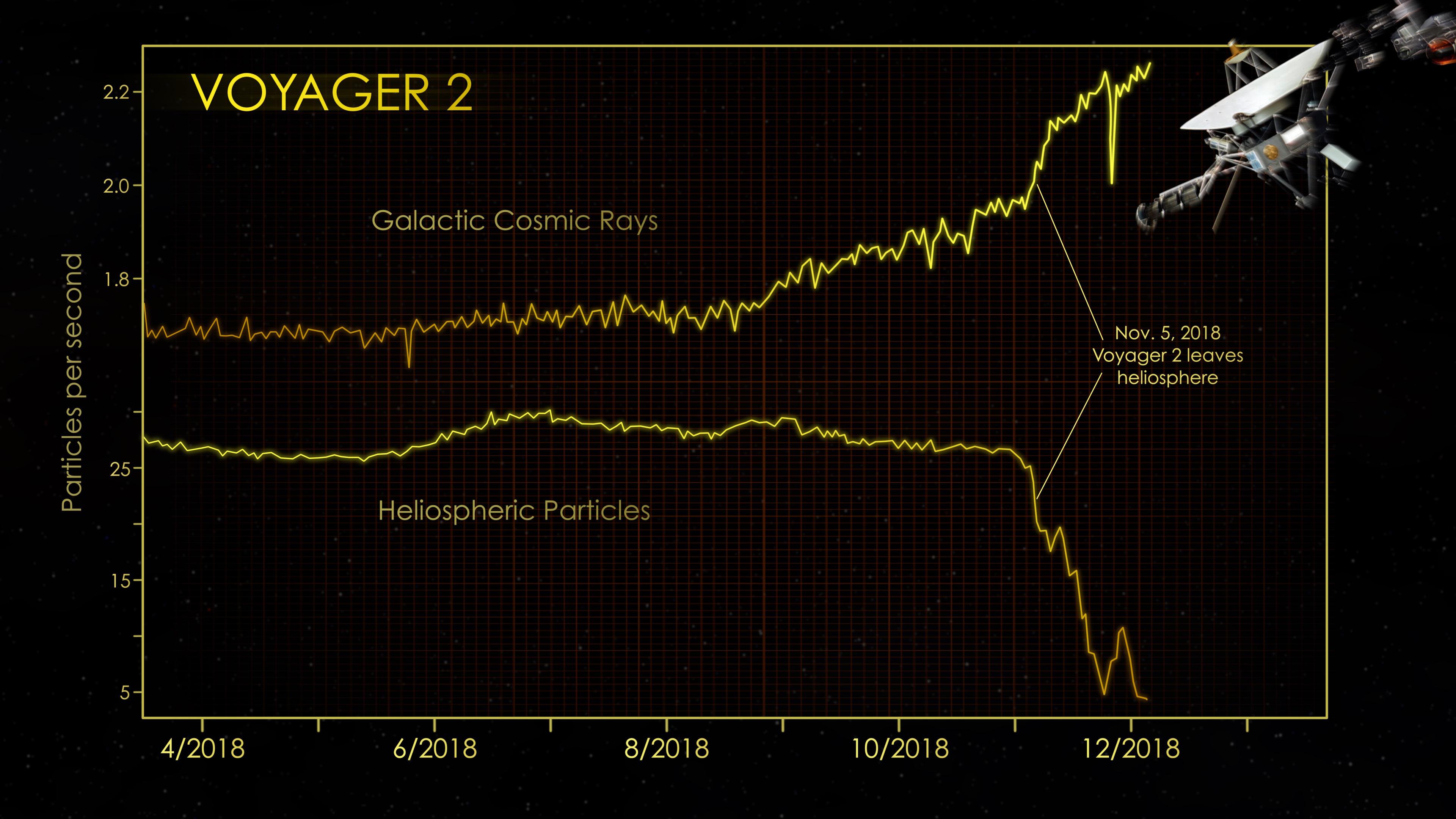

Once its planetary mission was over, Voyager 2 was described as working on an interstellar mission, which NASA is using to find out what the Solar System is like beyond the heliosphere. , Voyager 2 is transmitting scientific data at about 160 bits per second. Information about continuing telemetry exchanges with Voyager 2 is available from Voyager Weekly Reports.

In 1992, Voyager 2 observed the nova V1974 Cygni in the far-ultraviolet, first of its kind. The further increase in the brightness at those wavelengths helped in the more detailed study of the nova.
In July 1994, an attempt was made to observe the impacts from fragments of the comet Comet Shoemaker–Levy 9 with Jupiter. The craft's position meant it had a direct line of sight to the impacts and observations were made in the ultraviolet and radio spectrum. Voyager 2 failed to detect anything, with calculations showing that the fireballs were just below the craft's limit of detection.
On November 29, 2006, a telemetered command to Voyager 2 was incorrectly decoded by its on-board computer—in a random error—as a command to turn on the electrical heaters of the spacecraft's magnetometer. These heaters remained turned on until December 4, 2006, and during that time, there was a resulting high temperature above 130 °C, significantly higher than the magnetometers were designed to endure, and a sensor rotated away from the correct orientation.
On August 30, 2007, Voyager 2 passed the termination shock and then entered into the heliosheath, approximately 1 e9mi closer to the Sun than Voyager 1 did.{{cite web | url=https://www.nasa.gov/mission_pages/voyager/voyager-20071210.html | title=NASA – Voyager 2 Proves Solar System Is Squashed | website=www.nasa.gov | access-date=October 5, 2018 | archive-date=April 13, 2020 | archive-url=https://web.archive.org/web/20200413080741/https://www.nasa.gov/mission_pages/voyager/voyager-20071210.html | url-status=live }} This is due to the interstellar magnetic field of deep space. The southern hemisphere of the Solar System's heliosphere is being pushed in.
On April 22, 2010, Voyager 2 encountered scientific data format problems. On May 17, 2010, JPL engineers revealed that a flipped bit in an on-board computer had caused the problem, and scheduled a bit reset for May 19. On May 23, 2010, Voyager 2 resumed sending science data from deep space after engineers fixed the flipped bit.
In 2013, it was originally thought that Voyager 2 would enter interstellar space in two to three years, with its plasma spectrometer providing the first direct measurements of the density and temperature of the interstellar plasma. However, Voyager project scientist Edward C. Stone and his colleagues said they lacked evidence of what would be the key signature of interstellar space: a shift in the direction of the magnetic field. Finally, in December 2018, Stone announced that Voyager 2 reached interstellar space on November 5, 2018.

Maintenance to the Deep Space Network cut outbound contact with the probe for eight months in 2020. Contact was reestablished on November 2, when a series of instructions was transmitted, subsequently executed, and relayed back with a successful communication message. On February 12, 2021, full communications were restored after a major ground station antenna upgrade that took a year to complete.
In October 2020, astronomers reported a significant unexpected increase in density in the space beyond the Solar System as detected by the Voyager 1 and Voyager 2; this implies that "the density gradient is a large-scale feature of the VLISM (very local interstellar medium) in the general direction of the heliospheric nose".
On July 18, 2023, Voyager 2 overtook Pioneer 10 as the second farthest spacecraft from the Sun.
On July 21, 2023, a programming error misaligned Voyager 2's high gain antenna 2 degrees away from Earth, breaking communications with the spacecraft. By August 1, the spacecraft's carrier signal was detected using multiple antennas of the Deep Space Network. A high-power "shout" on August 4 sent from the Canberra station successfully commanded the spacecraft to reorient towards Earth, resuming communications. As a failsafe measure, the probe is also programmed to autonomously reset its orientation to point towards Earth, which would have occurred by October 15.
Reductions in capabilities
As the power from the RTG slowly reduces, various items of equipment have been turned off on the spacecraft. The first science equipment turned off on Voyager 2 was the PPS in 1991, which saved 1.2 watts.
| Year | End of specific capabilities as a result of the available electrical power limitations | |
|---|---|---|
| 1998 | ||
| 2007 | ||
| 2008 | ||
| 2019 | ||
| 2021 | ||
| 2023 | ||
| 2024 | ||
| 2025 | ||
| 2026 | ||
| 2030 approx | ||
| 2036 |
Concerns with the orientation thrusters
Some thrusters needed to control the correct attitude of the spacecraft and to point its high-gain antenna in the direction of Earth are out of use due to clogging problems in their hydrazine injector. The spacecraft no longer has backups available for its thruster system and "everything onboard is running on single-string" as acknowledged by Suzanne Dodd, Voyager project manager at JPL, in an interview with Ars Technica. NASA has decided to patch the computer software in order to modify the functioning of the remaining thrusters to slow down the clogging of the small diameter hydrazine injector jets. Before uploading the software update on the Voyager 1 computer, NASA will first try the procedure with Voyager 2, which is closer to Earth.
Future of the probe
The probe is expected to keep transmitting weak radio messages until at least the mid-2020s, more than 48 years after it was launched. NASA says that "The Voyagers are destined—perhaps eternally—to wander the Milky Way."
Voyager 2 is not headed toward any particular star. The nearest star is 4.2 light-years away, and at 15.341 km/s, the spacecraft travels one light-year in about 19,541 years — during which time the nearby stars will also move substantially. In roughly 42,000 years, Voyager 2 will pass the star Ross 248 (10.30 light-years away from Earth) at a distance of 1.7 light-years. If undisturbed for 296,000 years, Voyager 2 should pass by the star Sirius (8.6 light-years from Earth) at a distance of 4.3 light-years.
Golden record
Main article: Voyager Golden Record
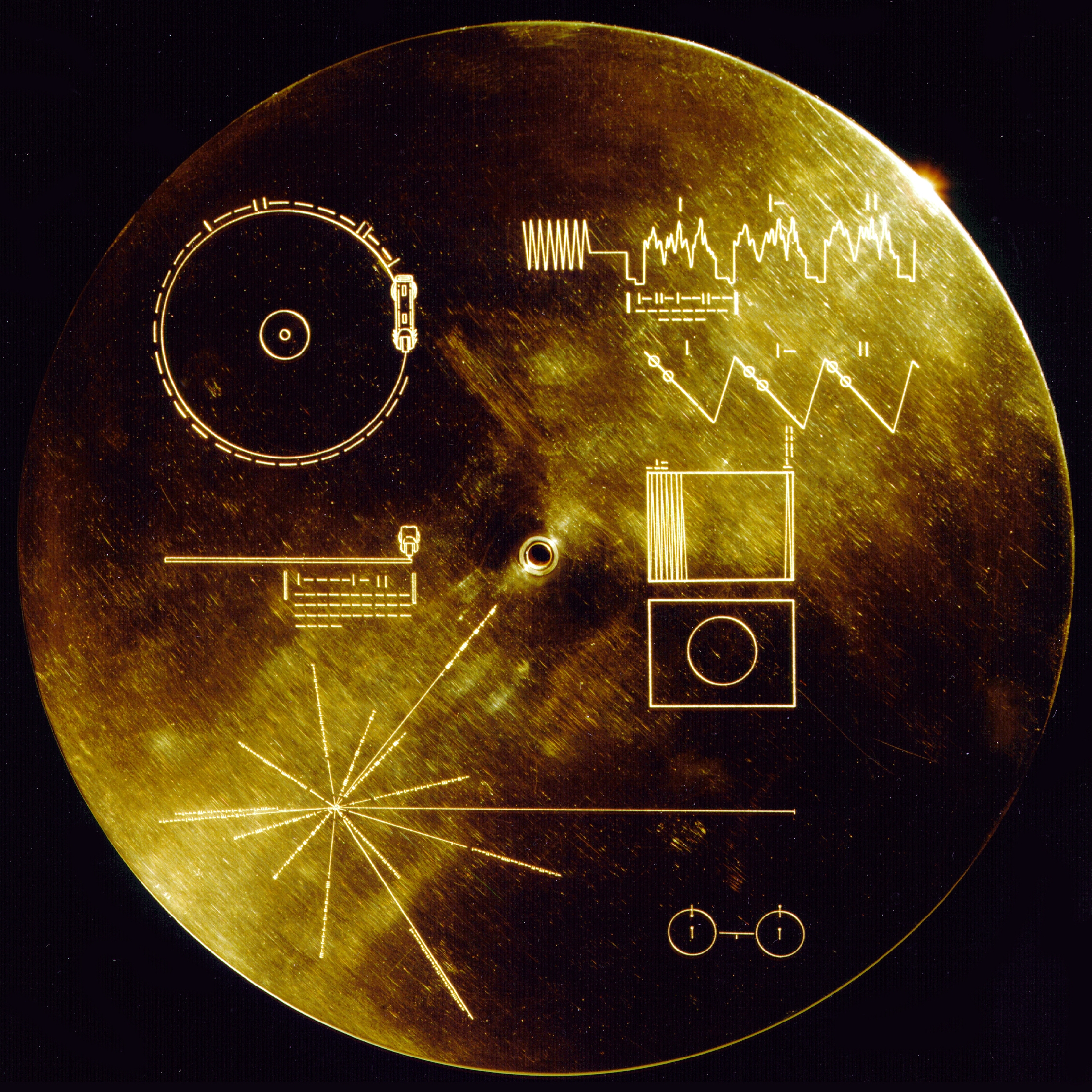
Both Voyager space probes carry a gold-plated audio-visual disc, a compilation meant to showcase the diversity of life and culture on Earth in the event that either spacecraft is ever found by any extraterrestrial discoverer. The record, made under the direction of a team including Carl Sagan and Timothy Ferris, includes photos of the Earth and its lifeforms, a range of scientific information, spoken greetings from people such as the Secretary-General of the United Nations, and a medley, "Sounds of Earth", that includes the sounds of whales, a baby crying, waves breaking on a shore, and a collection of music spanning different cultures and eras including works by Wolfgang Amadeus Mozart, Blind Willie Johnson, Chuck Berry and Valya Balkanska. Other Eastern and Western classics are included, as well as performances of indigenous music from around the world. The record also contains greetings in 55 different languages. The project aimed to portray the richness of life on Earth and stand as a testament to human creativity and the desire to connect with the cosmos.
Notes
References
References
- (1989). "Voyager: Mission Information". NASA.
- "Voyager 2". US National Space Science Data Center.
- "Voyager 2". NASA's Solar System Exploration website.
- "Voyager – Mission Status". [[National Aeronautics and Space Administration]].
- Staff. (September 9, 2012). "Where are the Voyagers?". [[NASA]].
- [[University of Iowa]]. (November 4, 2019). "Voyager 2 reaches interstellar space – Iowa-led instrument detects plasma density jump, confirming spacecraft has entered the realm of the stars". [[EurekAlert!]].
- Chang, Kenneth. (November 4, 2019). "Voyager 2's Discoveries From Interstellar Space – In its journey beyond the boundary of the solar wind's bubble, the probe observed some notable differences from its twin, Voyager 1.". [[The New York Times]].
- Gill, Victoria. (December 10, 2018). "Nasa's Voyager 2 probe 'leaves the Solar System'". [[BBC News]].
- (December 10, 2018). "Release 18–115 – NASA's Voyager 2 Probe Enters Interstellar Space". [[NASA]].
- (September 12, 2013). "At last, Voyager 1 slips into interstellar space – Atom & Cosmos". [[Science News]].
- NASA [http://voyager.jpl.nasa.gov/mission/index.html Voyager – The Interstellar Mission Mission Overview] {{webarchive. link. (May 2, 2011)
- (February 12, 2021). "Earth to Voyager 2: After a Year in the Darkness, We Can Talk to You Again – NASA's sole means of sending commands to the distant space probe, launched 44 years ago, is being restored on Friday.". [[The New York Times]].
- [https://voyager.jpl.nasa.gov/science/planetary.html Planetary Voyage] {{Webarchive. link. (August 26, 2013 [[NASA]] [[Jet Propulsion Laboratory]] – California Institute of Technology. March 23, 2004. Retrieved April 8, 2007.)
- "From Engineering Science to Big Science".
- David W. Swift. (January 1, 1997). "Voyager Tales: Personal Views of the Grand Tour". AIAA.
- Jim Bell. (February 24, 2015). "The Interstellar Age: Inside the Forty-Year Voyager Mission". Penguin Publishing Group.
- (1989). "Voyager 2: Host Information". NASA.
- (2013). "Voyager Telecommunications".
- "NASA News Press Kit 77–136". JPL/NASA.
- (1999). "U.S. space missions using radioisotope power systems". Nuclear News.
- "NASA's Voyager Will Do More Science With New Power Strategy". NASA Jet Propulsion Laboratory.
- (October 1, 2024). "NASA Turns Off Science Instrument to Save Voyager 2 Power". NASA.
- "MR-103".
- (October 1980). "Voyager Backgrounder". Nasa.
- (November 6, 2003). "What Fuel Does Voyager 1 Use?".
- NASA/JPL. (August 26, 2003). "Voyager 1 Narrow Angle Camera Description". NASA / PDS.
- NASA/JPL. (August 26, 2003). "Voyager 1 Wide Angle Camera Description". NASA / PDS.
- link. (July 23, 2011 Muller, Daniel, 2010)
- [https://pds-rings.seti.org/voyager/mission/ "Voyager Mission Description"] {{Webarchive. link. (October 7, 2018 NASA, February 19, 1997)
- link. (February 20, 2017 NASA, JPL, PDS.)
- Sullivant, Rosemary. (November 5, 2011). "Voyager 2 to Switch to Backup Thruster Set". JPL.
- "Distance between the Sun and Voyager 2".
- "Distance between the Sun and Pioneer 10".
- (October 1, 2024). "NASA Turns Off Science Instrument to Save Voyager 2 Power – Voyager".
- "NASA Turns Off Two Voyager Science Instruments to Extend Mission".
- "Voyager - Fact Sheet".
- "Voyager - Fast Facts".
- [https://ssd.jpl.nasa.gov/horizons.cgi HORIZONS] {{Webarchive. link. (October 7, 2012 , JPL Solar System Dynamics (Ephemeris Type ELEMENTS; Target Body: Voyager ''n'' (spacecraft); Center: Sun (body center); Time Span: ''launch + 1 month'' to ''Jupiter encounter – 1 month''))
- (July 8, 2019). "40 Years Ago: Voyager 2 Explores Jupiter – NASA".
- Littmann, Mark. (2004). "Planets Beyond: Discovering the Outer Solar System". [[Courier Corporation]].
- Davies, John. (January 23, 1986). "Voyage to the tilted planet".
- "Basics of space flight: Interplanetary Trajectories".
- "History".
- "Voyager Mission Description".
- "NASA – NSSDCA – Master Catalog – Event Query".
- "Saturn Approach". [[Jet Propulsion Laboratory]].
- (1987). "Engineering the voyager uranus mission". [[Jet Propulsion Laboratory]].
- (May 30, 1995). "Lesson 394: Voyager Scan Platform Problems". [[NASA]].
- Bell, Jim. (February 24, 2015). "The Interstellar Age: Inside the Forty-Year Voyager Mission". Penguin Publishing Group.
- [https://voyager.jpl.nasa.gov/mission/science/uranus/ "Uranus Approach"] {{Webarchive. link. (September 9, 2018 NASA Jet Propulsion Laboratory, California Institute of Technology. Accessed December 11, 2018.)
- (2001). "Voyager's Eleventh Discovery of a Satellite of Uranus and Photometry and the First Size Measurements of Nine Satellites". Icarus.
- (1993). "Planetary magnetospheres". Reports on Progress in Physics.
- (2020). "Atmospheric Electricity at the Ice Giants". Space Science Reviews.
- (1986). "Radio detection of uranian lightning by Voyager 2". Nature.
- Elizabeth Landau (2016) [https://www.nasa.gov/feature/jpl/voyager-mission-celebrates-30-years-since-uranus "Voyager Mission Celebrates 30 Years Since Uranus"] {{Webarchive. link. (May 5, 2017 [[National Aeronautics and Space Administration]], January 22, 2016. Accessed December 11, 2018)
- Voyager 2 Mission Team (2012) [https://solarsystem.nasa.gov/news/184/1986-voyager-at-uranus/ "1986: Voyager at Uranus"] {{Webarchive. link. (May 24, 2019 NASA Science: Solar System Exploration, December 14, 2012. Accessed December 11, 2018.)
- Hatfield, Miles. (March 25, 2020). "Revisiting Decades-Old Voyager 2 Data, Scientists Find One More Secret – Eight and a half years into its grand tour of the solar system, NASA's Voyager 2 spacecraft was ready for another encounter. It was Jan. 24, 1986, and soon it would meet the mysterious seventh planet, icy-cold Uranus.". [[NASA]].
- Andrews, Robin George. (March 27, 2020). "Uranus Ejected a Giant Plasma Bubble During Voyager 2's Visit – The planet is shedding its atmosphere into the void, a signal that was recorded but overlooked in 1986 when the robotic spacecraft flew past.". [[The New York Times]].
- (March 15, 1987). "Voyager Steered Toward Neptune". Ukiah Daily Journal.
- "Neptune". Jet Propulsion Laboratory.
- [[National Aeronautics and Space Administration]] [https://voyager.jpl.nasa.gov/mission/science/neptune/ "Neptune Approach"] {{Webarchive. link. (September 9, 2018 NASA Jet Propulsion Laboratory: California Institute of Technology. Accessed December 12, 2018.)
- (1989). "Predictions of lightning activity at Neptune". Geophysical Research Letters.
- (1990). "Whistlers in Neptune's magnetosphere: Evidence of atmospheric lightning". Journal of Geophysical Research: Space Physics.
- (1989). "Plasma observations near Neptune: Initial results from Voyager 2". Science.
- [[National Aeronautics and Space Administration]] [https://solarsystem.nasa.gov/moons/neptune-moons/in-depth/ "Neptune Moons"] {{Webarchive. link. (April 10, 2020 NASA Science: Solar System Exploration. Updated December 6, 2017. Accessed December 12, 2018.)
- Elizabeth Howell (2016) [https://www.space.com/22222-neptunes-moons.html "Neptune's Moons: 14 Discovered So Far"] {{Webarchive. link. (December 15, 2018 ''[[Space.com]]'', June 30, 2016. Accessed December 12, 2018.)
- Phil Plait (2016) [https://slate.com/technology/2016/06/hubble-observation-reveals-a-new-dark-spot-on-neptune.html "Neptune Just Got a Little Dark"] {{Webarchive. link. (December 15, 2018 ''[[Slate (magazine)). Slate]]'', June 24, 2016. Accessed December 12, 2018.
- link. (June 11, 2017 NASA Jet Propulsion Laboratory: California Institute of Technology, August 2, 1998. Accessed December 12, 2018.)
- (September 7, 2023). "Voyager Space Flight Operations Schedule". [[Jet Propulsion Laboratory]].
- (September 6, 2013). "Voyager Weekly Reports". Voyager.jpl.nasa.gov.
- "V1974 Cygni 1992: The Most Important Nova of the Century".
- (2007). "Robotic Exploration of the Solar System Part I: The Golden Age 1957–1982". Springer.
- Shuai, Ping. (2021). "Understanding Pulsars and Space Navigations". Springer Singapore.
- [https://www.reuters.com/article/scienceNews/idUSN1044867120071211 Voyager 2 finds solar system's shape is 'dented' # 2007-12-10, Week Ending December 14, 2007.] {{Webarchive. link. (September 27, 2020 Retrieved December 12, 2007.)
- John Antczak. (May 6, 2010). "NASA working on Voyager 2 data problem".
- "Engineers Diagnosing Voyager 2 Data System". [[Jet Propulsion Laboratory]].
- "NASA Fixes Bug On Voyager 2".
- Dockrill, Peter. (November 5, 2020). "NASA finally makes contact with Voyager 2 after longest radio silence in 30 years". Live Science.
- Starr, Michelle. (October 19, 2020). "Voyager Spacecraft Detect an Increase in The Density of Space Outside The Solar System". [[ScienceAlert]].
- (August 25, 2020). "Observations of a Radial Density Gradient in the Very Local Interstellar Medium by Voyager 2". [[The Astrophysical Journal Letters]].
- Inskeep, Steve. (August 2, 2023). "NASA loses contact with Voyager Two after a programming error on Earth".
- (August 1, 2023). "Voyager 2: Nasa picks up 'heartbeat' signal after sending wrong command". BBC News.
- (July 28, 2023). "Mission Update: Voyager 2 Communications Pause – The Sun Spot".
- Ellen Francis. (August 5, 2023). "'Interstellar shout' restores NASA contact with lost Voyager 2 spacecraft". [[Washington Post]].
- (August 4, 2023). "Voyager 2: Nasa fully back in contact with lost space probe". BBC News.
- "Voyager – Operations Plan to the End Mission".
- "A New Plan for Keeping NASA's Oldest Explorers Going".
- (February 12, 2021). "Earth to Voyager 2: After a Year in the Darkness, We Can Talk to You Again". The New York Times.
- (1 October 2024). "NASA Turns Off Science Instrument to Save Voyager 2 Power".
- (2024-03-10). "Where Are Voyager 1 and 2 Now? - NASA Science".
- (July 2022). "Record-Breaking Voyager Spacecraft Begin to Power Down". Scientific American.
- "Voyager – Frequently Asked Questions".
- Clark, Stephen. (October 24, 2023). "NASA wants the Voyagers to age gracefully, so it's time for a software patch".
- (March 15, 2008). "Voyager – Spacecraft – Spacecraft Lifetime". [[NASA]] [[Jet Propulsion Laboratory]].
- "Future". NASA.
- (April 3, 2019). "Future stellar flybys of the Voyager and Pioneer spacecraft". Research Notes of the AAS.
- (December 4, 2017). "NASA's Voyager 2 heads for star Sirius... by time it arrives humans will have died out". Express.co.uk.
- Ferris, Timothy. (May 2012). "Timothy Ferris on Voyagers' Never-Ending Journey".
- Gambino, Megan. "What Is on Voyager's Golden Record?".
- "Voyager Golden record". JPL.
- Ferris, Timothy. (August 20, 2017). "How the Voyager Golden Record Was Made".
This article was imported from Wikipedia and is available under the Creative Commons Attribution-ShareAlike 4.0 License. Content has been adapted to SurfDoc format. Original contributors can be found on the article history page.
Ask Mako anything about Voyager 2 — get instant answers, deeper analysis, and related topics.
Research with MakoFree with your Surf account
Create a free account to save articles, ask Mako questions, and organize your research.
Sign up freeThis content may have been generated or modified by AI. CloudSurf Software LLC is not responsible for the accuracy, completeness, or reliability of AI-generated content. Always verify important information from primary sources.
Report