From Surf Wiki (app.surf) — the open knowledge base
Voter registration in the United States
Requirement for most elections in the United States of America

Requirement for most elections in the United States of America
All US states and territories, except North Dakota, require voter registration by eligible citizens before they can vote in federal, state and local elections. In North Dakota, cities in the state may register voters for city elections, and in other cases voters must provide identification and proof of entitlement to vote at the polling place before being permitted to vote. Voter registration takes place at the county level in many states or at the municipal level in several states. Many states set cutoff dates for registration or to update details, ranging from two to four weeks before an election, while 25 states and Washington, D.C. have same-day voter registration, which enables eligible citizens to register or update their registration on the same day they cast their vote. In states that permit early voting, and have voter registration, the prospective voter must be registered before casting a vote.
Some historical registration requirements, including poll taxes, literacy tests, and grandfather clauses, were part of the systematic disenfranchisement of African Americans in the Jim Crow South.
More recently, several common misconceptions have developed around the supposed consequences of registering to vote—that it exposes the person to the military draft, or affects car insurance rates, or requires a permanent address. Despite being untrue, these beliefs are sometimes deterrents for registration. The impact and fairness of other requirements, such as voter identification laws, are the subject of ongoing debate.
The legal case Pitts v. Black in 1984 established that eligible American voters residing in non-conventional accommodations, like a park bench, cannot be refused to register to vote, allowing people experiencing homelessness to participate in elections.
A 2023 study by the US Election Assistance Commission (EAC) found that 85.4% of the citizen voting age population (CVAP) in the United States were registered to vote at the time of the 2022 general elections, more than 203 million US citizens.
While voters were historically required to register at government offices by a certain date before an election, the federal government in the mid-1990s made efforts to increase turnout by easing the registration process. The National Voter Registration Act of 1993 (the "Motor Voter" law) requires state governments to either provide uniform opt-in registration services through drivers' license registration centers, disability centers, schools, libraries, and mail-in registration, or to allow Election Day voter registration, where voters can register at polling places immediately prior to voting.
In 2016, Oregon became the first state to make voter registration fully automatic (opt-out) when issuing driver licenses and ID cards, since followed by 15 more states and the District of Columbia. Political parties and other organizations sometimes hold voter registration drives to register new voters.
In 31 states and the District of Columbia, persons registering to vote may at the same time declare an affiliation with a political party.
History
In 1800, Massachusetts was the first state to require voter registration as a prerequisite for voting in the state. This was followed by Maine (1821), Pennsylvania (1836) and Connecticut (1839). During the 19th century, and especially after the Civil War, more states and cities set a voter registration as a prerequisite to voting, partially to prevent voting by immigrants in cities. However, it was not until 1913 when Nebraska became the first state to establish a permanent statewide voter register, overseen by an election commissioner.
According to a 2020 study, voter registration laws adopted in the period 1880–1916 reduced turnout as much as 19%.
North Dakota abolished voter registration in 1951 for state and federal elections, the only state to do so.
In 2002, Arizona made online voter registration available. In 2016, Oregon became the first state to implement a fully automatic (opt-out) voter registration system tied to the process of issuing driver licenses and ID cards.
In March 2025, Trump executive order on "enforcing restrictions of non-citizens from registering to vote or voting through use of databases maintained by the Department of Homeland Security" laid the groundwork for DOGE to integrate Systematic Alien Verification for Entitlements (SAVE) with data from the Social Security Administration to enable cross checking voter registration and citizenship status via social security numbers. In June 2025, the Supreme Court allowed DOGE to access sensitive data in the SSA.
No registration jurisdiction
North Dakota is the only state that does not have voter registration, which was abolished in 1951, although cities in North Dakota may register voters for city elections. In North Dakota voters must provide identification and proof of entitlement to vote at the polling place before being permitted to vote.
North Dakota is exempt from the requirements of the federal National Voter Registration Act of 1993. Because of this exemption, North Dakota has since 2004 required voters to produce an approved form of ID before being able to vote, one of which was a tribe ID commonly used by Native Americans. It was common and lawful for a post office box to be used on this ID, instead of a residential address, because there are no street addresses on reservations. In 2016, a change required tribal ID to have a residential address to be accepted, and North Dakota has been accused of voter suppression with many Native Americans being denied a vote because they did not have an approved form of ID with a residential address.
North Dakota's ID law especially adversely affected large numbers of Native Americans, with almost a quarter of Native Americans in the state, otherwise eligible to vote, being denied a vote on the basis that they do not have proper ID; compared to 12% of non-Indians. A judge overturned the ID law in July 2016, also saying: "The undisputed evidence before the Court reveals that voter fraud in North Dakota has been virtually non-existent." However, the denial of a vote on this basis was also an issue in the 2018 mid-term election.
Federal jurisdiction
While the United States Congress has jurisdiction over laws applying to federal elections, it has deferred most aspects of election law to the states. The United States Constitution prohibits states from restricting voting rights in ways that infringe on a person's right to equal protection under the law (14th Amendment), on the basis of race (15th Amendment), on the basis of sex (19th Amendment), on the basis of having failed to pay a poll tax or any tax (14th Amendment (see: Harper v. VA Elections Board) & 24th Amendment), or on the basis of age for persons age 18 and older (26th Amendment). The administration of elections, however, vary widely across jurisdictions.
In general, US citizens over the age of 18 have the right to vote in federal elections. In a few cases, permanent residents ("green card" holders) have registered to vote and have cast ballots without realizing that doing so was illegal. Non-citizens convicted in criminal court of having made a false claim of citizenship for the purpose of registering to vote in a federal election can be fined and imprisoned for up to a year. Deportation and removal proceedings have resulted from several such cases. Some municipalities allow non-citizen residents to vote in municipal or school district elections.
All states except Maine and Vermont (and the District of Columbia) deny the vote to convicted felons for some duration, a practice known as felony disenfranchisement. In 16 states, voting is only prohibited during incarceration. 21 states additionally prohibit voting during parole or probation but allow voting after. Eleven states either indefinitely suspend voting rights or require special action to have voting rights restored.
Security issues
In 2023 a contractor, WSD Digital, developing a voter registration and e-pollbook system for New Hampshire put in code to link to websites in Russia and used open source software managed by a Russian. New Hampshire found those issues by hiring another company, ReversingLabs, to review the code of the first company.
In 2016 Russian hackers probed all states and breached voter registration systems in two states. Breaches have the potential to add, remove or change voters, allowing later addition of ballots in those names.
Effect on participation

A 2012 study by The Pew Charitable Trusts estimates that 24% of the voting-eligible population in the United States are not registered to vote, a percentage that represents "at least 51 million eligible U.S. citizens."{{Cite news |access-date=February 16, 2015 |archive-date=April 12, 2019 |archive-url=https://web.archive.org/web/20190412201026/https://www.pewtrusts.org/~/media/legacy/uploadedfiles/pcs_assets/2012/pewupgradingvoterregistrationpdf.pdf |url-status=live
In a 1980 landmark study, Raymond E. Wolfinger and Steven J. Rosenstone came to the conclusion that less restrictive registration requirements would substantially increase the electoral turnout. According to their probit analysis, if all states adopted the procedures of the most permissive state regulations, which would mean:
- eliminating the closing date
- opening registration offices during the forty-hour work week
- opening registration offices in the evening or on Saturday
- permitting absentee registration for the sick, disabled and absent (p 73) turnout in the 1972 presidential election would have been 9.1% higher, with 12.2 million additional people having voted. In a seminal 1988 book, sociologists Richard Cloward and Francis Fox Piven argued that lowering registration requirements would improve socioeconomic equality in the composition of the electorate.
Findings such as this have inspired lawmakers to facilitate the registration process, eventually leading to the National Voter Registration Act of 1993 (or "Motor Voter" act) that required states to allow voter registration at various public offices, including drivers' license registration centers, disability centers, schools, libraries, as well as mail-in registration, unless a state adopts Election Day voter registration. The way towards passing this piece of federal legislation was however lengthy and rocky, as these reforms were highly contested. In an expanded 1990 edition of their 1988 book, titled "Why Americans still don't vote: and why politicians want it that way," Cloward and Piven argued that the reforms were expected to encourage less-privileged groups which happen to lean towards the Democratic Party.
While the turnout at federal elections did substantially increase following the electoral reforms, the effect fell short of Wolfinger and Rosenstone's expectations while Cloward's and Piven's hope of improving the demographic representativeness of the electorate wasn't fulfilled at all. Political scientist Adam Berinsky concluded in a 2005 article that the reforms designed to make voting "easier" in their entirety had an opposite effect, actually increasing the preexisting socioeconomic biases by ensuring "that those citizens who are most engaged with the political world – those with politically relevant resources – continue to participate, whereas those individuals without such resources fall by the wayside." As Berinsky reaffirms in a 2016 piece, the only way to increase turnout while improving representativeness is making more people become interested in politics.
The lack of a place of residence, a mailing address or a form of identification are barriers for the homeless to vote.
In a 2012 Pew Research Center study, researchers found that military personnel were disproportionately affected by voter registration errors. Most often these involved members of the military and their families who were deployed overseas.
Registration centers
Traditionally, voter registration took place at government offices, but the federal National Voter Registration Act of 1993, which came into effect on January 1, 1995, simplified registration. The Act requires state governments to provide opt-in registration services through drivers' license registration centers, disability centers, schools, libraries, as well as providing for mail-in registration. However, six states are exempt from the streamlined processes under the Act: North Dakota, Idaho, Minnesota, New Hampshire, Wisconsin and Wyoming.
Innovative voter registration methods
In the years since the 2000 presidential election, many states have implemented innovative policies that streamline the process of voter registration, promote voter list accuracy, and create options for eligible citizens to register or to update their registration. Such innovations include online voter registration, automatic voter registration, and same-day voter registration.
A September 2024 study by the Center for Election Innovation & Research found that the implementation of at least one of these three voter registration methods increased from seven states in 2000 to 46 states in 2024. To underscore this point: during the 2000 general election, fewer than 6 percent of voting-age citizens lived in states with one of these registration methods. As of this study, nearly 90 percent of voting-age citizens live in states that will have at least one of these methods in place for the 2024 presidential election, and roughly one-third of voting-age citizens now live in states that have implemented all three methods.
The maps below show the innovative registration methods available in each state and Washington, D.C., in 2024.

Online voter registration
As of September 2024, online voter registration is available in 43 states and the District of Columbia. North Dakota does not have voter registration. Since a federal judicial order in September 2020, Texas allows residents to register to vote online if and when they are renewing their driver's licenses or state identification cards.
| State or federal district | Date online voter | |||||||
|---|---|---|---|---|---|---|---|---|
| registration implemented | Website | |||||||
| Alabama | 2016-12-01 | Alabama Votes | ||||||
| Alaska | 2015-11 | Alaska Online Voter Registration | ||||||
| Arizona | 2002-07 | Service Arizona Voter Registration | ||||||
| California | 2012-09-19 | California Online Voter Registration | ||||||
| Colorado | 2010-04-01 | Go Vote Colorado | ||||||
| Connecticut | 2014-01-01 | Connecticut Online Voter Registration | ||||||
| Delaware | url=https://www.ncsl.org/research/elections-and-campaigns/electronic-or-online-voter-registration.aspx | title=Online Voter Registration | website=www.ncsl.org | access-date=October 12, 2022 | archive-date=October 12, 2022 | archive-url=https://web.archive.org/web/20221012232034/https://www.ncsl.org/research/elections-and-campaigns/electronic-or-online-voter-registration.aspx | url-status=live}} | I Vote Delaware |
| District of Columbia | 2015 | District of Columbia Online Voter Registration | ||||||
| Florida | 2017-10-01 | Register to Vote Florida Voter Registration | ||||||
| Georgia (US state) Georgia | 2014-03 | Georgia Online Voter Registration | ||||||
| Guam | 2022 | Guam Online Voter Registration | ||||||
| Hawaii | 2015-08-04 | Hawaii Online Voter Registration | ||||||
| Idaho | 2017-12-06 | Idaho Votes | ||||||
| Illinois | 2014-06-17 | Illinois Online Voter Registration | ||||||
| Indiana | 2010-07-01 | Indiana Online Voter Registration | ||||||
| Iowa | 2016-01-04 | Iowa Online Voter Registration | ||||||
| Kansas | url=https://www.brennancenter.org/sites/default/files/publications/Voter_Registration_Digital_Age_2015.pdf | title=List of States Adopting Electronic Registration, Online Voter Registration, or Both}} | Kansas Online Voter Registration | |||||
| Kentucky | 2016-03-01 | Kentucky Online Voter Registration | ||||||
| Louisiana | 2010-04 | Geaux Vote | ||||||
| Maine | 2023-11 | N/A | ||||||
| Maryland | 2012-07-01 | Maryland Online Voter Registration | ||||||
| Massachusetts | 2015-06-23 | Massachusetts Online Voter Registration | ||||||
| Michigan | 2019-12-02 | Michigan Online Voter Registration | ||||||
| Minnesota | 2013-09-26 | MN Votes | ||||||
| Missouri | 2014 | Vote Missouri | ||||||
| Nebraska | 2015-09-22{{Cite web | url=https://omaha.com/news/state_and_regional/want-to-register-to-vote-online-in-nebraska-now-you-can/article_7f1893e7-26d4-54bc-bf20-eada7155b15b.html | ||||||
| Nevada | 2012-09 | Nevada Online Voter Registration | ||||||
| New Jersey | 2020-09-04 | New Jersey Online Voter Registration | ||||||
| New Mexico | 2016-01-01 | New Mexico Online Voter Registration | ||||||
| New York | 2011 | New York Electronic Voter Registration | ||||||
| North Carolina | 2020-03-20 | North Carolina Online Voter Registration | ||||||
| Ohio | 2017-01-01 | Ohio Online Voter Registration | ||||||
| Oklahoma | url=https://www.ok.gov/elections/Online_Voter_Registration.html | title=Online Voter Registration | access-date=April 23, 2018 | archive-date=April 23, 2018 | archive-url=https://web.archive.org/web/20180423102050/https://www.ok.gov/elections/Online_Voter_Registration.html | url-status=dead}} | In Oklahoma, registered voters can update their registration information online but new voters and voters who have changed names or moved to a different county must fill in a paper form.}} | |
| Oregon | 2010-03-01 | OreStar | ||||||
| Pennsylvania | 2015-08-27 | PA Online Voter Registration | ||||||
| Rhode Island | 2016-08-01 | RI Online Voter Registration | ||||||
| South Carolina | 2012-10-02 | S.C. Online Voter Registration | ||||||
| Tennessee | 2017-08-29 | GoVote TN Voter Registration | ||||||
| Texas | 2020-09 | N/A | ||||||
| Utah | 2010-06 | Utah Online Voter Registration | ||||||
| Vermont | 2015-10-12 | Vermont Online Voter Registration | ||||||
| Virginia | 2013-07-23 | Virginia Voter Registration | ||||||
| Washington (state) Washington | 2008-01 | MyVote | ||||||
| West Virginia | 2015-09 | West Virginia Online Voter Registration | ||||||
| Wisconsin | 2017-01-09 | My Vote Wisconsin |
Automatic voter registration
As of September 2023, 24 states and the District of Columbia had automatic registration of citizens who interact with state agencies such as the DMV, along with 3 other states that have passed legislation or committed administratively to create automatic registration systems, but not yet implemented it. Those interacting with the state agencies have the option to opt-out of registering.
On January 1, 2016, the Oregon Motor Voter Act implemented automatic voter registration of eligible citizens tied to the process of issuing driver licenses and ID cards, with the person having the right to opt out. By April 2016 three more states – California, West Virginia, and Vermont – adopted the system, and in May 2016 Connecticut announced plans to implement it administratively rather than by legislation. Alaskan voters approved Measure 1 on November 8, 2016, to allow residents to register to vote when applying annually for the state's Permanent Dividend Fund. Voter approval of Measure 1 made Alaska the first state to implement automatic (opt-in) voter registration via ballot initiative. New York passed automatic voter registration on December 22, 2020, with implementation to commence in 2023. Several more states have considered legislation for automatic registration. On August 28, 2017, Illinois set July 1, 2018, for implementation of automatic voter registration at motor vehicle agencies, and a year later at other state agencies.
In 2023, the Center for Election Innovation & Research conducted a study of the impact of automatic voter registration in Georgia, which has operated through the state's Department of Driver Services (DDS) since 2016. Among the key findings:
- Active voter registration increased from 78 to 98 percent of eligible citizens in the first four years of AVR’s implementation
- The registered voter population became more representative of the state’s population in terms of age and gender
- The majority of new voter registrations in Georgia are now through DDS transactions.
| State or federal district | Automatic voter | |||||||||
|---|---|---|---|---|---|---|---|---|---|---|
| registration implemented | Type of opt-out | |||||||||
| Alaska | 2017-03-01 | back-end (post-transaction mailer) | ||||||||
| California | url = https://www.brennancenter.org/analysis/automatic-voter-registration | title = Automatic Voter Registration | date = July 24, 2018 | access-date = October 10, 2018 | website = Brennan Center for Justice | archive-date = April 26, 2016 | archive-url = https://web.archive.org/web/20160426110739/http://www.brennancenter.org/analysis/automatic-voter-registration | url-status = live }} | front-end (point of service) | |
| Colorado | 2017-02 | back-end (post-transaction mailer) | ||||||||
| Connecticut | 2018 | front-end (point of service) | ||||||||
| Delaware | 2023 | back-end (post-transaction mailer) | ||||||||
| District of Columbia | 2018-06-26 | front-end (point of service) | ||||||||
| Georgia (US state) Georgia | 2016-09 | front-end (point of service) | ||||||||
| Hawaii | 2021 | front-end (point of service) | ||||||||
| Illinois | 2018-07-02 | front-end (point of service) | ||||||||
| Maine | 2022-01 | front-end (point of service) | ||||||||
| Maryland | 2019-07-01 | front-end (point of service) | ||||||||
| Massachusetts | 2020-01 | back-end (post-transaction mailer) | ||||||||
| Michigan | 2019-09-09 | front-end (point of service) | ||||||||
| Minnesota | 2023-05-05 | back-end (post-transaction mailer) | ||||||||
| Nevada | 2020-01 | front-end (point of service) | ||||||||
| New Jersey | 2018-11-01 | front-end (point of service) | ||||||||
| New Mexico | url=https://www.governor.state.nm.us/2019/03/27/gov-lujan-grisham-enacts-same-day-automated-voter-registration/ | title=Gov. Lujan Grisham enacts same-day, automated voter registration | date=March 27, 2019 | website=Office of the Governor – Michelle Lujan Grisham | language=en-US | access-date=January 24, 2020 | archive-date=January 24, 2020 | archive-url=https://web.archive.org/web/20200124182329/https://www.governor.state.nm.us/2019/03/27/gov-lujan-grisham-enacts-same-day-automated-voter-registration/ | url-status=live}} | front-end (point of service) |
| New York | 2020-12-22 | front-end (point of service) | ||||||||
| Oregon | 2016-01-01 | back-end (post-transaction mailer) | ||||||||
| Pennsylvania | 2023-09-19 | front-end (point of service) | ||||||||
| Rhode Island | 2018-06 | front-end (point of service) | ||||||||
| Vermont | 2017-01 | front-end (point of service) | ||||||||
| Virginia | 2020-04 | front-end (point of service) | ||||||||
| Washington (state) Washington | 2019-07 | front-end (point of service) | ||||||||
| West Virginia | 2019-07 | front-end (point of service) |
Same-day voter registration
Most states require voters to register two to four weeks before an election, with cutoff dates varying from 15 to 30 days. An increasing number of states allow same-day voter registration (SDR), which enables eligible citizens to register to vote or update their registration on the same day they vote.
Same-day registration allows eligible citizens to register or update their registration at the polls or their local election office by showing valid identification to a poll worker or election official, who checks the identification, consults the registration list and, if they are not registered or the registration is out of date, registers them on the spot.
Twenty-five states and the District of Columbia will offer same-day voter registration for the 2024 general election, which allows any qualified resident of the state to register to vote and cast a ballot the same day.
Voter turnout is much higher in states using same-day registration than in states that do not. A 2013 report analyzing turnout in the 2012 United States presidential election had SDR states averaging at a turnout of 71%, well above the average voter turn-out rate of 59% for non-SDR states. According to official turnout data report in the 2014 edition of America Goes to the Polls, voter turnout in SDR states has averaged 10–14 percent higher than states that lack that option. A 2021 study found that same-day registration disproportionately increases turnout among young voters; young voters move more frequently, which disproportionately burdens them under traditional voter registration laws.
| Federal district or state | Same day voting registration implemented | Early voting period registration implemented | |||||||
|---|---|---|---|---|---|---|---|---|---|
| California | url=https://www.ncsl.org/research/elections-and-campaigns/same-day-registration.aspx | title=Same Day Voter Registration | website=www.ncsl.org | access-date=October 12, 2022 | archive-date=October 12, 2022 | archive-url=https://web.archive.org/web/20221012232038/https://www.ncsl.org/research/elections-and-campaigns/same-day-registration.aspx | url-status=live}} | ||
| Colorado | 2013 | ||||||||
| Connecticut | 2012 | 2024 | |||||||
| District of Columbia | 2010 | N/A | |||||||
| Hawaii | 2014 | ||||||||
| Idaho | 1994 | N/A | |||||||
| Illinois | 2005 and 2015 | N/A | |||||||
| Iowa | 2007 | ||||||||
| Maine | url=http://bangordailynews.com/2011/10/11/politics/maine-municipalities-endorse-yes-on-1/?ref=latest | title=Maine towns back Yes on 1, same-day voter signup – Politics | newspaper=Bangor Daily News | date=October 11, 2011 | access-date=December 17, 2015 | archive-date=December 24, 2015 | archive-url=https://web.archive.org/web/20151224025757/http://bangordailynews.com/2011/10/11/politics/maine-municipalities-endorse-yes-on-1/?ref=latest | url-status=live }} | N/A |
| Maryland | 2013 and 2018 | ||||||||
| Michigan | url=https://content.govdelivery.com/accounts/MISOS/bulletins/21f2f89 | title=News Update – Transition to QVF Refresh, Recount Request Deadline Elapses, and More | website=Michigan Secretary of State | language=en | access-date=January 24, 2020}} | 2019 | |||
| Minnesota | 1974 | N/A | |||||||
| Montana | 2005 | N/A | |||||||
| Nevada | 2019 | ||||||||
| New Hampshire | 1996 | N/A | |||||||
| New Mexico | url=https://nmpoliticalreport.com/2019/03/27/gov-signs-same-day-voter-registration-bill/ | title=Gov. signs same-day voter registration bill | last=Reichbach | first=Matthew | date=March 27, 2019 | website=The NM Political Report | language=en-US | access-date=January 24, 2020}} | |
| North Carolina | 2007 | ||||||||
| Utah | 2018 | ||||||||
| Vermont | 2015 | ||||||||
| Virginia | 2022 | N/A | |||||||
| Washington (state) Washington | 2018 | 2019 | |||||||
| Wisconsin | 1975 | N/A | |||||||
| Wyoming | 1994 | N/A |
Voter re-registration
In many jurisdictions in the United States, registered voter must re-register to vote upon changing residential addresses (even within the same county), or changing names. In the 31 states (and District of Columbia) where voters register by political party, a voter desiring to switch party affiliation must also re-register to vote in closed primaries.
Some jurisdictions have automatic voter re-registration whereby existing registrants are automatically re-registered after changing home addresses. A 2022 study found that automatic voter re-registration would increase voter turnout in the US by 5.8 percentage points.
Partial automatic
This type does transfer some data from DMV electronically to election officials. For instance, name, age and address. However, does not fully meet the definition of an fully automated system, because it is still relying on paper forms in some way.
Permanent and portable registration

As of 2014, Delaware, Hawaii, Oregon, and Texas allow registered voters who have moved within the state to update their registrations when they vote, and are given a regular ballot when they vote. Florida briefly allowed any registered voter who moved to another county and another voting precinct to vote by provisional ballot, except if "the precinct to which you have moved has an electronic poll book or you are an active military member", in which case the voter was given a regular ballot when they voted. As of 2014, the District of Columbia, Maryland, Ohio, and Utah allow registered voters who have moved within the state or the District of Columbia to vote in their new county without re-registering at their new address, but they can only vote a provisional ballot, which could require further action from the voter before it is counted.
Preregistration

Preregistration allows individuals younger than 18 years of age to register to vote, but not to actually vote until they reach 18. All states have some form of preregistration, starting at age 16, except for North Dakota which does not have any registration.
| Federal district or state | Preregistration requirements |
|---|---|
| Alabama | 18 years old by the election date |
| Alaska | Within 90 days preceding 18th birthday |
| Arizona | 18 years old by the election date |
| Arkansas | 18 years old by the election date |
| California | 16-year-olds may preregister |
| Colorado | 16-year-olds may preregister |
| Connecticut | 18 years old by the election date |
| Delaware | 16-year-olds may preregister |
| District of Columbia | 16-year-olds may preregister |
| Florida | 16-year-olds may preregister |
| Georgia (US state) | 17.5-year-olds may preregister |
| Hawaii | 16-year-olds may preregister, and 17-year-olds may register but not vote |
| Idaho | 18 years old by the election date |
| Illinois | 18 years old by the election date |
| Indiana | 18 years old by the election date |
| Iowa | 17.5-year-olds may preregister |
| Kansas | 18 years old by the election date |
| Kentucky | 18 years old by the election date |
| Louisiana | 16-year-olds may preregister |
| Maine | 17-year-olds may preregister |
| Maryland | 16-year-olds may preregister |
| Massachusetts | 16-year-olds may preregister |
| Michigan | 18 years old by the election date |
| Minnesota | 18 years old by the election date |
| Mississippi | 18 years old by the election date |
| Missouri | 17.5-year-olds may preregister |
| Montana | 18 years old by the election date |
| Nebraska | 18 years old by the election date |
| Nevada | 17-year-olds may preregister |
| New Hampshire | 18 years old by the election date |
| New Jersey | 17-year-olds may preregister |
| New Mexico | 18 years old by the election date |
| New York | 16 year olds may preregister |
| North Carolina | 16-year-olds may preregister |
| Ohio | 18-year-olds by the election date |
| Oklahoma | 18 years old by the election date |
| Oregon | 16-year-olds may preregister |
| Pennsylvania | 18 years old by the election date |
| Rhode Island | 16-year-olds may preregister, and 17-year-olds may register if they will be 18 years old by the election |
| South Carolina | 18 years old by the election date |
| South Dakota | 18 years old by the election date |
| Tennessee | 18 years old by the election date |
| Texas | Individuals 17 years and 10 months old may register |
| Utah | 16-year-olds may preregister |
| Vermont | 18 years old by the election date |
| Virginia | 18 years old by the election date |
| Washington | 18 years old by the election date |
| West Virginia | 17-year-olds may preregister |
| Wisconsin | 18 years old by the election date |
| Wyoming | 18 years old by the election date |
Registration drives

A voter registration drive is an effort undertaken by a government authority, political party or other entity to register to vote persons otherwise entitled to vote. In many jurisdictions, the functions of electoral authorities includes endeavors to get as many people to register to vote as possible. In most jurisdictions, registration is a prerequisite to a person being able to vote at an election.
In the United States, such drives are often undertaken by a political campaign, political party, or other outside groups (partisan and non-partisan), that seeks to register persons who are eligible to vote but are not registered. In all US states except North Dakota, registration is a prerequisite to a person being able to vote at federal, state or local elections, as well as to serve on juries and perform other civil duties. Sometimes these drives are undertaken for partisan purposes, and target specific demographic groups considered to be likely to vote for one candidate or other; on the other hand, such drives may be undertaken by non-partisan groups and targeted more generally.
In 2004, the Nu Mu Lambda chapter of Alpha Phi Alpha fraternity held a voter registration drive in DeKalb County, Georgia, from which Georgia Secretary of State Cathy Cox (Dem.) rejected all 63 voter registration applications because the fraternity did not obtain specific pre-clearance from the state to conduct their drive. Nu Mu Lambda filed Charles H. Wesley Education Foundation v. Cathy Cox (Wesley v. Cox) asserting that the Georgia's long-standing policy and practice of rejecting mail-in voter registration applications that were submitted in bundles, by persons other than registrars, deputy registrars, or "authorized persons", violated the requirements of the National Voter Registration Act of 1993 by undermining voter registration drives. A senior US District Judge upheld earlier federal court decisions in the case, which found that private entities have a right, under the federal law, to engage in organized voter registration activity in Georgia at times and locations of their choosing, without the presence or permission of state or local election officials.
Organizations that regularly work to register voters and promote citizens' engagement in elections include the following (some working nationally and others more locally):
- Advancement Project
- Black Voters Matter
- Close Up Foundation
- Democrats Abroad
- HeadCount
- League of Women Voters
- Let America Vote
- Association of Community Organizations for Reform Now
- National Association for the Advancement of Colored People
- Nonprofit VOTE
- Our Time
- Rock the Vote
- Southern Regional Council
- Southwest Voter Registration Education Project
- Student Association for Voter Empowerment
- The Voter Participation Center
- Turning Point USA
- US Vote Foundation
- United States Hispanic Chamber of Commerce
- Vote.org
- Voto Latino
- Women Engaged (led by Malika Redmond and focused on Georgia)
Party affiliation
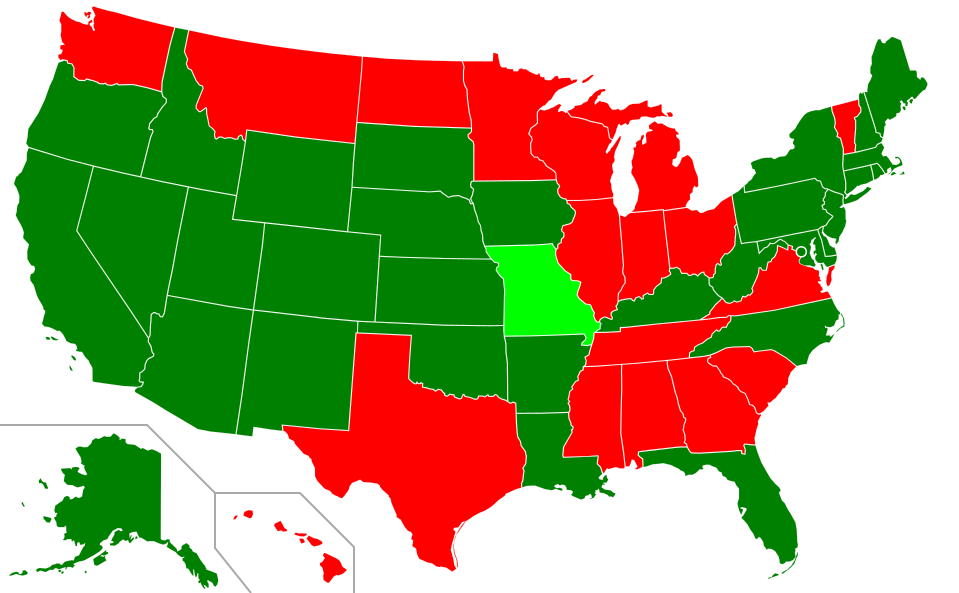
In 32 states and the District of Columbia, voters are allowed to mark their party affiliation, or their unaffiliated status, on their voter registration form. In those states which host closed primaries for political parties, voters are often mandated to declare their party affiliation prior to receiving a primary ballot, whether on the day of the primary or by a prior deadline. In addition, regardless of the method of primary in these states, voters who are party-affiliated in their voter files are most often allowed to participate in intra-party elections and decision-making. Missouri, an open-primary state, became the most recent state to instate an optional party affiliation question on voter registration forms in 2023.
States with party affiliation questions
| Federal district of state | Party affiliation question? | Year of adoption |
|---|---|---|
| Alabama | No | N/A |
| Alaska | Yes | ? |
| Arizona | Yes | ? |
| Arkansas | Yes | ? |
| California | Yes | ? |
| Colorado | Yes | ? |
| Connecticut | Yes | ? |
| Delaware | Yes | ? |
| District of Columbia | Yes | ? |
| Florida | Yes | ? |
| Georgia (US state) | No | N/A |
| Hawaii | No | N/A |
| Idaho | Yes | 2011 |
| Indiana | No | N/A |
| Illinois | No | N/A |
| Iowa | Yes | ? |
| Kansas | Yes | ? |
| Kentucky | Yes | |
| Louisiana | Yes | ? |
| Maine | Yes | ? |
| Maryland | Yes | ? |
| Massachusetts | Yes | 1916 |
| Michigan | No | N/A |
| Minnesota | No | N/A |
| Mississippi | No | N/A |
| Missouri | Yes | 2023 |
| Montana | No | N/A |
| Nebraska | Yes | ? |
| Nevada | Yes | ? |
| New Hampshire | Yes | ? |
| New Jersey | Yes | ? |
| New Mexico | Yes | ? |
| New York | Yes | ? |
| North Carolina | Yes | ? |
| North Dakota | No | N/A |
| Ohio | No | N/A |
| Oklahoma | Yes | ? |
| Oregon | Yes | ? |
| Pennsylvania | Yes | ? |
| Rhode Island | Yes | ? |
| South Carolina | No | N/A |
| South Dakota | Yes | ? |
| Tennessee | No | N/A |
| Texas | No | N/A |
| Utah | Yes | ? |
| Vermont | No | N/A |
| Virginia | No | N/A |
| Washington | No | N/A |
| West Virginia | Yes | ? |
| Wisconsin | No | N/A |
| Wyoming | Yes | ? |
Deadline to re-register with a party for a primary election
| Federal district of state | Deadline to re-register with a political party for a partisan primary election | Deadline to re-register with a political party for the 2020 US Presidential Caucuses and Primary elections | ||||||
|---|---|---|---|---|---|---|---|---|
| Colorado | url=https://www.sos.state.co.us/pubs/elections/calendars/2020ElectionCalendar.pdf | title=2020 Election Calendar | access-date=December 27, 2019 | archive-date=December 27, 2019 | archive-url=https://web.archive.org/web/20191227073524/https://www.sos.state.co.us/pubs/elections/calendars/2020ElectionCalendar.pdf | url-status=live}} | 2020-02-03 | |
| Connecticut | 3 months prior to the partisan primary election | |||||||
| Delaware | The last Saturday in May of the year of the partisan primary election | |||||||
| District of Columbia | url=https://www.dcboe.org/Community-Outreach/Events/Deadline-to-change-party-affiliation-status | title=Deadline to change party affiliation status | access-date=July 16, 2018 | archive-date=July 17, 2018 | archive-url=https://web.archive.org/web/20180717013219/https://www.dcboe.org/Community-Outreach/Events/Deadline-to-change-party-affiliation-status | url-status=live}} | ||
| Idaho | 10th Friday prior to the partisan primary election | |||||||
| Kansas | url=https://www.nyccfb.info/PDF/news_media/PartyAffiliationDeadlines.pdf | title=Deadlines to change party affiliation in closed primary states | access-date=July 16, 2018 | archive-date=July 9, 2017 | archive-url=https://web.archive.org/web/20170709011257/http://www.nyccfb.info/PDF/news_media/PartyAffiliationDeadlines.pdf | url-status=live}} | ||
| Kentucky | url=https://kentucky.gov/Pages/Activity-stream.aspx?n=SOS&prId=146 | title=Deadline to Change Party Affiliation Ahead of 2018 May Primary is Dec. 31}} | ||||||
| Maine | In Maine, unenrolled registered voters may re-register up to and on the partisan primary day}} | |||||||
| New Hampshire | 1st Tuesday of June of the year of the partisan primary election | |||||||
| New Jersey | In New Jersey, unaffiliated registered voters may re-register up to and on the partisan primary day}} | 2020-04-08 | ||||||
| New York | The Friday 10 weeks before the Presidential Primary Election in 2020 | 2020-02-14 | ||||||
| Oregon | 21st day prior to the partisan primary election | 2020-04-28 | ||||||
| Rhode Island | 30th day prior to the partisan primary election | |||||||
| Wyoming | url=https://sos.wyo.gov/faqs.aspx?root=ELEC | title=Wyoming Secretary of State | website=sos.wyo.gov | access-date=October 12, 2022 | archive-date=October 12, 2022 | archive-url=https://web.archive.org/web/20221012232034/https://sos.wyo.gov/faqs.aspx?root=ELEC | url-status=live}} |
Youth voting
In some cities, people younger than 18 can vote in local elections, such as for city councils and school boards. Takoma Park, Maryland, was the first city to allow youth voting, starting in 2013. Other nearby cities, including Hyattsville, Greenbelt and Riverdale Park adopted similar measures.
References
References
- [https://lifehacker.com/the-most-common-myths-about-voter-registration-debunke-1829497517 The Most Common Myths About Voter Registration, Debunked] {{Webarchive. link. (June 8, 2023 lifehacker.com)
- Skelley, Geoffrey. (May 17, 2021). "How The Republican Push To Restrict Voting Could Affect Our Elections".
- "Pitts v. Black, 608 F. Supp. 696".
- (June 29, 2023). "2022 Election Administration and Voting Survey Report".
- Cook, Rhodes. (July 12, 2018). "Registering By Party: Where the Democrats and Republicans Are Ahead – Sabato's Crystal Ball".
- "Acts, 1800. – Chapter 74".
- (February 1, 2021). "America's first voter identification laws: The effects of personal registration and declining political party competition on presidential election turnout, 1880–1916". Electoral Studies.
- Ortiz, Eric. (February 14, 2020). "North Dakota, native tribes agree to settle voter ID lawsuits".
- Totenberg, Nina. (June 6, 2025). "Supreme Court grants DOGE access to confidential Social Security records". NPR.
- "The Voter's Self Defense System".
- Secretary of State North Dakota. "Voter Registration in North Dakota".
- (August 2, 2016). "As November Approaches, Courts Deal Series Of Blows To Voter ID Laws".
- "The Right to Vote". [[United States Citizenship and Immigration Services]].
- Kirk Semple, "[https://www.nytimes.com/2010/10/17/nyregion/17voting.html "Immigrants Find Voting Can Come At a Cost"] {{Webarchive. link. (May 20, 2021 . ''New York Times'', October 15, 2010.)
- . (October 1, 2020). ["Felon Voting Rights"](http://www.ncsl.org/research/elections-and-campaigns/felon-voting-rights.aspx).
- Sakellariadis, John. (September 1, 2024). "Hacking blind spot: States struggle to vet coders of election software".
- (1980). ["Who Votes?"]({{Google books). [[Yale University Press]].
- (1988). "Why Americans don't vote". [[Random House]].
- Toby S. James. (2012). ["Elite Statecraft and Election Administration: Bending the Rules of the Game?"]({{Google books). [[Palgrave Macmillan]].
- Adam Berinsky. (July 2015). "The perverse consequences of electoral reform in the United States". [[American Politics Research]].
- Adam Berinsky. (February 8, 2016). "Making Voting Easier Doesn't Increase Turnout". [[Stanford Social Innovation Review]].
- (May 11, 2024). "The Potential Voters Everyone Forgets". Newsweek.
- Kate Kelly. (February 2012). "Inaccurate, Costly, and Inefficient Evidence That America's Voter Registration System Needs an Upgrade". [[Pew Research Center]].
- (September 24, 2020). "Texas begins letting people register to vote online when they're updating their driver's licenses".
- Gore, Leada. (February 1, 2016). "You can now register to vote online in Alabama".
- [http://www.pewtrusts.org/~/media/legacy/uploadedfiles/pcs_assets/2010/onlinevoterregpdf.pdf Online Voter Registration (OLVR) Systems in Arizona and Washington: Evaluating Usage, Public Confidence and Implementation Processes] {{Webarchive. link. (June 27, 2018)
- (September 20, 2012). "California launches online voter registration".
- (September 2025). "Online Voter Registration}}{{Dead link".
- "Voter Registration and Absentee Ballots".
- "Online Voter Registration".
- "Online Voter Registration".
- (August 4, 2015). "Office of Elections launches online voter registration system". KHON2.
- (December 6, 2017). "Idaho launches online voter registration | the Spokesman-Review".
- (June 17, 2014). "Online voting registration begins in Illinois".
- "Voter Registration".
- (January 4, 2016). "Iowa Residents Can Register to Vote Online".
- "List of States Adopting Electronic Registration, Online Voter Registration, or Both".
- [http://www.kentucky.com/news/politics-government/article65982842.html Online voter registration comes to Kentucky] {{Webarchive. link. (June 28, 2018)
- (July 23, 2021). "Maine to allow online voter registration in November 2023".
- "Online Voter Registration".
- (June 23, 2015). "Massachusetts Launches Online Voting Registration System".
- "SOS – Benson announces beginning of online voter registration and availability of eNotary services in Michigan".
- (October 30, 2013). "Editorials: Online voter registration offers multiple advantages | Mark Ritchie/PostBulletin".
- Wildstein, David. (September 4, 2020). "Online voter registration in N.J. goes live".
- "New Jersey Department of State – Press Releases – September 8, 2020, NJ Division of Elections".
- "Online Voter Registration Now Available in New Mexico!".
- [https://twitter.com/NCSBE/status/1244707072312250368 NCSBE Press Release] {{Webarchive. link. (June 10, 2021)
- "Ohio's Online Voter Registration System is Now Live".
- "Online Voter Registration".
- Bill Graves, The Oregonian. (March 1, 2010). "Oregon offers online voter registration".
- (August 27, 2015). "Pennsylvania Launches Online Voter Registration".
- Pina, Alisha A.. "R.I. secretary of state: Voter registration is easier with new online system".
- "South Carolina Launches Online Voter Registration System".
- (August 29, 2017). "After A Year In The Works, Online Voter Registration Goes Live In Tennessee".
- (October 12, 2015). "Online Voter Registration Now Open In Vermont".
- (July 23, 2013). "Virginia residents can now register to vote online".
- "The Launch of Online Voter Registration in Wisconsin through MyVote.wi.gov".
- "Automatic Voter Registration, a Summary".
- (April 22, 2019). "National Conference of State Legislatures: Automatic Voter Registration".
- "Oregon Secretary of State: Oregon Motor Voter Act FAQ".
- (April 1, 2016). "Automatic Voter Registration". Brennan Center for Justice.
- (April 28, 2016). "Shumlin signs into law automatic voter registration". Vermont Business Magazine.
- Lieutenant Governor Byron Mallott. (March 7, 2016). "Proper Filing Letter". Alaska Division of Elections.
- (November 23, 2016). "Unofficial Results – November 8, 2016 General Election". Alaska Division of Elections.
- "Cuomo Signs Automatic Voter Registration Measure".
- "Automatic Voter Registration".
- (August 28, 2017). "Illinois governor signs automatic voter registration law". Washington Post.
- "Analyzing the Impacts of Automatic Voter Registration in Georgia".
- "PFD Automatic Voter Registration & Updates to Registrations FAQ's".
- (July 24, 2018). "Automatic Voter Registration".
- "Automatic Voter Registration in Connecticut".
- "DMV voter registration approved by General Assembly".
- "Bill Detail – Delaware General Assembly".
- "Automatic Voter Registration Begins at DC DMV on June 26, 2018".
- "Automatic voter registration at DMV begins in IL".
- "Automatic Voter Registration".
- Dwyer, Paul. (January 15, 2020). "State lawmakers get update on automatic voter registration".
- "SOM – Secretary Benson announces modernized voter registration on National Voter Registration Day".
- "Minnesota Secretary Of State – Sec. Simon Celebrates Signing of Historic New Elections Legislation".
- (January 20, 2020). "Nevada voter rolls swell as automatic registration takes effect".
- Michelle Brunetti Post. (November 2018). "Voter registration now automatic at NJ Motor Vehicle Commission".
- (March 27, 2019). "Gov. Lujan Grisham enacts same-day, automated voter registration".
- "Cuomo Signs Automatic Voter Registration Measure".
- "Oregon Secretary of State".
- "LIS > Bill Tracking > HB235 > 2020 session".
- "The Expansion of Innovative Voter Registration Methods, 2000–2024".
- Timpe, Brenden. (March 14, 2013). "New Report: Higher Voter Turnout Linked to SDR". [[Demos (U.S. think tank)]].
- "America Goes to the Polls 2014 – Nonprofit Vote".
- (March 2015). "America Goes to the Polls 2014". Nonprofit Vote.
- (2021). "Rock the Registration: Same Day Registration Increases Turnout of Young Voters". The Journal of Politics.
- "Same Day Voter Registration".
- (June 7, 2023). "Connecticut General Assembly House Bill 5004".
- (October 11, 2011). "Maine towns back Yes on 1, same-day voter signup – Politics". [[Bangor Daily News]].
- "News Update – Transition to QVF Refresh, Recount Request Deadline Elapses, and More".
- Reichbach, Matthew. (March 27, 2019). "Gov. signs same-day voter registration bill".
- Kim, Seo-Young Silvia. (2022). "Automatic Voter Reregistration as a Housewarming Gift: Quantifying Causal Effects on Turnout Using Movers". American Political Science Review.
- "Update or Change Your Voter Registration". USA.gov.
- [https://www.ncsl.org/research/elections-and-campaigns/primary-types.aspx State Primary Election Types] {{Webarchive. link. (November 30, 2020 , National Conference of State Legislatures (January 6, 2021).)
- Ponoroff, Christopher. (2010). "Voter Registration in a Digital Age". Brennan Center For Justice.
- "FAQ – Voting – Division of Elections – Florida Department of State".
- [https://www.demos.org/policy-briefs/millions-polls Millions to the Polls]
- "Preregistration for Young Voters".
- ''[https://caselaw.findlaw.com/us-11th-circuit/1062271.html Charles H. Wesley Education Foundation v. Cathy Cox]''.
- "Cox Violated Voter Rights, Judge Declares".
- "2020 Election Calendar".
- "Registration Deadlines".
- (May 8, 2018). "Deadline looming to switch party before Connecticut primary".
- (May 18, 2018). "Party affiliation change deadline approaching".
- "Deadline to change party affiliation status".
- "Primary Elections in Idaho".
- (March 6, 2018). "Friday is deadline to change party affiliation in Idaho".
- "Deadlines to change party affiliation in closed primary states".
- . ["Deadline nears to change party affiliation"](https://www.hutchnews.com/story/news/local/2018/05/30/deadline-nears-to-change-party-affiliation/12105097007/).
- "Deadline to Change Party Affiliation Ahead of 2018 May Primary is Dec. 31".
- "Deadline to Change Party Enrollment in Time to Vote in June 12 Primary".
- "Party Affiliation in New Hampshire".
- [https://www.doj.nh.gov/media-center/press-releases/2018/20180516-change-party-affiliation.htm June 5, 2018 Deadline to Change Party Affiliation for Voting in the September 11, 2018 State Primary Election] {{Webarchive. link. (October 10, 2018)
- (April 1, 2018). "Division of Elections Reminds Registered Voters of Upcoming April 11 Deadline for Change of Party Affiliation Declaration Forms for Primary Election to be Filed with County Commissioners of Registration".
- "New York Consolidated Laws, Election Law – ELN § 5-304".
- "You Have Until February 14th To Change Your Party Registration For The 2020 Presidential Primary".
- "Voting and Voter Registration".
- [https://elections.ri.gov/faq/ Frequently Asked Questions] {{Webarchive. link. (September 25, 2022 State of Rhode Island Board of Elections.)
- "R.I. voters have until June 14 to switch party affiliations before Sept. 12 primary".
- "Wyoming Secretary of State".
- "More cities consider letting 16-year-olds vote in local elections". Washington Post.
This article was imported from Wikipedia and is available under the Creative Commons Attribution-ShareAlike 4.0 License. Content has been adapted to SurfDoc format. Original contributors can be found on the article history page.
Ask Mako anything about Voter registration in the United States — get instant answers, deeper analysis, and related topics.
Research with MakoFree with your Surf account
Create a free account to save articles, ask Mako questions, and organize your research.
Sign up freeThis content may have been generated or modified by AI. CloudSurf Software LLC is not responsible for the accuracy, completeness, or reliability of AI-generated content. Always verify important information from primary sources.
Report