From Surf Wiki (app.surf) — the open knowledge base
Vote counting
Process of counting votes in an election

Process of counting votes in an election
Vote counting is the process of counting votes in an election. It can be done manually or by machines. In the United States, the compilation of election returns and validation of the outcome that forms the basis of the official results is called canvassing.
Counts are simplest in elections where just one seat is being filled and only a few candidates are on the ballot, and these are often counted manually. In elections where many seats are being filled on the same ballot, counts are often done by computers to give quick results. Tallies done at distant locations must be carried or transmitted accurately to the central election office.
Manual counts are usually accurate within one percent. Computers are at least that accurate, except when they have undiscovered bugs, broken sensors scanning the ballots, paper misfeeds, or hacks. Officials keep election computers off the internet to minimize hacking, but the manufacturers are on the internet. They and their annual updates are still subject to hacking, like any computers. Further, voting machines are in public locations on election day, and often the night before, so they are vulnerable.
Paper ballots and computer files of results are stored until they are tallied, so they need secure storage, which is hard. The election computers themselves are stored for years, and briefly tested before each election.
Despite the challenges to the U.S. voting process integrity in recent years, including claims by Republican Party members of error or voter fraud in 2020 and 2021, a robust examination of the voting process in U.S. states, including Arizona (where claims were most strenuous), found no basis in truth for those claims. The absence of error and fraud is partially attributable to the inherent checks and balances in the voting process itself, which are, as with democracy, built into the system to reduce their likelihood.
Manual counting==
Manual counting, also known as hand-counting, requires a physical ballot that represents voter intent. The physical ballots are taken out of ballot boxes and/or envelopes, read and interpreted; then results are tallied. Manual counting may be used for election audits and recounts in areas where automated counting systems are used.
Manual methods
One method of manual counting is to sort ballots in piles by candidate, and count the number of ballots in each pile. If there is more than one contest on the same sheet of paper, the sorting and counting are repeated for each contest. This method has been used in Burkina Faso, Russia, Sweden, United States (Minnesota), and Zimbabwe.
A variant is to read aloud the choice on each ballot while putting it into its pile, so observers can tally initially, and check by counting the piles. This method has been used in Ghana, Indonesia, and Mozambique. These first two methods do not preserve the original order of the ballots, which can interfere with matching them to tallies or digital images taken earlier.
Another approach is for one official to read all the votes on a ballot aloud, to one or more other staff, who tally the counts for each candidate. The reader and talliers read and tally all contests, before going on to the next ballot. A variant is to project the ballots where multiple people can see them to tally.
Another approach is for three or more people to look at and tally ballots independently; if a majority (Arizona) or all (Germany) agree on their tallies after a certain number of ballots, that result is accepted; otherwise they re-tally.
A variant of all approaches is to scan all the ballots and release a file of the images, so anyone can count them. Parties and citizens can count these images by hand or by software. The file gives them evidence to resolve discrepancies. The fact that different parties and citizens count with independent systems protects against errors from bugs and hacks. A checksum for the file identifies true copies. Election machines which scan ballots typically create such image files automatically, though those images can be hacked or be subject to bugs if the election machine is hacked or has bugs. Independent scanners can also create image files. Copies of ballots are known to be available for release in many parts of the United States. The press obtained copies of many ballots in the 2000 Presidential election in Florida to recount after the Supreme Court halted official recounts. Different methods resulted in different winners.

When manual counts happen
The tallying may be done at night at the end of the last day of voting, as in Britain, Canada, France, Germany, and Spain, or the next day, or 1–2 weeks later in the US, after provisional ballots have been adjudicated.
If counting is not done immediately, or if courts accept challenges which can require re-examination of ballots, the ballots need to be securely stored, which is problematic.
Australia federal elections count ballots at least twice, at the polling place and, starting Monday night after election day, at counting centres.
Errors in manual counts
Hand counting has been found to be slower and more prone to error than other counting methods.
Repeated tests have found that the tedious and repetitive nature of hand counting leads to a loss of focus and accuracy over time. A 2023 test in Mohave County, Arizona used 850 ballots, averaging 36 contests each, that had been machine-counted many times. The hand count used seven experienced poll workers: one reader with two watchers, and two talliers with two watchers.
The results included 46 errors not noticed by the counting team, including:
- Caller called the wrong candidate, and both watchers failed to notice the incorrect call
- Tally markers tried to work out inconsistencies while tallying
- Tally markers marked a vote for an incorrect candidate and the watchers failed to notice the error
- Caller calling too fast resulted in double marking a candidate or missed marking a candidate
- Caller missed calling a vote for a candidate and both watchers failed to notice the omission
- Watchers not watching the process due to boredom or fatigue
- Illegible tally marking caused incorrect tally totaling
- Enunciation of names caused incorrect candidate tally
- Using incorrect precinct tally sheets to tally ballots resulted in incorrect precinct level results.
Similar tallying errors were reported in Indiana and Texas election hand counts. Errors were 3% to 27% for various candidates in a 2016 Indiana race, because the tally sheet labels misled officials into over-counting groups of five tally marks, and officials sometimes omitted absentee ballots or double-counted ballots. 12 of 13 precincts in the 2024 Republican primary in Gillespie County, TX, were added or written down wrong after a hand count, including two precincts with seven contests wrong and one with six contests wrong. While the Texas errors were caught and corrected before results were finalized, the Indiana errors were not.
Average errors in hand-counted candidate tallies in New Hampshire towns were 2.5% in 2002, including one town with errors up to 20%. Omitting that town cut the average error to 0.87%. Only the net result for each candidate in each town could be measured, by assuming the careful manual recount was fully accurate. Total error can be higher if there were countervailing errors hidden in the net result, but net error in the overall electorate is what determines winners. Connecticut towns in 2007 to 2013 had similar errors up to 2%.
In candidate tallies for precincts in Wisconsin recounted by hand in 2011 and 2016, the average net discrepancy was 0.28% in 2011 and 0.18% in 2016.
India hand tallies paper records from a 1.5% sample of election machines before releasing results. For each voter, the machine prints the selected candidate on a slip of paper, displays it to the voter, then drops the slip into a box. In the April–May 2019 elections for the lower house of Parliament, the Lok Sabha, the Election Commission hand-tallied the slips of paper from 20,675 voting machines (out of 1,350,000 machines) and found discrepancies for 8 machines, usually of four votes or less. Most machines tally over 16 candidates, and they did not report how many of these candidate tallies were discrepant. They formed investigation teams to report within ten days, were still investigating in November 2019, with no report as of June 2021. Hand tallies before and after 2019 had a perfect match with machine counts.
An experiment with multiple types of ballots counted by multiple teams found average errors of 0.5% in candidate tallies when one person, watched by another, read to two people tallying independently. Almost all these errors were overcounts. The same ballots had errors of 2.1% in candidate tallies from sort and stack. These errors were equally divided between undercounts and overcounts of the candidates. Optical scan ballots, which were tallied by both methods, averaged 1.87% errors, equally divided between undercounts and overcounts. Since it was an experiment, the true numbers were known. Participants thought that having the candidate names printed in larger type and bolder than the office and party would make hand tallies faster and more accurate.
Intentional errors hand tallying election results are fraud. Close review by observers, if allowed, may detect fraud, and the observers may or may not be believed. If only one person sees each ballot and reads off its choice, there is no check on that person's mistakes. In the US only Massachusetts and the District of Columbia give anyone but officials a legal right to see ballot marks during hand counting. If fraud is detected and proven, penalties may be light or delayed. US prosecution policy since the 1980s has been to let fraudulent winners take office and keep office, usually for years, until convicted, and to impose sentencing level 8–14, which earns less than two years of prison.
In 1934, the United States had been hand-counting ballots for over 150 years, and problems were described in a report by Joseph P. Harris, who 20 years later invented a punched card voting machine,
| Place | Year | Candidate tally errors, as % of votes counted | Reference Standard | Notes | ||||
|---|---|---|---|---|---|---|---|---|
| New Hampshire towns | ||||||||
| New Hampshire towns | ||||||||
| Connecticut towns | ||||||||
| Experiment, optical scan style ballots | ||||||||
| Experiment, read to talliers | ||||||||
| Experiment, sort & stack | ||||||||
| Wisconsin precincts | ||||||||
| Wisconsin precincts | ||||||||
| Indiana, Jeffersonville | ||||||||
| Colorado audits | ||||||||
| Colorado audits | ||||||||
| India national election audit | ||||||||
| Colorado audits | ||||||||
| Maricopa County, AZ audit | ||||||||
| Mohave County, AZ, experiment |
Data in the table are comparable, because average error in candidate tallies as percent of candidate tallies, weighted by number of votes for each candidate (in NH) is mathematically the same as the sum of absolute values of errors in each candidate's tally, as percent of all ballots (in other studies).
Time needed and cost of manual counts

Cost depends on pay levels and staff time needed, recognizing that staff generally work in teams of two to four (one to read, one to watch, and one or two to record votes). Teams of four, with two to read and two to record are more secure and would increase costs. Three to record might more quickly resolve discrepancies, if 2 of the 3 agree.
Typical times in the table below range from a tenth to a quarter of a minute per vote tallied, so 24-60 ballots per hour per team, if there are 10 votes per ballot.
One experiment with identical ballots of various types and multiple teams found that sorting ballots into stacks took longer and had more errors than two people reading to two talliers.
| Team (Wall Clock) Minutes per Vote Checked | Team Size | Staff Minutes per Vote Checked | Number of Contests Checked per Ballot | Full Precincts /Batches, or Random Ballots | Type of Paper Ballot | Number of Ballots Checked | Total Staff Time, Minutes | Year | Sources | Overheads Excluded & Notes | ||||||||||||
|---|---|---|---|---|---|---|---|---|---|---|---|---|---|---|---|---|---|---|---|---|---|---|
| Searcy Cnty, AR | ||||||||||||||||||||||
| Butler Cnty, PA, Butler City | ||||||||||||||||||||||
| Butler Cnty, PA, Donegal Twp | ||||||||||||||||||||||
| Dane County, WI | ||||||||||||||||||||||
| Mohave County, AZ, experiment | ||||||||||||||||||||||
| Maricopa County, AZ recount | ||||||||||||||||||||||
| New Hampshire | ||||||||||||||||||||||
| Carlisle, MA | ||||||||||||||||||||||
| Hancock, MA | ||||||||||||||||||||||
| Provincetown, MA | ||||||||||||||||||||||
| Tolland, CT | ||||||||||||||||||||||
| Bloomfield, CT | ||||||||||||||||||||||
| Vernon, CT | ||||||||||||||||||||||
| Bridgeport, CT | ||||||||||||||||||||||
| Bibb County, GA | ||||||||||||||||||||||
| Camden County, GA | ||||||||||||||||||||||
| Cobb County, GA | ||||||||||||||||||||||
| San Diego precincts | ||||||||||||||||||||||
| Clark County, NV | ||||||||||||||||||||||
| Washington State recount | ||||||||||||||||||||||
| Orange County, CA | ||||||||||||||||||||||
| Read to Talliers Experiment Second Contest | ||||||||||||||||||||||
| Read to Talliers Experiment First Contest | ||||||||||||||||||||||
| Sort & Stack Experiment Second Contest | ||||||||||||||||||||||
| Sort & Stack Experiment First Contest | ||||||||||||||||||||||
| COUNTING BALLOTS IN RANDOM ORDER | ||||||||||||||||||||||
| Carroll County, MD | ||||||||||||||||||||||
| Montgomery County MD | ||||||||||||||||||||||
| Merced County, CA | ||||||||||||||||||||||
| Humboldt County, CA |
Mechanical counting
Mechanical voting machines have voters selecting switches (levers), pushing plastic chips through holes, or pushing mechanical buttons which increment a mechanical counter (sometimes called the odometer) for the appropriate candidate.
There is no record of individual votes to check.
Errors in mechanical counting
Tampering with the gears or initial settings can change counts, or gears can stick when a small object is caught in them, so they fail to count some votes. When not maintained well the counters can stick and stop counting additional votes; staff may or may not choose to fix the problem. Also, election staff can read the final results wrong off the back of the machine.
Electronic counting
Main article: Electronic voting, Electronic voting machine
Electronic machines for elections are being procured around the world, often with donor money. In places with honest independent election commissions, machines can add efficiency, though not usually transparency. Where the election commission is weaker, expensive machines can be fetishized, waste money on kickbacks and divert attention, time and resources from harmful practices, as well as reducing transparency.
An Estonian study compared the staff, computer, and other costs of different ways of voting to the numbers of voters, and found highest costs per vote were in lightly used, heavily staffed early in-person voting. Lowest costs per vote were in internet voting and in-person voting on election day at local polling places, because of the large numbers of voters served by modest staffs. For internet voting they do not break down the costs. They show steps to decrypt internet votes and imply but do not say they are hand-counted.
Optical scan counting
Main article: Optical scan voting system


In an optical scan voting system, or marksense, each voter's choices are marked on one or more pieces of paper, which then go through a scanner. The scanner creates an electronic image of each ballot, interprets it, creates a tally for each candidate, and usually stores the image for later review.
The voter may mark the paper directly, usually in a specific location for each candidate, either by filling in an oval or by using a patterned stamp that can be easily detected by OCR software.
Or the voter may pick one pre-marked ballot among many, each with its own barcode or QR code corresponding to a candidate.
Or the voter may select choices on an electronic screen, which then prints the chosen names, usually with a bar code or QR code summarizing all choices, on a sheet of paper to put in the scanner. This screen and printer is called an electronic ballot marker (EBM) or ballot marking device (BMD), and voters with disabilities can communicate with it by headphones, large buttons, sip and puff, or paddles, if they cannot interact with the screen or paper directly. Typically the ballot marking device does not store or tally votes. The paper it prints is the official ballot, put into a scanning system which counts the barcodes, or the printed names can be hand-counted, as a check on the machines. Most voters do not look at the paper to ensure it reflects their choices, and when there is a mistake, an experiment found that 81% of registered voters do not report errors to poll workers.
Two companies, Hart and Clear Ballot, have scanners which count the printed names, which voters had a chance to check, rather than bar codes and QR codes, which voters are unable to check.
Timing of optical scans
The machines are faster than hand-counting, so are typically used the night after the election, to give quick results. The paper ballots and electronic memories still need to be stored, to check that the images are correct, and to be available for court challenges.
Errors in optical scans
Main article: Electronic voting in the United States#Errors in optical scans
Scanners have a row of photo-sensors which the paper passes by, and they record light and dark pixels from the ballot. A black streak results when a scratch or paper dust causes a sensor to record black continuously. A white streak can result when a sensor fails. In the right place, such lines can indicate a vote for every candidate or no votes for anyone. Some offices blow compressed air over the scanners after every 200 ballots to remove dust. Fold lines in the wrong places can also count as votes.
Software can miscount; if it miscounts drastically enough, people notice and check. Staff rarely can say who caused an error, so they do not know whether it was accidental or a hack. Errors from 2002 to 2008 were listed and analyzed by the Brennan Center in 2010. There have been numerous examples before and since.
- In a 2020 election in Baltimore, Maryland, the private company which printed ballots shifted the location of some candidates on some ballots up one line, so the scanner looked in the wrong places on the paper and reported the wrong numbers. It was caught because a popular incumbent got implausibly few votes.
- In a 2018 New York City election when the air was humid, ballots jammed in the scanner, or multiple ballots went through a scanner at once, hiding all but one.
- In a 2000 Bernalillo County (Albuquerque area), New Mexico, election, a programming error meant that straight-party votes on paper ballots were not counted for the individual candidates. The number of ballots was thus much larger than the number of votes in each contest. The software was fixed, and the ballots were re-scanned to get correct counts.
- In the 2000 Florida presidential race the most common optical scanning error was to treat as an overvote a ballot where the voter marked a candidate and wrote in the same candidate.
Researchers find security flaws in all election computers, which let voters, staff members or outsiders disrupt or change results, often without detection. Security reviews and audits are discussed in Electronic voting in the United States#Security reviews.
When a ballot marking device prints a bar code or QR code along with candidate names, the candidates are represented in the bar code or QR code as numbers, and the scanner counts those codes, not the names. If a bug or hack makes the numbering system in the ballot marking device not aligned with the numbering system in the scanner, votes will be tallied for the wrong candidates. This numbering mismatch has appeared with direct recording electronic machines (below).
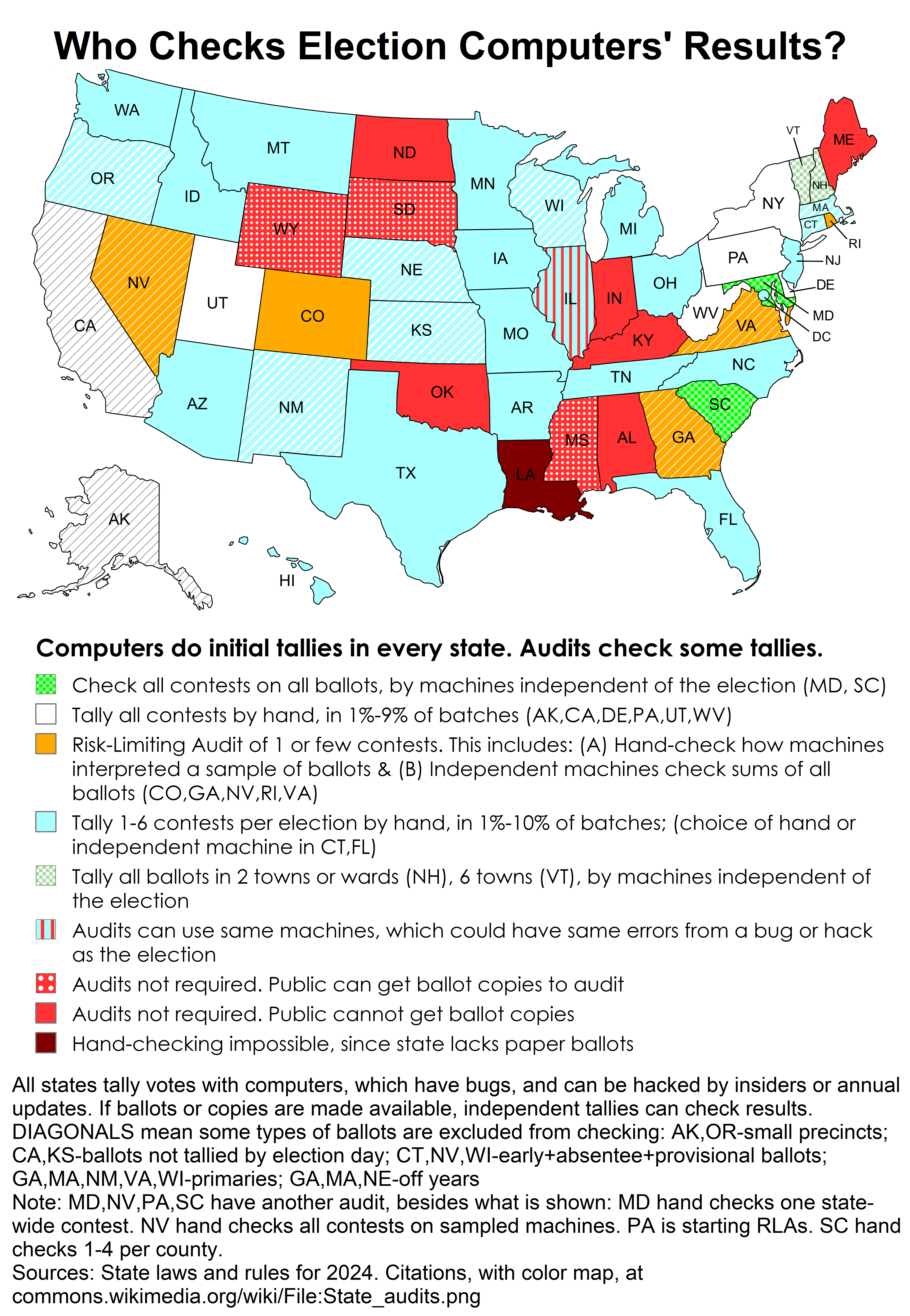
Some US states check a small number of places by hand-counting or use of machines independent of the original election machines.
Recreated ballots
Recreated ballots are paper or electronic ballots created by election staff when originals cannot be counted for some reason. They usually apply to optical scan elections, not hand-counting. Reasons include tears, water damage and folds which prevent feeding through scanners. Reasons also include voters selecting candidates by circling them or other marks, when machines are only programmed to tally specific marks in front of the candidate's name. As many as 8% of ballots in an election may be recreated.
Recreating ballots is sometimes called reconstructing ballots, ballot replication, ballot remaking or ballot transcription. The term "duplicate ballot" sometimes refers to these recreated ballots, and sometimes to extra ballots erroneously given to or received from a voter.
Recreating can be done manually, or by scanners with manual review.
Because of its potential for fraud, recreation of ballots is usually done by teams of two people working together or closely observed by bipartisan teams. The security of a team process can be undermined by having one person read to the other, so only one looks at the original votes and one looks at the recreated votes, or by having the team members appointed by a single official.
When auditing an election, audits need to be done with the original ballots, not the recreated ones.
Cost of scanning systems
List prices of optical scanners in the US in 2002–2019, ranged from $5,000 to $111,000 per machine, depending primarily on speed. List prices add up to $1 to $4 initial cost per registered voter. Discounts vary, based on negotiations for each buyer, not on number of machines purchased. Annual fees often cost 5% or more per year, and sometimes over 10%. Fees for training and managing the equipment during elections are additional. Some jurisdictions lease the machines so their budgets can stay relatively constant from year to year. Researchers say that the steady flow of income from past sales, combined with barriers to entry, reduces the incentive for vendors to improve voting technology.
If most voters mark their own paper ballots and one marking device is available at each polling place for voters with disabilities, Georgia's total cost of machines and maintenance for 10 years, starting 2020, has been estimated at $12 per voter ($84 million total). Pre-printed ballots for voters to mark would cost $4 to $20 per voter ($113 million to $224 million total machines, maintenance and printing). The low estimate includes $0.40 to print each ballot, and more than enough ballots for historic turnout levels. the high estimate includes $0.55 to print each ballot, and enough ballots for every registered voter, including three ballots (of different parties) for each registered voter in primary elections with historically low turnout. The estimate is $29 per voter ($203 million total) if all voters use ballot marking devices, including $0.10 per ballot for paper.
The capital cost of machines in 2019 in Pennsylvania is $11 per voter if most voters mark their own paper ballots and a marking device is available at each polling place for voters with disabilities, compared to $23 per voter if all voters use ballot marking devices. This cost does not include printing ballots.
New York has an undated comparison of capital costs and a system where all voters use ballot marking devices costing over twice as much as a system where most do not. The authors say extra machine maintenance would exacerbate that difference, and printing cost would be comparable in both approaches. Their assumption of equal printing costs differs from the Georgia estimates of $0.40 or $0.50 to print a ballot in advance, and $0.10 to print it in a ballot marking device.
Direct-recording electronic counting
Main article: DRE voting machine

A touch screen displays choices to the voter, who selects choices, and can change their mind as often as needed, before casting the vote. Staff initialize each voter once on the machine, to avoid repeat voting. Voting data and ballot images are recorded in memory components, and can be copied out at the end of the election.
The system may also provide a means for communicating with a central location for reporting results and receiving updates, which is an access point for hacks and bugs to arrive.
Some of these machines also print names of chosen candidates on paper for the voter to verify. These names on paper can be used for election audits and recounts if needed. The tally of the voting data is stored in a removable memory component and in bar codes on the paper tape. The paper tape is called a Voter-verified paper audit trail (VVPAT). The VVPATs can be counted at 20–43 seconds of staff time per vote (not per ballot).
For machines without VVPAT, there is no record of individual votes to check.
Errors in direct-recording electronic voting
This approach can have software errors. It does not include scanners, so there are no scanner errors. When there is no paper record, it is hard to notice or research most errors.
- The only forensic examination which has been done of direct-recording software files was in Georgia in 2020, and found that one or more unauthorized intruders had entered the files and erased records of what it did to them. In 2014-2017 an intruder had control of the state computer in Georgia which programmed vote-counting machines for all counties. The same computer also held voter registration records. The intrusion exposed all election files in Georgia since then to compromise and malware. Public disclosure came in 2020 from a court case. Georgia did not have paper ballots to measure the amount of error in electronic tallies. The FBI studied that computer in 2017, and did not report the intrusion.
- A 2018 study of direct-recording voting machines (iVotronic) without VVPAT in South Carolina found that every election from 2010 to 2018 had some memory cards fail. The investigator also found that lists of candidates were different in the central and precinct machines, so 420 votes which were properly cast in the precinct were erroneously added to a different contest in the central official tally, and unknown numbers were added to other contests in the central official tallies. The investigator found the same had happened in 2010. There were also votes lost by garbled transmissions, which the state election commission saw but did not report as an issue. 49 machines reported that their three internal memory counts disagreed, an average of 240 errors per machine, but the machines stayed in use, and the state evaluation did not report the issue, and there were other error codes and time stamp errors.
- In a 2017 York County, Pennsylvania, election, a programming error in a county's machines without VVPAT let voters vote more than once for the same candidate. Some candidates had filed as both Democrat and Republican, so they were listed twice in races where voters could select up to three candidates, so voters could select both instances of the same name. They recounted the DRE machines' electronic records of votes and found 2,904 pairs of double votes.
- In a 2011 Fairfield Township, New Jersey, election a programming error in a machine without a VVPAT gave two candidates low counts. They collected more affidavits by voters who voted for them than the computer tally gave them, so a judge ordered a new election which they won.
- A 2007 study for the Ohio Secretary of State reported on election software from ES&S, Premier and Hart. Besides the problems it found, it noted that all "election systems rely heavily on third party software that implement interfaces to the operating systems, local databases, and devices such as optical scanners... the construction and features of this software is unknown, and may contain undisclosed vulnerabilities such trojan horses or other malware."
General issues
Interpretation, in any counting method

Election officials or optical scanners decide if a ballot is valid before tallying it. Reasons why it might not be valid include: more choices selected than allowed; incorrect voter signature or details on ballots received by mail, if allowed; lack of poll worker signatures, if required; forged ballot (wrong paper, printing or security features); stray marks which could identify who cast the ballot (to earn payments); and blank ballots, though these may be counted separately as abstentions.
For paper ballots officials decide if the voter's intent is clear, since voters may mark lightly, or circle their choice, instead of marking as instructed. The ballot may be visible to observers to ensure agreement, by webcam or passing around a table, or the process may be private. In the US only Massachusetts and the District of Columbia give anyone but officials a legal right to see ballot marks during hand counting. For optical scans, the software has rules to interpret voter intent, based on the darkness of marks. Software may ignore circles around a candidate name, and paper dust or broken sensors can cause marks to appear or disappear, not where the voter intended.
Officials also check if the number of voters checked in at the polling place matches the number of ballots voted, and that the votes plus remaining unused ballots matches the number of ballots sent to the polling place. If not, they look for the extra ballots, and may report discrepancies.
Secure storage to enable counts in future

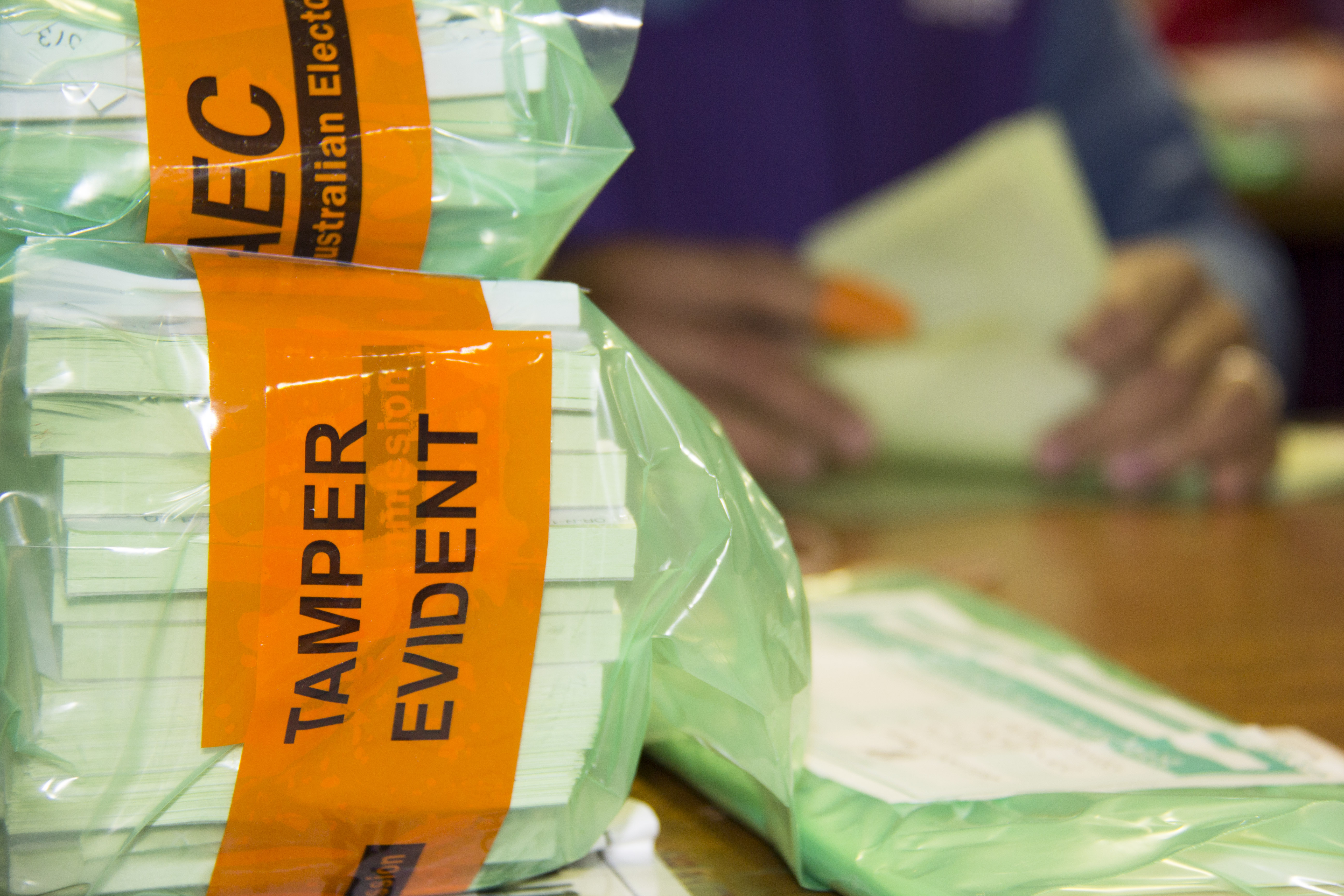

If ballots or other paper or electronic records of an election may be needed for counting or court review after a period of time, they need to be stored securely.
Election storage often uses tamper-evident seals, although seals can typically be removed and reapplied without damage, especially in the first 48 hours. Photos taken when the seal is applied can be compared to photos taken when the seal is opened. Detecting subtle tampering requires substantial training. Election officials usually take too little time to examine seals, and observers are too far away to check seal numbers, though they could compare old and new photos projected on a screen. If seal numbers and photos are kept for later comparison, these numbers and photos need their own secure storage. Seals can also be forged. Seals and locks can be cut so observers cannot trust the storage. If the storage is breached, election results cannot be checked and corrected.
Experienced testers can usually bypass all physical security systems. LocksThere are several sources on lock vulnerabilities:
- Lockpicking is widely taught and practiced:
- Different techniques apply to electronic locks:
- More on electronic locks:
- There are no statistics on how often criminals enter rooms undetected, but law enforcement often does so, so ability to enter rooms undetected is widespread: and camerasSecurity camera flaws have been covered extensively:
are vulnerable before and after delivery. Guards can be bribed or blackmailed. Insider threats and the difficulty of following all security procedures are usually under-appreciated, and most organizations do not want to learn their vulnerabilities.
Security recommendations include preventing access by anyone alone, which would typically require two hard-to-pick locks, and having keys held by independent officials if such officials exist in the jurisdiction; having storage risks identified by people other than those who design or manage the system; and using background checks on staff.
No US state has adequate laws on physical security of the ballots.
Starting the tally soon after voting ends makes it feasible for independent parties to guard storage sites.Organisation for Security and Cooperation in Europe (OSCE) policy calls for independent foreign officials to sleep with ballots, and allows parties to do so:
Turkish opposition sleeping with balllots:
Republicans guarded warehouse of voted ballots in 2000 in Florida and had state police lock up ballots in New Mexico:
Secure transport and internet
The ballots can be carried securely to a central station for central tallying, or they can be tallied at each polling place, manually or by machine, and the results sent securely to the central elections office. Transport is often accompanied by representatives of different parties to ensure honest delivery. Colorado transmits voting records by internet from counties to the Secretary of State, with hash values also sent by internet to try to identify accurate transmissions.
Postal voting is common worldwide, though France stopped it in the 1970s because of concerns about ballot security. Voters who receive a ballot at home may also hand-deliver it or have someone else to deliver it. The voter may be forced or paid to vote a certain way, or ballots may be changed or lost during the delivery process, or delayed so they arrive too late to be counted or for signature mis-matches to be resolved.
Postal voting lowered turnout in California by 3%. It raised turnout in Oregon only in Presidential election years by 4%, turning occasional voters into regular voters, without bringing in new voters. Election offices do not mail to people who have not voted recently, and letter carriers do not deliver to recent movers they do not know, omitting mobile populations.
Some jurisdictions let ballots be sent to the election office by email, fax, internet or app. Email and fax are highly insecure. Internet so far has also been insecure, including in Switzerland, Australia, and Estonia. Apps try to verify the correct voter is using the app by name, date of birth and signature, which are widely available for most voters, so can be faked; or by name, ID and video selfie, which can be faked by loading a pre-recorded video. Apps have been particularly criticized for operating on insecure phones, and pretending to more security during transmission than they have.
References
References
- "Election Management Guidelines". [[U.S. Election Assistance Commission]].
- (September 26, 2022). "As more states create election integrity units, Arizona is a cautionary tale". [[The Washington Post]].
- [https://www.pbs.org/newshour/vote2004/primaries/sr_technology_history.html History of Voting Technology] {{Webarchive. link. (2013-11-01 from [[Public Broadcasting Service). PBS]]'s [[The NewsHour with Jim Lehrer]]
- (2018-07-19). "2018 Post-Election Review Guide".
- "Country Examples Index —".
- (October 2016). "Post-Election Tabulation Audit Pilot Program Report".
- Fifield, Jen and Andrew Oxford. (2021-04-24). "Arizona election audit: Here's what you're seeing on the video feeds as counting continues Saturday". Arizona Republic.
- "Elections in Germany {{!}} Checking and counting ballot papers".
- (2018-11-26). "Ballot Image Audit Guide for Candidates and Campaigns".
- Lutz, Ray. (2017-01-10). "The Open Ballot Initiative".
- Trachtenberg, Mitch. (2013-06-29). "The Humboldt County Election Transparency Project and TEVS".
- "States/Counties that Use Ballot Images from Paper Ballots".
- "I. Election Records Archives".
- "Reporters Committee Election Legal Guide, Updated 2020".
- (2013-02-17). "National Association of Secretaries of State Survey".
- (2001-12-14). "NORC Florida Ballots Project".
- Game, Chris. (May 7, 2015). "Explainer: how Britain counts its votes". The Conversation.
- "Elections, Our Country, Our Parliament".
- (January 14, 2018). "Qu'est-ce qu'un dépouillement ? - Comment se déroule une journée dans un bureau de vote ? Découverte des institutions - Repères - vie-publique.fr".
- (2019). "Stimmenauszählung".
- (April 28, 2019). "¿Qué es el escrutinio y cómo se cuentan los votos en las elecciones generales 2019?". El Confidencial.
- (2018). "Principles and Best Practices for Post-Election Tabulation Audits".
- Australian Electoral Commission. "House of Representatives count".
- Australian Electoral Commission. "The Senate counting process".
- "Explaining Election Day: How hand counting votes carries risks".
- BEILMAN, ELIZABETH. "Jeffersonville City Council At-large recount tally sheets show vote differences". News and Tribune (Jeffersonville, IN).
- Contreras, Natalia. (2024-03-18). "Texas county's GOP officials declared hand count a success, but kept finding errors". Votebeat.
- Ansolabehere, Stephen. (January 2004). "Using Recounts to Measure the Accuracy of Vote Tabulations: Evidence from New Hampshire Elections 1946-2002.".
- (2018-03-20). "Learning from Recounts". Election Law Journal: Rules, Politics, and Policy.
- (2019-03-09). "What are EVMs, VVPAT and how safe they are". Times of India.
- Nath, Damini. (2019-07-25). "ECI sets up teams to probe VVPAT mismatch in Lok Sabha election". The Hindu.
- Pickles, Eric. (2016-12-27). "Securing the ballot: review into electoral fraud".
- (December 2017). "Federal Prosecution of Election Offenses Eighth Edition".
- "Federal Prosecution of Election Offenses".
- (2018-06-27). "2018 Chapter 2 PART C - OFFENSES INVOLVING PUBLIC OFFICIALS AND VIOLATIONS OF FEDERAL ELECTION CAMPAIGN LAWS".
- (2011-10-26). "Sentencing Table".
- (1983). "Joseph P. Harris: Professor and Practitioner: Government, Election Reform, and the Votomatic". Regional Oral History Office.
- Harris, Joseph P.. (1934). "Election Administration in the United States, chapter VI, pages 236-246".
- Antonyan, Tigran. (2013-06-21). "Computer Assisted Post Election Audits". State Certification Testing of Voting Systems National Conference.
- (2020-04-16). "Colorado Risk Limiting Audits: Three Years In".
- (2021-06-03). "Tallying of VVPAT slips and EVM count in constituencies that went to polls recently throw up 100% match". Times of India.
- (2019-04-09). "Supreme Court: Count VVPAT slips of 5 booths in each assembly seat". Times of India.
- (2020-11-25). "2020 General Election Risk-limiting Audit Discrepancy Report".
- Anglen, Robert. (2021-10-12). "New Arizona audit review shows Cyber Ninjas' ballot count off by 312K". Arizona Republic.
- (2021-10-08). "Scan of Pullen Pallets Binders 1-45".
- (2023-07-25). "Ballot Hand Tally".
- (2024-08-23). "Post-Election Audit Report 2024 General Election [actually preference primary], pages 4,5,24,25".
- Madison, Richard Chris. (2024-06-27). "Re: March 2024 Preferential Primary Audit Process".
- McGoldrick, Gillian. (2022-08-17). "Butler County finishes its review of 2020 election, finds no inaccuracies among 1,600 ballot". Pittsburgh Post-Dispatch.
- McGoldrick, Gillian. (2022-08-18). "Butler County Finishes 2020 Election Review After 170 Hours". Governing.
- "FOR ELECTION OFFICIALS".
- McKim, Karen. (January 2016). "Using automatically created digital ballot images to verify voting-machine output in Wisconsin".
- Polletta, Maria and Piper Hansen. (2021-04-28). "Here's what happened at the Arizona election audit of Maricopa County ballots". Arizona Republic.
- Tobi, Nancy. (2007-09-06). "Hands-on Elections: (Condensed Version)".
- Tobi, Nancy. (2011). "Hands-on elections : an informational handbook for running real elections, using real paper ballots, counted by real people : lessons from New Hampshire". Healing Mountain Publications.
- Connecticut Citizen Election Audit Coalition. (2011-01-12). "Report and Feedback December 2010 Bridgeport Connecticut Coalition Recount".
- Georgia Secretary of State, Elections Division. (2007-04). ". (April 1, 2007). "Voter Verified Paper Audit Trail Pilot Project Report. Pages 18-22, 42-63.".
- Lutz, Ray. (2019-01-28). "White Paper: Election Audit Strategy".
- Theisen, Ellen. (2004). "Cost Estimate for Hand Counting 2% of the Precincts in the U.S.".
- Goggin, Stephen N.. (March 2012). "Post-Election Auditing: Effects of Procedure and Ballot Type on Manual Counting Accuracy, Efficiency, and Auditor Satisfaction and Confidence". Election Law Journal: Rules, Politics, and Policy.
- Maryland State Board of Elections. (October 21, 2016). "Post-Election Tabulation Audit Pilot Program Report".
- Bowen, Debra. (2011-03-01). "AB 2023 (Saldaña), Chapter 122, Statutes of 2010 Post-Election Risk-Limiting Audit Pilot Program March 1, 2012, Report to the Legislature". Internet Archive.
- Shapiro, Eliza. (2012-11-10). "RIP, Lever Voting Machines". The Daily Beast.
- (16 March 2012). "Vote: The Machinery of Democracy".
- Emspak, Jesse. (2016-11-08). "Why Not Paper Ballots? America's Weird History of Voting Machines".
- (2014-05-15). "It happens all the time: Interview with the consultant who discovered the Medford miscount".
- (2018-11-17). "Digital dilemmas: the unintended consequences of election technology". Democratization.
- (2021-01-02). "New methodology for calculating cost-efficiency of different ways of voting: is internet voting cheaper?". Public Money & Management.
- "Ballot Marking Devices".
- Cohn, Jennifer. (2018-05-05). "What is the latest threat to democracy?". Medium.
- Bernhard, Matthew. (2019-12-28). "Can Voters Detect Malicious Manipulation of Ballot Marking Devices?".
- Perez, Edward. (March 2019). "Georgia State Election Technology Acquisition, Assessing Recent Legislation in Light of Planned Procurement".
- Walker, Natasha. (2017-02-13). "2016 Post-Election Audits in Maryland".
- Ryan, Tom and Benny White. (November 30, 2016). "Transcript of Email on Ballot Images".
- Gideon, John. (July 5, 2005). "Hart InterCivic Optical-Scan Has A Weak Spot".
- (2015-02-17). "Unregistered Dust Bunnies May be Voting in Wisconsin Elections: Stoughton Miscount Update".
- Appel, Andrew. (2021-06-07). "New Hampshire Election Audit, part 2".
- Norden, Lawrence. (September 16, 2010). "Voting system failures: a database solution".
- Opilo, Emily. (June 3, 2020). "Concern from candidates, officials as error creates delay in release of returns; Dixon leads in Baltimore mayoral count". Baltimore Sun.
- MacDougall, Ian. (November 7, 2018). "What Went Wrong at New York City Polling Places? It Was Something in the Air. Literally.". ProPublica.
- Gruley, Bryan. (2000-12-16). "Election Day Became a Nightmare, As Usual, for Bernalillo County". Wall Street Journal.
- Baker, Deborah. (2004-10-31). "ABQjournal: Contentious 2000 Election Closest in N.M. History". Albuquerque Journal.
- Blaze, Matt. (2019-09-26). "DEF CON 27 Voting Machine Hacking Village".
- Buell, Duncan. (December 23, 2018). "Analysis of the Election Data from the 6 November 2018 General Election in South Carolina". League of Women Voters of South Carolina.
- Jordan, Ben. (2018-11-07). "MKE Election Commission responds to criticism". WTMJ TV Milwaukee.
- White, Rebecca. (2019-11-18). "One Washington County Plans to Speed Vote Counting with Tech". Government Technology.
- Miller, Steve. (2006-11-07). "Oddly marked ovals bane of poll workers' day". Rapid City Journal.
- Shafer, Michelle. (2020-07-20). "Ballot Duplication: What it is, what it is not, and why we are talking about it".
- Black, Eric. (2008-12-17). "Recount's next big issue: duplicate ballots". MinnPost.
- Tomasic, Megan. (2020-05-14). "Some Allegheny County voters received duplicate mail-in ballots due to system glitch". Tribune Review.
- Shafer, Michelle. (2020-08-31). "Ballot Duplication Technology: What is it and how does it work?".
- Duplicate ballot procedures in Ventura County, CA https://recorder.countyofventura.org/wp-content/uploads/2018/05/BALLOT-DUPLICATION-PROCESS-FACTS-2-Final-1.pdf
- Duplicate ballot procedures in Michigan https://www.michigan.gov/documents/sos/XII_Precinct_Canvass_-_Closing_the_Polls_266013_7.pdf
- Caulfield, Matthew. (2021-03-30). "Price of Voting".
- Perez, Edward. (March 2019). "Georgia State Election Technology Acquisition, A Reality Check".
- Fowler, Stephen. "Here's What Vendors Say It Would Cost To Replace Georgia's Voting System". Georgia Public Broadcasting.
- Deluzio, Christopher. (2020-02-28). "Pennsylvania Counties' New Voting Systems Selections: An Analysis".
- "NYVV - Paper Ballots Costs".
- [http://www.eac.gov/VVSG%20Volume_I.pdf 2005 Voluntary Voting System Guidelines] {{webarchive. link. (2006-02-08 from the US [[Election Assistance Commission]])
- Theisen, Ellen. (2005-06-14). "Cost Estimate for Hand Counting 2% of the Precincts in the U.S.".
- Lamb, Logan. (2020-01-14). "SUPPLEMENTAL DECLARATION OF LOGAN LAMB".
- (2020-01-16). "Coalition Plaintiffs' Status Report, pages 237-244".
- Bajak, Frank. (2020-01-16). "Expert: Georgia election server showed signs of tampering". Associated Press.
- Zetter, Kim. "Will the Georgia Special Election Get Hacked?". Politico.
- Freed, Benjamin. (2019-01-07). "South Carolina voting machines miscounted hundreds of ballots, report finds". Scoop News Group.
- (2017-11-07). "'Redo' of some York County races - including judge - possible after voting problems". York Daily Record.
- Lee, Rick. (2017-11-20). "UPDATE: York Co. election judicial winners: Kathleen Prendergast, Clyde Vedder, Amber Anstine Kraft". York Daily Record.
- Thibodeau, Patrick. (2016-10-05). "If the election is hacked, we may never know". ComputerWorld.
- McDaniel. (2007-12-07). "EVEREST: Evaluation and Validation of Election-Related Equipment, Standards and Testing".
- (2017-02-10). "State Audit Laws".
- "Chapter 3. PHYSICAL SECURITY".
- (October 1, 2012). "Risk-Limiting Post-Election Audits: Why and How".
- Stark, Philip. (July 26, 2018). "An Introduction to Risk-Limiting Audits and Evidence-Based Elections Prepared for the Little Hoover Commission".
- Johnston, Roger G.. (July 31, 2012). "How to Choose and Use Seals". Army Sustainment.
- Coherent Cyber. (August 28, 2017). "Security Test Report ES&S Electionware 5.2.1.0". Freeman, Craft McGregor Group.
- Stauffer, Jacob. (November 4, 2016). "Vulnerability & Security Assessment Report Election Systems &Software's Unity 3.4.1.0".
- Turner, Karl. (November 5, 2007). "Elections board workers take plea deal". Cleveland Plain Dealer.
- Recount Now. (January 11, 2017). "Report on the 2016 Presidential Recount in Clark County, Nevada. Page 20.".
- Seivold, Garett. (April 2, 2018). "Physical Security Threats and Vulnerabilities - LPM".
- (2018). "Principles and Best Practices for Post-Election Tabulation Audits".
- Benaloh. (2017). "Public Evidence from Secret Ballots".
- "Rule 25. Post-election audit".
- (2005-04-04). "Judge upholds vote-rigging claims". BBC.
- Mawrey, Richard. (2010-11-01). "Judgment of Commissioner Mawrey QC Handed down on Monday 4th April 2005 in the matters of Local Government elections for the Bordesley Green and Aston Wards of the Birmingham City Council both held on 10th June 2004".
- (11 December 2018). "Thousands of mailed ballots in Florida were not counted".
- "If you vote by mail in Florida, it's 10 times more likely that ballot won't count".
- Kousser, Thad. (2007-07-13). "Does Voting by Mail Increase Participation? Using Matching to Analyze a Natural Experiment". Political Analysis.
- BERINSKY, ADAM J.. (2001). "Who Votes by Mail?: A Dynamic Model of the Individual-Level Consequences of Voting-by-Mail Systems". Public Opinion Quarterly.
- Slater, Michael. (2007-06-29). "Vote-by-Mail Doesn't Deliver". NonprofitVote.org.
- "Electronic Transmission of Ballots".
- Jefferson, David. "What About Email and Fax?".
- Zetter, Kim. (2019-02-21). "Experts Find Serious Problems With Switzerland's Online Voting System". Vice.
- Porup, J. M.. (2018-05-02). "Online voting is impossible to secure. So why are some governments using it?". CSO.
- "Independent Report on E-voting in Estonia - A security analysis of Estonia's Internet voting system by international e-voting experts.".
- Parks, Miles. (2020-01-22). "Exclusive: Seattle-Area Voters To Vote By Smartphone In 1st For U.S. Elections". NPR.
- Zetter, Kim. (2020-02-13). "'Sloppy' Mobile Voting App Used in Four States Has 'Elementary' Security Flaws". Vice.
- Specter, Michael A.. (2020-02-12). "The Ballot is Busted Before the Blockchain: A Security Analysis of Voatz, the First Internet Voting Application Used in U.S. Federal Elections".
- Jefferson, David. (2019-05-01). "What We Don't Know About the Voatz "Blockchain" Internet Voting System".
This article was imported from Wikipedia and is available under the Creative Commons Attribution-ShareAlike 4.0 License. Content has been adapted to SurfDoc format. Original contributors can be found on the article history page.
Ask Mako anything about Vote counting — get instant answers, deeper analysis, and related topics.
Research with MakoFree with your Surf account
Create a free account to save articles, ask Mako questions, and organize your research.
Sign up freeThis content may have been generated or modified by AI. CloudSurf Software LLC is not responsible for the accuracy, completeness, or reliability of AI-generated content. Always verify important information from primary sources.
Report