From Surf Wiki (app.surf) — the open knowledge base
Volvo 850
Car model made by Volvo Car Corporation
.jpg)
Car model made by Volvo Car Corporation
| Field | Value |
|---|---|
| name | Volvo 850 |
| image | Volvo-850.jpg |
| caption | 1994 Volvo 850 saloon |
| manufacturer | Volvo Cars |
| production | 1991–1997 (716,903 units) |
| model_years | 1992–1997 |
| assembly | |
| predecessor | Volvo 240 |
| successor | Volvo S70 (Sedan)/V70 (Estate) |
| class | Compact executive car (D) |
| body_style | |
| layout | |
| platform | Volvo P80 platform |
| engine | |
| transmission | {{ubl |
| wheelbase | 2664 mm |
| length | |
| width | 1760 mm |
| height | |
| weight | |
| designer | Jan Wilsgaard (1989) |
| sp | uk |
|5-speed Volvo M56 manual |5-speed Volvo M58 manual |5-speed Volvo M59 manual |4-speed Aisin AW50-42LE automatic
The Volvo 850 is a compact executive car that was produced by the Swedish manufacturer Volvo Cars from 1991 until 1997. Designed by Jan Wilsgaard, the car was introduced in a saloon body style; an estate style was introduced in 1993.
The Volvo 850 was shown for the first time in June 1991, and the car marked a departure for Volvo, featuring multiple unprecedented features for the company; these included a transverse 5-cylinder engine driving the front wheels, a Delta-link rear axle, a side impact protection system, and a self-adjusting front seat belt mechanism.
The Volvo 850 was succeeded by the Volvo S70 and Volvo V70.
Models
Development of what would become the 800 series first began in 1978. The so-called Project Galaxy ultimately resulted in the Volvo 850, the smaller 400 series, new manufacturing technologies as well as the Volvo Modular engine and M Gearbox lines. When development had finished, Volvo had spent the highest sum in the history of the country on an industrial project in Sweden.
850
The Volvo 850 was introduced in Europe in June 1991, as a 1992 model year car. It was launched with the slogan "A dynamic car with four unique innovations" which referred to the newly developed five cylinder transverse engine, the Delta-link rear axle, Initially, only the saloon was available,
In 1992, the 850 was brought to the United States as a 1993 model, becoming Volvo's first front-wheel drive (FWD) car on the U.S. market. These included a CNG-powered Bi-Fuel model and a diesel engined 850 badged as 850 TDI. The 850 was available in both saloon and estate versions, with manual 5-speed or automatic 4-speed transmissions.
For the 850, Volvo created what it called "Delta-link semi-independent rear suspension". Volvo held a U.S. patent for rear axle bushings that compress under load, giving the Volvo 850 passive rear steering. It also has a tight turning circle, 10.2 m, and is considered very maneuverable. By comparison, later large Volvos had a 11.9 m turning circle.
The estate version of the 850 went on sale in February 1993 Full power equipment was standard on all 1993 850 models, with a sunroof and built-in child booster seat in the back folding arm rest.
File:Volvo 850 vorne rechts.jpg|Pre-facelift Volvo 850, notice different front bumper, airdam, and headlights (Europe) File:1993 Volvo 850 GLT.jpg|Pre-facelift Volvo 850, rear (Europe) File:Volvo-850-wagon-rear.jpg|Volvo 850 estate (United States) File:1993 Volvo 850 Estate GLE - interior (9067639564).jpg|Volvo 850 interior File:Volvo850-dashboard.jpg|Dashboard instrument cluster of a 1996 Volvo 850. File:Volvo850-euro-sport-winter-buttons.jpg|Button on Volvo 850 to select between economy and sport modes, as well as button to select winter traction mode.
Beginning in 1994, a facelift for all subsequent 850 models was introduced; this facelift subtly altered the visual appearance of the car, featuring new front and rear bumpers, new headlights and indicators on the outside, and a new switchgear on the inside. The same year, the 850 estate was awarded the Japanese "Good Design Grand Prize" award from the Ministry of International Trade and Industry. In August 1994,
File:1995 Volvo 850 SE 2.5 sedan (25967852114).jpg|Post-facelift Volvo 850 (Australia) File:1994-1997 Volvo 850 SE 2.5 sedan (2011-01-13) 02.jpg|Post-facelift Volvo 850, rear (Australia)
Beginning with their 1995 model year, Volvo introduced the SIPS-Bag on the 850; these airbags were included as standard equipment on the 1995 Turbo models, and were optional for an additional $500 on other 850 models. The SIPS became standard equipment for all new Volvo cars beginning with the 1996 model year. In 1995, the Volvo 850 was ranked the fourth-safest vehicle on the market by the Insurance Institute for Highway Safety.
In 1996, a "Platinum" edition of the 850 Turbo was available. The exterior paint for these models came in a metallic pearl platinum-colour and had special 16 inch alloy wheels. The interior was fitted with leather seats and burled walnut accents. Only 1,400 of these were imported for the U.S. market. 1,000 of which came in the sedan variant, while the other 400 were wagons.
In 1997, the 850 Turbo was rebadged as the 850 "T-5."
850 T-5R
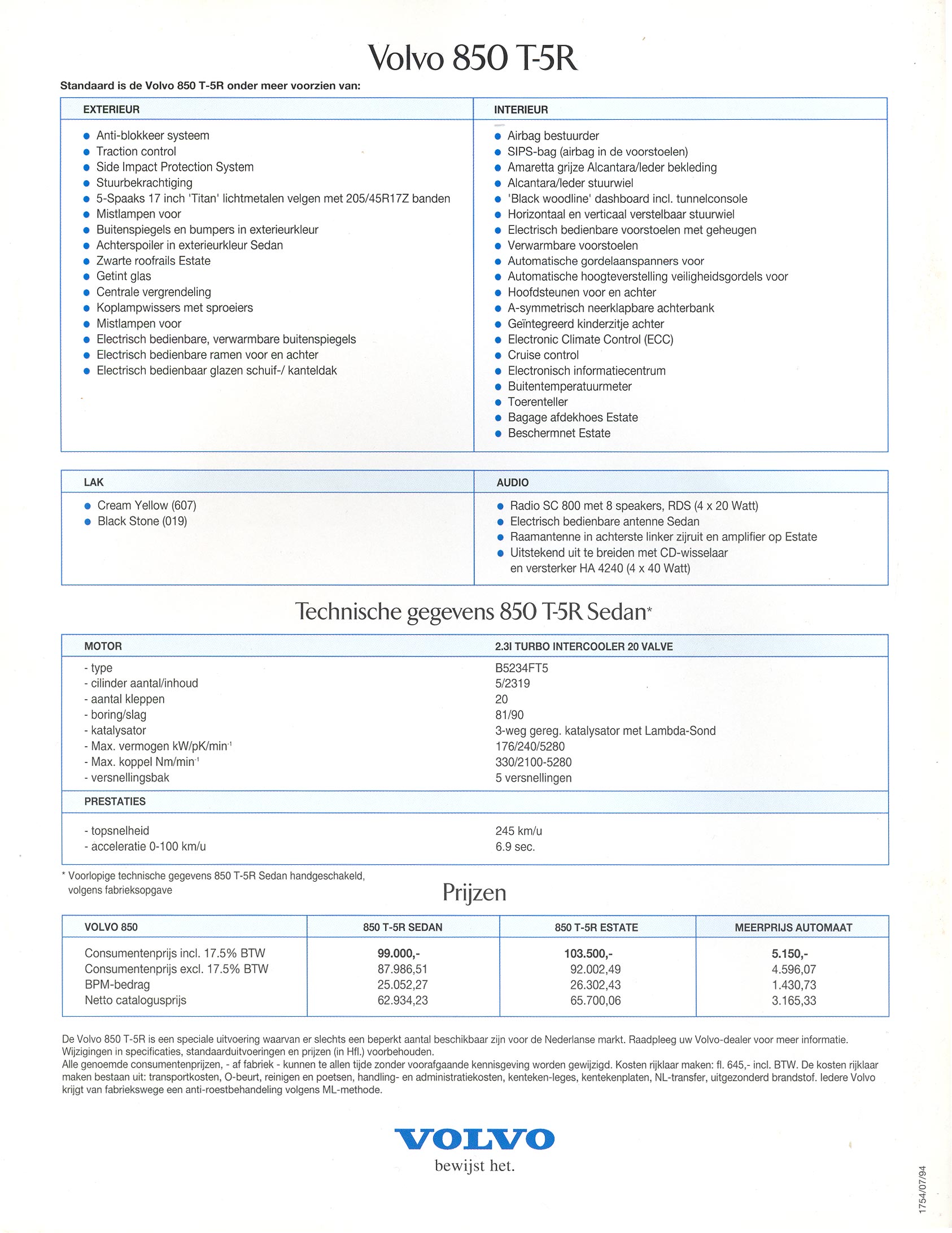
For 1995, the special limited edition 850 T-5R was offered, and was a commercial success, leading Volvo to produce a second run in 1996. Originally, it was to be called 850 Plus 5. The vehicle was based on the 850 Turbo, utilizing the B5234T5 engine with a special ECU (Bosch #628 in U.S and #629 in EU) that added an additional 2 psi of turbocharger boost pressure, giving the engine an extra 18 hp for a total of 243 hp and 250 lbft of torque. The engine was mated to a 4-speed automatic transmission or 5-speed manual transmission, the latter of which was not available in the United States. The T-5R was renowned as a sleeper car; despite its boxy, understated appearance, it boasted a drag coefficient of 0.29 and was capable of accelerating from 0 to 60 mi/h in 5.8 – 6.0 seconds (depending on transmission and body type). The top speed was electronically limited to 152.2 mi/h. The vehicle came standard with Pirelli P-Zero tyres, providing lateral grip of 0.88 g. The engine tuning was co-developed with Porsche, as was the transmission and other powertrain components. Porsche also aided in designing some of the interior, such as the Alcantara seat inserts. These cars came as standard with nearly every feature available, only a handful of options – such as heated rear seats – were available. On the North American market only two options could be chosen, a trunk-mounted Alpine 6-CD changer and no-cost 16" wheels for a smoother, more comfortable ride and driveability in snow when using all-season tires.
Also included in the 1995 T-5R package was a front bumper with a lip, rear spoiler, side skirts, polished aluminum door sills, special graphite leather and Alcantara seats, and a black interior with deep walnut wood grain accents. Both yellow and black versions came with the same black interior as the only choice. The T-5R has an additional badge to the left of the "850" on the trunk, referred to as "The Motorsport badge". The standard road wheel was the titanium-gray 5-spoke 17×7 "Titan". 1995 was the only year that the a model was badged as a "T-5R"; the following year, as Volvo recognized the vehicle's popularity, the model was renewed with the designation "850R".
The T-5R featured side airbags installed in the seat cushions. The side airbags were integrated into the rest of the Volvo model line the following year as an option, and became standard a year after that; other manufacturers soon followed suit. The car was also fitted with an early example of daytime running lamps. Also, just like the 940, it had three-point seatbelts at all five seating positions (previously, cars had only a lap belt for the center rear seat). The T-5R also used the OBDII diagnostics system, a year before OBDII was made an automotive standard.
6964 T-5Rs were produced worldwide, of which the largest market was Germany (1,433), Italy (914; 2.0 turbo), United States (876), Japan (749), Netherlands (489), UK (440), Sweden (321), Spain (185), and Canada (103).
The 1995 850 T-5R was limited in exterior paint color choices:
- Cream Yellow2,537 worldwide including saloon and estate. Only 346 sedans in this color were imported into the United States; wagons, only 49. Cream Yellow was marketed in the Australian market as 'Faded Yellow' to compensate for the unrelenting Australian sun. The Gothenburg engineers were aware of the 1990s paint technology, and the fact it wouldn't retain its deep luster over the course of time, and hence, the clever marketing descriptor, 'Faded Yellow' was coined.
- Stone Black2,516 worldwide including saloon and estate
- Olive Green metallic 1,911 worldwide including saloon and estate
Colour distribution was limited in some countries, that is, not all countries got all three colours: Norway only received yellow, for instance.
Two white, two Aubergine and three grey T-5Rs were also produced. The white and aubergine cars were preproduction cars whereas the grey ones were produced by special demand for the Arabian market. Both aubergines, at least one grey and at least one white T-5R were still registered in Sweden as late as 2014.
File:850t5r.jpg|Volvo 850 T-5R saloon at the Volvo Museum (Europe) File:Volvo T5R ar.jpg|Volvo 850 T-5R saloon rear (Europe) File:Volvo 850 T-5R.jpg|Volvo 850 T-5R estate in green (Europe) File:Volvo 850 T5 R (14484522901).jpg|Volvo 850 Estate T-5R in yellow
850 R
In the spring of 1996, Volvo introduced a new high-performance Volvo 850 as a replacement for the hugely successful limited edition T-5R. Volvo decided there should be no direct successor to the T-5R, but due to its success, Volvo decided to develop a new high-performance model. The new car, based on the T-5R, was called the 850 R, which again came in either saloon or sport wagon editions.
The only colours available were Bright Red, Black Stone, Dark Grey Pearl, Dark Olive Pearl, Turquoise Pearl and Polar White. In the U.S. market only Bright Red, Polar White and Black Stone were available. Cream yellow was discontinued for the 850 R. The saloon featured a newly designed rear spoiler; spoiler was now standard on the estate. The interior upgrades included bucket style heavily bolstered 'sport' front seats (Alcantara centre with leather bolsters), Alcantara door cards, 2-tone leather steering wheel, stainless steel '850' kick plates and R branded over mats. A 200w amplifier was also added to the 8-speaker audio system as was the option to have an SC-805/815 in-dash CD player (some markets).
For a limited time in 1996 only, Volvo offered a new heavy duty manual transmission designed specifically for the 850 R (excluding U.S. market), called the M59, which featured a viscous coupling limited slip differential. Furthermore, the M59 equipped cars were fitted with the B5234T4 2.3-litre 5-cylinder engine featuring a larger TD04HL-16T turbo, re-designed turbo manifold & intercooler, unique ECU with Motronic 4.3, uprated fuel pressure sensor and a heavy duty clutch. These modifications enabled the manual transmission cars to produce 250 PS and 350 Nm versus 240 PS and 330 Nm for the automatic transmission.
Due to encumbrances placed on engine volume by the Italian government, 850 Rs sold in Italy were based on the 2.0-litre 850 Turbo, producing 211 PS. The transmission was the standard AW/50-42 used in all U.S. 850s, the M59 being available in other countries.
850 AWD
_01.jpg)
In November 1996, Volvo launched the 850 AWD. Available as a 1997 model The only available transmission was a 5-speed manual. rear axle with rear self-leveling suspension was standard. Visual features included front and rear mudflaps, the exhaust exiting on the right rear with the bumper being provisioned for dual outlets and specific AWD badging. The Volvo 850 was discontinued in 1997 after a newer generation became available in 1996.
Engines
| Model | Engine code | Year(s) | Fuel Delivery | Power at rpm | Torque at rpm | Displacement | 0–100 km/h (0–62 mph) | Top speed | Ref(s). |
|---|---|---|---|---|---|---|---|---|---|
| 2.0 10V | B5202FS | 1995–1997 | Siemens Fenix 5.2 | 126 PS at 6100 | 170 Nm at 4800 | 1984 cc | 194 km/h | ||
| 2.0 20V | B5204FS | 1992–1996 | Bosch LH 3.2 Jetronic | 143 PS at 6500 | 184 Nm at 3800 | 10.5s | 203 km/h | ||
| 2.4 20V | B5244F | 1994–1997 | Bosch | 148 PS at 6500 | 197 Nm at 3700 | 2319 cc | 196 km/h | ||
| 2.5 10V | B5252S | 1994–1997 | Siemens Fenix 5.2 | 144 PS at 5400 | 206 Nm at 3600 | 2435 cc | 10.0s | 205 km/h | |
| 2.5 20V | B5254FS | 1991–1995 | Bosch LH 3.2 Jetronic | 170 PS at 6200 | 220 Nm at 3300 | 210 km/h | |||
| B5254T | 1996–1997 | Bosch Motronic 4.4 | 193 PS at 5100 | 270 Nm at 1800 | 7.8s | 225 km/h | |||
| T-5 2.0 | B5204T | 1993–1997 | Bosch Motronic 4.3 | 211 PS at 5000 | 300 Nm at 2200 | 1984 cc | 7.3s | 230 km/h | |
| T-5 2.3 | B5234T | 1993–1997 | Bosch Motronic 4.3 | 225 PS at 5200 | 340 Nm at 2000 | 2319 cc | 7.2s | 240 km/h | |
| T-5R 2.0 | B5204T | 1995–1996 | Bosch Motronic 4.3 | 211 PS at 5400 | 300 Nm at 1900 | 1984 cc | 229 km/h | ||
| T-5R (Auto) | B5234T5 | 1995–1996 | Bosch Motronic 4.3 | 300 Nm at 2000 | 2319 cc | 7.4s | 245 km/h | ||
| T-5R (Manual) | B5234T5 | 1995–1996 | Bosch Motronic 4.3 | 330 Nm at 3000 | 6.9s | 245 km/h | |||
| R (Auto) | B5234T5 | 1996–1997 | Bosch Motronic 4.3 | 240 PS at 5400 | 300 Nm at | 7.5s | 235 km/h | ||
| R (Manual) | B5234T4 | 1996–1997 | Bosch Motronic 4.3 | 250 PS at 5400 | 350 Nm at 2400 | 6.7s | 255 km/h |
| Model | Engine code | Year(s) | Power | Torque at rpm | Displacement | 0–100 km/h (0–62 mph) | Top speed | Refs. |
|---|---|---|---|---|---|---|---|---|
| TDI | D5252T (MSA 15.7) | 1996–1997 | 140 PS | 290 Nm at 1900 | 2461 cc | 9.9 s | 200 km/h |
Notes
- a B5254S: 1992–1995 have Bosch LH 3.2. In 1996, both Bosch LH 3.2 and Bosch Motronic 4.4 was fitted. As of 1997 only Bosch Motronic 4.4 was fitted. Please see Volvo Owners Manual and press release for the 1995 T-5R.
- b Modified 2.5L VAG TDI engine.
Motorsport
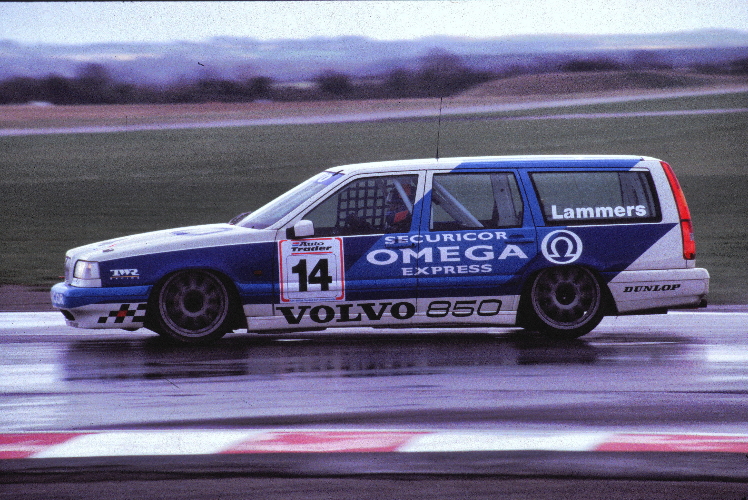
Volvo joined forces with Tom Walkinshaw Racing (TWR) in 1994 to build an 850 Estate Super Touring Car to compete in the British Touring Car Championship (BTCC). Despite much criticism, the 850 Estate performed well, with a best qualifying placing of third and a best race finish of fifth. The 850 Estates were driven by Rickard Rydell and Jan Lammers and Volvo finished eighth in the Manufacturers' standings of the 1994 championship. For 1995, TWR built a Saloon version, with the switch from Estate to Saloon being made mainly due to changes in BTCC regulations regarding aerodynamic aids which effectively ended any chance of the Estate being competitive. With Rickard Rydell and Tim Harvey driving, the 850 Saloons qualified on pole position 12 times and won six races, with Volvo placing third in the Manufacturers Championship. In 1996, an improved 850 Saloon competed in the championship with Rickard Rydell and Kelvin Burt driving, achieving five race wins. Volvo again finishing third in the Manufacturers’ Championship. Volvo also competed in the Super Touring category with the 850 across Europe and in Australia in this era.
In Australia Volvo Dealer Racing entered an 850 T-5 for Peter Brock and Tony Scott in the 1994 James Hardie 12 Hour production car race at Bathurst, finishing 25th. It entered the Australian Super Touring Championship with an estate version driven by Scott in 1995, a saloon version driven by Brock in 1996 and Jim Richards in 1997. Two cars were entered in the 1997 Bathurst 1000.
References
Works cited
References
- "Volvo 850 Production Statistics".
- Yvonne (Pur-Filur). (22 May 2018). "Funny wall decorations inside the passage, body sides of different models built at the factory through the years".
- (12 April 2017). "Volvo 850".
- (12 June 2018). "Made in the Philippines: Cars that proudly flew the flag".
- "Volvo 850 Sedan". Volvo Car Corporation.
- (1996). "1997 Volvo 850 owner's manual". Volvo Car Corporation.
- (1993). "1994 Volvo 850 owner's manual". Volvo Car Corporation.
- (1995). "1996 Volvo 850 owner's manual". Volvo Car Corporation.
- (25 August 2016). "In memoriam of Jan Wilsgaard". Volvo Car Corporation.
- (9 June 2011). "Volvo with four world-firsts turns 20". Volvo Car Corporation.
- (7 December 2013). "Volvo 850 Projekt Galaxy "Att sikta mot stjärnorna"". Volvo AB.
- "Volvo History. Volvo 850 Saloon or Sedan".
- (8 January 2000). "1990–1999: A historical review". Volvo Car Corporation.
- (7 June 2016). "The model that aimed for the stars: the Volvo 850 celebrates its 25th birthday". Volvo Car Corporation.
- Toma, Ilie. (23 January 2014). "Poza istorică a zilei: Volvo 850, 1991–1996". Online Media Ltd.
- (February 1993). "Volvo 850 GLT". Hearst Magazines.
- "Volvo 850 Sedan 1st Generation 1992 – 1993". Jonas Bonde.
- "Volvo 850 Station Wagon 1st Generation 1993 – 1993". Jonas Bonde.
- (4 February 1997). "Sales And Production Statistics 1996". Volvo Group AB.
- Fritscher, Otto. (29 May 1996). "Volvo 850 TDI Kombi – Und immer unterwegs". Süddeutsche Zeitung.
- "Volvo 850 Estate models".
- "Volvo 850 models". Auto Evolution.
- "Volvo 850 1st Generation 1992 – 1993 Specifications". Jonas Bonde.
- Schuon, Marshall. (31 October 1993). "About Cars: From Volvo, Speed and Space". The New York Times.
- "Volvo 850 Estate". Volvo Car Corporation.
- Woodham, Jonathan. (2016). "A Dictionary of Modern Design". Oxford University Press.
- Elsworth, Peter C.. (2 October 1994). "DRIVING SMART; The First Side-Impact Air Bags: How Volvo's System Works". The New York Times.
- (17 July 1998). "Second-Generation Sips-Bag protects both chest and head". Volvo Group AB.
- USDOT. (7 June 1999). "PE99-040". NHTSA.
- Appel, Tom. (28 July 2014). "1993–97 Volvo 850". Consumer Guide Auto.
- (April 1996). "New Cars". Popular Mechanics.
- (11 April 1994). "Volvo 850 Plus 5". Volvo Car UK Ltd..
- "Volvo's Turbo 850 T-5R: Thor's newest lightning bolt". Volvo Cars of North America.
- Fordham, John. (22 April 1995). "Motoring: The Volvo T-5R estate in 0–60 seconds by John Fordham". The Independent.
- Herrebout, Matthew. (26 March 2018). "Cream Yellow 850 T-5R Volvos are very rare...it's the paint".
- DeMuro, Doug. (June 2017). "I Always Lusted After the Volvo 850 T-5R". [[Auto Trader Group.
- (7 August 2014). "Production numbers".
- Schuon, Marschall. (3 March 1996). "Behind the Wheel: Volvo 850 R; A Wolf in Swedish Clothing". [[The New York Times]].
- (1 October 1996). "Volvo 850 R Car Review".
- Muche, Jan-Henrik. (11 January 2013). "Volvo 850 AWD – Schwedische Familienkutsche". Auto Bild.
- (1996). "Volvo 850 AWD 1996 U.S. Brochure". Volvo Car Corporation.
- "850 AWD". Volvo Car Corporation.
- (1992). "Volvo 850". Haymarket, Pub., Limited.
- (2014-07-13). "Volvo 850 – Versions and Engines by year (1992 to 1997)".
- (1995). "1996 Volvo 850". Volvo Car Corporation.
- "Volvo Preisliste Modelljahr 1997". Volvo Deutschland GmbH.
- (1997). "Volvo S70 Technical Specifications".
- "Prijslijste Volvo 850 T-5R".
- "850 R".
- "Trouble-Shooting – Volvo". Autodiagnos.
- (1996). "'97 Imports". Ziff-Davis Publishing Company.

This article was imported from Wikipedia and is available under the Creative Commons Attribution-ShareAlike 4.0 License. Content has been adapted to SurfDoc format. Original contributors can be found on the article history page.
Ask Mako anything about Volvo 850 — get instant answers, deeper analysis, and related topics.
Research with MakoFree with your Surf account
Create a free account to save articles, ask Mako questions, and organize your research.
Sign up freeThis content may have been generated or modified by AI. CloudSurf Software LLC is not responsible for the accuracy, completeness, or reliability of AI-generated content. Always verify important information from primary sources.
Report