From Surf Wiki (app.surf) — the open knowledge base
Volkswagen Taro
Pickup truck

Pickup truck
| Field | Value |
|---|---|
| name | Volkswagen Taro |
| (Typ 7A) | |
| image | 1991 Volkswagen Taro.jpg |
| caption | Volkswagen Taro |
| manufacturer | Volkswagen Commercial Vehicles |
| Toyota | |
| Hino | |
| aka | Toyota Hilux/Pickup |
| production | February 1989–March 1997 |
| assembly | |
| class | Light commercial vehicle |
| body_style | Pickup truck |
| layout | Longitudinal front engine; |
| rear-wheel drive (4x2), or | |
| four-wheel drive (4x4) | |
| engine | {{ubl |
| transmission | 5-speed manual |
| wheelbase | |
| length | |
| width | |
| height | |
| predecessor | Volkswagen Caddy |
| successor | Volkswagen Amarok |
| sp | uk |
(Typ 7A) Toyota Hino rear-wheel drive (4x2), or four-wheel drive (4x4) | Petrol: | 1.8 L 2Y I4 | 2.2 L 4Y I4 | 2.4 L 22R-E I4 | Diesel: | 2.4 L 2L I4 The Volkswagen Taro was a compact pickup truck that was introduced in January 1989 by Volkswagen Commercial Vehicles It was a 1 tonne pickup truck to complement the half tonne Caddy pickup / panel van ranges, and the 1 tonne Transporter van and chassis cab ranges. The name "tarō" is a suffix used in Japanese to denote the oldest brother or son, or the first-born son of a family.
The Taro was a project of badge engineering. The Taro was a rebadged fifth generation Toyota Hilux, which was fully engineered and designed by Toyota. The two companies came together in an effort to solve each other's problems:
- Volkswagen Group at the time did not have a one-tonne pickup truck.
- Toyota wanted a bigger European market share of the one-tonne utility market.
History
In the late 1980s, Volkswagen Group and Toyota signed an agreement that Volkswagen Commercial Vehicles would assemble the Toyota Hilux at its VWCV factory in Hanover, Germany, and it would be sold under the Volkswagen Taro moniker.
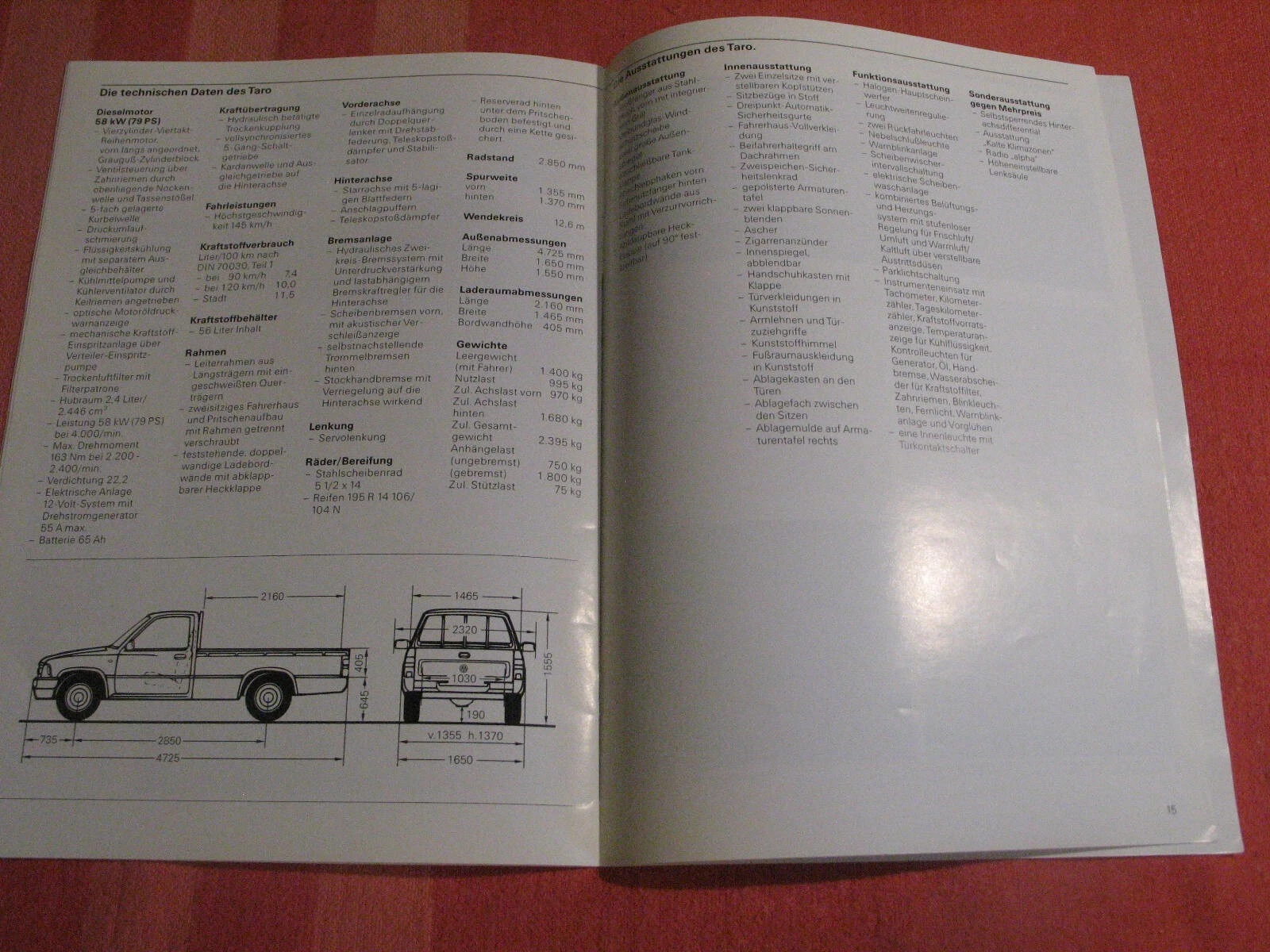
The first Taros manufactured in Hanover, Germany, from 1989-1994 had a 2.4-litre diesel engine with 61 kW, torque was 165 Nm at 2,400 rpm, with loading space of 3.4 m2 and a 1125 kg payload. The Hanover plant only built the Taro with two-wheel drive and a regular cab, although the "Volkswagen Taro" name was used for other versions imported from Japan in some European markets.
In September 1994 at the IAA Nutfahrzeuge (Commercial Vehicle Fair) in Hanover, Germany, Volkswagen released the four-wheel drive version of the Taro which had an extended cabin. The 4x4 Extended Cab Taro was manufactured in Toyota's Tahara plant in Japan, but now the Taro had an updated 2.4-litre diesel engine which produced 58 kW at 4,000 rpm and torque of 163 Nm at 2,400 rpm. The 4x4 Taro had a 2.9 m2 loading space and 815 kg payload, but could tow 750 kg without brakes, and 2100 kg with brakes.

The joint venture ended in 1997, due to sales failing to meet either car marque's expectations.
In the 1990s, Volkswagen Brazil built a pick-up truck prototype of the Volkswagen Santana using the bed of the Volkswagen Taro but it did not enter-production.
Specifications
;engine ID code, displacement, configuration and rated power output :2Y: 1.8-litre inline four OHV petrol engine with carburettor, 83 PS at 4,800 rpm :4Y: 2.2-litre inline four OHV petrol engine with carburettor, 92 PS at 4,400 rpm :2L: 2.4-litre inline four indirect injection SOHC diesel engine, 82-83 PS at 4,200 rpm, 165 Nm at 2,400 rpm
:22R-E: 2.4-litre inline four SOHC petrol engine with Bosch L-Jetronic injection, 114 PS ;driveline: 4x2 = RWD, 4x4 = 4WD ;loading area:
- Single Cab: 3.047 m2
- Double Cab: 2.06 m2 ;track width - front: (4x2) 1355 mm, (4x4) 1430 mm ;track width - rear: (4x2) 1370 mm, (4x4) 1425 mm ;turning circle: (4x2) 12.6 m, (4x4) 14.0 m ;permissible total weight:
- (4x2 petrol) 2305 kg
- (4x2 diesel) 2395 kg
- (4x4 diesel) 2460 kg ;payload:(4x2) 995 kg, (4x4) 815 kg ;trailer weight braked: (4x2) 1800 kg, (4x4) 2100 kg ;trailer weight unbraked: 750 kg ;maximum speed km/h:(4x2) 145 km/h, (4x4) 130 km/h ;acceleration - 0-80 km/h: (4x2) 15.0 seconds, (4x4) 17.0 seconds ;fuel consumption: (4x2) 9.6 L/100 km, (4x4) 10.2 L/100 km
Specifications source
Successor
Starting in 2010, Volkswagen Commercial Vehicles began selling the Volkswagen Amarok pick-up, which competes against the Nissan Navara and Toyota Hilux. The Amarok is available in single and double cab versions, as well as the option of 2WD or 4WD and high torque diesels.
References
References
- (Jan 1989). "Volkswagen Taro Press Release".
- (July 1989). "Lastauto Omnibus Katalog 1990". Motor-Presse-Verlag GmbH und Co. KG.
- (Sep 1994). "Volkswagen Taro Press Release".
- https://autotest.com.ar/noticias/historia-pick-up-volkswagen-produccion/
- (January 1990). "De Volkswagen Taro".
- (July 1994). "Der Taro (1994)".
- "Volkswagen Taro 2.4 1994a - Gaznet Autokeskused".
- [[ETKA]]
This article was imported from Wikipedia and is available under the Creative Commons Attribution-ShareAlike 4.0 License. Content has been adapted to SurfDoc format. Original contributors can be found on the article history page.
Ask Mako anything about Volkswagen Taro — get instant answers, deeper analysis, and related topics.
Research with MakoFree with your Surf account
Create a free account to save articles, ask Mako questions, and organize your research.
Sign up freeThis content may have been generated or modified by AI. CloudSurf Software LLC is not responsible for the accuracy, completeness, or reliability of AI-generated content. Always verify important information from primary sources.
Report