From Surf Wiki (app.surf) — the open knowledge base
Volkswagen Golf Mk7
Seventh generation of Golf compact car
_–_Frontansicht,_19._Juni_2014,_Düsseldorf.jpg)
Seventh generation of Golf compact car
| Field | Value | |||||||||||||
|---|---|---|---|---|---|---|---|---|---|---|---|---|---|---|
| name | Volkswagen Golf Mk7 | |||||||||||||
| image | 2013 Volkswagen Golf SE BlueMotion Technology 1.4 Front.jpg | |||||||||||||
| manufacturer | Volkswagen | |||||||||||||
| production | 2012–2020 (Europe) | |||||||||||||
| 2013–2020 (China) | ||||||||||||||
| 2015–2020 (Brazil) | ||||||||||||||
| 2014–2021 (Mexico) | ||||||||||||||
| model_years | 2015–2021 (North America) | |||||||||||||
| assembly | {{ubl | |||||||||||||
| Indonesia: Jakarta (National Assemblers)<ref>{{Cite web | last | Wicaksono | first=Krisna | date=2016-06-20 | title=VW Indonesia Setop Produksi Golf TSI | url=https://www.viva.co.id/otomotif/mobil/787449-vw-indonesia-setop-produksi-golf-tsi | trans-title=VW Indonesia ended Golf TSI production | access-date=2022-06-17 | website=www.viva.co.id | language=id}} | ||||
| designer | {{ubl | |||||||||||||
| Klaus Bischoff, Marc Lichte, Andreas J. Mindt and Philipp Römers<ref>{{Cite patent | country | US | number=D690231 | title=Motor vehicle | pubdate=2013-09-24 | inventor1-last=Bischoff | inventor1-first=Klaus | inventor2-last=Lichte | inventor2-first=Marc | inventor3-last=Mindt | inventor3-first=Andreas J. | inventor4-last=Römers | inventor4-first=Philipp | assign1=Volkswagen AG}} |
| Thomasz Bachorski (interior){{Citation needed | date | February 2021}} | ||||||||||||
| Manuela Joosten (trim){{Citation needed | date | February 2021}} | ||||||||||||
| Andreu Sola (lights){{Citation needed | date | February 2021}} | ||||||||||||
| class | Compact car/small family car (C) | |||||||||||||
| body_style | {{ubl | |||||||||||||
| layout | Front-engine, front-wheel-drive | |||||||||||||
| Front-engine, all-wheel-drive | ||||||||||||||
| platform | Volkswagen Group MQB | |||||||||||||
| related | Volkswagen Golf Sportsvan | |||||||||||||
| Audi A3 Mk3 | ||||||||||||||
| Audi TT Mk3 | ||||||||||||||
| SEAT León Mk3 | ||||||||||||||
| Škoda Octavia Mk3 | ||||||||||||||
| engine | {{ubl | |||||||||||||
| motor | AC electric motor 136 PS (e-Golf) | |||||||||||||
| battery | 35,8 kWh (e-Golf), 8,7kWh (GTE) | |||||||||||||
| transmission | {{ubl | |||||||||||||
| wheelbase | 2631-2637 mm | |||||||||||||
| {{convert | 2619-2629 | mm | in | abbr | on}} (facelift) | |||||||||
| length | {{ubl | |||||||||||||
| {{convert | 4255-4280 | mm | in | 1 | abbr | on}} (hatchback) | ||||||||
| {{convert | 4562-4679 | mm | in | 1 | abbr | on}} (wagon) | ||||||||
| width | 1791-1799 mm | |||||||||||||
| height | 1435-1514 mm | |||||||||||||
| weight | 1205 - | |||||||||||||
| predecessor | Volkswagen Golf Mk6 | |||||||||||||
| successor | Volkswagen Golf Mk8 | |||||||||||||
| Volkswagen ID.3 (for e-Golf) | ||||||||||||||
| sp | uk |
2013–2020 (China) 2015–2020 (Brazil) 2014–2021 (Mexico) | Germany: Wolfsburg (Wolfsburg Plant); Zwickau (Zwickau-Mosel Plant); Dresden (Transparent Factory; e-Golf only) | China: Changchun; Foshan (FAW-VW) | Mexico: Puebla (Volkswagen de México) | Brazil: São José dos Pinhais (Volkswagen do Brasil) | Indonesia: Jakarta (National Assemblers) | Klaus Bischoff, Marc Lichte, Andreas J. Mindt and Philipp Römers | Thomasz Bachorski (interior) | Manuela Joosten (trim) | Andreu Sola (lights) | 3-door hatchback | 5-door hatchback | 5-door estate Front-engine, all-wheel-drive Audi A3 Mk3 Audi TT Mk3 SEAT León Mk3 Škoda Octavia Mk3 | Petrol: | 1.0 L TSI I3 | 1.2 L TSI I4 | 1.4 L TSI I4 | 1.5 L TSI I4 | 1.6 L MSI I4 | 1.8 L TSI I4 | 2.0 L TSI I4 | Petrol plug-in hybrid: | 1.4 L TSI I4 (GTE) | Diesel: | 1.6 L TDI I4 | 2.0 L TDI I4 | 5-speed manual MQ350 | 6-speed manual MQ350 | 6-speed automatic AQ250 | 8-speed automatic AQ450 | 6-speed DSG DQ250 | 7-speed DSG DQ200 | 7-speed DSG DQ381
2619-2629 mm (facelift) | 4255-4280 mm (hatchback) | 4562-4679 mm (wagon) Volkswagen ID.3 (for e-Golf)
The Volkswagen Golf (Mk7) is a C-segment car manufactured by German automobile manufacturer Volkswagen. It is the seventh generation in the Golf series and the successor to the Golf Mk6, and was introduced in Berlin on 4 September 2012, before a public launch at the 2012 Paris Motor Show. Sales in Europe began with the model in November 2012.
Marketed in three-door and five-door hatchback, van, and estate forms, the Golf Mk7 shares the MQB platform with the third generation Audi A3, SEAT León and Škoda Octavia.
In November 2016, Volkswagen presented a facelift of the Golf Mk7. It was replaced in December 2019 by the Golf Mk8, which is built on the MQB Evo platform. Production of the e-Golf and the Golf Variant ended in mid-2020.
Overview
Compared with the previous generation, the Golf Mk7 has a more spacious cabin with greater shoulder room for the front and rear passengers, more rear legroom, and a larger boot space. It is 20 mm wider than the Mk6, with a 59 mm longer wheelbase.
Engine options at launch include 1.2 and 1.4-litre turbocharged petrol engines, with 85 PS and 140 PS respectively, and 1.6 and 2.0-litre diesel engines, with 105 PS and 150 PS respectively. The 1.6 TDI BlueMotion Concept has a theoretical combined fuel consumption of 3.2 L/100 km and anticipated 85 g/km emissions.
Available body styles are three and five-door hatchbacks (including high-performance Golf GTI and Golf R models), and a five-door estate (known as the SportWagen in the United States, first advertised in May 2015). Sales of the three-door hatchback were not as strong as previous generations, and it was dropped with the launch of the eighth generation model in late 2019.
A van version based on the three-door Golf was sold only in Ireland to commercial customers and was cancelled as corporations opted for the bigger Volkswagen Caddy.
At launch in the US market, Volkswagen also offered the Golf Sport model. Around 650 of these SE four-door models were built, equipped with a six-speed automatic transmission. Offered in either Pure White or Platinum Gray, the Sport model is visually enhanced with a body kit that includes a front lip spoiler, side skirts, a rear valence, a larger rear spoiler, and chrome exhaust tips.
The Golf went on sale in the UK in early January and was released in Australia in April 2013.
In Brazil, the Golf Mk7 went on sale in September 2013, only in the High-line and GTI trims, along with the Comfortline trim, which was made available from March 2014. All models were imported from Germany until 2015, when local assembly commenced.
At its introduction in 2013, it won the Car of the Year Japan Award, the first time it was awarded to a European product.
New safety systems
- Proactive Occupant Protection
- Multi-collision brake system
- Adaptive cruise control (optional)
- Collision avoidance system (Front Assist) with City Emergency Braking (optional)
- Lane-keeping assistant (optional)
- Driver fatigue detection (optional)
- Traffic sign recognition (optional)
- Automatic parking system (optional)
- Rear assist camera (optional)
Safety
ANCAP
Euro NCAP
Latin NCAP
The Golf, in its most basic Latin American market configuration with 7 airbags, received 5 stars for adult occupants and 5 stars for toddlers from Latin NCAP 1.0 in 2014.
In 2017, it was awarded 5 stars for adult occupants and 5 stars for toddlers as well as the Advanced Award from Latin NCAP 2.0.
| Child protection stars |
|---|
IIHS
The 2021 Golf was tested by the IIHS:
Estate (Golf Variant, Golf SportWagen, and Golf Alltrack)
The estate/station wagon of the Golf was revealed at Geneva Motor Show in March 2013. It was marketed as the Golf Variant in Germany and Golf SportWagen in the United States and Canada, replacing the Jetta SportWagen nameplate previously used in the US.
The Golf Estate's load space volume was expanded from the 505 litres of its predecessor to 605 litres (loaded up to the back seat backrest), versus the 380 litres of the Golf hatchback. Loaded up to the front seat backrests and under the roof, the Golf Estate offered a cargo volume of 1,620 litres (versus the 1,495 litres of the Golf Estate Mk6). The rear seat backrests can be folded remotely via a release in the boot. Four petrol engines and three diesel engines were available, ranging from 85 PS to 140 PS for the standard petrol engines and 90 PS to 150 PS for the diesel engines. For the first time, the Golf Estate was also available as a "full" BlueMotion model, including revised aerodynamics. This model uses a 1.6-litre diesel engine producing 110 PS and a six-speed manual gearbox, and was expected to achieve a combined fuel consumption of 85.6 mpg (equivalent to 87 g/km of ).
The Golf R Estate used the same EA888 2.0L engine and all-wheel drive system found in the Golf R hatchback, along with the other features unique to the R.
The Golf Alltrack was introduced as a ruggedized version of the Golf Estate with slightly raised suspension, body cladding, a front skidplate, and all-wheel drive, among other minor mechanical changes.
The Golf SportWagen was available in S, SE, and GT/SEL (Trendline, Comfortline, and Highline in Canada) trim levels and used the same drivetrains as the standard Golf. The Golf Sportwagen was also available with all-wheel drive in the US and Canada beginning with the 2017 model year, using the 1.8L engine with either a 6-speed manual or 6-speed DSG transmission until its discontinuation in 2020. The AWD Sportwagen shared its drivetrain with the Alltrack, though it did not incorporate the other changes made for that submodel.
File:VW Golf Variant 1.6 BlueTDI Comfortline (VII) – Frontansicht, 29. Juni 2014, Düsseldorf.jpg|Golf Variant File:VW Golf Variant 1.6 BlueTDI Comfortline (VII) – Heckansicht, 29. Juni 2014, Düsseldorf.jpg|Golf Variant File:2015 Volkswagen Golf Alltrack 2.0 TDI 4Motion in silver, front left.jpg|2015 Golf Alltrack (pre-facelift; Europe) File:2016 Volkswagen Golf Alltrack TDi BlueMotion 4MOTION 2.0.jpg|2016 Golf Alltrack (pre-facelift, UK) File:2018 Volkswagen Golf Alltrack 4Motion in Great Falls Green Met., front right.jpg|2018 Golf Alltrack (facelift; US) File:Volkswagen Golf Mk7.5 R Wagon Variant Estate.jpg|2018 Golf R Estate (facelift; Australia)
e-Golf
The production version of the 2014 Volkswagen e-Golf was unveiled at the 2013 Frankfurt Motor Show. On 14 February 2014, Volkswagen launched sales of the e-Golf in Germany. On 11 March 2014, Volkswagen opened ordering for the e-Golf in the UK with deliveries began at the end of June. Production of vehicles destined for retail customers began in March 2014. U.S. sales started in selected states in November 2014 with a single SEL Premium model for the 2015 model year. Volkswagen stopped sales of the e-Golf in the UK in 2021.
Drivetrain and specifications
.jpg)
According to VW, the e-Golf has a practical all-electric range of 130 to, with an official NEDC cycle of 190 km, reduced to 80 to in the winter. Under the EPA driving cycle used in the United States, the 2015 e-Golf has a range of 83 mi, and combined city/highway efficiency of 116 mpge (miles per gallon petrol equivalent). Real-world experience showed range varied between 58 and, depending on the weather and use of climate control, with an average efficiency of 3.7 mi/kWh over 2700 mi of driving, mostly within the city. A heat pump was available as an option to reduce the power consumed by the heater in cold weather.
The high-voltage traction battery has a storage capacity of 24.2 kWh, composed of 264 individual cells arranged in 27 modules of 6 or 12 cells each. It has a nominal voltage of 323 V. However, the "liquid-cooled" description was removed from subsequent press releases in early 2014. Active thermal management for the battery pack was dropped because internal testing using Mk6 e-Golf prototypes showed high ambient temperatures did not affect battery performance. The smaller battery in the hybrid petrol-electric GTE does use active thermal management, but that model is positioned as a hybrid version of the sporty GTI, rather than the e-Golf's equivalence as an electric version of the regular Golf Mk7.
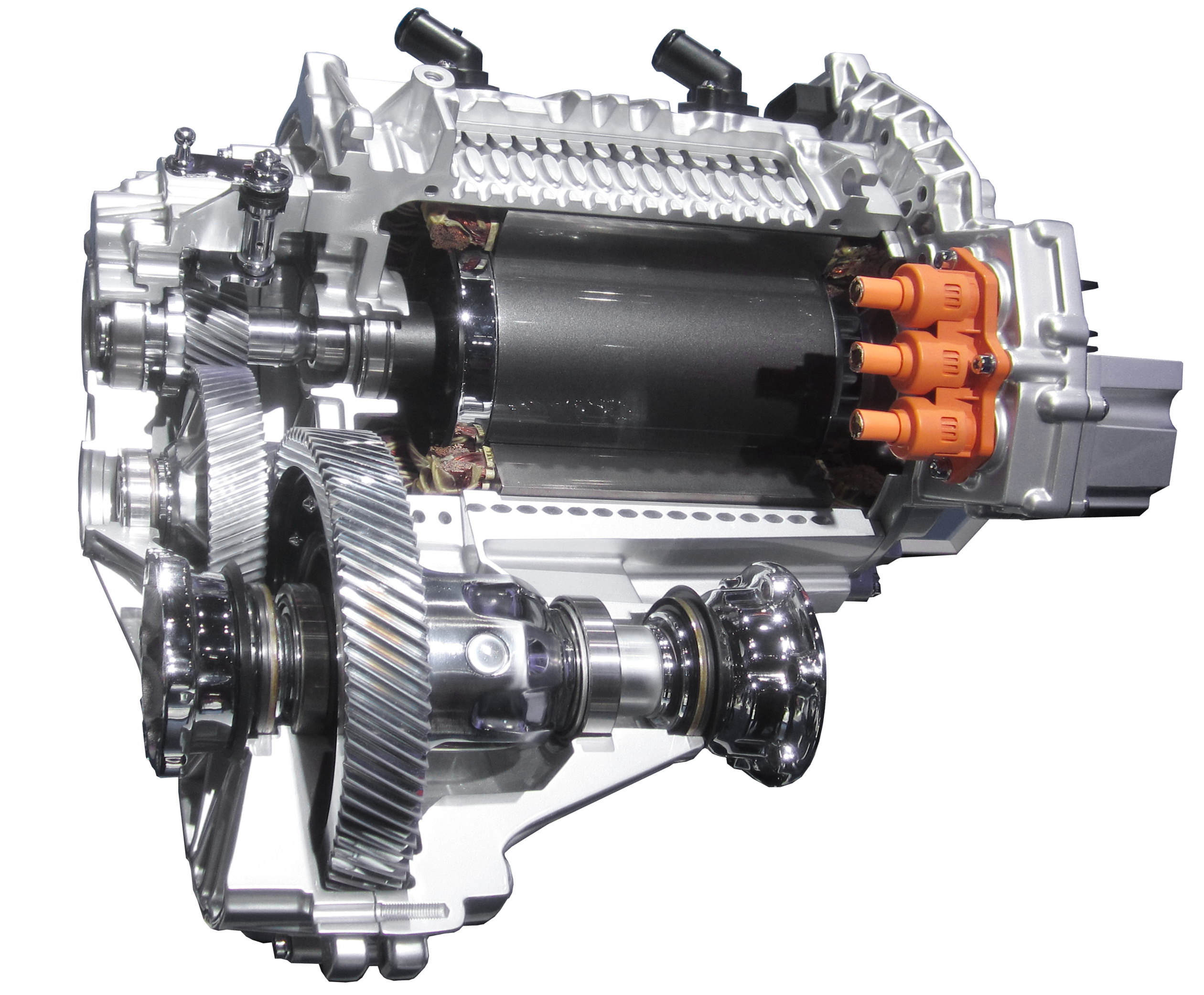
The 2014–2016 model year e-Golf has a traction motor (designed EEM 85) and single-speed gearbox (EQ 270) with an output of 85 kW / 270 Nm in "Normal" mode; using "Eco" and "Eco+" mode reduces power / torque output to 94 hp / 162 lbft and 73 hp / 129 lbft, respectively; both Eco and Eco+ disable the air conditioning system. In addition, four different levels of regenerative braking can be selected. The standard on-board AC charger has a maximum input power rating of 3.6 kW; as an option, DC fast charging using a Combined Charging System (CCS) connector is available, accepting DC power at a maximum rate of 40 kW.
Top speed was electronically limited to 140 km/h.
Upgrades in 2017
.jpg)
The 2017 version (Mk7.5) has an improved battery pack with a greater storage capacity of 35.8 kWh, giving a range of 300 km on the NEDC scale and an EPA rating of 125 mi. In addition, the onboard charger was upgraded and accepts AC power at up to 7.2 kW as standard; DC fast charging (with CCS connector) was optional on the SE trim, and made standard for the SEL Premium and Limited Edition trims. Traction motor output also increased, to 100 kW and 290 Nm, Real-world testing indicated a full charge would provide a range of 110 –. For the 2020 model year, due to a change in the EPA testing procedure, the e-Golf was re-rated to a 123 mi range and the combined efficiency rating dropped from 119 to.
The e-Golf was the last hatchback version of the Golf Mk7 produced in Europe, with production continuing until late December 2020 due to high demand, well after other powertrain variants which were discontinued in 2019. The successor ID.3 had been launched in 2019 and took over the e-Golf's Transparent Factory production line in Dresden, starting at the end of January 2021. In the United States, the production allotment of 2020 model year e-Golfs was diverted to Canada.
In China, domestic e-Golf production by the FAW-Volkswagen joint venture supplanted vehicles imported from Wolfsburg, starting in 2019. This helped VW meet the electric vehicle quota imposed by China: starting in 2019, manufacturers that sell more than 30,000 vehicles per year must ensure that ten percent of those are electric. Chinese production of the e-Golf by FAW-VW at the Foshan plant continued into 2021 with two models, the Golf·Pure Electric Motor and Golf·Pure Electric Motor Pro; the Foshan plant, which produced MQB platform vehicles from its opening in 2014, was retooled to add a MEB vehicle production line and the first ID.4 CROZZ vehicles began production at Foshan in late November 2020.
Spektrum Program

From the 2017 to 2020 model years, Canadian-market e-Golfs could be optioned with one of 40 custom-order paint colours offered as part of Volkswagen's Spektrum program at a cost of roughly $3,000 CAD. A total of 104 e-Golfs were ordered with a Spektrum-program colour.
Golf GTE

The Golf GTE plug-in hybrid is driven by two power sources: a 1.4-litre 110 kW TSI direct-injection petrol engine and a 75 kW electric motor. Together, they combine to produce power of 150 kW and 350 Nm of torque, with a theoretical range of 827 km. Using the electric motor alone, the GTE is capable of speeds of 130 km/h. With the TSI engine as well, the Golf GTE can accelerate from 0-100 km/h in 7.6 seconds and on to a top speed of 215 km/h. The Golf GTE shares the basic powertrain hardware with the Audi A3 Sportback e-tron but the software controls are different. The Golf GTE also shares the same plug-in hybrid powertrain with the Volkswagen Passat GTE, but the Passat has a larger 9.9 kWh Li-ion battery pack.
In EV mode, the Golf GTE has an official all-electric range of 50 km but in real world testing will often get around 35 km to 39 km miles of range. Under the New European Driving Cycle, combined fuel economy is 157 mpgUS equivalent. The electric power can also be saved—for example when driving to a zero-emissions zone. The 8.8 kWh lithium-ion battery can be charged in around three and a half hours from a domestic mains outlet, or two and a half hours from a domestic wallbox. The battery weighs 120 kg, giving the GTE a total kerb weight of 1520 kg.
The car has four (or on some older models, five) driving modes. The car will always start in all-electric mode (unless the battery has a very low charge). A button beside the gear stick allows the driver to select between Hybrid drive, which allows the car to switch between electric drive and the petrol motor when driving; Charge Mode, which uses energy from the petrol engine to recharge the car's battery; Battery hold mode, which solely uses the petrol engine to save battery power (only available on older models) and back to Electric mode; the final option, called GTE Mode, has a separate button beside the gear stick which allows the car to use both the petrol engine and the electric motor for punchier performance.
The Golf GTE uses a six-speed DSG gearbox with a triple-clutch system specially developed for hybrid vehicles. The electric motor is integrated into the gearbox housing, while further hybrid components include power electronics and a charger. An electro-mechanical brake servo and an electric air conditioning compressor make for energy-efficient braking and air conditioning.
Volkswagen claims a 0.299 drag coefficient.
Inside as on the outside, the Golf GTE features blue highlights where the GTI has red. This includes stitching on the steering wheel, gear lever gaiter and seats, and a blue stripe in the tartan pattern on the sports seats. It includes bespoke functions for electric vehicles, including the ability to identify potential destinations on electric range, and electric charging points. The GTE will also feature an e-manager which allows the driver to preset vehicle charging as well as interior cooling or heating. These functions can also be operated remotely using the Volkswagen Car-Net app on a smartphone: a three-year subscription will be included in the UK.
The first GTE units were registered in Germany in August 2014, and it was the second-best selling plug-in hybrid in Europe in 2015 with 17,282 sales.
Golf GTD
_–_Frontansicht,_6._April_2014,_Düsseldorf.jpg)
_–_Heckansicht,_6._April_2014,_Düsseldorf.jpg)
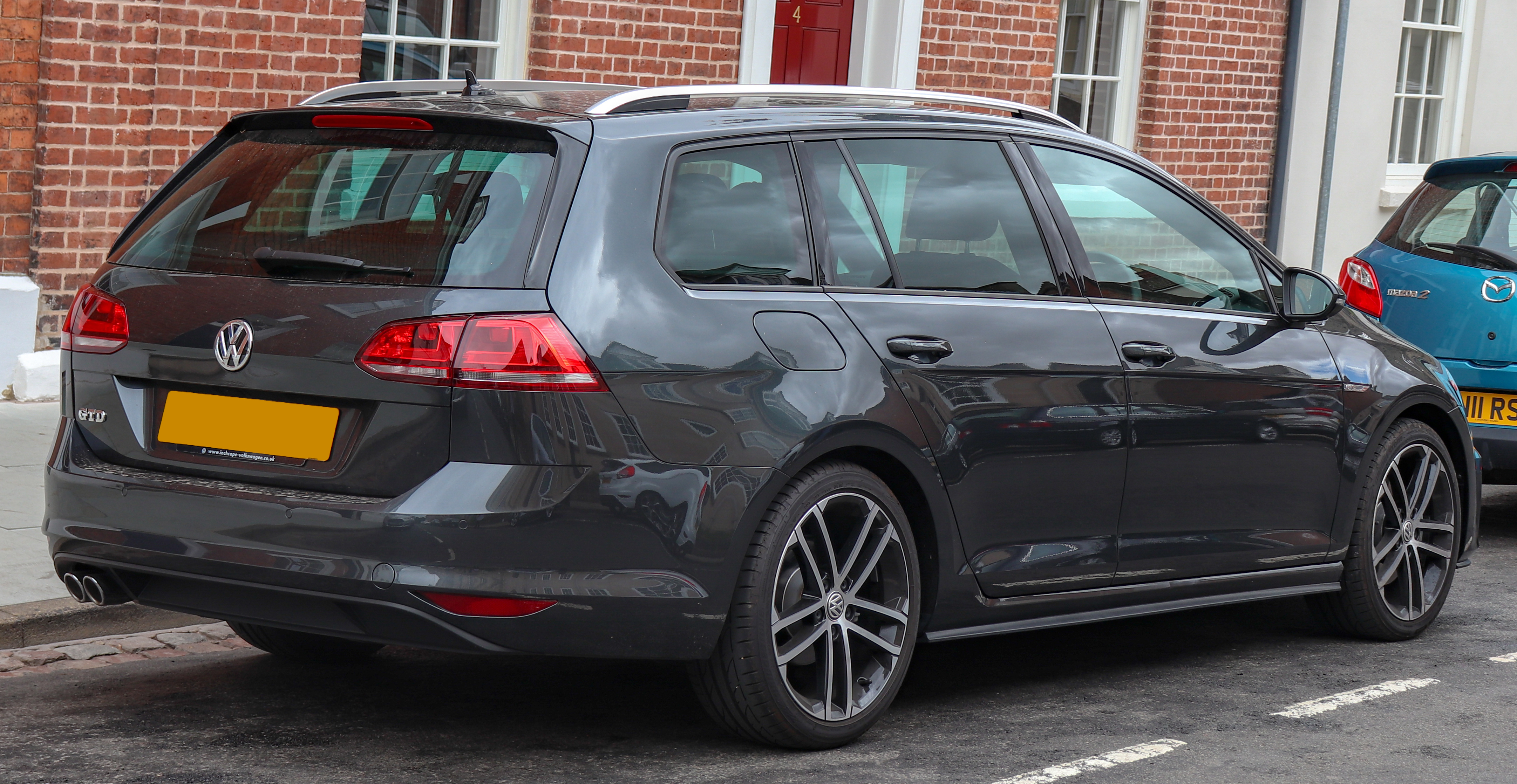
The Golf Mk7 GTD is powered by a 2.0-litre turbocharged common rail diesel engine with 184 PS. Maximum torque has risen from 350 Nm to 380 Nm from 1,750 rpm. The Golf R, in comparison, has 380 Nm from 1,800 rpm. Acceleration from 0-100 km/h takes 7.5 seconds, while the top speed is 227 km/h. The GTD has a combined fuel consumption of 67.5 mpgimp, making for emissions of only 109 g/km. With the optional six-speed dual-clutch gearbox (DSG), fuel consumption is 62.8 mpgimp and emissions of 119 g/km. For comparison, when the first generation Golf BlueMotion went on sale at the end of 2007, it had the same fuel economy and emissions.
Golf GTI

The Golf Mk7 GTI is powered by a 2.0-litre turbocharged direct-injection petrol engine (TSI) with 220 PS. In the GTI Performance version, the engine's maximum power is boosted to 230 PS. Both GTI models develop 350 Nm of torque. The standard GTI accelerates from 0 to 100 km/h in 6.5 seconds and can reach a top speed of 250 km/h. The GTI Performance has a top speed of 250 km/h and accelerates from 0 to 100 km/h in 6.4 seconds.
Both versions of the GTI are equipped with a start-stop system and fulfil 2014 Euro 6 emissions standards. With a six-speed manual gearbox, they attain the same low fuel consumption value of 47.1 mpgimp ( emissions of 139 g/km. This means that the latest Golf GTI offers an 18 percent improvement in fuel economy compared to the previous model. With the optional six-speed DSG gearbox, the two GTI models achieve fuel consumption figures of 44.1 mpgimp (equivalent to 148 g/km for the standard GTI and 149 g/km for the GTI Performance).
Buyers who purchase the £980 Performance Pack not only gain 7 kW but also upgraded brakes and a limited-slip differential. The front differential is a new development, dubbed VAQ. This provides more neutral and agile driving behaviour and allows higher speeds to be carried through curves. The system consists of a multi-plate coupler between the differential cage and right driveshaft, which controls locking torque electro-hydraulically. Visually, vehicles with the Performance Pack are distinguished by 'GTI' lettering on the front brake caliper, larger vented brake discs front and rear (the same as fitted to the 'R' version), and red GTI badges on the front and rear although some cars still retained their silver badging despite being fitted with the Performance Pack.
As well as high performance, a high level of safety equipment comes standard in the Golf GTI. On top of high passive safety levels—thanks in part to a passenger cell made from high- and ultra-high strength steels—active safety features include the Automatic Post-Collision Braking system, which automatically applies the vehicle brakes after an accident to reduce the chances of a second impact; the pre-crash system, which tensions seatbelts and closes windows and the sunroof if an accident is likely to improve the effectiveness of the airbags; and seven airbags as standard, including one for the driver's knees.
In many markets including Mexico and South Africa, the GTI version is only available with the five-door body style, with no plans to introduce the three-door body.
Volkswagen introduced a "Rabbit Edition" GTI for the 2019 model year. The Rabbit Edition featured a LED lighting package, a "Vmax" spoiler, 18-inch "Pretoria" alloy wheels painted in gloss black, and red tags embroidered with the VW Rabbit logo on the seat.
Volkswagen's Mexican division introduced an "Oettinger" version for the GTI for the 2021 model year. The Oettinger version features an aerodynamic kit for the front fascia with lip and splitters, side skirts, a new rear bumper with integrated diffuser and a new spoiler with flaps, which stand out next to the version-specific 18-inch wheel set and black side mirrors. It is available in three colour options; Pure White, Tornado Red and Cornflower Blue. It will go on sale on 7 December 2020 and 700 units will only be built.
GTI Clubsport (2016)

Volkswagen introduced the special-edition GTI Clubsport for 2016, coinciding with the GTI's 40th anniversary. The Clubsport was not available in the United States. On the exterior, the Clubsport features a revised front fascia, more aggressive rear hatch spoiler, new rear diffuser with larger exhaust tips, and a black stripe along the lower sides of the body. Inside the car, the Clubsport is equipped with bucket seats and an Alcantara steering wheel and shift lever.
The Clubsport uses the same 2.0-litre EA888 turbocharged inline-4 as the standard GTI which has been revised to produce 261 horsepower, with up to 286 horsepower for 10 seconds at a time via an included overboost feature which raises the engine's boost pressure by 0.2 bar, up to 2.1 bar. Transmission choices remain the same as the standard GTI, with both the 6-speed manual and 6-speed DSG available, both equipped with the standard GTI's optional limited-slip differential. Weight is listed as 1,375 kg. The Clubsport was available from the factory with optional Michelin Pilot Sport Cup 2 tires. The official 0-to-60 time is quoted as 5.9 seconds, 0.6 seconds quicker than the standard GTI with Performance Package.
GTI Clubsport S (2016)
The 3-door GTI Clubsport S was a limited-edition version of the GTI Clubsport sold as a higher-strung version optimized for faster track times. Only 400 were produced for the 2016 model year. Upgrades from the Clubsport to the Clubsport S include new front suspension and subframe components, updated suspension alignment, upgraded brakes, a more highly-strung version of the GTI's 2.0L EA888 turbocharged inline-4, using the larger IHI IS38 turbocharger instead of the IS20, that produces 310 PS and 385 Nm of torque, standard Michelin Pilot Sport Cup 2 track-oriented tires, removal of the rear seats and some sound deadening, and a quoted weight of 2,998 pounds (1,360 kg).
The result of these modifications is a lap time of 7 minutes, 49.21 seconds around the Nürburgring Nordschleife track, 1.4 seconds faster than the Honda Civic Type R, which held the previous record for a front-wheel drive production car. The Clubsport S was released with an estimated base price of £35,000.
GTI TCR (2019)

In January 2019, Volkswagen introduced new high-performance variation, the Golf GTI TCR with 290 PS 2-litre engine and special trim.
Units were largely limited in production.
Australia received an allocation of 300 vehicles in total, 100 units in each of the three available colors - red, grey and white. All the vehicles arrived in the fourth quarter of 2020 for the MY20 model year. They were sold as the final GTI examples for the Mk7 shape.
Golf R
Like the GTI, the Golf R is also built as a three- or five-door hatchback and there's also a wagon version. It is powered by a newly developed version of the 1984 cc turbocharged EA888 petrol FSI straight-four engine used in the latest Golf GTI, Audi S3, Volkswagen Tiguan and Jetta, and dozens of other Volkswagen AG vehicles, but in this application, it produces 300 PS (or 280 PS for "hot climate" markets such as Australia, South Africa, Japan, and the US) from 5,500 to 6,200 rpm and 380 Nm from 1,800 to 5,500 rpm of torque. Compared to the GTI's powerplant, the Golf R's engine has a modified cylinder head, exhaust valves, valve seats and springs, pistons, injection valves and larger intercooler and turbocharger. DSG-equipped models also come with an auxiliary oil cooler on the passenger side on right hand drive models.
0-62 mph (100 km/h) takes 5.1 seconds (versus 5.7 seconds for the previous Golf R) or 4.9 seconds with the optional DSG gearbox. The top speed is electronically limited to 155 mph. Despite this increased performance, a combined fuel consumption of 39.8 mpgimp, and emissions of 165 g/km and emissions of 159 g/km DSG) make the Golf R up to 18 percent more efficient than its predecessor.
The R uses an updated, fifth-generation Haldex 4MOTION four-wheel drive system. Under low loads or when coasting, the rear axle is decoupled, helping to reduce fuel consumption. Drive to the rear axle can be engaged in fractions of a second via the Haldex coupling, which is actuated by an electro-hydraulic pump. Up to 50 percent of power can be transferred to the rear axle. A brake-actuated XDS+ system mimics a limited-slip differential by applying the brakes to the wheel with the least traction, this is on both the front and rear axles.
The ride height is 20 mm lower than the standard Golf. Golf R models equipped with the optional 'DCC' (Dynamic Chassis Control) offer three suspension modes: 'Comfort', 'Normal', and 'Race'. Each mode adjusts the stiffness of the suspension damping, thereby offering drivers a way to change the way the vehicle responds with the push of a button. Comfort mode places the dampers in the softest setting, increasing the absorption of road imperfections and allowing for a smoother and more comfortable ride. Race mode stiffens the dampers to their most aggressive setting, reducing body movements and increasing adhesion to the road for more precise high-speed driving. Race mode also increases throttle response, firms up the steering for a heftier feel, and alters the shift pattern of the DSG gearbox (where fitted), and increases the speed of the Adaptive headlamps (AFS) response time.
On top of ESC Sport mode, as found on the GTI and GTD, which delays intervention of the electronic stability control system, the R offers the option fully to disengage the ESC, for track driving.
For the Canadian market, the optional Discover Pro 8" infotainment system is available as part of the single option "Technology Package," while only the 6.5" Discover is available to US consumers. In North America, the Golf R comes standard with halogen tail lights and HID bi-xenon headlights with LED front and side view mirror turn signals, while ROW markets received the options for a sunroof, a three-door version, and LED tail lights. All these features are not available in the North American version. The Golf R and e-Golf are the only Golf models available in North America that was produced in Germany. Other Golf models for the North American market are produced by Volkswagen de México in Puebla, Mexico.
A limited edition Golf R400 was rumored in August 2015 by Heinz-Jakob Neusser, then-head of brand development, but in the wake of the Volkswagen emissions scandal (and Neusser's suspension) it was cancelled in favor of focusing on the Golf R.
For the South African market, the Golf R received another upgrade in power in March 2019. The upgrade resulted in 310 PS and 400 Nm of torque (up from 290 PS and 380 Nm in the facelift seen in July 2017). Additionally, the Golf R was also optionally available with an Akrapovič performance exhaust from the factory.
The Mk7 Golf R was discontinued in the United States in August 2019.
Spektrum Program
For the 2018 model year in Canada and 2019 model year in both Canada and the United States, Volkswagen offered 40 custom-order paint colours for the Golf R as part of their Spektrum Program. The program was initially introduced only for Canadian-market e-Golfs. Many of the colours offered were previously available on past Volkswagen Group models. The option carried a lead time of two to four months, as each car ordered as part of the Spektrum program was hand-painted in a separate facility from the main production line. Each custom-order colour carried an MSRP in the United States of $2,500.
A total of 473 Spektrum Golf Rs were produced, with 199 going to the United States, before the Mk7 Golf R's discontinuation in North America.
Facelift
In November 2016, Volkswagen revealed a facelifted version of the Golf Mk7. This model is referred to as the "New Golf" by Volkswagen, while it is often informally referred to as the Golf 7.5. A new engine was introduced along with the facelift: a 1.5-litre TSI which produces 95.6 kW or 110 kW. Initially, the existing 1.4-litre TSI was available alongside the new 1.5-litre engine. The updated Golf GTI was increased from 162 kW to 169 kW in the standard car and from 169 kW to 180.2 kW with the Performance Pack. The Golf R similarly had its output increased from 221 kW to 228 kW. In addition, the facelift increased infotainment screen size across the range, as well as adding the option for a fully digital dashboard. The rear lights now utilise LED technology as standard (including a "sweeping" indicator effect on performance models) while this technology is optional on most models for the headlights.
The facelifted Golf Mk7 was released in North America for the 2018 model year. The previous 1.8L EA888 engine was replaced by the 147 hp 1.4L EA211 engine as the only available powerplant, while the 5-speed manual and 6-speed automatic transmissions were replaced by 6- and 8-speed units, respectively. The all-wheel drive Golf Sportwagen and Golf Alltrack models retained the 1.8L EA888 engine along with the 6-speed manual or 6-speed DSG transmissions.
File:2018 Volkswagen Golf (5G MY18) 110TSI base hatchback (2018-11-02) 01.jpg|5-door hatchback (facelift) File:2018 Volkswagen Golf (5G MY18) 110TSI base hatchback (2018-11-02) 02.jpg|5-door hatchback (facelift) File:2018 Volkswagen Golf R-Line TSi EVO S-A 1.5 Front.jpg|Golf R-Line (facelift) File:2018 Volkswagen Golf R-Line TSi EVO S-A 1.5 Rear.jpg|Golf R-Line (facelift) File:2017 Volkswagen Golf Variant SE Navigation TDi BlueMotion 2.0 Rear.jpg|Golf Variant (facelift) File:2020 VW Golf MK7.5 280 TSI R-Line interior view in Brunei.jpg|Interior (facelift)
Powertrain
The Golf line is available in all the relevant drive systems: the Golf TSI, including GTI, is petrol-powered; Golf TDI, including GTD, is diesel-powered; the Golf TGI is powered by compressed natural gas (CNG); the e-Golf is powered by electricity; and Golf GTE is a plug-in hybrid. The use of a modular transverse matrix assembly kit enables the manufacturing of Golf models with petrol, diesel, natural gas, electric and hybrid drives from bumper to bumper at Volkswagen factories. Retail deliveries of the e-Golf in Germany began in the second quarter of 2014. U.S. sales started in selected markets during the fourth quarter of 2014. The Golf GTE was launched also in the fourth quarter of 2014.
All internal combustion engines are three- or four-cylinder units:
| Petrol engines | Model | Displacement | Power | Torque | Acceleration | |||||||||||||||||||||
|---|---|---|---|---|---|---|---|---|---|---|---|---|---|---|---|---|---|---|---|---|---|---|---|---|---|---|
| 0–100 km/h (0-62 mph) | Top speed | Transmission | Notes | Diesel engines | Model | Displacement | Power | Torque | Acceleration | |||||||||||||||||
| 0–100 km/h (0-62 mph) | Top speed | Transmission | Notes | Electric motor | Model | Displacement | Power | Torque | Acceleration | |||||||||||||||||
| 0–100 km/h (0-62 mph) | Top speed | Transmission | Notes | |||||||||||||||||||||||
| 1.2 TSI BlueMotion | 1197 cc | 85 PS at 4,300–5,300 rpm | 160 Nm at 1,400–3,500 rpm | 11.9 s | 179 km/h | 5-speed manual | ||||||||||||||||||||
| 1.2 TSI BlueMotion | 1197 cc | 105 PS at 5,000 rpm | 175 Nm at 1,550–4,100 rpm | 10.2 s | 192 km/h | 6-speed manual | ||||||||||||||||||||
| 7-speed DSG | ||||||||||||||||||||||||||
| 1.0 TSI BlueMotion | 999 cc | 115 PS at 5,000–5,500 rpm | 200 Nm at 2,000–3,500 rpm | 9.7 s | 204 km/h | 6-speed manual | ||||||||||||||||||||
| 7-speed DSG | ||||||||||||||||||||||||||
| 1.4 TSI BlueMotion | 1390 cc | 122 PS at 5,000 rpm | 200 Nm at 1,400–4,000 rpm | 9.3 s | 203 km/h | 6-speed manual | ||||||||||||||||||||
| 7-speed DSG | ||||||||||||||||||||||||||
| 1.4 TSI BlueMotion | 1390 cc | 125 PS at 5,000–6,000 rpm | 200 Nm at 1,400–4,000 rpm | 9.1 s | 204 km/h | 6-speed manual | ||||||||||||||||||||
| 7-speed DSG | from April 2014 | |||||||||||||||||||||||||
| 1.4 TSI BlueMotion | 1395 cc | 140 PS at 4,500–6,000 rpm | 250 Nm at 1,500–3,500 rpm | 8.4 s | 212 km/h | 6-speed manual | ||||||||||||||||||||
| 7-speed DSG | ||||||||||||||||||||||||||
| 1.4 TSI BlueMotion | 1395 cc | 150 PS at 5,000–6,000 rpm | 250 Nm at 1,500–3,500 rpm | 8.2 s | 216 km/h | 6-speed manual | ||||||||||||||||||||
| 7-speed DSG | ||||||||||||||||||||||||||
| 8-speed automatic (USA) | from April 2014 (MY2018 in USA) | |||||||||||||||||||||||||
| 1.5 TSI EVO | 1498 cc | 150 PS at 5,000–6,000 rpm | 250 Nm at 1,500–3,500 rpm | 8.1 s | 216 km/h | 6-speed manual | ||||||||||||||||||||
| 7-speed DSG | ||||||||||||||||||||||||||
| 1.6 | 1598 cc | 110 PS at 3050–4800 rpm | 164 Nm at 3400–4700 rpm | 13.6 s | 190 km/h | 5-speed manual | ||||||||||||||||||||
| Brazil, Chile, Colombia | ||||||||||||||||||||||||||
| 1.8 TSI | 1798 cc | 172 PS at 4,800–6,200 rpm | 270 Nm at 1,600–4,200 rpm | 7.6 s | 209 km/h | 5-speed manual | ||||||||||||||||||||
| 6-speed Tiptronic | ||||||||||||||||||||||||||
| 6-speed DSG (AWD only) | North America | |||||||||||||||||||||||||
| GTE | 1395 cc | GTE Hybrid mode—205 PS at 3,750–6,000 rpm | ||||||||||||||||||||||||
| Electric Motor—100 PS | ||||||||||||||||||||||||||
| Petrol Motor—150 PS | 350 Nm at 1,500–4,000 rpm | 7.6 s | 222 km/h | 6-speed DSG | ||||||||||||||||||||||
| EU | ||||||||||||||||||||||||||
| GTI (2013-2016) | 1984 cc | 220 PS at 4,500-6,200 rpm | 350 Nm at 1,500-4,400 rpm | 6.3 s | 246 km/h | 6-speed manual | ||||||||||||||||||||
| 6-speed DSG | ||||||||||||||||||||||||||
| GTI Performance Package (2013-2016) | 1984 cc | 230 PS at 4,700-6,200 rpm | 350 Nm at 1,500-4,600 rpm | 6.2 s | 250 km/h | 6-speed manual | ||||||||||||||||||||
| 7-speed DSG | ||||||||||||||||||||||||||
| GTI (2016-2020) | 1984 cc | 230 PS at 4,500-6,200 rpm | 350 Nm at 1,500-4,400 rpm | 6.2 s | 246 km/h | 6-speed manual | ||||||||||||||||||||
| 6-speed DSG | ||||||||||||||||||||||||||
| GTI Performance Package (2016-2020) | 1984 cc | 245 PS at 4,700-6,200 rpm | 370 Nm at 1,500-4,600 rpm | 6.0 s | 250 km/h | 6-speed manual | ||||||||||||||||||||
| 7-speed DSG | ||||||||||||||||||||||||||
| GTI Clubsport (2016) | 1984 cc | 265 PS at 5,350-6,600rpm | 370 Nm at 1,700-5,300rpm | 5.9 s | 250 km/h | 6-speed manual | ||||||||||||||||||||
| 7-speed DSG | ||||||||||||||||||||||||||
| GTI Clubsport S | 1984 cc | 310 PS at 4,700-6,200 rpm | 385 Nm at 1,500-4,600 rpm | 5.7 s | 250 km/h | 6-speed manual | ||||||||||||||||||||
| 7-speed DSG | ||||||||||||||||||||||||||
| GTI TCR (2019) | 1984 cc | 290 PS at 5,400-6,400 rpm | 380 Nm at 1,800-5,300 rpm | 5.6 s | 250 km/h | 7-speed DSG | ||||||||||||||||||||
| R (2014-2016) | 1984 cc | 300 PS at 5,500-6,200 rpm | 380 Nm at 1,800-5,500 rpm | 4.9 s | 250 km/h | 6-speed manual | ||||||||||||||||||||
| 6-speed DSG | CJXC | |||||||||||||||||||||||||
| R (2016-2018) | 1984 cc | 310 PS at 5,500-6,200 rpm | 380 Nm at 1,800-5,500 rpm | 4.9 s | 250 km/h | 6-speed manual | ||||||||||||||||||||
| 7-speed DSG | DJHA | |||||||||||||||||||||||||
| R (2018-2020) | 1984 cc | 300 PS at 5,500-6,200 rpm | 400 Nm at 1,800-5,500 rpm | 4.9 s | 250 km/h | 6-speed manual | ||||||||||||||||||||
| 7-speed DSG | DNUE | |||||||||||||||||||||||||
| 1.6 TDI BlueMotion (CLHB) | 1598 cc | 90 PS at 2750–4800 rpm | 230 Nm at 1400–2700 rpm | 12.9 s | 185 km/h | 5-speed manual | ||||||||||||||||||||
| 7-speed DSG | ||||||||||||||||||||||||||
| 1.6 TDI BlueMotion (CLHA) | 1598 cc | 105 PS at 3,000–4,000 rpm | 250 Nm at 1,500–2,750 rpm | 10.7 s | 192 km/h | 5-speed manual | ||||||||||||||||||||
| 7-speed DSG | ||||||||||||||||||||||||||
| 1.6 TDI BlueMotion (DDYA, DGTE) | 1598 cc | 115 PS at 3,000–4,000 rpm | 250 Nm at 1,500–3,200 rpm | 10.2 s | 198 km/h | 5-speed manual | ||||||||||||||||||||
| 7-speed DSG | ||||||||||||||||||||||||||
| 2.0 TDI | 1968 cc | 150 PS at 4,400 rpm | 320 Nm at 1,750–3,000 rpm | 8.6 s | 216 km/h | 6-speed manual | ||||||||||||||||||||
| 6-speed DSG | ||||||||||||||||||||||||||
| 2.0 TDI BlueMotion (CKFC) | 1968 cc | 150 PS at 3,500–4,000 rpm | 340 Nm at 1,750–3,000 rpm | 8.6 s | 216 km/h | 6-speed manual | ||||||||||||||||||||
| 7-speed DSG | ||||||||||||||||||||||||||
| GTD (CUNA / DGCA / CUP) | 1968 cc | 184 PS at 3,500–4,000 rpm | 380 Nm at 1,750–3,250 rpm | 7.5 s | 230 km/h | 6-speed manual | ||||||||||||||||||||
| 6-speed DSG | ||||||||||||||||||||||||||
| 7-speed DSG | ||||||||||||||||||||||||||
| e-GOLF (EAGA) | Electric Motor | 136 PS | 290 Nm | 9.6 s | 150 km/h | Single-speed automatic | 35.8 kWh battery | |||||||||||||||||||
| e-GOLF (EAGA) | Electric Motor | 115 PS | 270 Nm | 9.6 s | 140 km/h | Single-speed automatic | 24.2 kWh battery |
Awards
- Car and Drivers 10Best list in 2019
- 2015 North American Car of the Year
- 2015 Motor Trend Car of the Year
- 2013 European Car of the Year
- 2013 World Car of the Year
- 2013 Car of the Year Japan
- 2013–14 Japan's Import Car of the Year
- 2014 What Car?—Best Estate Car (Great Britain)
- 2013 Wheels Car of the Year (Australia)
- 2013 Cars Guide Car of the Year (Australia)
{{anchor|Sportsvan|SportsVan|SV}}Golf Sportsvan/SV
Main article: Volkswagen Golf Sportsvan
The Golf Sportsvan or Golf SV, is a five-door compact MPV which was designed and produced by the German automaker Volkswagen between 2014 and 2020. Previewed as the Volkswagen Sportsvan concept at the 2013 Frankfurt Motor Show and positioned below the seven-seater Touran in the company's product catalogue, it is derived from the Golf Mk7 and based on the MQB platform, and was also assembled at the Wolfsburg plant alongside the standard Golf hatchback. At 4,338 mm long, the new SV is 134 mm longer than the Golf Plus that it replaces, 83 mm longer than the Golf hatchback, and 224 mm shorter than the Golf Estate.
References
References
- Wicaksono, Krisna. (2016-06-20). "VW Indonesia Setop Produksi Golf TSI".
- "Motor vehicle".
- "Golf-vii engines & performance". Volkswagen UK.
- "Golf-gti-vii engines & performance". Volkswagen UK.
- Kable, Greg. (4 September 2012). "2013 Volkswagen Golf revealed". [[Autocar (magazine).
- (7 November 2012). "VW Golf VII: Markteinführung am Samstag".
- GmbH, Frankfurter Allgemeine Zeitung. (10 November 2016). "Weltpremiere in Wolfsburg: VW hat den Golf renoviert". FAZ.NET.
- Gilboy, James. (3 October 2019). "2020 Volkswagen Golf MK8 Set for October 24 Debut in Wolfsburg: Report".
- "VW Gläserne Manufaktur - 16.155 e-Golf: Gläserne Manufaktur 2019 mit Allzeit-Produktionsrekord".
- (August 2025). "Produktion des ID.3 im Werk Zwickau startet im November".
- Kable, Greg. (4 September 2012). "Volkswagen Golf Mk7 engine line-up announced". [[Autocar (magazine).
- (4 September 2012). "World premiere of the new Golf in Berlin". [[Volkswagen AG]].
- "Modelle < Volkswagen Deutschland".
- "2015 Volkswagen Golf: The best hatchback just got even better". Volkswagen.
- (16 January 2013). "Volkswagen Golf 1.4 TSI (2013) CAR review {{pipe}} Road Testing Reviews {{pipe}} Car Magazine Online". Carmagazine.co.uk.
- TMR Team. (18 April 2013). "New 2013 Volkswagen Golf 7 On Sale In Australia". themotorreport.com.au.
- (7 September 2013). "Auto Esporte—Novo Golf custará a partir de R$ 67.990; veja todos os preços". Auto Esporte.
- (21 August 2014). "Volkswagen Golf passará a ser importado do México". Notícias Automotivas.
- "pdf".
- "Official results of the Volkswagen Golf + 7 Airbags 2014".
- "Official results of the Volkswagen Golf VII + 7 Airbags 2017".
- "2021 Volkswagen Golf 4-door hatchback".
- "Geneva motor show 2013: VW Golf estate revealed".
- Radu, Mihnea. (2 March 2013). "This Is the 2013 Volkswagen Golf Variant and Next Jetta SportWagen".
- Chris Paukert. (10 September 2013). "2015 Volkswagen e-Golf is ready to battle the Nissan Leaf". [[Autoblog.com]].
- Skogstad, Knut. (25 February 2014). "VW e-Golf: Solgte over 1.300 biler—på ni timer". TV2 / Broom.
- Mike Szostech. "UK e-Golf—orders open, priced at £25,845".
- Michaël Torregrossa. (10 March 2014). "Volkswagen débute la production de la Golf électrique à Wolfsburg". Association pour l'Avenir du Véhicule Electrique Méditerranéen (AVEM).
- VW Press Release. (25 August 2014). "Volkswagen prices e-Golf in US at $35,445". Green Car Congress.
- "VOLKSWAGEN E-GOLF - How Many Left?".
- VW Media Services. (15 February 2014). "Volkswagen launches the battery-electric e-Golf in Germany; "Das e-Auto"". Green Car Congress.
- "Volkswagen e-Golf gets EPA rated 83 mile range". My Electric Car News.
- Halvorson, Bengt. (April 28, 2016). "Volkswagen e-Golf: real-world range vs. EPA estimates over six-month test". Green Car Reports.
- Ross, Jeffrey N.. (November 13, 2013). "2015 VW e-Golf electric vehicle revealed ahead of LA". autoblog.
- Mike Szostech. "Volkswagen chooses to drop the liquid cooling on the e-Golf". My Electric Car News.
- Blanco, Sebastian. (March 31, 2014). "VW decides against active-cooling system for e-Golf lithium battery". autoblog.
- (March 7, 2014). "e-motor and single-speed gearbox". Volkswagen Newsroom.
- Hutton, Ray. (14 March 2014). "Volkswagen e-Golf 2014 review". AutoExpress.
- Halvorson, Bengt. (April 27, 2016). "VW e-Golf: Do its 3 modes do what electric-car drivers want?". Green Car Reports.
- (March 2014). "International driving presentation of the new e-Golf". Volkswagen AG.
- (1 April 2014). "VW e-Golf (2014) review". Car.
- (21 February 2017). "Longer Range Volkswagen e-Golf goes on sale in Germany".
- Robinson, Aaron. (May 11, 2017). "2017 Volkswagen e-Golf EV First Drive: Now with More E!". Car and Driver.
- (September 2019). "The e-Golf: IAA International Motor Show". Volkswagen Aktiengesellschaft.
- (11 January 2022). "VW e-Golf (2022) Review". Car.
- Halvorson, Bengt. (November 1, 2019). "2020 VW e-Golf electric car range falls, just before ID EV range rises". Green Car Reports.
- (December 23, 2020). "Phasing out the e-Golf: Volkswagen prepares to launch the ID.3 at the Transparent Factory in Dresden". Volkswagen Newsroom.
- Silvestro, Brian. (March 2, 2020). "The Volkswagen e-Golf Is Dead". Road & Track.
- (July 14, 2017). "VW taps electric Golf to help meet China's EV quota". Automotive News Europe.
- (March 29, 2019). "VW brand to launch 3 electric cars in mid-2019". Automotive News.
- (May 2020). "Sustainability Report 2018/2019". FAW-Volkswagen Automotive Co., Ltd..
- Wöllenstein, Stephan. (February 2019). "Growth and change: The Chinese car market remains the largest in the world, and China is also assuming a leading role in e-mobility and digitalization – with the Volkswagen Group as a strong partner.". Volkswagen AG.
- "Volkswagen e-Golf (Chinese market)".
- Dick, Andreas. (11 July 2014). "The new FAW-Volkswagen Foshan Factory". Car Plant Foshan, FAW-Volkswagen.
- (June 22, 2018). "Volkswagen Group China's mega-factory in Foshan will strengthen e-mobility strategy in China". Volkswagen Newsroom.
- (November 30, 2020). "Volkswagen Group commences climate-friendly MEB production at Foshan and Anting plants". Volkswagen AG.
- "Volkswagen of Canada e-Golf Buyer's Guides".
- "Spektrum Only".
- "VOLKSWAGEN Golf VII GTE (2017, 2018, 2019, 2020) - photos, specs & model history".
- "volkswagen.co.uk".
- Mike Millikin. (13 March 2014). "Volkswagen: e-mobility and sustainability; Part 1, the e-Golf and Golf GTE". Green Car Congress.
- Mike Millikin. (29 September 2014). "Promised VW Passat plug-in hybrid to debut at Paris show; both sedan and wagon". Green Car Congress.
- "Volkswagen Golf GTE Review".
- Noah Joseph. (20 February 2014). "VW Golf GTE plugs in the GTI for guilt-free fun". [[Autoblog.com]].
- "Electric & Hybrid Driving Modes - Volkswagen UK".
- Volkswagen AG Service Training. (November 2014). "Self-study Programme 537 The Golf GTE".
- Jose Pontes. (13 September 2014). "Germany August 2014". EVSales.com.
- "VW Golf GTD Mk VII specs, 0-60, quarter mile, lap times".
- (2020-06-03). "VOLKSWAGEN Golf GTD 5 Doors 2013-2017".
- "The Legendary Rabbit Name Makes a 2019 Comeback—Newsroom".
- (30 November 2020). "Volkswagen Golf GTI Oettinger, precios, versiones y equipamiento en México".
- (10 September 2015). "2016 Volkswagen Golf GTI Clubsport @ Top Speed".
- (14 September 2015). "2016 Volkswagen GTI Clubsport marks 40th anniversary".
- (25 November 2015). "2016 Volkswagen Golf GTi Clubsport first drive".
- (8 February 2021). "Volkswagen Golf GTI Clubsport 2021 review – has the Honda Civic Type R been usurped?".
- (7 June 2016). "2016 Volkswagen Golf GTI Clubsport S review: Why it's a record-breaking ace".
- (4 May 2016). "2016 Volkswagen Golf GTI Clubsport S @ Top Speed".
- "2016 Volkswagen Golf GTI Clubsport S review review - Autocar".
- "Golf GTI TCR (Golf GTI TCR WLTP fuel consumption in l/100 km: Low 10.3 / Medium 7.5 / High 6.7 / Extra high 7.8 / Combined 7.7; CO₂-Emission combined, g/Km: 175; efficiency class: D. Golf GTI TCR NEDC fuel consumption in l/100 km: Urban 8.3 / Extra-urban 5.8 – 5.7 / Combined 6.7; combined CO2 emissions in g/Km: 153 – 151; efficiency class: D.) – the driving presentation".
- (4 February 2014). "VW Golf R 2014 review".
- Jens Meiners. (25 April 2016). "With Golf R400 canceled, VW shifts to Golf R". AUTOMOTIVE NEWS.
- "Volkswagen Golf R Dropped For 2020, Returns As Mk8".
- (15 August 2018). "Volkswagen Spektrum program offers 40 custom colors for 2019 Golf R".
- (6 August 2020). "These are the 40 special-order colors you picked for your 2019 VW Golf Rs".
- (10 November 2016). "2017 VW Golf Mk7 facelift old vs new compared".
- (28 November 2018). "2019 Volkswagen Golf Review, Pricing, and Specs". Car and Driver.
- "2019 Volkswagen Golf Review & Ratings".
- VW Media. (21 February 2014). "Volkswagen to introduce Golf plug-in hybrid at Geneva; first deliveries in autumn". Green Car Congress.
- Damon Lowney. (10 September 2013). "2015 Volkswagen e-Up! shows EV commitment at Frankfurt this season". [[Autoblog.com]].
- VW Press Release. (14 November 2013). "VW provides details on e-Golf prior to launch at LA Auto Show". Green Car Congress.
- (5 September 2012). "2013 Volkswagen Golf—"Technik und Preise"". [[Volkswagen AG]].
- "New Golf 2.0 TDI Comfortline". Volkswagen Group South Africa.
- (29 November 2018). "2019 10Best Cars".
- "North American Car & Truck of the Year".
- Mike Millikin. (13 November 2014). "Volkswagen Golf family named "2015 Motor Trend Car of the Year"". Green Car Congress.
- (4 March 2013). "Car of the Year 2013: VW Golf does it again". caroftheyear.org.
- Steven J. Ewing. (28 March 2013). "Volkswagen Golf named 2013 World Car of the Year". [[Autoblog.com]].
- (23 November 2013). "Volkswagen Golf Won the 2013-2014 Car of the Year Japan Award". Japan Automobile Importers Association.
- (15 January 2014). "Wheels COTY: How the Golf won". [[Wheels (magazine).
- (5 December 2013). "VW Golf Mark VII is 2013 Car of the Year".
This article was imported from Wikipedia and is available under the Creative Commons Attribution-ShareAlike 4.0 License. Content has been adapted to SurfDoc format. Original contributors can be found on the article history page.
Ask Mako anything about Volkswagen Golf Mk7 — get instant answers, deeper analysis, and related topics.
Research with MakoFree with your Surf account
Create a free account to save articles, ask Mako questions, and organize your research.
Sign up freeThis content may have been generated or modified by AI. CloudSurf Software LLC is not responsible for the accuracy, completeness, or reliability of AI-generated content. Always verify important information from primary sources.
Report