From Surf Wiki (app.surf) — the open knowledge base
Voinjama
| Field | Value | |
|---|---|---|
| official_name | Voinjama | |
| native_name | ||
| settlement_type | ||
| image_skyline | Voinjama.jpg | |
| imagesize | 300px | |
| dot_x | dot_y = | |
| pushpin_map | Liberia | |
| pushpin_label_position | bottom | |
| pushpin_mapsize | 300 | |
| pushpin_map_caption | Location in Liberia | |
| subdivision_type | Country | |
| subdivision_name | [[Image:Flag of Liberia.svg | 25px]] Liberia |
| subdivision_type1 | County | |
| subdivision_name1 | Lofa County | |
| subdivision_type2 | District | |
| leader_title1 | ||
| established_title | ||
| established_title2 | ||
| established_title3 | ||
| unit_pref | Imperial | |
| area_land_km2 | ||
| population_as_of | 2008 | |
| population_total | 26594 | |
| population_blank1_title | Ethnicities | |
| population_blank2_title | Religions | |
| coordinates | ||
| elevation_footnotes | ||
| postal_code_type | ||
| blank_name | Climate | |
| blank_info | Am |
Voinjama is a small city that serves as the capital of Lofa County, Liberia and is located in the hilly, far northern part of the country near the Guinean border. As of the 2008 national census, the population stood at 26,594.
Before the Liberian civil war it was a busy crossroads town, with a large weekly market. The population was principally from the Lorma and Mandingo tribes, with other ethnic groups from surrounding areas also present. It boasted a number of schools, including the public Voinjama Multilateral High School, as well as Saint Joseph's Catholic school under the direction of Sister Joan Margaret Kelly, and private schools run by Swedish missionaries and other groups. The Voinjama airport, outside of town on the road to Zorzor, featured a grass landing strip and flight service several times a week from Monrovia through the national carrier, Air Liberia.
The city had an electric generating station (with power in the evening) and a water treatment plant that supplied running water for most of the town. There were numerous general goods stores on the main road and a large parking station in the central plaza where one could catch a ride on a public car south to Zorzor, Gbarnga and Monrovia, west to Kolahun, Foya and Sierra Leone, or north to the Guinean border, four miles away.
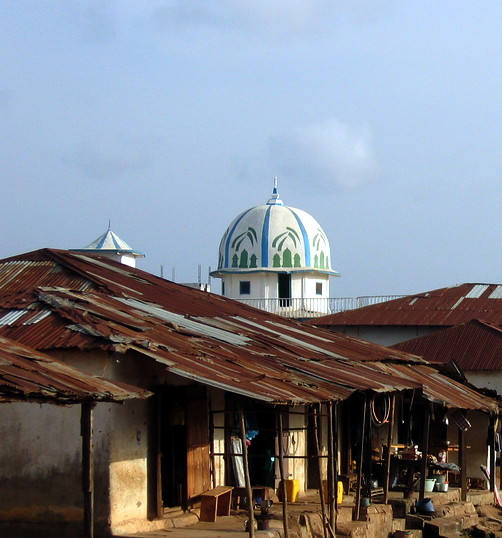
Voinjama featured numerous churches of many different denominations as well as a mosque situated in the predominantly Muslim area of town known as the Mandingo Quarter. As capital of the county, it served as a government headquarters housing county officials and offices as well as being home to numerous international development projects, including the Lofa County Agricultural Development Project. It is served by a number of US Peace Corps Volunteers (Tarnue and Akoi) and Japan Overseas Cooperation Volunteers.
Subsistence rice farming was the principal occupation of most of the population. The rice generally grown in Liberia is dryland rice, on ground cleared through slashing and burning of the abundant forest land, and not paddy rice as in other parts of the world. Other prominent crops grown in the Voinjama area were cassava, potato greens, collard greens, and palm nuts, from which the popular red palm oil was extracted. "Palm wine" harvested from certain palm trees was also popular.
References
References
- (2008). "2008 National Population and Housing Census: Preliminary Results". Government of the Republic of Liberia.
This article was imported from Wikipedia and is available under the Creative Commons Attribution-ShareAlike 4.0 License. Content has been adapted to SurfDoc format. Original contributors can be found on the article history page.
Ask Mako anything about Voinjama — get instant answers, deeper analysis, and related topics.
Research with MakoFree with your Surf account
Create a free account to save articles, ask Mako questions, and organize your research.
Sign up freeThis content may have been generated or modified by AI. CloudSurf Software LLC is not responsible for the accuracy, completeness, or reliability of AI-generated content. Always verify important information from primary sources.
Report