From Surf Wiki (app.surf) — the open knowledge base
Voiceless alveolo-palatal fricative
Consonantal sound represented by ⟨ɕ⟩ in IPA
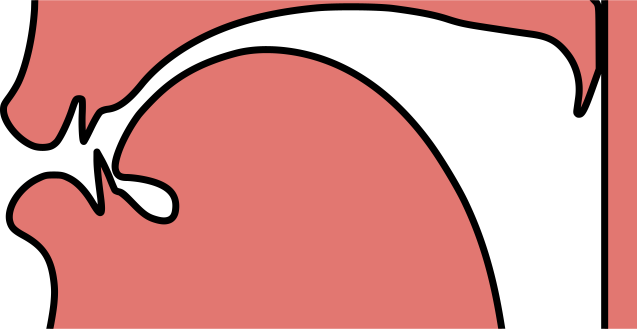
Consonantal sound represented by ⟨ɕ⟩ in IPA
| Field | Value |
|---|---|
| ipa symbol | ɕ |
| ipa number | 182 |
| decimal1 | 597 |
| x-sampa | s\ |
| braille | 236 |
| braille2 | c |
| imagefile | IPA Unicode 0x0255.svg |
|x-sampa=s\
A voiceless alveolo-palatal sibilant fricative is a type of consonantal sound, used in some spoken languages. The symbol in the International Phonetic Alphabet that represents this sound is ("c", plus the curl also found in its voiced counterpart ). Some Americanists may distinguish as an affricate, typically transcribed in IPA with , and instead use the symbol to represent the fricative that is referenced on this page. There is also a superscript / . It is the sibilant equivalent of the voiceless palatal fricative.
Features
Features of a voiceless alveolo-palatal fricative:
In English
In British Received Pronunciation, after syllable-initial (as in Tuesday) is realized as a devoiced palatal fricative. The amount of devoicing is variable, but the fully voiceless variant tends to be alveolo-palatal in the sequence: . It is a fricative, rather than a fricative element of an affricate because the preceding plosive remains alveolar, rather than becoming alveolo-palatal, as in Dutch.
The corresponding affricate can be written with or in narrow IPA, though is normally used in both cases. In the case of English, the sequence can be specified as as is normally apical (although somewhat palatalized in that sequence), whereas alveolo-palatal consonants are laminal by definition.
An increasing number of British speakers merge this sequence with the voiceless palato-alveolar affricate : (see yod-coalescence), mirroring Cockney, Australian English and New Zealand English. On the other hand, there is an opposite tendency in Canadian accents that have preserved , where the sequence tends to merge with the plain instead: (see yod-dropping), mirroring General American which does not allow to follow alveolar consonants in stressed syllables.
Occurrence
| Language | Word | IPA | Meaning | Notes | |
|---|---|---|---|---|---|
| Adyghe | щы / śy / شہ | 'three' | |||
| Assamese | ব্ৰিটিছ / British | 'British' | |||
| Asturian | xarda | 'mackerel' | May be realised as [ʃj], [ɕj], [ɕ] or [ʃ], depending on context and speaker. | ||
| Burmese | ရှ / hyạ | 'to abrade; to cut superficially' | See Burmese phonology. | ||
| Catalan | reixa | 'grille' | See Catalan phonology. | ||
| Chinese | Some Hokkien dialects | 心 / sim | 'heart' | ||
| Mandarin | 西安 / Xī'ān | 'Xi'an' | Complementary distribution allophone of in front of high front vowels and palatal glides. See Mandarin phonology. | ||
| Chuvash | çиçĕм / cicĕm | 'lightning' | Contrasts with and . Lenis when intervocalic. | ||
| Damin | *j2iwu* | 'small' | Varies with a doubled Voiceless alveolo-palatal plosive [t̠ʲ\t̠ʲ] | ||
| Danish | sjæl | 'soul' | See Danish phonology. | ||
| Dutch | Some speakers | sjabloon | 'template' | ||
| English | Cardiff | *human* | 'human' | ||
| Conservative Received Pronunciation | *tuesday* | 'Tuesday' | Allophone of after syllable-initial (which is alveolar in this sequence), may be only partially devoiced. is often realized as an affricate in British English. Mute in General American: . Typically transcribed with in broad IPA. See English phonology, yod-coalescence and yod-dropping. | ||
| Some Canadian English | |||||
| Ghanaian | *ship* | 'ship' | Educated speakers may use , to which this phone corresponds in other dialects. | ||
| Some speakers | sure | [ɕɔː] | 'sure' | ||
| Guarani | Paraguayan | che | 'I' | ||
| Japanese | 塩 / shio | 'salt' | See Japanese phonology. | ||
| Kabardian | щэ / śə / صە | 'hundred' | |||
| Karen | Eastern Pwo | ယှး | 'star' | ||
| Western Pwo | ၡၪ | 'star' | |||
| Kazakh | шіркін / şırkın / شىركىن | 'wretch' | Often transcribed as . See Kazakh phonology. | ||
| Korean | South | 시 / si | 'poem' | ||
| Kyrgyz | шайтан / shaitan / شايتان | 'Satan' | Often transcribed as . See Kyrgyz phonology. | ||
| Lower Sorbian | pśijaśel | 'friend' | |||
| Luxembourgish | liicht | 'light' | Allophone of after phonologically front vowels; some speakers merge it with . See Luxembourgish phonology. | ||
| Marathi | शेतकरी / śetakrī | 'farmer' | Contrasts with . Allophone of . See Marathi phonology. | ||
| Malayalam | കുരിശ് / kuriśŭ | 'Cross' | See Malayalam phonology. | ||
| Norwegian | Urban East | kjekk | 'handsome' | ||
| Polish | śruba | 'screw' | Contrasts with and . See Polish phonology. | ||
| Romani | Kalderash | ćhavo | 'Romani boy; son' | ||
| Romanian | Transylvanian dialects | ce | 'what' | ||
| Russian | счастье / sčastje | 'happiness' | Also represented by . Contrasts with , , and . See Russian phonology. | ||
| Sema | ashi | 'meat' | Possible allophone of before . | ||
| Serbo-Croatian | Croatian | miš će | 'the mouse will' | ||
| Some speakers of Montenegrin | с́утра / śutra | 'tomorrow' | Phonemically or, in some cases, . | ||
| Swedish | Finland | sjok | 'chunk' | ||
| Sweden | kjol | 'skirt' | See Swedish phonology. | ||
| Tibetan | Lhasa dialect | བཞི་ / bzhi | 'four' | ||
| Tatar | өчпочмак / öçpoçmaq / ئۇچپۇچماق | 'triangle' | |||
| Uzbek | yoʻldosh / йўлдош / یۉلداش | 'satellite' | Typically transcribed as . See Uzbek phonology. | ||
| Xumi | Lower | 'one hundred' | |||
| Upper | |||||
| Yámana (Yahgan) | šúša | 'penguin' | |||
| Yi | ꑟ / xi | 'thread' | |||
| Zhuang | cib | 'ten' |
References
Sources
-
{{cite book
-
{{cite journal |doi-access = free
-
{{cite book |editor-last1 = Coupland |editor-first1 = Nikolas |editor-last2 = Thomas |editor-first2 = Alan Richard
-
{{cite book
-
{{cite journal
-
{{cite book |editor-last1=Hardcastle |editor-first1=William J. |editor-last2=Laver |editor-first2=John |editor-last3=Gibbon |editor-first3=Fiona E.
-
{{cite journal |doi-access = free
-
{{cite book |editor1-last=Schneider |editor1-first=Edgar W. |editor2-last=Burridge |editor2-first=Kate |editor3-last=Kortmann |editor3-first=Bernd |editor4-last=Mesthrie |editor4-first=Rajend |editor5-last=Upton |editor5-first=Clive
-
{{cite journal
-
{{cite book
-
{{cite book
-
{{cite book |chapter-url = https://archive.org/details/rosettaproject_jpn_phon-2
-
{{cite book
-
{{cite journal |archive-date=2020-11-22 |access-date=2013-04-16 |archive-url=https://web.archive.org/web/20201122112513/http://pagines.uab.cat/danielrecasens/sites/pagines.uab.cat.danielrecasens/files/affricates.pdf |url-status=dead
-
{{cite book
-
{{cite journal
-
{{cite journal |doi-access = free
References
- [https://www.unicode.org/L2/L2021/21041-add-para-ipa-ltr.pdf L2/21-041: Unicode request for additional para-IPA letters]
- {{Harvcoltxt. Collins. Mees. 2003. /j/ after {{IPA. /t/ as more front than the main allophone of {{IPA. /j/.
- Chambers, J.K.. (1998). "Changes in progress in Canadian English: Yod-dropping". [[University of Toronto.
- {{Harvcoltxt. Recasens. Espinosa. 2007
- {{Harvcoltxt. Huber. 2004
- {{Harvcoltxt. Okada. 1999
- {{Harvcoltxt. Jassem. 2003
- {{Harvcoltxt. Boretzky. Igla. 1994
- {{Harvcoltxt. Teo. 2012
- {{Harvcoltxt. Landau. Lončarić. Horga. Škarić. 1999
- {{Harvcoltxt. Sjoberg. 1963
This article was imported from Wikipedia and is available under the Creative Commons Attribution-ShareAlike 4.0 License. Content has been adapted to SurfDoc format. Original contributors can be found on the article history page.
Ask Mako anything about Voiceless alveolo-palatal fricative — get instant answers, deeper analysis, and related topics.
Research with MakoFree with your Surf account
Create a free account to save articles, ask Mako questions, and organize your research.
Sign up freeThis content may have been generated or modified by AI. CloudSurf Software LLC is not responsible for the accuracy, completeness, or reliability of AI-generated content. Always verify important information from primary sources.
Report