From Surf Wiki (app.surf) — the open knowledge base
Vltava
Longest river in the Czech Republic

Longest river in the Czech Republic
| Field | Value |
|---|---|
| name | Vltava |
| image | Prague skyline view.jpg |
| image_caption | The Vltava in Prague |
| map | |
| map_caption | The course and drainage basin of the Vltava from its source to its confluence with the Elbe (magenta) |
| mapframe | yes |
| mapframe-zoom | 6 |
| source1 | Teplá Vltava |
| source1_location | Kvilda, Bohemian Forest |
| source1_coordinates | |
| mouth_location | Elbe |
| mouth_coordinates | |
| progression | |
| subdivision_type1 | Country |
| subdivision_name1 | Czech Republic |
| subdivision_type2 | Regions |
| subdivision_name2 | |
| subdivision_type3 | Cities |
| subdivision_name3 | |
| length_km | 431.3 |
| source1_elevation | 1174 m |
| mouth_elevation | 156 m |
| discharge1_avg | 149.9 m3/s near estuary |
| basin_size_km2 | 28089.9 |
| tributaries_left | Otava, Berounka |
| tributaries_right | Lužnice, Sázava |
the river in the Czech Republic
| mapframe-zoom = 6
The Vltava ( , ; ) is the longest river in the Czech Republic, a left tributary of the Elbe River. It runs southeast along the Bohemian Forest and then north across Bohemia, through Český Krumlov, České Budějovice, and Prague. It is commonly referred to as the "Czech national river".
Etymology
Both the Czech name Vltava and the German name Moldau are believed to originate from the old Germanic words wilt ahwa 'wild water' (compare Latin aqua). In the Annales Fuldenses (872 AD) it is called Fuldaha; from 1113 AD it is attested as Wultha. In the Chronica Boemorum (1125 AD) it is attested for the first time in its Bohemian form, Wlitaua.
Course
The Vltava originates by a confluence of two rivers, the Teplá Vltava, which is longer, and the Studená Vltava, originating in Bavaria. From a water management point of view, the Vltava and Teplá Vltava are one river with single numbering of river kilometres. The Teplá Vltava originates in the territory of Kvilda in the Bohemian Forest at an elevation of 1174 m, on the slope of the Černá hora mountain. Together with the Teplá Vltava, the Vltava is 431.3 km long. Without the Teplá Vltava, the Vltava is 377.0 km long. The river flows north across Bohemia, through Český Krumlov, České Budějovice and Prague. It merges with the Elbe River at Mělník at an elevation of 156 m. The height difference from source to mouth is 1018 m.
The Vltava River drains an area of 28089.9 km2 in size, over half of Bohemia and about a third of the Czech Republic's entire territory. The waters ultimately drain to the North Sea.
As it runs through Prague, the river is crossed by 18 bridges (including the Charles Bridge) and covers 31 km within the city. The water from the river was used for drinking until 1912 when the Vinohrady Water Tower ceased pumping operations, and is now a place to view the city. It is, however, the source of drinking water in case of failures of or repairs to the water supply from the Želivka and Kárané sources. The Podolí water processing plant is on standby for such cases with the long section of the river upstream of the Podolí plant under the stricter, second degree of pollution prevention regulations.
Along its course, the river receives many tributaries. The longest tributaries of the Vltava are:
| Tributary | Length (km) | River km | Side |
|---|---|---|---|
| Berounka | 244.6 | 63.4 | left |
| Sázava | 225.9 | 78.3 | right |
| Lužnice | 197.9 | 202.2 | right |
| Otava | 134.8 | 169.1 | left |
| Malše | 96.0 | 240.0 | right |
| Mastník | 49.5 | 104.6 | right |
| Kocába | 47.7 | 82.8 | left |
| Bakovský potok | 44.6 | 13.7 | left |
| Bezdrevský potok | 43.1 | 231.0 | left |
| Rokytka | 37.2 | 47.4 | right |
| Botič | 33.8 | 55.2 | right |
| Polečnice | 32.8 | 281.3 | left |
| Křemžský potok | 31.8 | 258.5 | left |
From a strict hydrological point of view, it is the Elbe upstream of Mělník that is a tributary of the Vltava rather than the other way around, owing to the Vltava's longer distance upstream (434 km against 294 km of the Elbe), greater discharge, and larger drainage basin; however, since at the confluence point the Elbe flows through the main valley in a straight line, relative to which the Vltava flows at a right angle, the combined river downstream is identified as the Elbe for historical reasons. Had the combined river been identified as the Vltava in line with the hydrological convention, it would be 1252 km long.
Navigation
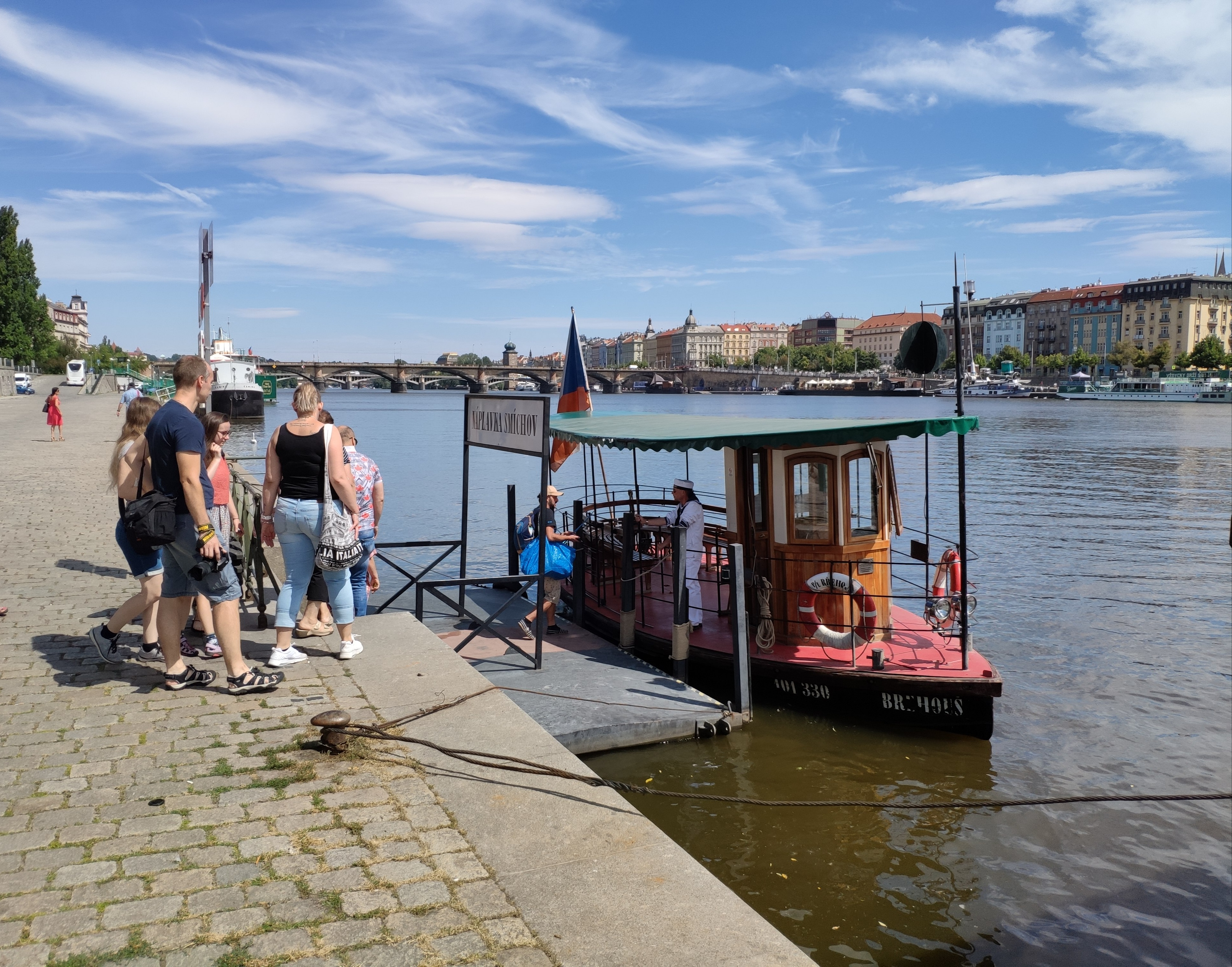
Between the confluence with the Elbe at Mělník and Prague, the river is navigable by vessels of up to 1000 tonnes displacement. Most of the river upstream of Prague as far as České Budějovice is navigable by craft of up to 300 tonnes displacement, but such vessels cannot pass the dams at Orlík and Slapy, and are also restricted by a low bridge at Týn nad Vltavou. Work is planned to complete boat lifts, planned for but never completed, at the two dams, and to rebuild the bridge, in order for them to navigate throughout. Much smaller craft, of up to 3.5 tonnes displacement and under 3 m beam and 3 m air draft, can avoid these obstacles.
Upstream of České Budějovice, the river's section around Český Krumlov (specifically from Vyšší Brod to Boršov nad Vltavou) is a very popular destination for water tourism.
Dams

Nine hydroelectric dams have been built on the Vltava south of Prague to regulate the water flow and generate hydroelectric power, starting in the 1930s. Beginning at the headwaters, these are: Lipno, Lipno II, Hněvkovice, Kořensko, Orlík, Kamýk, Slapy, Štěchovice and Vrané. The Orlík Reservoir supports the largest reservoir on the Vltava by volume, while the Lipno Reservoir retains the largest reservoir by area. The Štěchovice Reservoir is built over the site of St John's Rapids.
The river also features numerous weirs that help mitigate its flow from 1172 m in elevation at its source near the German border to 155 m at its mouth in Mělník.
Floods
The Vltava basin has flooded multiple times throughout recorded history. Markers have been created along the banks denoting the water line for notable floods in 1784, 1845, 1890, 1940, and the highest of all in 2002.
In August of 2002, the basin was heavily affected by the 2002 European floods when the flooded river killed several people and caused massive damage and disruption along its length, including in Prague. It left the oldest bridge in Prague, Charles Bridge, seriously weakened, requiring years of work to repair.
Prague was again flooded in 2013. Many locations within the Vltava and Elbe basins were left under water, including the Prague Zoo, but metal barriers were erected along the banks of the Vltava to help protect the historic city centre.
References in culture and science
In the classic narrative of the golem in Jewish folklore, the mystic Judah Loew ben Bezalel made the artificial giant "out of clay from the banks of the Vltava River and brought it to life through rituals and Hebrew incantations to defend the Prague ghetto from antisemitic attacks and pogroms."
One of the best-known works of classical music by a Czech composer is Bedřich Smetana's Vltava, sometimes called The Moldau in English. It is from the Romantic era of classical music and is a musical description of the river's course through Bohemia.
Smetana's symphonic poem also inspired a song of the same name by Bertolt Brecht. An English version of it, by John Willett, features the lyrics Deep down in the Moldau the pebbles are shifting / In Prague three dead emperors moulder away.
The Vltava River has been used as the setting for a number of films, including the 1942 Czech drama The Great Dam. More recently, the Vltava has been used as a film location for such films as Amadeus in 1984 and Mission: Impossible in 1996. The river also appeared in the 2002 film xXx. During filming, Vin Diesel's stunt double, Harry O'Connor, was tragically killed when he parasailed into the Palacký Bridge while filming an action sequence.
A minor planet, 2123 Vltava, discovered in 1973 by Soviet astronomer Nikolai Stepanovich Chernykh, is named after the river.
References
References
- Wells, John C.. (2008). "Longman Pronunciation Dictionary". Longman.
- "Vltava". [[Oxford University Press]].
- {{Cite Merriam-Webster. Vltava
- (2001). "The History of the Czech Republic and Slovakia". ABC-CLIO.
- (1946). "O jménech našich řek". [[Institute of the Czech Language]].
- (2023). "The Vltava River – Historical Communication Link in the Český Krumlov Region".
- "Základní charakteristiky toku Vltava a jeho povodí". T. G. Masaryk Water Research Institute.
- "Základní charakteristiky toku Teplá Vltava a jeho povodí". T. G. Masaryk Water Research Institute.
- "About Prague". Avantgarde Prague.
- (2024). "Prague Water Tower of Vinohrady, Hundred Years over the Vltava, virtual tour". Prague of the Centuries.
- "Vodní toky". [[Czech Hydrometeorological Institute]].
- (July 2017). "Upper Vltava navigation inaugurated in May". Inland Waterways International.
- [https://www.vltava-river.com/en/trip/along-the-river-branna-nove-spoli-xindtj2dy8 Along the River Branna Nove Spoli - vltava-river.com]
- [https://web.archive.org/web/20180709162858/http://americaninprague.eu/Prague/Czech-Republic/Vltava-River.shtml American in Prague (2018 webpage)]
- (16 September 2007). "I. Flood Protection Measures of the City of Prague".
- (9 February 2010). "Flooding in Prague".
- (15 April 2012). "The Vltava River".
- (3 June 2013). "Thousands flee as central Europe flood waters rise". BBC News.
- (3 June 2013). "News". Radio Praha.
- elisniv. (2011-02-01). "The Golem in the Attic".
- . (21 August 2012). ["The song of the Moldau"](http://www.antiwarsongs.org/canzone.php?lang=en&id=5159#agg117930).
- (2023-11-01). "Remembering Stuntmen and Stuntwomen Who Tragically Died On Set".
- Schmadel, Lutz D.. (2003). "Dictionary of Minor Planet Names". Springer Verlag.
This article was imported from Wikipedia and is available under the Creative Commons Attribution-ShareAlike 4.0 License. Content has been adapted to SurfDoc format. Original contributors can be found on the article history page.
Ask Mako anything about Vltava — get instant answers, deeper analysis, and related topics.
Research with MakoFree with your Surf account
Create a free account to save articles, ask Mako questions, and organize your research.
Sign up freeThis content may have been generated or modified by AI. CloudSurf Software LLC is not responsible for the accuracy, completeness, or reliability of AI-generated content. Always verify important information from primary sources.
Report