From Surf Wiki (app.surf) — the open knowledge base
Vital capacity
Measure of human lung capacity
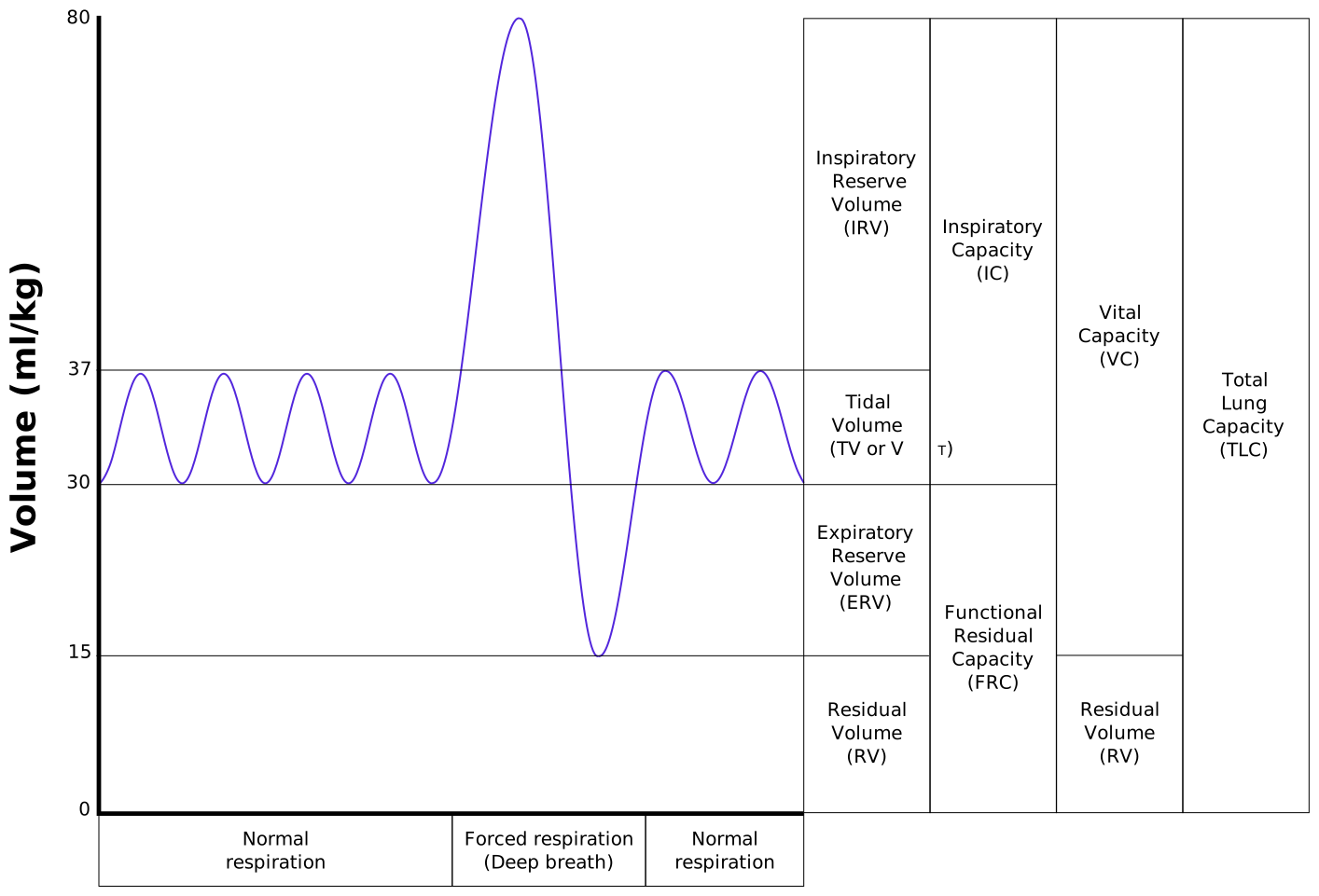
Measure of human lung capacity
Vital capacity (VC) is the maximum amount of air a person can expel from the lungs after a maximum inhalation. It is equal to the sum of inspiratory reserve volume, tidal volume, and expiratory reserve volume. It is approximately equal to Forced Vital Capacity (FVC).
A person's vital capacity can be measured by a wet or regular spirometer. In combination with other physiological measurements, the vital capacity can help make a diagnosis of underlying lung disease. Furthermore, the vital capacity is used to determine the severity of respiratory muscle involvement in neuromuscular disease, and can guide treatment decisions in Guillain–Barré syndrome and myasthenic crisis.
A normal adult has a vital capacity between 3 and 5 litres. A human's vital capacity depends on age, sex, height, mass, and possibly ethnicity. However, the dependence on ethnicity is poorly understood or defined, as it was first established by studying black slaves in the 19th century and may be the result of conflation with environmental factors.
Lung volumes and lung capacities refer to the volume of air associated with different phases of the respiratory cycle. Lung volumes are directly measured, whereas lung capacities are inferred from volumes.
Role in diagnosis
The vital capacity can be used to help differentiate causes of lung disease. In restrictive lung disease the vital capacity is decreased. In obstructive lung disease it is usually normal or only slightly decreased.
Estimated vital capacities
| Height | 150–155 cm (4'11"–5'1") | 155–160 cm (5'1"–5'3") | 160–165 cm (5'3"–5'5") | 165–170 cm (5'5"–5'7") | 170–175 cm (5'7"–5'9") | 175–180 cm (5'9"–5'11) | Vital capacity (cm3) |
|---|---|---|---|---|---|---|---|
| 2900 | 3150 | 3400 | 3720 | 3950 | 4300 |
| Age | 15–25 | 25–35 | 35–45 | 45–55 | 55–65 | Vital capacity (cm3) |
|---|---|---|---|---|---|---|
| 3425 | 3500 | 3225 | 3050 | 2850 |
Formulas
Vital capacity increases with height and decreases with age. Formulas to estimate vital capacity are:
\begin{align} vc_{female} = (21.78 - 0.101 a ) \cdot h \ vc_{male} = (27.63 - 0.112 a ) \cdot h \ \end{align} where vc is approximate vital capacity in cm3, a is age in years, and h is height in cm.
References
References
- (January 1998). "Forced Vital Capacity, Slow Vital Capacity, or Inspiratory Vital Capacity: Which Is the Best Measure of Vital Capacity?". Journal of Asthma.
- "Forced Expiratory Volume and Forced Vital Capacity".
- (January 1846). "On the Capacity of the Lungs, and on the Respiratory Functions, with a View of Establishing a Precise and Easy Method of Detecting Disease by the Spirometer". Journal of the Royal Society of Medicine.
- (14 August 2019). "How False Beliefs in Physical Racial Difference Still Live in Medicine Today". The New York Times.
- (2015). "Race, ethnicity and lung function: A brief history". Canadian Journal of Respiratory Therapy.
- "Pulmonary Function Tests". UCSD.
- (December 1922). "Long-Continued Observations on the Vital Capacity in Health and Heart Disease". The American Journal of the Medical Sciences.
- "Vital Capacity". Family Practice Notebook.
This article was imported from Wikipedia and is available under the Creative Commons Attribution-ShareAlike 4.0 License. Content has been adapted to SurfDoc format. Original contributors can be found on the article history page.
Ask Mako anything about Vital capacity — get instant answers, deeper analysis, and related topics.
Research with MakoFree with your Surf account
Create a free account to save articles, ask Mako questions, and organize your research.
Sign up freeThis content may have been generated or modified by AI. CloudSurf Software LLC is not responsible for the accuracy, completeness, or reliability of AI-generated content. Always verify important information from primary sources.
Report