From Surf Wiki (app.surf) — the open knowledge base
Virginia v. John Brown
Criminal trial held at Charles Town

Criminal trial held at Charles Town
| Field | Value | ||
|---|---|---|---|
| name | Virginia v. John Brown | ||
| image | John Brown on trial.jpg | ||
| caption | 1859 illustration of the trial by David Hunter Strother | ||
| judges | Richard Parker | ||
| date decided | |||
| verdict | Guilty of all charges; sentenced to death by hanging | ||
| charge | prosecution=Andrew Hunter | defence= |
Virginia v. John Brown was a criminal trial held in Charles Town, Virginia, in October 1859. The abolitionist John Brown was quickly prosecuted for treason against the Commonwealth of Virginia, murder, and inciting a slave insurrection, all part of his raid on the United States federal arsenal at Harpers Ferry, Virginia. (Since 1863, both Charles Town and Harpers Ferry are located in West Virginia.) He was found guilty of all charges, sentenced to death, and was executed by hanging on December 2. He was the first person executed for treason in the United States.
|access-date=May 10, 2021 |archive-date=May 3, 2021 |archive-url=https://web.archive.org/web/20210503132340/https://www.newspapers.com/clip/76943173/john-browns-raid-on-harpers-ferry/ |url-status=live
During most of the trial Brown, unable to stand, lay on a pallet.
Background
On October 16, 1859, Brown led (counting himself) 22 armed men, 5 black and 17 white, to Harpers Ferry, an important railroad, river, and canal junction. His goal was to seize the federal arsenal and then, using the captured arms, lead a slave insurrection in the South. Brown and his men engaged in a two-day standoff with local militia and federal troops, in which ten of his men were shot or killed, five were captured, and five escaped.{{cite book |access-date=September 17, 2017 |archive-date=September 9, 2017 |archive-url=https://web.archive.org/web/20170909110456/http://www.pbs.org/wgbh/aia/part4/4p2940.html |url-status=live
Reporting on the trial
Thanks to the recently invented telegraph, Brown's trial was the first to be reported nationally. In attendance were reporters from the New York Herald and The Daily Exchange, both of whom had been in Harpers Ferry since October 18;{{cite news |access-date=August 12, 2020 |archive-date=September 1, 2020 |archive-url=https://web.archive.org/web/20200901022605/https://www.newspapers.com/clip/57191951/john-brown-harpers-ferry-statements/ |url-status=live |access-date=August 18, 2020 |archive-date=June 16, 2019 |archive-url=https://web.archive.org/web/20190616164607/https://www.famous-trials.com/johnbrown/615-interview |url-status=live |access-date=August 18, 2020 |archive-date=September 1, 2020 |archive-url=https://web.archive.org/web/20200901022605/https://www.newspapers.com/clip/57579394/report-from-the-daily-exchanges/ |url-status=live |access-date=February 3, 2021 |archive-date=July 21, 2021 |archive-url=https://web.archive.org/web/20210721090837/https://www.newspapers.com/clip/66156316/news-from-harpers-ferry-pt-1-pt-2-is/ |url-status=live |access-date=February 9, 2021 |archive-date=July 21, 2021 |archive-url=https://web.archive.org/web/20210721090838/https://virginiachronicle.com/?a=d&d=DD18591219 |url-status=live |access-date=August 20, 2020 |archive-date=September 1, 2020 |archive-url=https://web.archive.org/web/20200901022605/https://www.newspapers.com/clip/57703881/mary-browns-visit-to-her-husband-john/ |url-status=live |access-date=August 20, 2020 |archive-date=September 1, 2020 |archive-url=https://web.archive.org/web/20200901022621/https://www.newspapers.com/clip/57706178/mary-browns-visit-to-her-husband-john/ |url-status=live |access-date=August 20, 2020 |archive-date=September 1, 2020 |archive-url=https://web.archive.org/web/20200901022619/https://www.newspapers.com/clip/57707139/visit-of-mary-brown-to-her-husband-john/ |url-status=live |access-date=August 20, 2020 |archive-date=September 1, 2020 |archive-url=https://web.archive.org/web/20200901022620/https://newspaperarchive.com/new-york-herald-dec-03-1859-p-2/ |url-status=live
The stories in the New York Daily Tribune were published unsigned, as the reporter, Edward Howard House, was in Charles Town in disguise, under a false name, with credentials from a Boston pro-slavery paper. He begged a visitor who knew him, Edward A. Brackett, a sketch artist from Frank Leslie's Illustrated Newspaper, not to say his real name aloud.{{cite journal |access-date=July 14, 2021 |archive-date=July 14, 2021 |archive-url=https://web.archive.org/web/20210714080550/https://www.winchester.us/DocumentCenter/View/4401/Sculptor-and-Abolitionist |url-status=live |access-date=July 13, 2021 |archive-date=July 13, 2021 |archive-url=https://web.archive.org/web/20210713161734/http://homenewshere.com/daily_times_chronicle/news/winchester/article_9b098b2c-7d0b-11e2-a1d5-0019bb2963f4.html |url-status=live
A second artist from Frank Leslie's Illustrated Newspaper was also in attendance,{{cite news |access-date=August 12, 2020 |archive-date=September 1, 2020 |archive-url=https://web.archive.org/web/20200901022606/https://accessible.com/accessible/emailedURL?AADoc=FRANKLESLIESWEEKLY.FL1859111201.00001 |url-status=live |access-date=February 9, 2021 |archive-date=July 21, 2021 |archive-url=https://web.archive.org/web/20210721090842/https://chroniclingamerica.loc.gov/lccn/sn84024828/1888-07-14/ed-1/seq-1/ |url-status=live |access-date=January 24, 2021 |archive-date=May 19, 2021 |archive-url=https://web.archive.org/web/20210519020126/https://www.americanheritage.com/eyewitness-describes-hanging-john-brown#5 |url-status=live one of his drawings is in the Gallery, below. Leslie informed his readers that "one of our imitators" was publishing bogus pictures. He described how his paper had engravers and artists standing by in a New York hotel, and once a sketch had arrived from Charles Town, 16 artists worked simultaneously at transforming it (split into 16 segments) into an illustration ready to be printed.{{cite journal |orig-date=December 17, 1859 |url-access=subscription |access-date=April 9, 2022 |archive-date=March 28, 2022 |archive-url=https://web.archive.org/web/20220328123501/https://www.accessible.com/accessible/docButton?AAWhat=builtPage&AAWhere=FRANKLESLIESWEEKLY.FL1859122401.00001&AABeanName=toc3&AANextPage=%2FprintBrowseBuiltPage.jsp |url-status=live The illustrations were so widely distributed that Yale Literary Magazine made fun of them, publishing the drawings of "our own artist on the spot" of "Governor Wise's shoes", "John Brown's watch", and the like.{{cite journal |access-date=November 18, 2020 |archive-date=December 9, 2020 |archive-url=https://web.archive.org/web/20201209093251/https://www.google.com/books/edition/The_Yale_Literary_Magazine/IiUBAAAAYAAJ?hl=en&gbpv=1&bsq=Brown |url-status=live
Significance of the trial
Considering its aftermath, it was arguably the most important criminal trial in the history of the country, for it was closely related to the war that quickly followed. According to historian Karen Whitman, "The conduct of John Brown during his incarceration and trial was so strong and unwavering that slavery went on trial rather than slavery's captive."{{cite journal |access-date=May 1, 2021 |archive-date=January 26, 2021 |archive-url=https://web.archive.org/web/20210126120418/http://www.wvculture.org/history/journal_wvh/wvh34-1.html |url-status=live
According to Brian McGinty, the Dana 60 was thus born in his trial. Had Brown died before his trial, he would have been "condemned as a madman and relegated to a footnote of history". Robert McGlone added that "the trial did magnify and exalt his image. But Brown's own efforts to fashion his ultimate public persona began long before the raid and culminated only in the weeks that followed his dramatic speech at his sentencing."{{cite news |access-date=December 13, 2018 |archive-date=December 15, 2018 |archive-url=https://web.archive.org/web/20181215224231/http://muse.jhu.edu/article/441179 |url-status=live |access-date=October 31, 2020 |archive-date=December 9, 2020 |archive-url=https://web.archive.org/web/20201209093232/https://www.google.com/books/edition/Overland_Monthly_and_Out_West_Magazine/wmE4AAAAIAAJ?hl=en&gbpv=1&bsq=Brown |url-status=live
The trial
Jurisdiction
This was the first criminal case in the United States where there was a question of whether federal courts or state courts had jurisdiction.{{cite news |orig-date=October 18, 1859 |access-date=April 11, 2021 |archive-date=April 11, 2021 |archive-url=https://web.archive.org/web/20210411152449/https://www.newspapers.com/clip/75537693/john-brown-federal-or-state/ |url-status=live
The Secretary of War, after a lengthy meeting with President Buchanan, telegraphed Lee that the United States Attorney for the District of Columbia, Robert Ould, was being sent to take charge of the prisoners and bring them to justice.{{cite news |access-date=February 5, 2021 |archive-date=February 10, 2021 |archive-url=https://web.archive.org/web/20210210021602/https://www.newspapers.com/clip/69412297/john-browns-assault-on-harpers-ferry/ |url-status=live
President Buchanan was indifferent to where Brown and his men were tried; Ould, in his brief report, did not call for federal prosecutions, as the only relevant crimes were those few that took place within the Armory.{{cite news |access-date=February 5, 2021 |archive-date=July 21, 2021 |archive-url=https://web.archive.org/web/20210721090840/https://www.newspapers.com/clip/69445518/robert-ould-district-attorney-of-the/ |url-status=live |access-date=December 28, 2020 |archive-date=July 21, 2021 |archive-url=https://web.archive.org/web/20210721090901/https://www.newspapers.com/clip/66238781/venue-for-john-brown/ |url-status=live |access-date=August 18, 2020 |archive-date=August 29, 2020 |archive-url=https://web.archive.org/web/20200829130440/https://www.newspapers.com/clip/33434279/cf-lg-report-for-harpers-ferry-the/ |url-status=live |editor-first=Paul |editor-last=Finkelman |editor-link=Paul Finkelman |access-date=February 22, 2021 |archive-date=July 21, 2021 |archive-url=https://web.archive.org/web/20210721090848/https://www.newspapers.com/clip/71750008/virginia-governor-henry-a-wise-on-john/ |url-status=live
In short, Brown and his men did not face federal charges. There were no federal court facilities nearby, and transporting the accused to a federal courthouse in the state capital of Richmond or Washington D.C.the nearest federal courthouse was in Staunton, Virginia, which was briefly mentioned in this regard{{cite news |access-date=August 7, 2021 |archive-date=August 7, 2021 |archive-url=https://web.archive.org/web/20210807194248/https://www.newspapers.com/clip/82989083/details-of-john-brown-prosecutions/ |url-status=live |access-date=August 3, 2021 |archive-date=August 3, 2021 |archive-url=https://web.archive.org/web/20210803012011/https://www.newspapers.com/clip/82696541/harpers-ferry-virginia-legislature/ |url-status=live
The trial, then, took place in the county courthouse in Charles Town, not to be confused with today's capital, Charleston, West Virginia. Charles Town is the county seat of Jefferson County, about 7 mi west of Harpers Ferry. The judge was Richard Parker, of Winchester.
Military presence in Harpers Ferry
Between Brown's arrest and his execution, Charles Town was filled with armed forces, both federal and state (militia). "The Governor [kept] the state troops constantly on guard. so that from the time Brown and his men were put in jail until after his execution, Charlestown had much the appearance of a military camp." The state was spending almost a thousand dollars a day () on military guards and other items, and after the episode was over the Virginia legislature appropriated $100,000 () to cover these expenditures.{{cite news |access-date=August 6, 2021 |archive-date=August 6, 2021 |archive-url=https://web.archive.org/web/20210806192342/https://www.newspapers.com/clip/82928635/the-costs-of-the-harpers-ferry-affair/ |url-status=live
Charles Town was described thus by a reporter there at the time:
|access-date=October 21, 2020 |archive-date=December 9, 2020 |archive-url=https://web.archive.org/web/20201209093208/https://www.newspapers.com/clip/61518920/charles-town-at-time-of-john-browns/ |url-status=live
Coordinating local security activities, including keeping non-residents without legitimate business in the city away, was Andrew Hunter, personal attorney of Governor Wise, and the most distinguished attorney in Jefferson County.{{cite journal |author-link=Andrew Hunter (lawyer)
Even Hunter's office was put to military use:
|access-date=November 11, 2020 |archive-date=December 9, 2020 |archive-url=https://web.archive.org/web/20201209093209/https://www.newspapers.com/clip/62998074/situation-in-charles-town-virginia/ |url-status=live
The Court room, where so lately Brown and his associates were tried, is now a barrack room for one of the Richmond companies. Bedticks filled with straw were piled up on one side, arms stacked in another place, belts and cloaks hung up wherever a nail or a hook could be got into the wall, and the Judge's arm chair was occupied by a young volunteer, who was enjoying his after-breakfast pipe.{{citation
Grand jury
Brown faced a grand jury on Tuesday, October 25, 1859, just eight days after his capture in the armory. Brown was brought into court "accompanied by a body of armed men. Cannons were stationed in front of the court house [see illustration], and an armed guard were patrolling round the jail."
The grand jury was also considering the other prisoners to be tried with Brown: Aaron Stephens, Edwin Coppie, Shields Green, and John Copeland. The courtroom was so crowded with spectators, all white since Blacks were not admitted,{{cite news |access-date=March 29, 2021 |archive-date=July 20, 2021 |archive-url=https://web.archive.org/web/20210720144637/https://www.newspapers.com/clip/74653752/presley-dunwood-driver-of-judge/ |url-status=live
- Conspiring with slaves to produce insurrection,
- Treason against the Commonwealth of Virginia, and
- Murder.{{cite news |access-date=January 21, 2021 |archive-date=January 29, 2021 |archive-url=https://web.archive.org/web/20210129085633/https://www.newspapers.com/clip/68149880/bill-of-indictment-against-john-brown/ |url-status=live
Also on the 26th, M. Johnson, the United States Marshall from Cleveland, Ohio, arrived and identified Copeland as a fugitive from justice in Ohio.{{cite news |access-date=February 12, 2021 |archive-date=July 21, 2021 |archive-url=https://web.archive.org/web/20210721090908/https://www.newspapers.com/clip/70117861/john-brown-and-harpers-ferry/ |url-status=live
Counsel
The next question was what legal counsel Brown was to have. The Court assigned two "Virginians and pro-slavery men", John Faulkner and Lawson Botts, as counsel for him and the other accused. Brown did not accept them; he told the judge that he had sent for counsel, "who have not had time to reach here".
|orig-date=October 25, 1859 |access-date=August 18, 2020 |archive-date=September 1, 2020 |archive-url=https://web.archive.org/web/20200901022620/https://www.newspapers.com/clip/57585911/john-browns-trial-entire-page/ |url-status=live |orig-date=October 25, 1859 |access-date=March 8, 2020 |archive-date=September 1, 2020 |archive-url=https://web.archive.org/web/20200901022633/https://www.newspapers.com/clip/46314928/trial-of-john-brown-october-25-1859/ |url-status=live
Brown asked for "a delay of two or three days" for his counsel to arrive. The judge turned down Brown's request: "the expectation of other counsel...did not constitute a sufficient cause for delay, as there was no certainty about their coming. ...The brief period remaining before the close of the term of the Court rendered it necessary to proceed as expeditiously as practicable, and to be cautious about granting delays."
Brown asked for "a very short delay" so that he could recover his hearing:
|orig-date=October 26, 1859 |access-date=April 7, 2021 |archive-date=April 13, 2021 |archive-url=https://web.archive.org/web/20210413200632/https://www.newspapers.com/clip/75277822/news-from-harpers-ferry-john-brown/ |url-status=live
Prosecuting attorney Hunter said that delay would be dangerous; there was "exceeding pressure on the resources of the community". He asked that Brown's body be examined by a doctor, who did not find that Brown's health required delay.
The judge's refusal to postpone the trial even one day to allow Brown's counsel to arrive, or when it did arrive, to allow it to read the indictment and the testimony given so far (see below), and that Brown was being tried when he was too wounded to stand, much less "attend to his own defense", or follow what was being said, contributed to Brown's transformation into a martyr.{{cite book |editor-first=Paul |editor-last=Finkleman |editor-link=Paul Finkleman |author-link=Paul Finkleman
The remainder of October 26 was used to choose jurors. Also on the 26th, abolitionist Lydia Maria Child sent Wise a letter to deliver to Brown, and asked to be permitted to nurse him.{{citation |author-link=Lydia Maria Child |editor-last=Zittle |editor-first=Hanna Minnie Weaver |author-link1=Lydia Maria Child |author-link2=Henry A. Wise |access-date=August 26, 2020 |archive-date=August 29, 2020 |archive-url=https://web.archive.org/web/20200829130443/https://www.newspapers.com/clip/58069321/richmond-enquirer/ |url-status=live |access-date=November 11, 2020 |archive-date=November 19, 2020 |archive-url=https://web.archive.org/web/20201119204713/https://www.newspapers.com/clip/57064476/the-harpers-ferry-affair-john-brown/ |url-status=live |author-link=John Brown (abolitionist) |access-date=November 12, 2020 |archive-date=December 9, 2020 |archive-url=https://web.archive.org/web/20201209093209/https://babel.hathitrust.org/cgi/pt?id=uc1.31175035177438&view=2up&seq=18 |url-status=live |access-date=November 11, 2020 |archive-date=December 9, 2020 |archive-url=https://web.archive.org/web/20201209093209/https://accessible.com/accessible/emailedURL?AADoc=NATIONALANTISLAVERYSTANDARD.AS1860010706.00006 |url-status=live |author-link=Lydia Maria Child
The trial proper
On Thursday, October 27, the trial proper began. Brown stated that he did not wish to use an insanity defense, as had been proposed by relatives and friends.{{cite book |author-link=David S. Reynolds
Brown, having received by telegraph news from a lawyer in Ohio, asked for a delay of one day; this was denied. The state attorney said that Brown's real motive was "to give to his friends the time and opportunity to organize a rescue."
On Friday, October 28, George Henry Hoyt, a young but prominent Boston lawyer, arrived as counsel. One report says that Hoyt was a volunteer, but another that Hoyt was hired to defend Brown by John W. Le Barnes, one of the abolitionists who had given money to Brown in the past.
On that day Brown was described as "walking feebly" from the jail to the courthouse, where he lay down on the cot.{{cite news |access-date=January 7, 2021 |archive-date=July 21, 2021 |archive-url=https://web.archive.org/web/20210721090841/https://www.newspapers.com/clip/67099447/john-brown-on-trial/ |url-status=live
Prosecution
The prosecuting attorney for Jefferson County was Charles R. Harding, "whose daily occupations [drinking] are not of the nature to fit for the management of an important case". He was not on the same level as the defense attorneys. He agreed, unhappily, to be replaced for these cases, as Wise wanted, by Wise's personal attorney, Andrew Hunter.{{cite news |access-date=February 3, 2021 |archive-date=July 21, 2021 |archive-url=https://web.archive.org/web/20210721090907/https://virginiachronicle.com/?a=d&d=SS18591129&e=-------en-20--21-byDA-txt-txIN-%22Shields+green%22------- |url-status=live |access-date=February 4, 2021 |archive-date=July 8, 2021 |archive-url=https://web.archive.org/web/20210708152140/https://newspapers.library.in.gov/cgi-bin/indiana?a=d&d=INR19370227-01.1.9 |url-status=live
The prosecuting attorney, then, was Hunter, whose office was in CharlesToen, despite the fact that in writing he referred to himself as the Assistant Prosecuting Attorney. He wrote the indictment.
The central prosecution witness in the trial was Colonel Lewis Washington, great-grandnephew of George Washington, who had been kidnapped out of his home, Beall-Air, and held hostage near the Federal Armory. His slaves were militarily "impressed" (conscripted) by Brown, but they took no active part in the insurrection, he said. Other local witnesses testified to the seizure of the federal armory, the appearance of Virginia militia groups, and shootings on the railroad bridge. Other evidence described the U.S. Marines' raid on the fire engine house where Brown and his men were barricaded. U.S. Army Colonel Robert E. Lee and cavalry officer J. E. B. Stuart led the Marine raid, and it freed the hostages and ended the standoff. Lee did not appear at the trial to testify, but instead filed an affidavit to the court with his account of the Marines' raid.
The manuscript evidence was of particular interest to the judge and jury. Many documents were found on the Maryland farm rented by John Brown under the alias Isaac Smith. These included hundreds of undistributed copies of a previously unknown Provisional Constitution for an anti-slavery government. These documents clinched the treason and pre-meditated murder charges against Brown.
The prosecution concluded its examination of witnesses. The defense called witnesses, but they did not appear as subpoenas had not been served on them. Mr. Hoyt said that other counsel for Brown would arrive that evening. Both court-appointed attorneys then resigned, and the trial was adjourned until the next day.
Defense
The trial resumed on Saturday, October 29. A lawyer, Samuel Chilton, arrived from Washington, and asked for a few hours to read the indictment and the testimony so far given; this was denied. The defense called six witnesses.
The defense claimed that the Harpers Ferry Federal Armory was not on Virginia property, but since the murdered townspeople had died in the streets outside the perimeter of the Federal facility, this carried little weight with the jury. John Brown's lack of official citizenship in Virginia was presented as a defense against treason against the State. Judge Parker dispatched this claim by reference to "rights and responsibilities" and the overlapping citizenship requirements between the Federal union and the various states. John Brown, an American citizen, could be found guilty of treason against Virginia on the basis of his temporary residence there during the days of the insurrection.
Three other substantive defense tactics failed. One claimed that since the insurrection was aimed at the U.S. government it could not be proved treason against Virginia. Since Brown and his men had fired upon Virginia troops and police, this point was mooted. His lawyers also said that since no slaves had joined the insurrection, the charge of leading a slave insurrection should be thrown out. The jury apparently did not favor this claim, either.
Extenuating circumstances were claimed by the defense when they stressed that Colonel Washington and the other hostages were not harmed and were in fact protected by Brown during the siege. This claim was not persuasive as Colonel Washington testified that he had seen men die of gunshot wounds and had been confined for days.
A dissenting news story reported Washington having testified on the 28th: |access-date=December 28, 2020 |archive-date=July 21, 2021 |archive-url=https://web.archive.org/web/20210721090847/https://www.newspapers.com/clip/66156475/news-from-harpers-ferry-pt-2-part-1/ |url-status=live
The final plea by the defense team for mercy concerned the circumstances surrounding the death of two of John Brown's men, who were apparently fired upon and killed by the Virginia militia while under a flag of truce. The armed community surrounding the Federal Arsenal did not hold their fire when Brown's men emerged to parley. This incident is noticeable upon a close reading of the published testimony, but is generally neglected in more popular accounts. If the rebels under a flag of truce were deliberately fired upon, it does not appear to have been a major issue to the judge and jury.
The defense's closing argument was given by Hiram Griswold, a lawyer from Cleveland, Ohio, who arrived on October 31. Griswold was well-known as an abolitionist; he had helped fugitive slaves, and was representing Brown pro bono. In contrast, Chilton was no abolitionist, and only became involved after supporters of Brown promised to pay a very high fee, $1,000 ().{{cite news |access-date=November 27, 2020 |archive-date=December 9, 2020 |archive-url=https://web.archive.org/web/20201209093237/https://www.newspapers.com/clip/64103879/hanging-of-john-brown/ |url-status=live
Brown, while making various suggestions to his attorneys, was frustrated because under Virginia law, defendants were not allowed to testify, the assumption being that they had reason not to tell the truth.
Verdict
The prosecution began its closing argument on Friday, concluding on Monday, October 31. The jury retired to consider its verdict.
The jury deliberated for only 45 minutes. When it returned, according to the report in the New York Herald, "the only calm and unruffled countenance there" was that of Brown. When the jury reported that it found him guilty of all charges, "not the slightest sound was heard in the vast crowd".{{cite news |access-date=March 6, 2020 |archive-date=March 27, 2020 |archive-url=https://web.archive.org/web/20200327120119/https://www.newspapers.com/clip/46215786/conclusion-of-first-day-of-john-browns/ |url-status=live
One of Brown's attorneys made "a motion for an arrest of judgment", but it was not argued. "Counsel on both sides being too much exhausted to go on, the motion was ordered to stand over until tomorrow, and Brown was again removed unsentenced to prison" (actually to the Jefferson County jail).
Speech to the court and sentence
Main article: John Brown's last speech

|access-date=July 22, 2021 |archive-date=July 22, 2021 |archive-url=https://web.archive.org/web/20210722071924/https://www.co.essex.ny.us/wp/courthouse-history/ |url-status=live Brown's sentencing took place on November 2, 1859. As Virginia court procedure required, Brown was first asked to stand and say if there was reason sentence should not be passed upon him. He arosehe could now stand unassistedand made what his first biographer called "[his] last speech". In his speech, Brown said that his only goal was to free slaves, not start a revolt, that it was God's work, that if he had been helping the rich instead of the poor he would not be in court, and also that the entire criminal trial had been more fair than he expected. According to Ralph Waldo Emerson, this speech's only equal in American oratory is the Gettysburg Address.{{cite book |author-link=Ralph Waldo Emerson |access-date=August 10, 2020 |archive-date=March 9, 2019 |archive-url=https://web.archive.org/web/20190309063642/http://www.rwe.org/xv-abraham-lincoln/ |url-status=live |author-link=Ralph Waldo Emerson |access-date=April 25, 2021 |archive-date=April 25, 2021 |archive-url=https://web.archive.org/web/20210425181306/https://chroniclingamerica.loc.gov/lccn/sn83035487/1859-12-03/ed-1/seq-2/ |url-status=live It was reproduced in full in at least 52 American newspapers, making the front page of the New York Times, the Richmond Dispatch, and several other papers.{{cite news
After Brown completed his speech and sat back down on his cot, the entire courtroom sat in silence. According to one journalist news source: "The only demonstration made was by the clapping of the hands [applauding] of one man in the crowd, who is not a resident of Jefferson County. This was promptly suppressed, and much regret is expressed by the citizens at its occurrence."{{cite news |access-date=August 11, 2020 |archive-date=December 3, 2020 |archive-url=https://web.archive.org/web/20201203050122/https://www.newspapers.com/clip/57062971/john-browns-last-speech/ |url-status=live
November 2{{snd}}December 2
Under Virginia law a month had to separate the sentence of death and its execution. Governor Wise resisted pressures to move up Brown's execution because, he said, he did not want anyone saying that Brown's rights had not been fully respected. The delay meant that the issue grew further; Brown's raid, trial, visitors, correspondence, upcoming execution, and Wise's role in making it happen were reported on constantly in newspapers, both local and national.{{cite news |author-link=Andrew Hunter (lawyer) |access-date=February 9, 2021 |archive-date=February 12, 2021 |archive-url=https://web.archive.org/web/20210212071754/https://www.newspapers.com/clip/69752591/andrew-hunter-on-john-browns-raid/ |url-status=live
An appeal to the Virginia Court of Appeals (a petition for a Writ of Error) was not successful.{{cite news |access-date=April 25, 2021 |archive-date=April 25, 2021 |archive-url=https://web.archive.org/web/20210425141342/https://www.newspapers.com/clip/76448362/appeal-for-john-brown-unsuccessful/ |url-status=live |access-date=December 18, 2020 |archive-date=July 21, 2021 |archive-url=https://web.archive.org/web/20210721090847/https://www.newspapers.com/clip/65550494/john-browns-appeal-rejected/ |url-status=live
Expulsion of Brown's lawyers
After Brown's sentencing on November 2, a Wednesday, the Court proceeded with the trials of Shields Green, John Copeland Jr., John Edwin Cook, and Edwin Coppock. After conviction they were on Thursday, November 10, sentenced to death a month later. The Court session ended Friday, November 11.
On Saturday, November 12, the mayor of Charles Town, Thomas C. Green, issued a proclamation, presumably written by Hunter, telling "strangers" to leave the town or they would be subject to arrest.{{cite news |orig-date=November 12, 1859 |access-date=April 3, 2021 |archive-date=July 21, 2021 |archive-url=https://web.archive.org/web/20210721090906/https://www.newspapers.com/clip/74989767/expulsonfrom-charles-town-of-john/ |url-status=live |access-date=January 27, 2021 |archive-date=July 21, 2021 |archive-url=https://web.archive.org/web/20210721090909/https://www.newspapers.com/clip/68666356/john-browns-attorney-george-hoyt/ |url-status=live
The question of clemency
Main article: Henry A. Wise#John Brown
Many things that Governor Wise did augmented rather than reduced tensions: by insisting he be tried in Virginia, and by turning Charles Town into an armed camp, full of state militia units. According to Franny Nudelman, "At every juncture he chose to escalate rather than pacify sectional animosity." As he put it: "We are in arms. ...We must demand of each State what position she means to maintain in the future regarding slavery."{{cite news
Wise received many communicationsone source says "thousands", and the Virginia General Assembly's joint committee inspected "near 500"{{cite book |author-link=Alexander McClure |access-date=March 13, 2021 |archive-date=June 14, 2021 |archive-url=https://web.archive.org/web/20210614164315/https://www.newspapers.com/clip/71185864/a-mcclures-recollections-of-the/ |url-status=live
Wise replied that in his view Brown should be hung, and he regretted not having gotten to Harpers Ferry fast enough to declare martial law and execute the rebels through court-martial. Brown's trial was fair and "it was impossible not to convict him." As Governor, he had nothing to do with Brown's death sentence; he did not have to sign a death warrant. His only possible involvement was from his power to pardon, and he had received "petitions, prayers, threats from almost every Free State in the Union," warning that Brown's execution would turn him into a martyr. But Wise stated that as Governor he did not have authority to pardon a traitor, only the House of Burgesses could. For the other charges, Wise believed that it would not be wise to "spare a murderer, a robber, a traitor," because of "public sentiment elsewhere". He also refused to declare Brown insane, which would have spared his life and put him in a mental hospital; Brown's supporter Gerrit Smith was forced to do that.{{cite news |access-date=November 4, 2020 |archive-date=December 9, 2020 |archive-url=https://web.archive.org/web/20201209093209/https://www.newspapers.com/clip/62468432/exchange-of-letters-fernando-wood-and/ |url-status=live |access-date=March 4, 2021 |archive-date=July 21, 2021 |archive-url=https://web.archive.org/web/20210721090849/https://accessible.com/accessible/emailedURL?AADoc=THENATIONALERA.FR1859111709.82539 |url-status=live
Plans for a rescue
After a number of other reports of rescue plans from various surrounding states,{{cite news |author-link=Andrew Hunter (lawyer) |access-date=February 9, 2021 |archive-date=February 15, 2021 |archive-url=https://web.archive.org/web/20210215060537/https://www.newspapers.com/clip/69762648/more-legible-version-of-most-of-andrew/ |url-status=live |access-date=February 26, 2021 |archive-date=July 21, 2021 |archive-url=https://web.archive.org/web/20210721090846/https://www.newspapers.com/clip/72013464/richmond-dispatch/ |url-status=live |author-link=Henry A. Wise |chapter-url=https://archive.org/details/appendixtomessag00virg/page/n3/mode/2up |author-link=James Buchanan |chapter-url=https://archive.org/details/appendixtomessag00virg/page/52/mode/2up
Brown friend and admirer Thomas Wentworth Higginson traveled to North Elba in November, unsuccessfully seeking Mary Brown's support for a rescue attempt. He and Lysander Spooner, two weeks before the execution, were prevented only by lack of funds from kidnapping Governor Wise and holding him hostage in exchange for Brown's release.
At one point, Silas Soule, a young abolitionist who used to know Brown from the conflict of Bleeding Kansas, infiltrated the Charles Town jail one evening by getting himself arrested and contacted Brown in his jail cell with the offer to break him out during the night. Soule claimed that Brown did not want to be rescued. Brown allegedly told Soule that he had already decided to be executed as a martyr for the abolitionist cause. After Soule was released from the jail the following day, he quietly and uneventfully left Charles Town, leaving Brown behind to be executed.
Higginson accompanied Mary to Harpers Ferry to recover John's body after his execution.{{cite book
Brown's numerous visitors and extensive correspondence
During the month between his conviction and the day of his execution, Brown wrote over 100 letters, in which he described his vision of a post-slavery America in eloquent and spiritual terms. Most of them, and a few letters to him, were immediately published in newspapers and pamphlets.{{cite book |author-link=John Brown (abolitionist) |editor-first=Louis |editor-last=DeCaro Jr. |access-date=April 9, 2022 |archive-date=February 21, 2022 |archive-url=https://web.archive.org/web/20220221232151/https://www.nytimes.com/2020/11/16/arts/television/the-good-lord-bird-finale.html |url-status=live
He had previously been prevented by the Court from "making a full statement of his motives and intentions through the press", as he desired; the Court had "refused all access to reporters". Now that he had been convicted and sentenced, there were no more restrictions on visitors, and Brown, relishing the publicity his anti-slavery views received, talked to reporters or anyone else that wanted to see him, although abolitionists, like Rebecca Buffum Spring, could only visit him with great difficulty. "I have very many visits from pro-slavery persons almost daily, & I endeavor to Improve them faifthfully, plainly, and kindly."{{cite book |orig-date=November 24, 1859 |author-link=John Brown (abolitionist) |editor-first=Louis |editor-last=DeCaro Jr.
A scholar estimates the number of visitors received during that month as 800: politicians (including Governor Wise and a Virginia senator), reporters, foes, and friends.{{cite journal
"I have...had a great many rare opportunities for 'preaching righteousness in the great congregation'" [].{{cite news |author-link=John Brown (abolitionist) |orig-date=November 15, 1859 |access-date=April 25, 2021 |archive-date=April 25, 2021 |archive-url=https://web.archive.org/web/20210425154819/https://www.newspapers.com/clip/76452198/john-brown-correspondence-from-jail/ |url-status=live He wrote to his wife that he had received so many "kind and encouraging letters" that he could not possibly reply to them all.{{citation |author-link=John Brown (abolitionist) |access-date=September 12, 2020 |archive-date=December 9, 2020 |archive-url=https://web.archive.org/web/20201209093232/https://famous-trials.com/johnbrown/616-letters#Nov26 |url-status=live |author-link=John Brown (abolitionist) |orig-date=November 16, 1859
On November 28, Brown wrote the following to an Ohio friend, Daniel R. Tilden:
|access-date=October 21, 2020 |archive-date=December 9, 2020 |archive-url=https://web.archive.org/web/20201209093226/https://timesmachine.nytimes.com/timesmachine/1859/12/05/issue.html |url-status=live
Contemporary assessments
Northerners commemorated the trial and coming execution with public prayers, church services, marches, and meetings. Ralph Waldo Emerson's prediction, in a lecture on November 8, that Brown, if executed, "would make the gallows glorious, like the cross,"{{cite news |editor-first=Paul |editor-last=Finkleman |editor-link=Paul Finkleman |author-link=Paul Finkleman
The New York Independent said the following of him during this month:
In contrast, the Richmond Dispatch called him a "scoundrel", adding that he was "a cold-blooded, midnight murderer, with not a particle of humanity or generosity belonging to his character." "The recent events at Harper's Ferry have very much roused the military spirit among us."{{cite news |access-date=October 1, 2020 |archive-date=December 9, 2020 |archive-url=https://web.archive.org/web/20201209093225/https://www.newspapers.com/clip/60321350/opinions-about-john-brown/ |url-status=live
Help for Mary Brown and other relatives
A meeting was held in the Tremont Temple, Boston, on November 19, "in aid of the suffering families of John Brown and his associates". Attendance was over 2,000. Presiding was John A. Andrew;{{cite news
Visit from Henry Clay Pate
His visitors included his pro-slavery enemy from Kansas Henry Clay Pate, who came 175 mi from his home in Petersburg to Charles Town to see Brown.{{cite news |access-date=October 2, 2020 |archive-date=December 9, 2020 |archive-url=https://web.archive.org/web/20201209093226/https://www.newspapers.com/clip/60395677/henry-clay-pate-visits-john-brown/ |url-status=live |author-link=Henry Clay Pate
Visit from his wife Mary
John repeatedly expressed his desire that Mary not visit him, as that would "add to my affliction, & cannot possibly do me any good".{{cite book |author-link=John Brown (abolitionist) |editor-first=Louis |editor-last=DeCaro Jr. |orig-date=November 8, 1859 |author-link=John Brown (abolitionist) |editor-first=Louis |editor-last=DeCaro Jr. |orig-date=November 8, 1859
Despite her husband's words, Mary set out anyway for Charles Town. Brown's friend Thomas Higginson went to North Elba so as to escort her. By the time John heard about her trip, she was in Philadelphia, and he had his lawyer telegraph "Mary's abolitionist hosts in Philadelphia" (James Miller McKim) to detain her.{{cite news |access-date=March 12, 2022 |archive-date=March 12, 2022 |archive-url=https://web.archive.org/web/20220312015303/https://www.newspapers.com/clip/97428552/mary-brown-en-route-to-husband/ |url-status=live
Mary did, however, reach Charles Town, and was allowed by Virginia Governor Wise to visit Brown for several hours on December 1, though she was not allowed to stay with him overnight.
His will
John Brown's first will is dated November 18, 1859. According to other sources, the identical document was prepared December 1, in the presence of his wife, by Judge Andrew Hunter, witnessed by Hunter and the jailor Captain John Avis.{{cite news |access-date=July 3, 2021 |archive-date=July 9, 2021 |archive-url=https://web.archive.org/web/20210709183129/https://www.newspapers.com/clip/80724453/john-browns-will/ |url-status=live |author-link1=Franklin Benjamin Sanborn |author-link2=John Brown (abolitionist)

Brown made a second will, the morning of his execution, in which he authorized the Sheriff of Jefferson County to sell his pikes and guns, if they could be found, and give the money to his wife.{{cite news |access-date=February 26, 2022 |archive-date=February 26, 2022 |archive-url=https://web.archive.org/web/20220226134213/https://chroniclingamerica.loc.gov/lccn/sn86058541/1859-12-15/ed-1/seq-1/ |url-status=live
In his correspondence Brown mentioned several times how well he was treated by Avis, who was also in charge of Brown's execution and the one who put the noose around his neck. Avis was described by a visitor to the jail as Brown's friend.{{cite news |access-date=February 7, 2021 |archive-date=July 21, 2021 |archive-url=https://web.archive.org/web/20210721090844/https://www.newspapers.com/clip/69577595/reminiscences-by-russell-of-his-visits/ |url-status=live |author-link=Oswald Garrison Villard
Brown's last words

Brown was well read and knew that the last words of prominent people are often given special attention.{{cite book |author-link=James Ronda |editor-first=James J. |editor-last=Holmberg}} Just before his execution he wrote his final words on a piece of paper and gave it to his kind jailor, Avis, who conserved it as a treasure:
Charlestown, Va. 2nd December, 1859. I John Brown am now quite certain that the crimes of this guilty, land: will never be purged away; but with Blood. I had as I now think: vainly flattered myself that without very much bloodshed; it might be done.
"Without very much bloodshed" is an allusion to his own failed project to free the slaves, which in hindsight he saw as vanity and self-flattery.{{cite book |author-link=John Brown (abolitionist) |orig-date=November 22, 1859
This document was reproduced, and copies were made available as a souvenir when John Brown's Fort was exhibited at the Columbian Exposition in Chicago, in 1893.{{cite web |access-date=June 20, 2021 |archive-date=June 25, 2021 |archive-url=https://web.archive.org/web/20210625071420/http://www.wvculture.org/history/gallery/jb/jb40.html |url-status=live
He gave a similar, even stronger form of the same statement to jailer Hiram O'Bannon:
Execution
Brown was the first person executed for treason in the history of the United States. He was hanged on December 2, 1859, at about 11:15 AM,{{cite news |access-date=October 21, 2020 |archive-date=December 9, 2020 |archive-url=https://web.archive.org/web/20201209093244/https://timesmachine.nytimes.com/timesmachine/1859/12/03/78902730.html?pageNumber=4 |url-status=live
|access-date=October 21, 2020 |archive-date=December 9, 2020 |archive-url=https://web.archive.org/web/20201209093230/https://timesmachine.nytimes.com/timesmachine/1859/12/02/78902682.html?pageNumber=4 |url-status=live
According to jailer John Avis, Brown was the happiest man in Charles Town.
Spectators
Brown was not the only happy man present. For those who supported slavery, the execution of Brown was a momentous event. Finally abolitionists were starting to be dealt with appropriately. The rope with which Brown was to be hung, made of South Carolina cotton, as visitors were told, was on display in the Sheriff's office.{{cite news
An article on the mood in Charles Town on the eve of Brown's execution is entitled "Revelry". The day before the execution the military held a dress parade. (Two weeks later, another was held the day before the executions of Brown's four captured allies, Green, Copeland, Cook, and Coppic.{{cite news
The roster of those present sounds like a foretaste of the Civil War. Thomas Jackson (the future Stonewall Jackson) was there, as were Robert E. Lee and 2,000 Federal troops and Virginia militia. Actor John Wilkes Booth was present. Booth was such a white supremacist that in five years he would assassinate President Lincoln, after Lincoln supported giving Blacks the vote, which Booth called "nigger citizenship". He had read in a newspaper about the upcoming execution of Brown, whom he called "the grandest character of this century."{{cite book|title=John Brown's body: slavery, violence & the culture of war
About 2,000 "excursionists" intended to attend the execution, but the Baltimore and Ohio Railroad refused to transport them, and Governor Wise shut down the Winchester and Potomac Railroad for other than military use. as did the mayor of Charles Town (see below). A prospective visitor from northwestern Pennsylvania, where Brown had lived for 11 years, was told in Philadelphia not to proceed, as martial law had in fact been declared in "the country around Charlestown".{{cite news |orig-date=November 25, 1859 |access-date=June 3, 2021 |archive-date=June 3, 2021 |archive-url=https://web.archive.org/web/20210603101550/https://www.newspapers.com/clip/78853788/a-visit-to-john-brown-by-an-old-friend/ |url-status=live |access-date=October 15, 2020 |archive-date=December 9, 2020 |archive-url=https://web.archive.org/web/20201209093318/https://accessible.com/accessible/emailedURL?AADoc=NATIONALANTISLAVERYSTANDARD.AS1859120303.00003 |url-status=live |access-date=May 13, 2020 |archive-date=August 29, 2020 |archive-url=https://web.archive.org/web/20200829130443/https://digital.library.temple.edu/digital/collection/p16002coll5/id/9308/rec/1 |url-status=live}}{{cite news |author-link=James Buchanan |access-date=November 3, 2020 |archive-date=December 9, 2020 |archive-url=https://web.archive.org/web/20201209093235/https://www.newspapers.com/clip/62468178/letter-of-james-buchanan-to-governor/ |url-status=live }}
Military orders for the day of execution had 14 points.{{cite news |access-date=November 16, 2020 |archive-date=December 9, 2020 |archive-url=https://web.archive.org/web/20201209093235/https://www.newspapers.com/clip/63369403/john-browns-execution/ |url-status=live
As further protection, "a field-piece loaded with grape and canister had been planted directly in front of and aimed at the scaffold, so as to blow poor Brown's body to smithereens in the event of attempted rescue." "The outer line of military will be nearly a mile (1.4 km) from the scaffold, and the inner line so distant that not a word John Brown may speak can be heard."

When the four collaborators arrested and convicted with Brown were hung two weeks later, on December 16, there were no restrictions, and 1,600 spectators came to Charles Town "to witness the last act of the Harpers Ferry tragedy".
The gallows
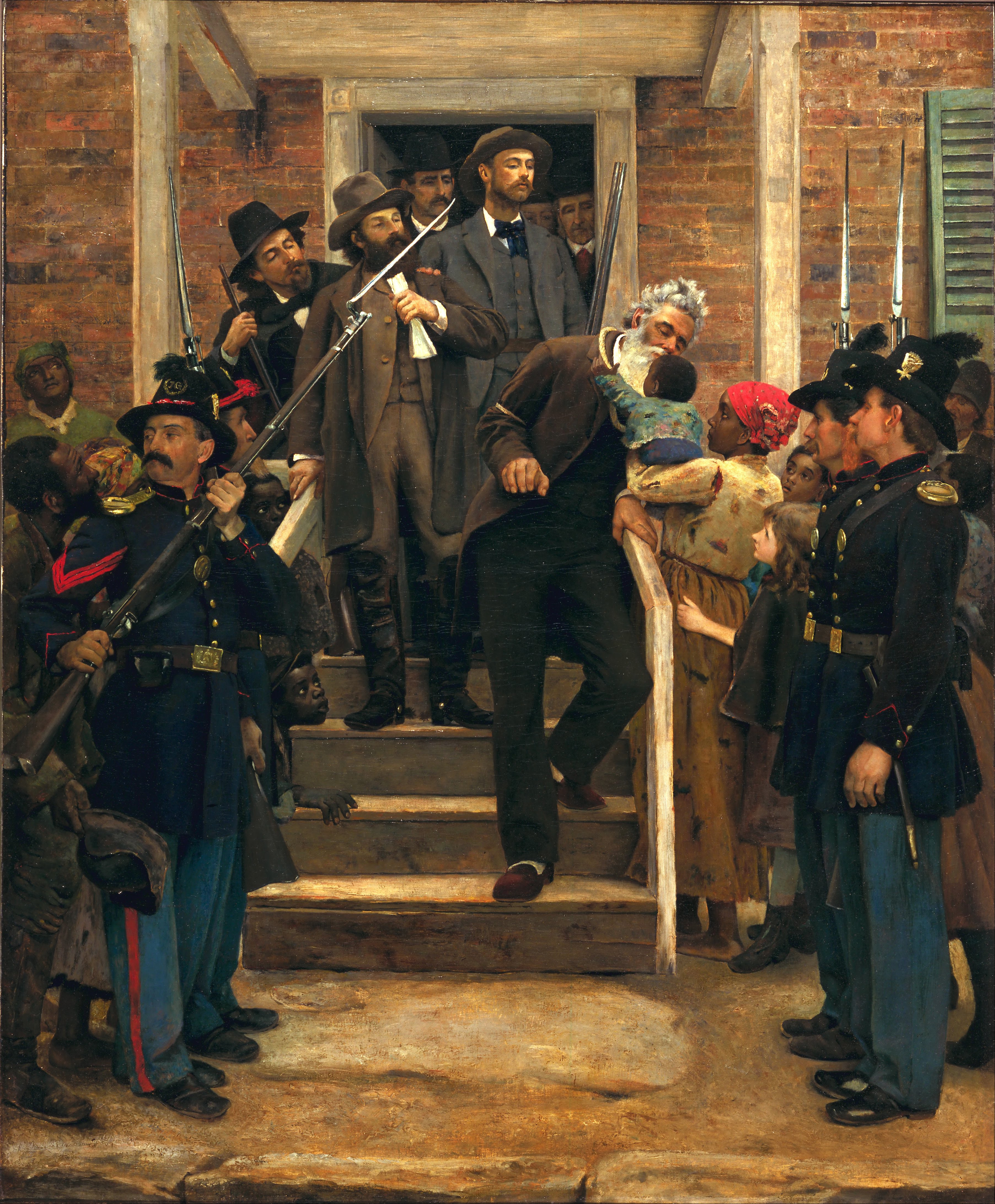

According to legend, popularized by a painting of Thomas Hovenden, Brown kissed a black baby when leaving the jail en route to the gallows. Several men who were present specifically deny it. For example, Prosecuting Attorney Andrew Hunter: "That whole story about his kissing a negro child as he went out of the jail is utterly and absolutely false from beginning to end. Nothing of the kind occurrednothing of the sort could have occurred. He was surrounded by soldiers and no negro could get access to him."{{cite book |access-date=November 18, 2020 |archive-date=December 9, 2020 |archive-url=https://web.archive.org/web/20201209093240/https://www.newspapers.com/clip/63512054/the-body-of-john-copeland-executed-for/ |url-status=live }}
On the short trip from the jail to the gallows, during which he sat on his coffin in a furniture wagon,{{cite book
On his way to the gallows he remarked to the Sheriff on the beauty of the country and the excellence of the soil. "This is the first time I have had the pleasure of seeing it." He asked the Sheriff and Avis not to make him wait. He "walked to the scaffold as coolly as if going to dinner", according to Hunter.{{cite news |access-date=March 17, 2021 |archive-date=May 16, 2021 |archive-url=https://web.archive.org/web/20210516224719/https://www.newspapers.com/clip/73674806/a-new-yorker-visits-west-virginia/ |url-status=live
After some twenty minutes,
Spectators took pieces of the gallows, or a lock of Brown's hair. The rope, specially made for the execution out of South Carolina cotton,{{cite news |access-date=December 18, 2020 |archive-date=July 21, 2021 |archive-url=https://web.archive.org/web/20210721090843/https://www.newspapers.com/clip/65537927/john-browns-execution/ |url-status=live
The gallows were built into the porch of a house under construction in Charles Town "to hide them from the Yankees". Twenty-five years later, "a syndicate of relic hunters" purchased them from the house owner.{{cite news |access-date=February 25, 2021 |archive-date=July 21, 2021 |archive-url=https://web.archive.org/web/20210721090844/https://www.newspapers.com/clip/72013254/john-browns-scaffold/ |url-status=live |author-link=Andrew Hunter (lawyer) |access-date=February 18, 2021 |archive-date=July 21, 2021 |archive-url=https://web.archive.org/web/20210721090845/https://www.coloradohistoricnewspapers.org/cgi-bin/colorado?a=d&d=SDM18880601-01.2.27&e=-------en-20--1--img-txIN%7CtxCO%7CtxTA-%22Andrew+hunter%22+%22john+brown%22-------0------ |url-status=live |access-date=August 24, 2021 |archive-date=August 24, 2021 |archive-url=https://web.archive.org/web/20210824231114/https://www.newspapers.com/clip/83918871/john-brown-scaffold/ |url-status=live
John Brown's body
Main article: John Brown's body
Governor Wise had John's body released to his widow Mary, who was awaiting it in Harpers Ferry. She and supporters traveled, via Philadelphia, Troy, New York, and Rutland, Vermont, to John Brown's Farm, in North Elba, New York, near the modern village of Lake Placid. The funeral and burial took place there on December 8, 1859. Rev. Joshua Young presided. Wendell Phillips spoke.
Aftermath


"In the minds of Southerners, Brown was the greatest threat to slavery the South had ever witnessed."{{cite journal |author-link=Paul Finkelman |access-date=September 11, 2021 |archive-date=June 23, 2016 |archive-url=https://web.archive.org/web/20160623023130/http://www.archives.gov/publications/prologue/2011/spring/brown.html |url-status=live |access-date=August 6, 2021 |archive-date=August 7, 2021 |archive-url=https://web.archive.org/web/20210807194248/https://www.newspapers.com/clip/82932326/john-brown-harpers-ferry-slavery-in-us/ |url-status=live |author-link=Fergus Bordewich |access-date=March 29, 2021 |archive-date=April 28, 2018 |archive-url=https://web.archive.org/web/20180428093448/https://www.smithsonianmag.com/history/john-browns-day-of-reckoning-139165084/ |url-status=live
In the North the result was the opposite. "We shall be a thousand times more Anti-Slavery than we ever dared to think of being before," proclaimed a Massachusetts newspaper. "The attempt of John Brown has not had much effect, but the manner in which that attempt is received at the North is what has done the injury. The orations, speeches, sympathy, approvals, the proposal to toll bells, close stores, &c., without any public manifestation to the contrary, has created a state of feeling at the South that is not to be described."{{cite news |orig-date=December 1, 1859
Meetings
Across the North, except for the large cities which feared the economic effect of Southern secession (Boston, New York, Philadelphia), the day Brown was hanged was treated as a day of national calamity: bells were rung, meetings held, speeches and sermons given, the flag flown at half-mast. "'The times that tried men's souls' have come again." "Martyr Services, as they were called, were held in many Northern localities."{{cite book |access-date=March 14, 2021 |archive-date=June 14, 2021 |archive-url=https://web.archive.org/web/20210614164205/https://www.google.com/books/edition/The_Raid_of_John_Brown_at_Harper_s_Ferry/GZAyAQAAMAAJ |url-status=live |access-date=December 4, 2020 |archive-date=December 9, 2020 |archive-url=https://web.archive.org/web/20201209093240/https://www.newspapers.com/clip/64578446/responses-to-john-brown/ |url-status=live
In Concord, Massachusetts, a ceremony was held at the Town Hall, in which an organ had been placed for the occasion. Henry Thoreau was a key speaker, as was Ralph Waldo Emerson. The "celebrated" words of President Thomas Jefferson on slavery were read. A considerable portion of the Wisdom of Solomon was read.{{cite book |chapter-url=https://archive.org/details/ASPC0005147600/page/451/mode/2up
In Boston, flags were at half-mast, and memorial services were held in the public schools.{{cite journal |access-date=March 14, 2022 |archive-date=March 14, 2022 |archive-url=https://web.archive.org/web/20220314111549/https://www.newspapers.com/clip/74865781/h-ford-douglas-boston-abolitionist/ |url-status=live
In Albany, New York, Brown received a slow 100-gun salute.{{cite book |access-date=December 12, 2020 |archive-date=July 21, 2021 |archive-url=https://web.archive.org/web/20210721090925/https://www.newspapers.com/clip/65124926/reactions-to-john-browns-execution/ |url-status=live |access-date=October 21, 2020 |archive-date=December 9, 2020 |archive-url=https://web.archive.org/web/20201209093226/https://timesmachine.nytimes.com/timesmachine/1859/12/05/issue.html |url-status=live |access-date=August 4, 2016 |archive-date=March 4, 2016 |archive-url=https://web.archive.org/web/20160304044953/http://www.civilwarphilly.net/johnbrown/tourstops.pdf |url-status=live |access-date=December 12, 2020 |archive-date=July 21, 2021 |archive-url=https://web.archive.org/web/20210721090857/https://www.newspapers.com/clip/65124926/reactions-to-john-browns-execution/ |url-status=live |access-date=April 27, 2021 |archive-date=April 27, 2021 |archive-url=https://web.archive.org/web/20210427003750/https://www.newspapers.com/clip/39966689/an-extensive-brown-meeting-john/ |url-status=live
In Cleveland there was a crowd of 5,000;{{cite news |access-date=January 28, 2021 |archive-date=February 9, 2021 |archive-url=https://web.archive.org/web/20210209205842/https://www.newspapers.com/clip/68737488/news-on-john-brown/ |url-status=live |access-date=January 28, 2021 |archive-date=February 7, 2021 |archive-url=https://web.archive.org/web/20210207115646/https://www.newspapers.com/clip/68741161/john-browns-execution-in-cleveland/ |url-status=live |access-date=March 31, 2022 |archive-date=March 31, 2022 |archive-url=https://web.archive.org/web/20220331172308/https://www.newspapers.com/clip/98758894/reaction-in-akron-to-john-browns/ |url-status=live
In Milwaukee, Wisconsin, 100 guns were fired at noon.{{cite news |access-date=February 23, 2022 |archive-date=February 23, 2022 |archive-url=https://web.archive.org/web/20220223135226/https://www.newspapers.com/clip/96242961/john-browns-role-in-starting-the-civil/ |url-status=live
In Montreal, there were "numerously attended" meetings on December 2, at which a collection for Brown's family was taken.{{cite news |access-date=May 30, 2021 |archive-date=June 2, 2021 |archive-url=https://web.archive.org/web/20210602213317/https://www.newspapers.com/clip/78590260/john-brown-meeting-in-montreal/ |url-status=live |access-date=August 25, 2021 |archive-date=August 25, 2021 |archive-url=https://web.archive.org/web/20210825162037/https://cdnc.ucr.edu/?a=d&d=PA18621115.2.12&srpos=21&e=-------en--20--21-byDA-txt-txIN-%22Owen+brown%22-------1 |url-status=live
In the United States, as of July 1860, $6,150 (~$ in ) had been raised to help the Brown widows and others affected by the raid.{{cite news |author-link=Thaddeus Hyatt |orig-date=July 16, 1860 |url-access=subscription |access-date=September 11, 2021 |archive-date=August 25, 2021 |archive-url=https://web.archive.org/web/20210825211404/https://www.accessible.com/accessible/docButton?AAWhat=builtPage&AAWhere=DOUGLASSMONTHLY.18601000_010.image&AABeanName=toc1&AACheck=4.156.1.4.4&AANextPage=%2FprintBuiltImagePage.jsp |url-status=live
In Princeton, New Jersey, on December 3 students demonstrated against Brown, and burned William H. Seward and Henry Ward Beecher in effigy.{{cite news |author-link=Edward Everett |access-date=May 30, 2021 |archive-date=June 2, 2021 |archive-url=https://web.archive.org/web/20210602213901/https://www.newspapers.com/clip/78590045/anti-john-brown-speech-of-former-mass/ |url-status=live |author-link=Edward Everett |access-date=May 30, 2021 |archive-date=June 2, 2021 |archive-url=https://web.archive.org/web/20210602213044/https://www.newspapers.com/clip/78590157/edward-everett-on-john-brown-pt-2-of-2/ |url-status=live |access-date=February 27, 2022 |archive-date=February 27, 2022 |archive-url=https://web.archive.org/web/20220227122118/https://www.newspapers.com/clip/92904214/the-pittsfield-sun/ |url-status=live |access-date=May 30, 2021 |archive-date=June 2, 2021 |archive-url=https://web.archive.org/web/20210602213044/https://www.newspapers.com/clip/78590157/edward-everett-on-john-brown-pt-2-of-2/ |url-status=live
Publications


Newspapers and magazines had whole sections on the episode. A poster (broadside) was made of Brown's last speech (see left). As there was as yet no process to print a photograph, a lithographed [engraved] reproduction of his last photograph and his signature were offered for sale for $1, to benefit the Brown family.{{cite news |access-date=December 12, 2020 |archive-date=July 21, 2021 |archive-url=https://web.archive.org/web/20210721090911/https://www.newspapers.com/clip/65132252/portrait-of-john-brown-for-sale/ |url-status=live
Pamphlets started to appear as soon as Brown was sentenced, before his execution.{{cite book |author-link=Wendell Phillips |access-date=December 4, 2020 |archive-date=December 9, 2020 |archive-url=https://web.archive.org/web/20201209093257/https://www.google.com/books/edition/The_Curse_of_God_Against_Political_Athei/OowZbf2r0loC?hl=en&gbpv=1 |url-status=live |author-link=John E. Cook |access-date=December 4, 2020 |archive-date=December 9, 2020 |archive-url=https://web.archive.org/web/20201209093310/https://digital.library.cornell.edu/catalog/may926904 |url-status=live |access-date=December 5, 2020 |archive-date=December 9, 2020 |archive-url=https://web.archive.org/web/20201209093238/http://reader.library.cornell.edu/docviewer/digital?id=may892819#mode/1up |url-status=live |author-link1=Samuel Chilton |author-link=James Freeman Clarke |author-link=John Brown (abolitionist) |author-link=Henry Clarke Wright |author-link=Fales Newhall |access-date=December 15, 2020 |archive-date=July 21, 2021 |archive-url=https://web.archive.org/web/20210721090916/https://babel.hathitrust.org/cgi/pt?id=hvd.32044050807726&view=1up&seq=7 |url-status=live |author-link=William Weston Patton |author-link=Lyman Trumbull |access-date=May 4, 2021 |archive-date=May 4, 2021 |archive-url=https://web.archive.org/web/20210504155107/https://www.loc.gov/resource/rbaapc.12300/?sp=22 |url-status=live |access-date=December 18, 2020 |archive-date=July 21, 2021 |archive-url=https://web.archive.org/web/20210721090855/https://babel.hathitrust.org/cgi/pt?id=chi.72973683&view=1up&seq=3 |url-status=live |author-link=Joseph Barker (minister)}}{{cite book |access-date=January 14, 2021 |archive-date=January 23, 2021 |archive-url=https://web.archive.org/web/20210123085035/https://babel.hathitrust.org/cgi/pt?id=hvd.32044011027240&view=1up&seq=9 |url-status=live |access-date=January 17, 2021 |archive-date=July 10, 2021 |archive-url=https://web.archive.org/web/20210710123024/https://www.login.amdigital.co.uk/Login.aspx?sessionID=01jdb345xtanoo45ttebr02n&returnURL=http%3A%2F%2Fwww.slavery.amdigital.co.uk%2FContents%2FTranscript.aspx%3Fimageid%3D652581%26vpath%3Dsearchresults&login=http%3A%2F%2Fwww.slavery.amdigital.co.uk%2FLogin.aspx&cookiesTesting=true |url-status=live |access-date=March 4, 2021 |archive-date=August 6, 2021 |archive-url=https://web.archive.org/web/20210806192344/https://catalog.hathitrust.org/Record/009596245 |url-status=live |orig-date=November 19, 1859 |orig-date=December 14, 1859 |author-link=Benjamin Wade |access-date=May 22, 2021 |archive-date=August 6, 2021 |archive-url=https://web.archive.org/web/20210806192343/https://www.google.com/books/edition/INVASION_OF_HARPER_S_FERRY_SPEECH_OF_HON/1r0I7-YcetkC?hl=en&gbpv=1&dq=Harpers+ferry&pg=PP3 |url-status=live |author-link=John Albion Andrew |author-link1=Amos C. Barstow |author-link2=George T. Day |author-link4=Thomas Davis (Rhode Island politician) |access-date=July 21, 2021 |archive-date=July 9, 2021 |archive-url=https://web.archive.org/web/20210709190845/https://babel.hathitrust.org/cgi/pt?id=loc.ark%3A%2F13960%2Ft3jw8hb65&view=2up&seq=2 |url-status=live |author-link=Charles Frederick Henningsen
In December two books on Brown (by De Witt and Pate) were published.{{cite book |access-date=December 2, 2020 |archive-date=December 9, 2020 |archive-url=https://web.archive.org/web/20201209093240/http://www.idaillinois.org/digital/collection/isl7/id/1624/rec/1 |url-status=live

|access-date=April 9, 2022 |archive-date=April 9, 2022 |archive-url=https://web.archive.org/web/20220409203545/https://www.newspapers.com/clip/99414809/who-taught-john-brown-it-was-virginia/ |url-status=live

.jpg)
It is no coincidence that the preface of the fourth, by the family's preferred biographer, James Redpath, is dated December 25, 1859, as Brown was sometimes seen, and saw himself, as Christ, or Moses leading the Israelites out of slavery. On the title page it has a version of the seal of Virginia, with its motto, "Sic semper tyrannis" ('Thus always to tyrants'), exclamation point added. Virginia is now the tyrant, as explained on the day of Brown's sentencing by abolitionist Wendell Phillips, to whom, along with Thoreau and the young Emerson, Redpath's volume is dedicated:
|chapter-url=https://books.google.com/books?id=_khHAQAAMAAJ&pg=PA263}}}}
There were advance orders of at least 20,000.{{cite news |access-date=December 13, 2020 |archive-date=August 6, 2021 |archive-url=https://web.archive.org/web/20210806192344/https://www.newspapers.com/clip/65193914/advertisement-for-james-redpaths/ |url-status=live |url-access=subscription |access-date=July 21, 2021 |archive-date=July 9, 2021 |archive-url=https://web.archive.org/web/20210709183141/https://www.accessible.com/accessible/docButton?AAWhat=builtPage&AAWhere=THENATIONALERA.FR1860010541.82890&AABeanName=toc1&AACheck=3.204.1.2.1&AANextPage=%2FprintBuiltPage.jsp |url-status=live |author-link=James Redpath
A 3-act play, Ossawatomie Brown; or, The Insurrection at Harper's Ferry, was first performed in New York at the Bowery Theater on December 16, 1859.{{cite journal |access-date=April 29, 2021 |archive-date=May 1, 2021 |archive-url=https://web.archive.org/web/20210501122341/https://www.kshs.org/p/an-old-play-on-john-brown/12702 |url-status=live |author-link1=James M. Mason |author-link2=Jacob Collamer
According to the New York Independent,
|access-date=May 18, 2020 |archive-date=August 3, 2020 |archive-url=https://web.archive.org/web/20200803073604/https://www.newspapers.com/clip/51578056/consequences-of-john-brown-trial/ |url-status=live |author-link=Wendell Phillips |access-date=August 25, 2021 |archive-date=August 27, 2021 |archive-url=https://web.archive.org/web/20210827091233/https://www.google.com/books/edition/_/XUUIAAAAQAAJ |url-status=live
Local retaliation by Blacks
The barns of all the members of the jury that convicted Brown were burned by slaves.{{citation |archive-url=https://web.archive.org/web/20160111174203/http://civilwarscholars.com/2011/06/a-dozen-set-fires-a-sign-of-slave-resistance/ |archive-date=January 11, 2016 |url-status=dead |author-link=Andrew Hunter (lawyer) |access-date=February 2, 2021 |archive-date=February 7, 2021 |archive-url=https://web.archive.org/web/20210207114346/https://www.newspapers.com/clip/69164907/fires-set-in-queen-anne-county-md-in/ |url-status=live
Long-term results. The outbreak of the Civil War
"The attempt of John Brown has not had much effect, but the manner in which that attempt is received at the North is what has done the injury. The orations, speeches, sympathy, approval, the proposal to toll bells, close stores, &c., without any public manifestation to the contrary, has created a state of feeling at the South that is not to be described. ...In all our previous troubles I never had a shadow of fear as to the Union. ...But now I acknowledge that my fears amount almost to conviction that we shall see on the 5th [of December 1859] the last Congress of the present Union assemble. ...The cry for dissolution is sincere and unanimous. It is no longer the ultras and the fire-eaters."{{cite news |orig-date=December 1, 1859
"The execution of these prisoners is yet [1901] memorable in Virginia as one of the most impressive exhibitions ever given in the history of the State. It would have been eminently wise for the Virginia governor to have treated Brown and his followers as fanatical [insane] beyond full responsibility to the law, but the ostentatious exhibition of vengeance that came up from Virginia did much to deepen and widen the anti-slavery sentiment of the North. ...[H]e gave his life in such heroic devotion to his cause that the Northern people were impressed far beyond what they themselves had knowledge of."
Reenactment
At the time of the Civil War Centennial, at the request of the Jefferson County Civil War Centennial Committee local author Julia Davis Healy wrote The Anvil about the trial. Its first performance, in 1961, was in the same courtroom, described as "jampacked", in the Jefferson County Courthouse where the trial had taken place.{{cite news |access-date=January 27, 2022 |archive-date=April 9, 2022 |archive-url=https://web.archive.org/web/20220409203546/https://timesmachine.nytimes.com/timesmachine/1961/12/12/118526359.html?pageNumber=54 |url-status=live |access-date=January 27, 2022 |archive-date=January 27, 2022 |archive-url=https://web.archive.org/web/20220127164044/https://www.newspapers.com/clip/93574710/play-on-john-brown-julia-davis/ |url-status=live |access-date=January 31, 2022 |archive-date=January 31, 2022 |archive-url=https://web.archive.org/web/20220131215338/https://www.newspapers.com/clip/93716457/charles-town-preparing-for-the-anvil/ |url-status=live |access-date=January 31, 2022 |archive-date=January 31, 2022 |archive-url=https://web.archive.org/web/20220131231324/https://www.newspapers.com/clip/93914795/the-anvil-play-about-john-brown/ |url-status=live |access-date=January 27, 2022 |archive-date=January 27, 2022 |archive-url=https://web.archive.org/web/20220127162957/https://www.newspapers.com/clip/93565331/play-about-john-brown-by-laura-davis/ |url-status=live |access-date=January 29, 2022 |archive-date=January 29, 2022 |archive-url=https://web.archive.org/web/20220129132258/https://www.newspapers.com/clip/93576175/play-the-anvil-about-john-brown/ |url-status=live
The trial was reenacted in 2019 by students from Shenandoah University. A version will be available at Shenandoah Valley Civil War Museum, in Winchester, Virginia.{{cite news |access-date=October 13, 2020 |archive-date=December 9, 2020 |archive-url=https://web.archive.org/web/20201209093242/https://www.winchesterstar.com/winchester_star/su-showcases-virtual-reality-reenactment-of-john-browns-historic-trial/article_fc582064-9830-53e3-81e1-cd32ecf0f8ca.html |url-status=live
Drama
- Harpers Ferry, by Barrie Stavis (1967), dramatizes the raid and trial.
- Episode No. 18 ("The Night Raiders") of the CBS (1963-64) television series The Great Adventure shows a dramatization of the raid and subsequent trial.
Gallery
File:John brown interior engine house.jpg|Interior of the engine house at the armory, just before the door is broken down. Note hostages on the left. File:John Brown at his arraignment.jpg|John Brown at his arraignment before a grand jury, drawing dated 1899 File:John Brown - Treason broadside, 1859.png|Request for prayers for Brown, dated November 4. File:Broadside warning re John Brown's hanging.jpg|A warning to citizens of Jefferson County, Virginia, and vicinity to stay home and not attend John Brown's execution. File:Broadside from mayor of Charles Town, Virginia.jpg|Broadside from mayor of Charles Town, Virginia, warning citizens to remain in their houses. File:T-john-brown-last-prophecy.jpg|John Brown's last words, given to the jailor, who requested an autograph. From an albumen print; location of the original is unknown.
File:John Brown riding on his coffin to the place of execution (Charlestown, W. Va.) LCCN99614097.jpg|John Brown riding on his coffin to the place of execution. File:John Brown on his way to be executed.jpg|John Brown on his way to the gallows. Note soldiers on each side of wagon transporting Brown, to prevent an armed rescue. File:John Brown ascending the scaffold preparatory to being hanged cph.3c32551.jpg|Brown ascending the scaffold preparatory to being hanged. From Frank Leslie's Illustrated Newspaper, December 17, 1859 File:John Brown's execution.jpg|John Brown hanging. From Frank Leslie's Illustrated Newspaper, December 10, 1859. File:Right half of picture of John Brown's execution.jpg|Right half of picture of John Brown's execution. Note spectators at lower right.
References
References
- (2020). "The Zealot and the Emancipator: John Brown, Abraham Lincoln and the Struggle for American Freedom". Doubleday.
- (1894). "John Brown and His Followers in Iowa". J. Birgham.
- {{rp. 30 a volunteer [[militia]] of 1,500 men traveling to [[Charles Town, West Virginia. Charles Town]] for Brown's hanging, to guard against a possible attempt to rescue Brown from the gallows by force.Kauffman, ''American Brutus'', p. 105.
- (December 1, 1859). "The Panic at Charlestown [sic]". [[New York Times]].
- Olcott, Henry S.. (1875). "Lotos Leaves". William F. Gill.
- (December 17, 1859). "John Brown's War. Another Panic in Virginia". [[Chicago Tribune]].
This article was imported from Wikipedia and is available under the Creative Commons Attribution-ShareAlike 4.0 License. Content has been adapted to SurfDoc format. Original contributors can be found on the article history page.
Ask Mako anything about Virginia v. John Brown — get instant answers, deeper analysis, and related topics.
Research with MakoFree with your Surf account
Create a free account to save articles, ask Mako questions, and organize your research.
Sign up freeThis content may have been generated or modified by AI. CloudSurf Software LLC is not responsible for the accuracy, completeness, or reliability of AI-generated content. Always verify important information from primary sources.
Report