From Surf Wiki (app.surf) — the open knowledge base
Virgin of Montserrat
Marian advocation venerated in the monastery of Montserrat
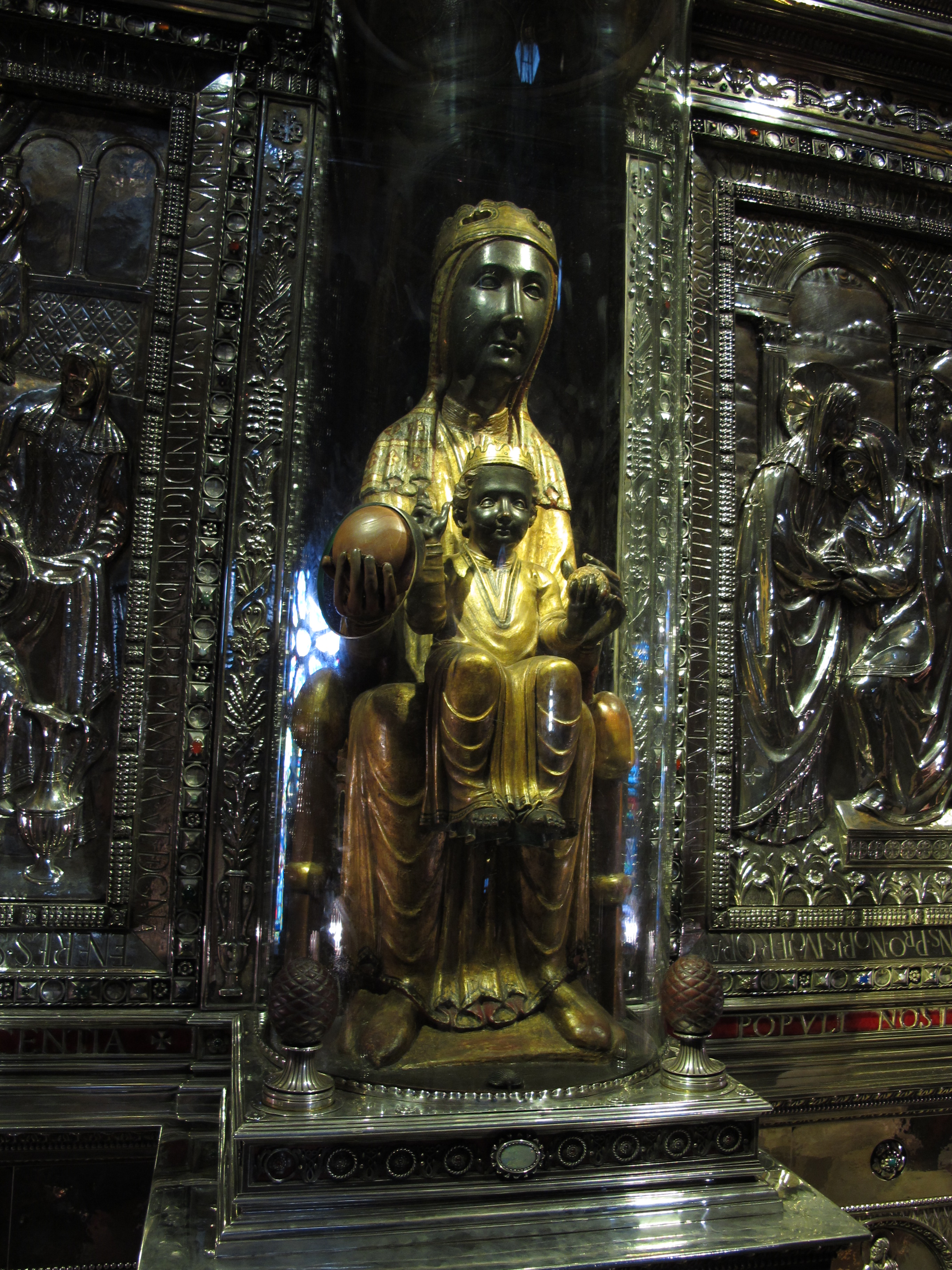
Marian advocation venerated in the monastery of Montserrat
| Field | Value |
|---|---|
| name | Virgin of Montserrat |
| “La Moreneta” | |
| image | A Virgem de Mont Serrat.jpg |
| caption | Our Lady of Montserrat |
| titles | Our Lady of Montserrat |
| Patroness of Catalonia | |
| venerated_in | Roman Catholic Church |
| major_shrine | Santa Maria de Montserrat Abbey, Catalonia, Spain |
| attributes | Statue painted in polychrome of Mary with the Christchild seated on the Throne of Wisdom holding an orb in her right hand |
| patronage | Catalonia |
“La Moreneta” Patroness of Catalonia Our Lady of Montserrat or the Virgin of Montserrat () is a Marian title associated with a statue of the Madonna and Child venerated at the Santa Maria de Montserrat monastery on Montserrat mountain in Catalonia, Spain. She is the patroness saint of Catalonia, an honour she shares with Saint George (Sant Jordi in Catalan). Miracles have been attributed to the statue.
Pope Leo XIII granted the image a canonical coronation on 11 September 1881. The image is one of the Black Madonnas of Europe, hence its familiar Catalan name, La Moreneta ("the little dark-skinned one" or "the little dark one"). Believed by some to have been carved in Jerusalem in the early days of the Church, it is more likely a Romanesque sculpture in wood from the late 12th century.
An 18th-century polychromed statue of the same image is also displayed in Saint Peter's basilica, previously stored in the Vatican Museums, which was gifted by President of Brazil João Goulart on the papal election of Pope Paul VI in 1963. The image has been on display for papal Masses since the pontificate of Pope Benedict XVI.
History
The mountain of Montserrat has been of religious significance since pre-Christian times, when the Romans built a temple to honor the Roman goddess Venus.
By one account, the image of the Madonna was moved to Montserrat in 718, to avoid the danger posed by invading Saracens.
Legend has it that the Benedictine monks could not move the statue to construct their monastery, choosing to instead build around it. The statue's sanctuary is located at the rear of the chapel, where an altar of gold surrounds the icon, and is now a site of pilgrimage.
Description
The 95-cm (38-inch) wooden statue shows evidence of Byzantine conventional and stylized form, and is painted in polychrome. The reliquary statue of Sainte-Foy in Conques (southern France) may have been a model. The art-historical designation for this type of pose is called "Throne of Wisdom". The body is thin, the face elongated. She holds an orb of the earth in her right hand. The Child's hand is raised in a formalized and traditional Eastern blessing.
In 2001, renovators working for the government observed that the black hands and face of La Moreneta had over the centuries undergone a change in colour. They attribute the change—from a lighter tone to black—either to prolonged exposure to candle smoke or a chemical reaction caused by a varnish used as a paint sealant. The statue was repainted black by successive generations of restorers. A series of tests, including X-rays, revealed the statue's original colour and also showed that the last repainting took place at the turn of the 19th century.
Veneration
After making a pilgrimage to Our Lady of Montserrat around 1203, Peter Nolasco went to Barcelona where he began to practise various works of charity. Nolasco became concerned with the plight of Christians captured in Moorish raids and decided to establish the Merecedarians, a religious order to succor these unfortunates.
Upon his recovery from battle wounds, Ignatius of Loyola visited the Benedictine monastery of Montserrat (on 25 March 1522), where he laid down his military accoutrements before the image. He then led a period of asceticism before later founding the Society of Jesus.
The hymn to the Virgin of Montserrat, known as "el Virolai" and sung at noon each day by the Escolania de Montserrat boys' choir, begins with the words: "Rosa d’abril, Morena de la serra..." (Rose of April, dark-skinned lady of the mountain...). Therefore, this virgin is sometimes also known as the "Rosa d'abril". Her feast is kept on April 27.
Patronage
The statue has always been considered one of the most celebrated images in Spain. "La Moreneta" is one of Catalonia's two patron saints, together with Sant Jordi (Saint George).
Given name
The name Montserrat, traditionally abbreviated to Serrat, Rat, Rateta, Tat or Tóna, and also to Montse in recent years, is a popular girl's name in Catalonia.
References
References
- (November 12, 2021). "The Mystery of Montserrat: A Sacred Mountain of Christianity".
- [http://www.montserratvisita.com/en/spirituality/our-lady "Our Lady"], on the official "Visit Montserrat Monastery" website (in Catalan, Spanish, English, French and Russian). She was declared the [[Patron Saint]] of Catalonia by [[Pope Leo XIII]] in 1881.
- link. (8 December 2014 , under "Spirituality", on the official Montserrat Monastery website (in Catalan, Spanish and English).)
- [http://santjordi.gencat.cat/en/llegenda_i_tradicio/tradicio_a_catalunya/ "Tradition in Catalonia"], in the Sant Jordi 2014 section of the [[Catalan Government]]'s website (in Catalan, Spanish and English).
- [http://www.arquebisbatbarcelona.cat/node/4371 "Els Patrons de Catalunya"], Archdiocese of Barcelona (text in Catalan).
- "A Real-Life Miracle on Spain's Montserrat Mountain". City Wonders.
- Simonis, Damien. Spain, Lonely Planet, 2009 (page 367) {{ISBN. 174179000X
- [http://www.barcelona.de/en/barcelona-excursions-monastery-montserrat.html "Montserrat monastery", Barcelona]
- [https://udayton.edu/imri/mary/m/montserrat-black-madonna.php Duricy, Michael P., "Black Madonnas: Our Lady of Montserrat", Marian Library, University of Dayton]
- Roccosalvo C.S.J., Joan L.. (Spring 2012). "Elegance Personified: The Black Madonna of Montserrat". Sacred Architecture Journal.
- Wilkinson, Isambard. (13 April 2001). "Montserrat Black Virgin 'was white originally'". The Telegraph.
- Badia, Enric. (2001-04-12). "Un examen radiológico confirma que 'La Moreneta' era blanca". El País.
- [http://www.escolania.cat/index.php?md=articles&id=367&lg=1 Escolania de Montserrat – El Virolai]
- "Wednesday of the Fifth Week of Easter - April 27, 2016 - Liturgical Calendar".
- Ruaix, Josep. ''Català Complet 3. Curs superior de llengua'', Editorial Claret, 1998, p. 23-26 (in Catalan)
- El Punt / Avui]]'', 2 May 2014 (in Catalan) [consulted 7 April 2015]
- Soler, Sílvia. (2013-06-29). "Montserrat".
- [https://pepvalsalobre.wordpress.com/2010/11/21/catalanot-ii-noves-tendencies-en-la-tradicio-catalana-de-pronunciar-els-noms-de-fonts/ "Catalanot II. Noves tendències en la tradició catalana d'escurçar els noms de font"], ''Melancholia'', 21 November 2010 (in Catalan) [consulted 7 April 2015]
This article was imported from Wikipedia and is available under the Creative Commons Attribution-ShareAlike 4.0 License. Content has been adapted to SurfDoc format. Original contributors can be found on the article history page.
Ask Mako anything about Virgin of Montserrat — get instant answers, deeper analysis, and related topics.
Research with MakoFree with your Surf account
Create a free account to save articles, ask Mako questions, and organize your research.
Sign up freeThis content may have been generated or modified by AI. CloudSurf Software LLC is not responsible for the accuracy, completeness, or reliability of AI-generated content. Always verify important information from primary sources.
Report