From Surf Wiki (app.surf) — the open knowledge base
Vidisha
| Field | Value |
|---|---|
| settlement_type | City |
| official_name | Vidisha |
| image_skyline | {{multiple image |
| border | infobox |
| total_width | 290 |
| perrow | 1/2/2/1 |
| image1 | Samrat ashok technological institute vidisha mp.jpg |
| caption1 | Samrat Ashok Technological Institute |
| image2 | Varahavtar_Panel.jpg |
| caption2 | Ancient Sculpture of Varahavtar, Udayagiri |
| image3 | Atal-bihari-vajpayee-government-medical-college-(abvgmc)-vidisha-banner (1).jpg |
| caption3 | Atal Bihari Vajpayee Medical College |
| image4 | A_less_often_visited_site_in_Vidhisa._The_Pillar_of_Heliodorus.jpg |
| caption4 | Heliodorus pillar |
| image5 | Vidisha Railway Station - Madhya Pradesh - 2013-02-21 4585.JPG |
| caption5 | Vidisha Railway Station |
| map_alt | Vidisha |
| image_map | |
| pushpin_map_alt | Vidisha |
| pushpin_map_caption | Location within Madhya Pradesh##Location within India |
| pushpin_relief | 1 |
| pushpin_map | India Madhya Pradesh#India3 |
| coordinates | |
| subdivision_type | Country |
| subdivision_name | India |
| subdivision_type1 | State |
| subdivision_name1 | Flag of Madhya Pradesh.svg Madhya Pradesh |
| subdivision_type2 | Division |
| subdivision_name2 | Bhopal |
| subdivision_type3 | District |
| subdivision_name3 | Vidisha |
| seat_type | Lok Sabha seat |
| seat | Vidisha Lok Sabha constituency |
| seat_type2 | Vidhan Sabha seat |
| seat2 | Vidisha Assembly constituency-- |
| unit_pref | Metric |
| elevation_m | 424 |
| population_total | 2,55,959 |
| population_as_of | 2021 |
| population_density_km2 | auto |
| blank_name_sec2 | Official language |
| blank_info_sec2 | Hindi |
| timezone1 | IST |
| utc_offset1 | +5:30 |
| postal_code_type | PINs |
| postal_code | 464 001 |
| area_code | +91-755 |
| registration_plate | MP-40 |
| website |
Vidisha (formerly known as Bhelsa and known as Besnagar and Bhaddalpur in ancient times) is a city in Indian state of Madhya Pradesh and the administrative headquarters of Vidisha district. It is located 62.5 km northeast of the state capital, Bhopal. The name "Vidisha" is derived from the nearby river "Bais", mentioned in the Puranas. "Vidisha" also finds its historic reference in ancient epic Ramayana, under the rule of Rama's youngest brother Shatrughna, later on under the rule of Shatrughna's younger son Shatrughati.
The district was created as Bhilsa District in 1904 by joining the tehsils of Vidisha (also known as Bhilsa) and Basoda (but not Basoda State) which were then part of Gwalior state. After India's independence in 1947, the former princely state of Gwalior became part of Madhya Bharat state, which was formed in 1948.
Vidishā was the administrative headquarters of Bhelsa, or Bhilsa, during the Medieval period. It was renamed Vidisha in 1956. Vidisha is also amongst the 112 Aspirational District in the Aspirational District Programme launched by NITI Aayog in 2018. Towards the seventh or eighth century, Bhadravati was raised from its ruins by a Bheel chieftain, who surrounded it with walls, and gave it the name of Bhilsa. When, in the year 1230, the Emperor Altamsh took possession of it, it was the seat of a Rajpoot prince of the Chohan clan. It was not, however, finally wrested from the Hindus until the year 1570, under Akbar.
Demographics
As of the 2011 Census of India, Vidisha had a population of 155,959. Males constitute 53.21% of the population and females 46.79%. Vidisha has an average literacy rate of 86.88%, higher than the national average of 74.04%: male literacy is 92.29%, and female literacy is 80.98%. In Vidisha, 15% of the population is under 6 years of age.
History
Besnagar
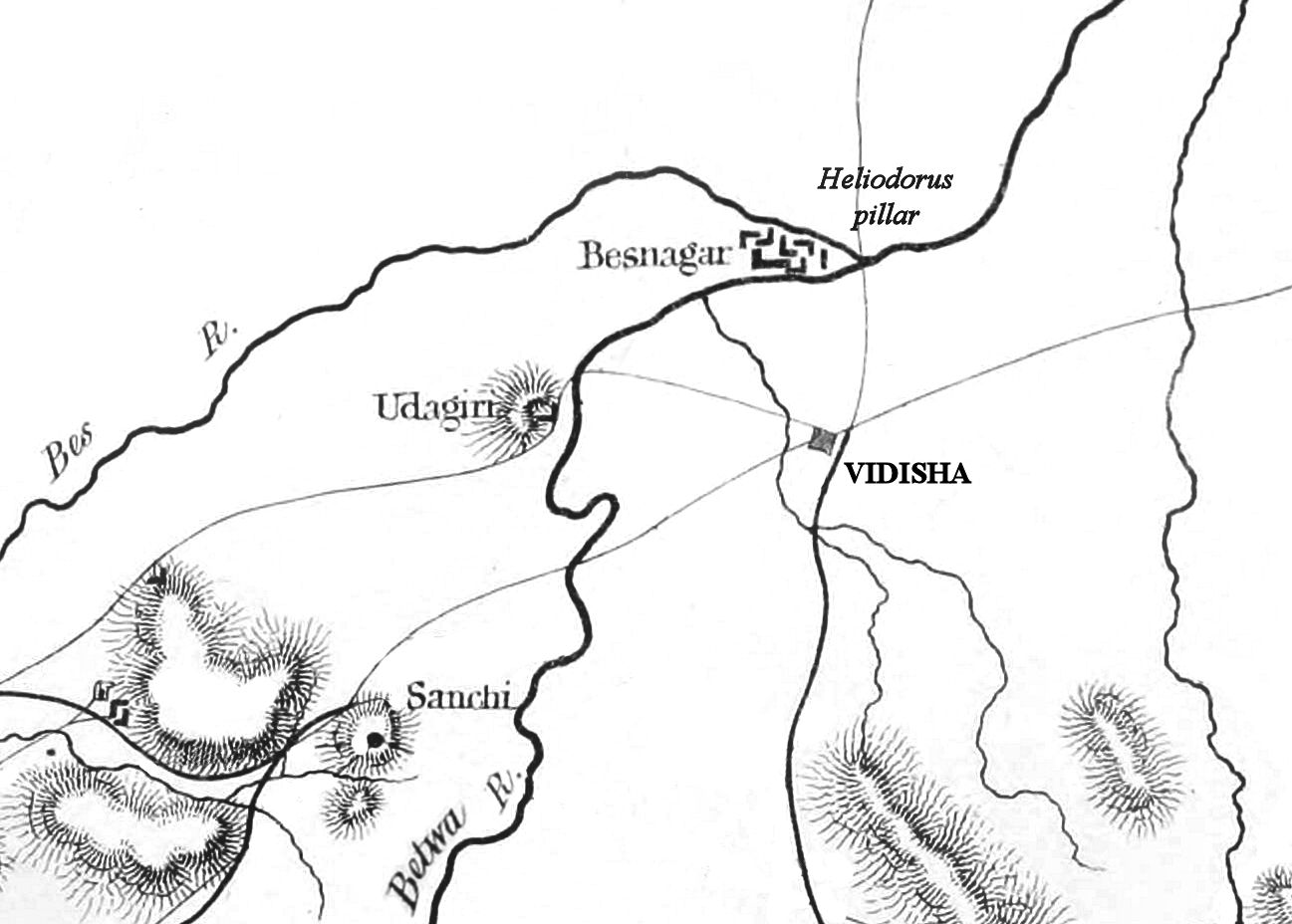
The town is situated east of the Betwa River, in the fork of the Betwa and Bes rivers, 9 km from Sanchi. The town of Besnagar, 3 km from present-day Vidisha on the west side of the river, became an important trade centre in the 6th and 5th centuries BCE, under the Shungas, Nagas, Satavahanas, and Guptas, and was mentioned in the Pali scriptures. The Emperor Ashoka was the governor of Vidisha during his father's lifetime. His Buddhist Empress Vidisha Devi who was also his first wife, was brought up in Vidisha. It finds mention in Kalidasa's Meghaduta.
The ruins of Besnagar were inspected by Alexander Cunningham in 1874–1875. Remains of a large defensive wall were found on the western side of the city. Ancient Buddhist railings were also found just outside of the city, which had probably adorned a stupa. Numerous coins were found, including nine coins of the Western Satraps.
The Heliodorus Pillar is a stone column, which was constructed in about 150 BCE. This stone column was erected by the Greek ambassador of the Indo-Greek King Antialcidas, who came to the court of Bhagabhadra, a possible Sunga king. Dedicated to Lord Vāsudeva, this column was constructed in front of the temple of Vāsudeva. The pillar is situated about four kilometers away from the city on Vidisha-Ganj Basoda SH-14, located on the northern bank of the Vais River. It is a 20 feet and 7 inches tall stone pillar, commonly called Kham Baba. The script used in the inscription is Brahmi but the language is Prakrit, recording that Heliodorus erected the pillar as a Garuda Stambha to pay homage to Lord Vasudeva, who was later integrated as a manifestation of Lord Vishnu.
File:Besnagar plan.jpg|Archaeological plan of the old city of Besnagar File:Besnagar lower levels BSN 3 next to the Heliodorus pillar.jpg|Archaeological layers at Besnagar: the Temple of Vāsudeva in the forefront, and the Heliodorus pillar in the back File:Besnagar pottery Period V.jpg|Besnagar pottery Period V File:Besnagar silver punch-marked coins.jpg|Besnagar silver punch-marked coins. File:Besnagar Yakshini.jpg|Besnagar Yakshini File:Kalpadruma.jpg|Besnagar Kalpadruma File:Besnagar Buddhist railings.jpg|Besnagar Buddhist railings File:Rail pillars from Besnagar Sunga period.jpg|Besnagar Buddhist railings File:Besnagar pillar capitals.jpg|Besnagar pillar capitals File:Heliodorus pillar with elevation.jpg|View of Heliodorus pillar File:GangaBeshnagarBhopalState.jpg|Besnagar Ganga statue
Emergence as Bhelsa

Besnagar was known as Bhelsa during the medieval period. It became famous for the temple of Sun god Bhillasvamin. It was ruled by the Later Gupta king Devagupta of Malwa and Rashtrakuta king Krishna III. The name is first noted in an inscription of 878 CE by a merchant Hatiaka of Paravada community. The 12th-century Tri-shashthi-shalaka-purusha-charitra mentions an image of Bhillasvamin at Vidisa, along with a copy of Jivant Swami buried in the sand. Minhajuddin's Tabaqat-i-Nusiri states that the temple was destroyed by Iltutmish in 1233–34 CE.
In 1293, Alauddin Khalji of the Delhi Sultanate sacked the city as a general of Sultan Jalaluddin. The attack was illustrative of Vidisha's importance in the medieval era. In 1532 Bhilsa was sacked by Bahadur Shah of Gujarat Sultanate. It then passed on to the Malwa Sultans, the Mughals and the Scindias.
Jainism in Vidisha
Main article: Jain temples, Vidisha

Vidisha is considered to be Puranakshetras Jain tirtha. Vidisha is also believed to be the birthplace of Shitalanatha, the tenth tirthankar. There are 14 temples in Vidisha, among which Bada Mandir, Bajramath Jain temple, Maladevi temple, Gadarmal temple and Pathari Jain temple, built between 9th-10th centuries CE, are the most prominent. These temples are rich in architecture.
Climate
| Jan record high C = 35.0 | Feb record high C = 36.2 | Mar record high C = 42.1 | Apr record high C = 46.9 | May record high C = 49.1 | Jun record high C = 49.0 | Jul record high C = 43.3 | Aug record high C = 38.6 | Sep record high C = 39.0 | Oct record high C = 40.8 | Nov record high C = 38.0 | Dec record high C = 35.0 | year record high C = 49.1 | Jan record low C = 0.0 | Feb record low C = 2.5 | Mar record low C = 5.8 | Apr record low C = 13.1 | May record low C = 18.5 | Jun record low C = 16.3 | Jul record low C = 13.0 | Aug record low C = 10.0 | Sep record low C = 10.1 | Oct record low C = 11.0 | Nov record low C = 4.9 | Dec record low C = 3.1 | year record low C = 0.0 | archive-url = https://web.archive.org/web/20200205040301/http://imdpune.gov.in/library/public/1981-2010%20CLIM%20NORMALS%20%28STATWISE%29.pdf | archive-date = 5 February 2020 | access-date = 29 December 2020}} | archive-url = https://web.archive.org/web/20200205042509/http://imdpune.gov.in/library/public/EXTREMES%20OF%20TEMPERATURE%20and%20RAINFALL%20upto%202012.pdf | archive-date = 5 February 2020 | access-date = 29 December 2020}}
Historic places and monuments


.jpg)
Near the eastern edge of the old town are the remains of a large temple of the late Paramara period known as the Bijamaṇḍal. The building was probably started in the second half of the 11th century. That it was never finished is evidenced by the unfinished carved niches and architectural pieces found round the base of the temple plinth. On top of the plinth is a small mosque made using pillars, one of which has an inscription dating probably from the time of king Naravarman (circa 1094–1134). It is a devotional inscription revering Carccikā (i.e. Cāmuṇḍā), of whom he was a devotee. The miḥrāb suggests the mosque was constructed in the late 14th century. To one side of the Bijamaṇḍal is a store house of the Archaeological Survey of India containing many sculptures collected in the neighbourhood. A step-well of the 7th century is in the same campus and has, beside the entrance, two tall pillars with Kṛṣṇa scenes. These are the earliest Kṛṣṇa scenes in the art of central India. The dimensions of Bijamandal Temple at Vidisha are comparable to those of Konark in Orissa.
Lohangi Pir is a rock formation in Vidisha District that derives its name from Shaykh Jalal Chishti, a saint who was locally known as Lohangi Pir. This small domed building is a tomb, which has two Persian inscriptions on it. One of the inscriptions dates back to 1460 CE, while the other is from 1583 CE. The tank and a large bell-capital dating back to the 1st century BCE can be seen on the nearby hill. Near the tomb are the remains of a medieval temple that survived as a pillared crypt. These are dedicated to Goddess Annapurna. Lohangi is a large rock right in the heart of Vidisha, within walking distance of the railway station, is of religious and historical significance in the region.
Udaygiri is less than 10 km from Vidisha town. It is a series of at least 20 caves, containing both Hindu and Jain sculptures from the Gupta Era, sometime between the 4th and 5th century CE. According to Jain texts, Tirthankara Sheetal Nath attained nirvana here. It is basically a small hill where intricate sculptures have been cut out of the rocks.
Maladevi temple is a grand Portal of ninth century CE, situated on the eastern slope of a hill and built on a huge platform cut out of the hillside and strengthened by a massive retaining wall, Maladevi temple's imposing structure provides a panoramic valley view, in Gyaraspur, about 40 km from Vidisha along NH-86.
Hindola Torana - Hindola means a swing and Torana is an arched gate - is a magnificent artwork of the 9th century or medieval period, situated in Gyaraspur. It is a developed, ornamental and decorated arched gate made of sandstone. On both of its pillars, Lord Vishnu's ten incarnations are engraved. Near it, four carved and sculpted pillars and beams seem to be the ruins of Trimurthy temple set on one raised platform, as Lord Shiva, Lord Ganesha, Goddess Parvati and their servants are sculpted on these pillars and beams. The gate may be an entrance gate for a temple for Vishnu, Shiva or Thirumurthy.
Bajramath Temple is situated in Gyaraspur, on NH-146 behind the Sub-Judicial Magistrate and Tehsildar's Office. The temple faces the east, and was a Hindu temple later transformed into a Jain temple. It is just opposite the hill on which Maladevi temple is situated.
Dashavtar Temple is situated on the north of the local lake, where ruins of a group of small Vaishnava shrines can be found. These small Vaishnava shrines are popularly known as Sadhavatara Temple. The temple comprises a large open pillared hall, in which the pillars are dedicated to the ten incarnations of Vishnu. These pillars date back from 8th to 10th century CE. Towards the western bank of the lake lie the ruins of sati pillars that date back to 9th or 10th century CE. One of these pillars is carved with four sculptured faces that depict a seated group of Hara-Gauri.
Girdhari Temple, which is known for its sculptures and fine carvings, is a popular attraction in Sironj. The ancient shrines of Jatashankar and Mahamaya are located close to this temple. Jatashankar Temple is situated 3 km towards the south-west of Sironj in the forest area. On the other hand, Mahamaya Temple is situated 5 km south-west of Sironj.
Udayeshwara Temple, located in Udaipur village of the Basoda Tehsil, is one of the most prominent Hindu shrines in the region. The inscriptions found in this temple suggest that the Udaipur Town was founded by the Parmara King Udayaditya during the 11th century CE. Other inscriptions found at the temple suggest that Parmara King Udayaditya dedicated it to Lord Shiva.
Vidisha District Museum

Main article: Vidisha Museum
Vidisha Museum or Vidisha District Museum is the main museum of the city of Vidisha.
The museum has many sculptures, terracottas and coins, especially from the 9th to the 10th century CE, as well as Harrappan art.
Notable people
Historic
- Maharani Devi (wife of Ashoka) – According to the Ceylonese chronicles, Ashoka's first wife was the daughter of a merchant of Vedisagiri (present-day Vidisha), Devi by name, whom Ashoka had married while he was Viceroy at Ujjain.
Social works
- Kailash Satyarthi – Born as Kailash Sharma in the Vidisha district, he is an Indian social reformer.
- Atul Shah – He is a social worker and a key figure in multiple Non Governmental Organisations which includes Lions club Vidisha and Red cross Society Vidisha
Education
- Pritam Babu Sharma – Indian academic and Vice Chancellor of Amity University, Gurgaon and ex Vice Chancellor of Delhi Technological University.
Art and sports
- Surendra Malviya – Indian Cricketer.
- Aalok Shrivastav – Indian Writer, Lyricist.
Politicians
- Atal Vihari Vajpayee – India's 10th Prime Minister represented Vidisha Lok Sabha as an MP in 2nd, 5th, 6th and 7th Lok sabha.
- Mukesh Tandon – Politician, MLA of Madhya Pradesh legislative assembly from Vidisha 144 Constituency.
- Munvvar Saleem – Politician, MP of Rajya Sabha for Uttar Pradesh.
- Pratap Bhanu Sharma – Indian Politician, MP of 7th and 8th Lok Sabha from Vidisha Lok Sabha constituency.
- Raghavji – Indian Politician, MP of Lok Sabha and Rajya Sabha.
- Sushma Swaraj — won the Vidisha constituency in Madhya Pradesh for a second term In the 2014 Lok Sabha Election retaining her seat.
Transport

Vidisha railway station is a railway station on the Delhi-Chennai, Delhi-Mumbai main line of the Central Railway, at a distance of 54 km from Bhopal, the capital of Madhya Pradesh. Sanchi on the Jhansi-Itarsi section of the West Central Railway and Bhopal to Bina triple electrified broad gauge lines, from Bina to Katni double electrified Lines, Vidisha 102 km from Bina, and Vidisha, 9 km from Sanchi, are more convenient. Vidisha is also well-connected by road.
Education
Vidisha has many primary and secondary schools affiliated with the Madhya Pradesh Board of Secondary Education. Some schools choose to be affiliated with Central Board of Secondary Education (CBSE).
There is a Grant-in-Aid Autonomous College called Samrat Ashok Technological Institute (SATI).
Atal Bihari Vajpayee Government Medical College, a medical college located in Vidisha. It became functional in 2018 and received its first batch of students in the same year. The number of students admitted in 2018 was 150 whereas in 2019 the intake was increased to 180. Students are admitted to the college through NEET-UG examination.
There are many more Schools and Colleges in Vidisha:
- Saraswati Shishu Mandir
- Magadham International School
- Vatsalya Senior Secondary School
- Jawahar Navodaya Vidyalaya
- Trinity Convent Senior Secondary School
- Kendriya Vidyalaya
- Nirmala Convent Higher Secondary School
- Government Lal Bahadur Shastri College
- Gurudev Vidya Sagar B.Ed College
- Saket MGM College
- Sanjay Gandhi College
- Grantham College of Education
- SGA Paramedical College
- Shyam kids convent school
- Jawaharlal Nehru College
Economy
Agriculture
Agriculture is the primary economic activity, with most of the population engaged in farming.Major crops include wheat, soybean, maize, pulses, and oilseeds.
Much of the district lies within the Betwa River basin, providing ample irrigation facilities. The majority of the population depends on agriculture.
Industries
The economy includes industries related to agriculture, such as oilseeds processing, Dairy Products and flour mills.The region hosts small-scale industries producing soaps, detergents, chemicals, textiles and engineering (e.g., steel furniture, agricultural implements).
References
References
- (1963). "Corpus Inscriptions Indicarum". Government Epigraphist for India, Ootacamund.
- Kulke, Hermann. (2021). "The History of India: An Introduction". [[Books Treasure]].
- "Vidisha". Encyclopædia Britannica, inc..
- "List of 112 Aspirational Districts".
- Rousselet, Louis. (1882). "India and Its Native Princes: Travels in Central India and in the Presidencies of Bombay and Bengal. By Louis Rousselet. Carefully revised and edited by Lieut.-Col. Buckle. With numerous illus. and maps". Bickers.
- "Census of India 2001: Data from the 2001 Census, including cities, villages and towns (Provisional)". Census Commission of India.
- (1880). "Report Of Tours In Bundelkhannd And Malwa Vol X 1874–75".
- Paul, Pran Gopal. (December 1989). "Brahmanical Imagery in the Kuṣāṇa Art of Mathurā: Tradition and Innovations". [[East and West (journal).
- Art & architecture of Daśārṇa (Malwa) Region, Rahman Ali, Sharada Pub. House, 2008, p. 14
- (Malwa Through the Ages, from the Earliest Times to 1305 A.D, K.C. Jain, p. 485
- Gleanings of Indian archaeology, history, and culture: R.N. Mehta commemoration volume, Volume 1, 2000, p. 263
- Madhya Pradesh: District Gazetteers, Vol. 42, V. S. Krishnan, Government Central Press p. 30
- [Studies in the Religious Life of Ancient and Medieval India, Dineschandra Sircar, Motilal Banarsidass Publ., 1971, p. 117]
- The Past Before Us, Romila Thapar [https://books.google.com/books?id=aei9AAAAQBAJ&pg=PA361 p. 361]
- O.P. Mishra, "Bijamaṇḍal and Carccikā: Tutelary Goddess of the Paramāra King Naravarman," ''Journal of the Royal Asiatic Society'' 22, 1 (2012), pp. 107–113.
- H. V. Trivedi, ''Inscriptions of the Paramāras, Chandellas, Kachchhapaghātas and Two Minor Dynasties'', Corpus Inscriptionum Indicarum, volume 7 in 2 parts (New Delhi, 1978–91) 2: 120–122.
- (17 September 2020). "Home | the Travelling Slacker".
- "Maladevi Temple {{!".
- "Bajramath Temple, Vidisha {{!}} History, Timings, Reviews, Photos {{!}} HolidayIQ.com".
- "Famous Museums in Madhya Pradesh | MP Museums Guide".
- (1985). "The Directory of Museums & Living Displays". Springer.
- (2010). "Buddhist Circuit in Central India: Sanchi, Satdhara, Sonari, Andher, Travel Guide". Goodearth Publications.
- "Devi : Ashoka’s first wife". by WikiEditPS.
- "Vidisha: The land of Emperor's Love". by WikiEditPS.
- "Atal Bihari Vajpayee Government Medical College, Vidisha".
- Pioneer, The. "CM: Medical College to start in Vidisha from August".
- https://www.mptradeportal.org/vidisha#:~:text=MP%20Trade%20Portal,products%20and%20agro%2Dbased%20commodities.
- "Dynamics of Food Grains Production in Vidisha District of Madhya Pradesh - Economicaffairs".
- https://www.indiastatdistricts.com/madhyapradesh/vidisha-district#:~:text=Agriculture%20is%20the%20backbone%20of,of%20several%20reputed%20educational%20institutions.
This article was imported from Wikipedia and is available under the Creative Commons Attribution-ShareAlike 4.0 License. Content has been adapted to SurfDoc format. Original contributors can be found on the article history page.
Ask Mako anything about Vidisha — get instant answers, deeper analysis, and related topics.
Research with MakoFree with your Surf account
Create a free account to save articles, ask Mako questions, and organize your research.
Sign up freeThis content may have been generated or modified by AI. CloudSurf Software LLC is not responsible for the accuracy, completeness, or reliability of AI-generated content. Always verify important information from primary sources.
Report