From Surf Wiki (app.surf) — the open knowledge base
Video magnifier
Electronic device used for optical magnification
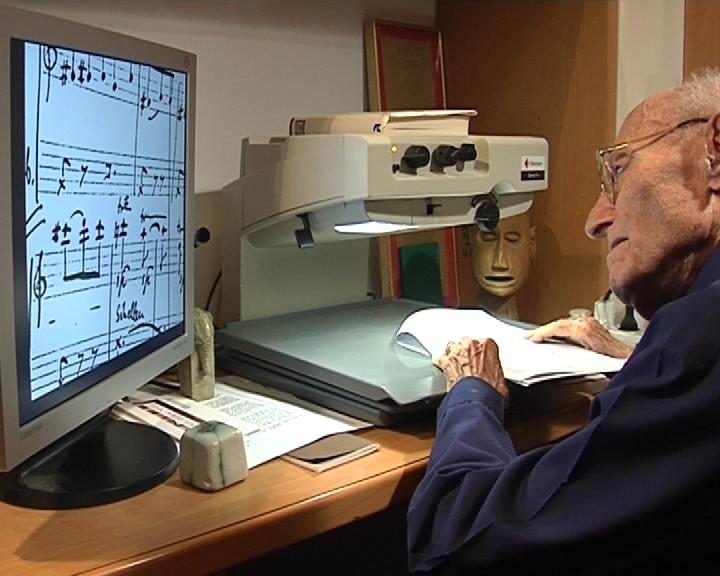
Electronic device used for optical magnification

Video magnifiers are electronic devices that use a camera and a display screen to perform digital magnification of printed materials. The display screen is usually LCD or a similar flat-screen technology (although older video magnifiers have used CRT displays), and the device usually includes a lamp to illuminate the source material. Video magnifiers are designed to be mostly used by people with low vision that cannot be helped using a conventional magnifying glass.
Advantages
Magnification range and display size
The main benefit of a video magnifier over purely optical magnification is that the video magnifier allows greater magnification across a larger field of view. With optical lenses, the field of meaningful, in-focus view is reduced with increased magnification. Thus, while a "full page magnifier" based on a fresnel lens can span some 625 cm2 (A4), it typically achieves no more than 1.4x magnification (advertised as "2x" if measured by area instead of the scale factor); an aspheric segment hand magnifier can achieve a scale factor in excess of two (area factor in excess of four) but typically measures no more than 10 x 3 cm, and higher magnification factors require conventional lenses that focus on a very small area. A video magnifier however is limited only by its display size and its electronics; video magnifiers that can be switched between 2 and 50 times magnification are common, and displays can range from smartphone-sized to TV-sized.
Image processing
Most video magnifiers can automatically focus the image, and the more advanced models are capable of further electronic image processing to change the colours, enhance the contrast, and/or assist in the tracking of images. Some can be set to save "snapshots" of previously seen images.
Disadvantages
Power requirements
Video magnifiers require power, either via mains electricity or from a battery. This may make battery life an issue if the magnifier is required for an extended period of time away from power, whereas a purely optical magnification device could be used indefinitely without needing to be connected to power.
Non-portability of the larger models
Very large video magnifiers are not typically portable, but they can still be used in home installations, libraries and classrooms. Some of these models are informally referred to as CCTV magnifiers.
Pricing
As of 2013, video magnifiers are typically several times more expensive than optical-only magnifiers.
Software video magnifiers
Due to the high cost of dedicated-hardware video magnifiers, there has been some interest in software video magnification running on smartphones such as iPhone and Android, tablets such as iPad, and laptops with suitably-mounted camera peripherals. Software magnifiers might not achieve the same quality as a good hardware video magnifier, and if used extensively they might exhaust the battery quickly, but if the user already has a smartphone, tablet or laptop then software magnification can be more economical than obtaining a separate hardware video magnifier.
References
References
- Rempel, John. (December 2013). "A Comparative Review of iPhone Magnifier Apps". [[American Foundation for the Blind]].
- Android magnifier apps include Zoom Plus, Magnify It, Magnify, Magnifying Glass, Real Magnifier, Ideal Magnifier, etc, but it seems a comparative review of these Android apps has not yet been published.
- Rempel, John. (August 2012). "Can the iPad and an App Replace Electronic Magnifiers (CCTVs)? An Evaluation of SightTech's EyeSight App". [[American Foundation for the Blind]].
- Wei. Jiawei. (5 April 2010). link. [[Public Television Service Foundation]]
- (April 2008). "Photonote: The making of a classroom adaptation system".
This article was imported from Wikipedia and is available under the Creative Commons Attribution-ShareAlike 4.0 License. Content has been adapted to SurfDoc format. Original contributors can be found on the article history page.
Ask Mako anything about Video magnifier — get instant answers, deeper analysis, and related topics.
Research with MakoFree with your Surf account
Create a free account to save articles, ask Mako questions, and organize your research.
Sign up freeThis content may have been generated or modified by AI. CloudSurf Software LLC is not responsible for the accuracy, completeness, or reliability of AI-generated content. Always verify important information from primary sources.
Report