From Surf Wiki (app.surf) — the open knowledge base
Victoria University of Wellington
Public university in Wellington, New Zealand

Public university in Wellington, New Zealand
| Field | Value |
|---|---|
| name | Victoria University of Wellington |
| native_name | mi |
| image_name | Victoria University of Wellington logo.svg |
| image_size | 250 |
| motto | Latin: Sapientia magis auro desideranda |
| mottoeng | Wisdom is more to be desired than gold |
| established | |
| chancellor | Alan Judge |
| vice_chancellor | Nic Smith |
| academic_staff | 1,147 (2021) |
| total_staff | 2,329 (2021) |
| students | 23,090 (2021) |
| type | Public |
| academic_affiliation | ACU, AACSB, AMBA, EQUIS |
| endowment | |
| (31 December 2021) | |
| budget | |
| (31 December 2021) | |
| city | Wellington |
| country | New Zealand |
| coor | |
| campus | Urban |
| free_label | Student magazine |
| free | Salient |
| colours | Green and white |
| website |
the New Zealand university
(31 December 2021) (31 December 2021)
The Victoria University of Wellington (; also known by its shorter names "VUW" or "Vic") is a public research university in Wellington, New Zealand. It was established in 1897 by an act of the New Zealand Parliament, and was a constituent college of the University of New Zealand.
The university is well known for its programmes in law, the humanities, and some scientific disciplines, and offers a broad range of other courses. Entry to all courses at first year is open, and entry to second year in some programmes (e.g. law, criminology, creative writing, architecture, engineering) is restricted.
Victoria had the highest average research grade in the New Zealand Government's Performance Based Research Fund exercise in both 2012 and 2018, having been ranked 4th in 2006 and 3rd in 2003. Victoria has been ranked 215th in the World's Top 500 universities by the QS World University Rankings (2020).
History
Victoria University of Wellington (originally known as Victoria University College) was founded in 1897, named after Queen Victoria, on the 60th anniversary of her coronation. Following the dissolution of the University of New Zealand in 1961, it became Victoria University of Wellington and began conferring its own degrees.
Early history and colonial politics
In 1868, the colonial government of New Zealand passed the University Endowment Act 1868, which established scholarship programmes for study in Great Britain, in addition to setting aside a land endowment in the burgeoning colony itself. The following year, with wealth generated from the Otago gold rush in addition to a strong foundation of the Scottish Enlightenment, the provincial government of Otago proceeded to lay the groundwork to establish the University of Otago. This was followed by the creation of Canterbury College, associated with the newly formed University of New Zealand.
In 1878, a royal commission was appointed to review the state of higher education in the country. It recommended the establishment of a federal system of four university colleges, established in Auckland and Wellington, in addition to the integration of the University of Otago and Canterbury College. The colonial government moved to provide sites, statutory grants and land endowments. This was somewhat delayed after the state of recession caused by the collapse of the City of Glasgow Bank in the same year, leading to a contraction in credit from Great Britain, and specifically London, the centre of global finance at the time. Nevertheless, in 1882, parliament passed the Auckland University College Act in 1882.
The growth of the population of Wellington, and the gradual improvement of the economy in the late 1880s were key factors in the final establishment of the college. A prominent advocate of creation was Robert Stout, Premier of New Zealand and later Chief Justice, as well as a member of the university senate. In June 1886, as Minister of Education, Stout signalled the government's intent of introducing a bill to establish a centre for higher learning in Wellington. Being the centre of the colonial government, Stout cited the opportunity for the college to be able to particularly specialise in law, political science, and history.
Stout further suggested that the staff of the New Zealand Colonial Museum could provide services in the fields of geology and natural history. This was indicated in the Wellington University College Bill of 1887, which meant the effective annexation of the museum. Colonial Museum director James Hector voiced considerable opposition to this bill. After a lengthy debate in parliament, this bill was promptly defeated.
Establishment
In 1897, the premier, Richard Seddon, who had until then been unsupportive of the university project, returned from Queen Victoria's Diamond Jubilee celebrations in Great Britain with an honorary Law degree from the University of Cambridge. Seddon decided that the establishment of a college in Wellington would be a suitable way to mark the Queen's jubilee year.
When introducing the Victoria College Bill in December 1897, Seddon stated:
I do not think there will be any question as to the necessity for the establishment of a University College here in Wellington...
The college was to be governed by a 16-man council, with its inaugural meeting taking place on 23 May 1898.
Founding professors
The founding professors of Victoria College were:
- John Rankine Brown – Professor of Classics
- Hugh Mackenzie – Professor of English language and Literature
- Thomas Easterfield – Professor of Chemistry and Physics
- Richard Cockburn Maclaurin – Professor of Mathematics
_(5053306454).jpg)
Early days
While Victoria College had been legally founded with a grant, a council and a number of students, it had no physical property for the first decade of its existence. Early courses were held at Wellington Girls High School as well as the Technical School building on Victoria Street.
The professors set about creating a unique identity for the college. The motto "Sapientia magis auro desideranda" was adopted in 1902. In 1903, the college adopted a badge and coat of arms featuring three crowns, the stars of the southern cross and the crest of its namesake Wellington. It was at this time that the colours of the college were chosen; dark green and gold, taking inspiration of the colours of the nearby gorse covered Tinakori Hill.
In 1903 the council intended to establish a professorship in law, 'with a desire of making the Law School at Wellington the most complete in the Colony', as soon as financially possible. The college appointed a fifth professor, in modern languages – selecting the Oxford educated Anglo-German George von Zedlitz, who was joined by newly appointed New Zealand-educated biology professor Harry Borrer Kirk. [[File:Victoria University plan (14849525480).jpg|thumbnail|The 1903 plan for the University Campus at Kelburn]]
Kelburn campus
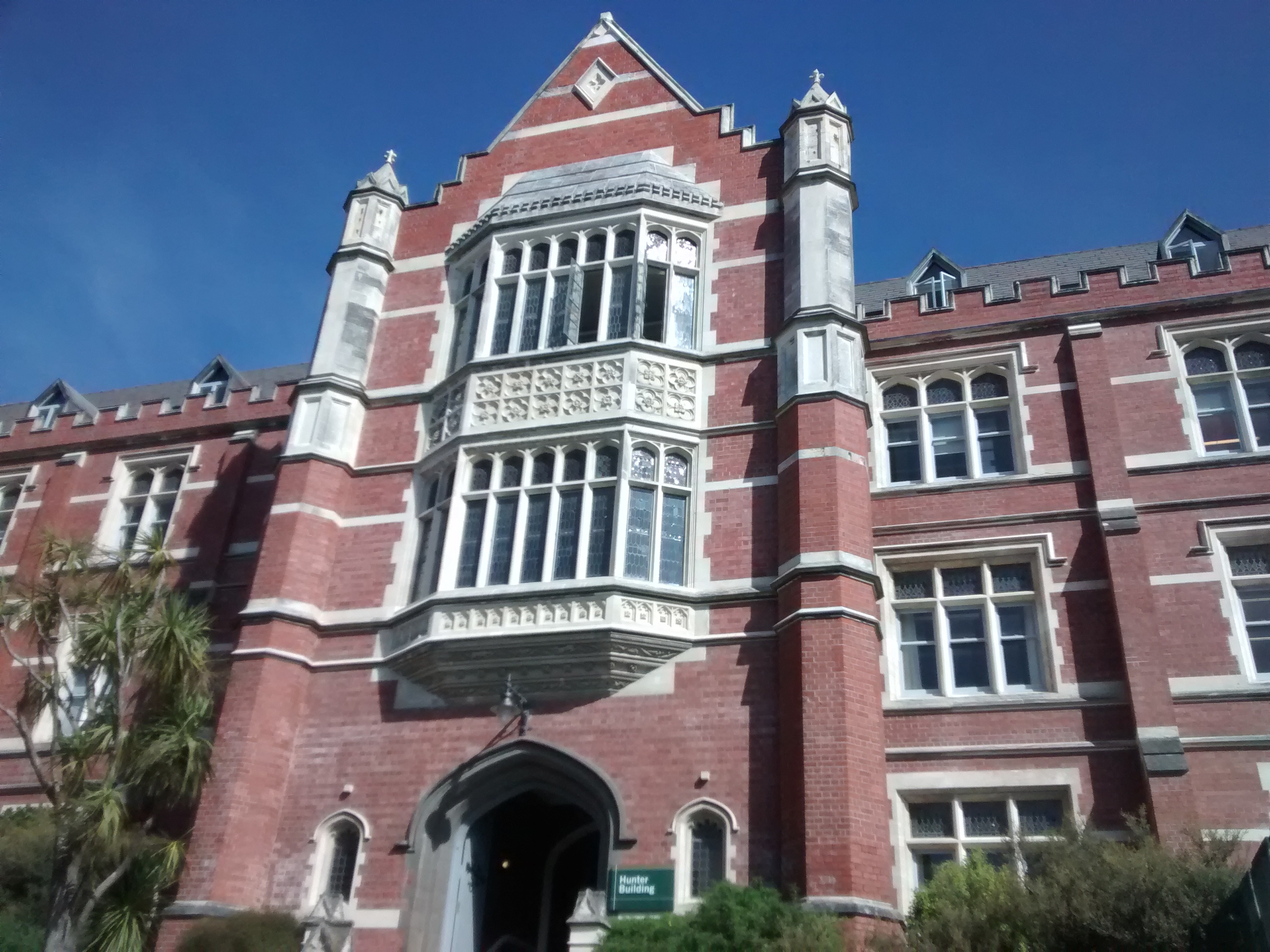
Construction began in 1902 with the regrading of the hillside. The construction of a main building followed shortly after, designed by local architects F. Penty and E.M. Blake in the Gothic Revival style. At the request of Richard Seddon, the building became more imposing with the addition of a third level. The then governor of New Zealand, Lord Plunket, laid the foundation stone on 27 August 1904.
While opened on 30 March 1906, the building was not completed to its original design, but was progressively added to as the college grew. In the meantime, students had built tennis courts, and a wooden gymnasium and social hall were constructed. The main building was named after Thomas Alexander Hunter, the well-regarded professor of mental science and political economy. Following the end of World War I, north and south wings were added to the building, providing new teaching areas, recreational spaces, and a new library.
Development

An extramural branch was founded at Palmerston North in 1960. It merged with Massey College on 1 January 1963. Having become a branch of Victoria upon the University of New Zealand's 1961 demise, the merged college became Massey University on 1 January 1964.
Victoria University has expanded beyond its original campus in Kelburn, with campuses in Te Aro (Faculty of Architecture and Design), and Pipitea (opposite Parliament, housing the Faculty of Law and Victoria Business School). Victoria also hosts the Ferrier Research Institute and the Robinson Research Institute in Lower Hutt, the Coastal Ecology Laboratory in Island Bay and the Miramar Creative Centre, in Park Rd, Miramar.
In 2015, Victoria opened a new campus in Auckland to service the growing demand for its courses and expertise.
Name-change proposal

In May 2018 it was reported that Victoria was exploring options to simplify its name to the University of Wellington. Vice-chancellor Grant Guillford said the university was pursuing a name change in order to reduce confusion overseas, as several other universities also carried the "Victoria" name. On 27 July 2018, the Victoria University of Wellington Council agreed in principle to the name change, as well as replacing the former Māori name Te Whare Wānanga o Te Upoko o Te Ika a Maui with Te Herenga Waka, the name of the university's marae. Of the 2,000 public submissions on the name-change proposal, 75% strongly opposed it. Alumni and students strongly opposed the name change, staff gave mixed feedback, while Wellington's regional mayors and members of the university's advisory board favoured the name change.
On 24 September 2018 Victoria University's council voted by a majority of nine to two to change the university's name to the University of Wellington. The council also voted to adopt the new Māori name of Te Herenga Waka. The university's vice-chancellor Grant Guilford abstained from the vote, citing a conflict of interest. Critics such as Victoria University law professor Geoff McLay criticised the name change for erasing 120 years of history. By contrast, Chancellor Neil Paviour-Smith defended the outcome of the vote as "one decision in a much broader strategy to try and help the university really achieve its potential". The council would submit its recommendation to the Minister of Education to make the final decision.
On 18 December 2018 the minister for education, Chris Hipkins, announced that he had rejected the University Council's recommendation, stating that the proposed change did not have sufficient support from Victoria's staff, students or alumni, and that such a change would not be in keeping with institution accountability or be in the national interest. On 6 May 2019 Victoria University's council announced that it would not contest the Education Minister's decision to reject its name-change proposal. The name change had received exceptionally strong opposition from faculty, alumni, students, and the Wellington City Council.
The university has, in recent years, distanced itself from the word 'Victoria', with many promotional materials referring solely to 'Wellington's University'. Many departments and initiatives have also been rebranded, for example Victoria Professional and Executive Development becoming Wellington Uni-Professional. In January 2021, the university spent $69,000 on a new sign highlighting the word 'Wellington', which drew criticism from students and staff who said the funds could have been better spent elsewhere.
2023 financial crisis
In May 2023, vice-chancellor Nic Smith confirmed that Victoria University was facing a NZ$33 million deficit due to declining student enrolments and a shortfall in government funding. The number of enrolments in 2023 dropped by 12.1% compared in 2022, accounting for 2,600 fewer students. In addition, the number of fulltime students declined from 17,000 in 2022 to 14,700 in 2023. To address this deficit, Smith proposed laying off between 230 and 260 staff members including 100 academics and 150 professional staff. On 27 June 2023, the New Zealand Government announced a NZ$128 million funding injection for New Zealand universities' degree and postgraduate-level programmes that would come into effect from 2024. In response to the announcement, Victoria University Tertiary Education Union branch president Dougal McNeill called on the university to shelve its planned staff cuts. Vice-chancellor Smith said that the funding injection would allow the university to save about a third of the 229 planned job cuts.
In October 2023 Victoria University issued a request for proposal to sell 24 properties, worth about $16 million, to recover its deficit. Of these properties, 11 were student flats, three of which were unoccupied.
Campuses and facilities


Victoria University of Wellington has three campuses spread out over Wellington city. It also has premises in Auckland.
Wellington
The main campus is in the suburb of Kelburn, overlooking the Wellington Central business district, where the Faculties of Humanities and Social Sciences, Science, Engineering, Education and Health are based. Additionally, it is the location of the university's Central Library and the site of its administrative offices. The campus has a range of amenities including cafes, the university book store VicBooks, a pharmacy and health services, childcare facilities, and a sports and recreation centre. The Victoria University of Wellington Students' Association is based here.
The Pipitea campus consists of the Wellington School of Business and Government, which includes the School of Accounting and Commercial Law, School of Economics and Finance, School of Government, School of Information Management, School of Management, School of Marketing and International Business, and the Faculty of Law. The campus is located near the New Zealand Parliament Buildings, consisting of Rutherford House, the Old Government Buildings and the west wing of the Wellington railway station. It is the location of the Commerce and Law libraries. Student services available at the Pipitea campus include Student Health and Well-being, the Recreation Centre and VicBooks.
The Wellington Faculty of Architecture and Design Innovation is located in the Te Aro Campus. The campus contains an Architecture and Design library.
Auckland
The School of Business and Government offers selected courses at the Auckland premises, which is located in the Auckland CBD.
Other facilities
The Victoria University Coastal Ecology Laboratory supports research programmes in marine biology and coastal ecology on Wellington's rugged south coast.
The Miramar Creative Centre is located by the Wētā Workshop buildings on Park Road, Miramar. The centre offers access to work experience and connections with New Zealand's film, animation and game design industries.
Library
The library was established in 1899. The collections are dispersed over four locations: Kelburn Library, Law Library, Architecture and Design Library and Commerce Library. The library also has a collection of digital resources and full text material online. In addition to electronic resources, printed books and journals, the Library also acquires works in microform, sound recordings, videos and other media consistent with the university's academic programme needs.
The library holds approximately 1.3 million printed volumes. It provides access to 70,000 print and electronic periodical titles and 200,000 e-books. It is an official Depository Library (DL-296) of the United Nations System (DEPOLIB), one of only three in the country. The J. C. Beaglehole Room is the official repository of all archival and manuscript material, and provides a supervised research service for Rare Books, for fine or fragile print items, and for 'last resort' copies of university publications.
The New Zealand Electronic Text Centre (NZETC) is a digital library of significant New Zealand and Pacific Island texts and materials, and is arranged according to the library of Congress classification system. The library has two online repositories: the ResearchArchive is its open research repository, which makes the university's research freely available online and the RestrictedArchive, which is the university's private research repository and is accessible only to Victoria University staff and students.
Between April 2003 and February 2010 the library was home to two locally famous residents, Tessa Brown and Sandy Rankine, a pair of library cats.
Campus developments
Te Huanui and 320 The Terrace
In September 2014, the university announced that it would purchase the abandoned Gordon Wilson Flats from Housing New Zealand. It was subsequently revealed that the purchase price was over NZ$6 million. The university bought the site due to its close proximity to the Kelburn campus, with the potential to create a link between Ghuznee St and the Terrace to the campus.

In July 2015, Urban Perspectives Limited, on behalf of Victoria University, lodged an application with Wellington City Council to rezone the area from "Inner Residential Area" to "Institutional Precinct", remove the Flats from the City District Plan's heritage list, and amend the Institutional Precinct provisions of the District Plan. Residents supported the removal of the flats from the area, as it was a significant case of urban decay in the area, while various groups, such as the Wellington Architectural Centre opposed the demolition of the flats, noting their architectural significance.
This issue bought up wider debate on whether it was worth retaining mid-century public housing for heritage purposes, when the building in question had itself paid scant value towards the past.
In April 2016, a Wellington City Council panel approved the rezoning of the flats, allowing Victoria University to demolish the building. However, in July 2016, the Architectural Centre lodged an appeal in the Environment Court against the Wellington City Council's decision to remove the Gordon Wilson flats' heritage status under Wellington's District Plan. The appeal was successful with the court determining that the heritage listing should stand in August 2017.
In 2018, Victoria University students Jessie Rogers and Hannah Rushton mapped the building using LIDAR mapping technology. This data was used to create a computer generated model of the flats, allowing for them to be explored in a virtual reality environment. This virtual reality experience was then displayed at an exhibition named Immersive Legacies: 320 The Terrace, at the Wellington Museum, allowing for users to see information about the building, the building in its prime state, and the current deterioration of the structure.**
In July 2020, Victoria University unveiled plans for what they called 'Te Huanui'. The plan showed that the university could be rezoning the site for institutional use, demolishing the Gordon Wilson Flats, while retaining the nearby McLeans Flats. The area would then be used to create a gateway between the hilltop Kelburn campus, and the city below, including an outdoor plaza and new teaching and research facilities. The development would also create a pedestrian and elevator link up to the Kelburn campus.
.jpg)
National Centre for Music
In 2019, Victoria University, on behalf of the New Zealand School of Music, signed an agreement with Wellington City Council and the New Zealand Symphony Orchestra to establish a new National Music Centre based in Wellington Town Hall. This would be established once refurbishment work on the town hall had been completed.

Ngā Mokopuna
Ngā Mokopuna (formally known as The Living Pā) was a redevelopment of the marae and surrounding area of the Kelburn campus. It involved the removal of five buildings from 42 to 50 Kelburn Parade and the creation of a new building employing principles based on the Living Building Challenge. Preparation work began in mid 2021, starting with the clearance and demolition of existing buildings on the construction site.
The building was opened in a ceremony late 2024, designed by Tennent Brown Architects, with art from David Hakaraia. Ngā Mokopuna is one of under 30 buildings certified as a living building by the International Living Future Institute.
Organisation and administration
From 1938 to 1957, the head of administration was the principal. Since 1957, the head of administration has been the vice-chancellor. The following people held the role of principal and/or vice-chancellor:
- Tommy Hunter, 1938–1951
- Jim Williams, 1951–1968
- Danny Taylor, 1968–1982
- Ian Axford, 1982–1985
- Les Holborow, 1986–1998
- Michael Irving, 1998–2000
- Stuart McCutcheon, 2000–2004
- Pat Walsh, 2005–2014
- Grant Guilford, 2014–2022
- Nic Smith, 2023–present
Guilford retired on 4 March 2022. Professor Jennifer Windsor was named acting vice-chancellor. On 22 June 2022 Victoria University of Wellington announced that Guilford's replacement as vice-chancellor will be Professor Nic Smith, the current Provost at the Queensland University of Technology (QUT). Nic Smith's tenure as VUW vice-chancellor is due to start in January 2023. Professor Jennifer Windsor was named acting vice-chancellor. On 22 June 2022 Victoria University of Wellington announced that Guilford's replacement as vice-chancellor will be Professor Nic Smith, the current provost at the Queensland University of Technology (QUT). Nic Smith's tenure as VUW vice-chancellor is due to start in January 2023.
Day-to-day governance is in the hands of the University Council, which consists of 20 people: four elected by the Court of Convocation, three elected by the academic staff, one elected by the general staff, two appointed by the student union executive, four appointed by the Minister of Education, four selected by the Council itself, and the vice-chancellor. The Court of Convocation is composed of all graduates who choose to participate. Charles Wilson, at the time the chief librarian of the parliamentary library, was a member of the original council and its chairman for two years.
For New Zealand residents entry to most courses is open, with a few exceptions. Performance Music requires an audition. There is selection for entry into the second year in degrees such as the LLB, BAS and BDes. BA in criminology and creative writing is also based on selection.
It owns the New Zealand School of Music.
Faculties

- Faculty of Architecture and Design Innovation
- Faculty of Business and Government
- Faculty of Education, Health, and Psychological Sciences
- Faculty of Graduate Research
- Faculty of Humanities and Social Sciences
- Faculty of Law
- Faculty of Science and Engineering The School of Māori Studies is unique in that it does not belong to any faculty, but rather to Iho Māori under the portfolio of the Deputy Vice-Chancellor (Māori).
Faculty of Law
The Faculty of Law is located in the restored Old Government Buildings at the centre of the country's law-making precinct, in close proximity to Parliament, the Supreme Court and the Court of Appeal, and the District and High courts. The faculty is rated 65th in the world in the 2021 QS World University Rankings and led New Zealand's law faculties for research in the most recent Performance-Based Research Fund Evaluation in 2006.
Research centres and institutes

Victoria has more than 40 research centres and institutes, including
- MacDiarmid Institute for Advanced Materials and Nanotechnology
- Robinson Research Institute
- Ferrier Research Institute
- Malaghan Institute of Medical Research
- Victoria University Coastal Ecology Laboratory
- Centre for Strategic Studies New Zealand
- Adam Art Gallery
- Antarctic Research Centre
- International Institute of Modern Letters
- New Zealand India Research Institute
- Language Learning Centre (defunct)
Academic profile
Academic reputation
In the 2024 Aggregate Ranking of Top Universities, which measures aggregate performance across the QS, THE and ARWU rankings, the university attained a position of #244 (3rd nationally).
In the 2026 Quacquarelli Symonds World University Rankings (published 2025), the university attained a tied position of #240 (4th nationally).
In the Times Higher Education World University Rankings 2026 (published 2025), the university attained a position of #401–500 (tied 3-4th nationally).
In the 2025 Academic Ranking of World Universities, the university attained a position of #401–500 (tied 2-4th nationally).
In the 2025–2026 U.S. News & World Report Best Global Universities, the university attained a tied position of #506 (3rd nationally).
In the CWTS Leiden Ranking 2024, the university attained a position of #782 (5th nationally).
Student life
Students' associations and student media
- Victoria University of Wellington Students' Association (VUWSA)
- Salient (student media)
Halls of residence
; Victoria operated
- 222 Willis Apartments (self-catered)
- Boulcott Hall (catered)
- Capital Hall (catered)
- Joan Stevens Hall (catered)
- Katharine Jermyn Hall (catered)
- Te Puni Village (catered)
- Weir House (catered)
- Willis St: Cumberland House (catered)
- Willis St: Education House (self-catered)
- University Hall (self-catered)
- University Hall: Whānau House (self-catered)
; Privately operated
- Victoria House (catered)
- Everton Hall (self-catered)
Controversies
In 2010 there was criticism of Victoria University of Wellington for removing the Gender Studies department. In 2017, a minor in Gender Studies was made available.
In 2012 a Facebook page that is associated with Victoria University of Wellington students, Overheard @ Vic, was in the media for the many rape comments that were made. These included comments like "you've got to rape the paper, man, you can't let the paper rape you" and "at least ugly girls don't get raped". In response to this, a spokesperson for Victoria University of Wellington said that "student safety was a key focus, and the university had partnered with police and Wellington City Council to promote awareness of personal safety".
In late 2015, academics and students at Victoria University of Wellington spoke out at the university hosting Israeli Defence Force troops for a public lecture. The opposition for this public lecture came about because of the soldiers' involvement in Operation Protective Edge, which is thought to have killed at least 2000 Palestinians, most of them civilians.
In July, 2016, a Victoria University of Wellington staff member Rebekah Proctor was jailed for two years and five months for defrauding the university out of $480,000 – as of 27 October Proctor has appealed her sentence. In October 2016 students protested the cut of several European languages, including the German language department losing 43% of staff. Also in 2016, Victoria University of Wellington was embroiled in a row with the Tertiary Education Union, when it was discovered that union members were being paid less than non-union members. This led the TEU to characterise the vice-chancellor Grant Guilford as being anti-union, and resulted in a one-day strike.
In April 2020, during the COVID-19 outbreak, the university came under fire from students, politicians, and media for suddenly announcing at 48 hours notice that they would be charging students a "placeholder fee" ($150 per week) for student accommodation that they had been forcibly removed from, despite emails from the university previously telling those same students that they would not have to pay.
Notable academics and staff
Main article: Academic staff of Victoria University of Wellington
- Bill Alington, architect
- James Belich, historian
- Doreen Blumhardt, education academic
- Jonathan Boston, public policy academic
- Mai Chen, public law lawyer
- Paul Callaghan, physical sciences academic
- Margaret Clark, political science academic
- Sally Davenport, management academic
- Lloyd Geering, religious studies academic
- Bill Hastings, chief censor and judge
- Robert Walker Hay FRSE, chemist
- Frank Holmes, economics academic
- George Edward Hughes, philosophy academic
- Simon Keller, philosophy academic
- Joanna Kidman, sociologist
- Allison Kirkman, sociologist
- Wendy Larner, social scientist, Provost
- Douglas Lilburn, music academic
- Richard Cockburn Maclaurin, mathematics academic
- Bill Manhire, author and poet
- Douglas Mews, academic and early keyboard specialist
- Paul Morris, religious studies academic
- Peter Munz, history academic
- Terence O'Brien, diplomat and academic
- Tipene O'Regan, Māori leader and education academic
- Vincent O'Sullivan, academic and poet
- Geoffrey Palmer, politician
- Matthew Palmer, law academic
- Pat Ralph, marine biologist; first woman at Victoria to be awarded a DSc
- Prof. James Renwick, climate scientist and science communicator
- Ivor Richardson, lawyer and academic
- Claudia Scott, public policy academic
- Kim Sterelny, philosophy academic
- Teresia Teaiwa, Pacific studies academic, author, poet
- Helen Tippett, architecture academic, architect
- Matt Visser, specialist in general relativity
- Colleen Ward, cross-cultural psychologist academic
- Colin J. N. Wilson, volcanology academic
- Whatarangi Winiata, Māori leader and Professor of Accountancy
- John Chapman Andrew, foundation Vice Chancellor
- Warwick Murray, geography and development studies academic, musician
- Nicholas Agar, philosophy academic
Notable alumni
Main article: Victoria University of Wellington alumni
- Fleur Adcock, (MA) poet, Queen's Gold Medal for Poetry recipient
- Barbara Anderson, (BA) author, poet
- Michelle Ang, (BCA, BSc) actor
- Sir Brian Barratt-Boyes, (BSc) cardiologist
- Gankhuurai Battungalag, Mongolian diplomat
- Dr John Cawte Beaglehole, (BA, MA) Captain Cook expert, OM recipient
- Harry J. Benda, (BA, MA) Czech-American Southeast Asianist
- Teresa Bergman, (BA) singer-songwriter
- Hera Lindsay Bird (MA (Poetry))
- Sir Michael Hardie Boys, (BA, LLB) former Governor-General of New Zealand
- Sarah Billinghurst, (BA) artistic director Metropolitan Opera
- Dr Robert Burchfield, (BA) lexicographic scholar
- Alistair Te Ariki Campbell, (BA, DipT) poet, novelist
- John Campbell, (BA(Hons)) New Zealand television personality
- Philippa Campbell, (BA) New Zealand film and television producer and theatre development executive
- Jane Campion, (BA) Oscar and Palme D'Or winning director/screenwriter
- Chea Serey, Director General of the National Bank of Cambodia
- Dr Helen Elizabeth Shearburn Clark (Rotman), Marine zoologist.
- John Clarke, (Honorary Doctor of Letters) creator of Fred Dagg
- Jemaine Clement, Flight of the Conchords
- Nellie Euphemia Coad, (MA) teacher, community leader, author
- Baron Cooke of Thorndon, (LLB, LLM) former Law Lord
- Frank Corner, (MA, Honorary Doctor of Laws) New Zealand diplomat, public servant
- Andrew Digby, (PhD) Astronomer and ecologist, working in conservation of New Zealand's endemic birds
- Sir Thomas Eichelbaum, (LLB) former Chief Justice of New Zealand
- Sir Randal Elliott, (BSc) social campaigner, surgeon
- Bill English, (BA(Hons)), former Prime Minister of New Zealand
- Edith Farkas (1921–1993), Hungarian-born New Zealand meteorologist who measured ozone levels
- Gareth Farr, (BMus(Hons)) Composer, Percussionist
- Sir Michael Fay, (LLB) merchant banker, top-10 richest New Zealanders
- John Feeney, documentary filmmaker, nominated for two Academy Awards
- Chris Finlayson, (BA, LLM) Attorney-General, MP
- Dr Alexander Gerst, (MSc) German ESA astronaut
- Patricia Grace, (DipTchg, Honorary Doctor of Literature) author
- Paul A. Griffin, Distinguished Professor Emeritus at the Graduate School of Management, University of California, Davis
- Prof Harry Hawthorn, (BA) NZ-Born Canadian anthropologist
- Hon. Georgina te Heuheu, (BA, LLB) MP
- Dr Fred Hollows, (BA) NZ-Born eye surgeon
- Don Hunn, (MA) State Services Commissioner
- Sir Jack Hunn, (LLM) New Zealand public servant
- Chris Hipkins, (BA) 41st Prime Minister of New Zealand
- Prof Witi Ihimaera, (BA, Honorary Doctor of Literature) author of Whale Rider
- Moana Jackson, (BA LLB) Māori lawyer specialising in Treaty of Waitangi and constitutional issues
- Anthony Jennings, (B Mus) harpsichordist, organist, choral and orchestral director, and academic
- Sir Robert Jones, (BA) property tycoon
- Lloyd Jones, (BA) author, Commonwealth Writers' Prize recipient
- Sir Kenneth Keith, (LLM, Honorary Doctor of Laws) international jurist
- Roger Kerr, Executive director of New Zealand Business Roundtable
- Chong Kah Kiat, (LLB, LLM (Hons)) Former Chief Minister of Sabah state
- Hon. Sir Doug Kidd, (LLB) former Speaker of the New Zealand House of Representatives
- Dr Michael King, (BA, DLitt) historian
- Chris Kraus, (BA) American writer
- Sir George Laking, (LLB) New Zealand diplomat, public servant
- Sarah Leberman, Sport management academic
- Melanie Lynskey, Actress
- Dianne Macaskill, Chief Archivist
- Douglas R. MacFarlane (BSc), Chemist, researcher and author
- Prof Alan MacDiarmid, (BSc, MSc, Honorary Doctor of Science) winner of the Nobel Prize in Chemistry 2000
- Sabine Marcelis, Artist and designer
- Sir Jack Marshall, (BA, LLB) former Prime Minister
- Melissa Cristina Márquez, "Mother of Sharks", marine biologist, and science communicator
- James Jemut Masing, (BA) former Deputy Chief Minister of Sarawak
- Fiamē Naomi Mataʻafa, 7th Prime Minister of Samoa
- Sir Thaddeus McCarthy, (LLM) Court of Appeal judge
- Sir Alister McIntosh, (MA) New Zealand public servant
- Bret McKenzie, Flight of the Conchords
- Dr John Money, (BSc) sexologist
- Dr Mary Morgan-Richards, (PhD) evolutionary biologist, professor at Massey University
- Sam Neill, (BA) actor
- W. H. Oliver, (MA) historian, poet, writer
- Teima Onorio, (BA) Vice President of Kiribati
- Simon O'Neill, M.Mus, (BMus(Hons), Honorary Doctor of Music) International Opera Singer
- Lorae Parry, (MA) Playwright and Actress
- Mark Paston (BSc) All Whites goalkeeper for the 2010 Fifa World Cup
- Tamatha Paul, (BA) Wellington City Councillor for the Lambton Ward
- Sir Guy Powles, (LLB) New Zealand diplomat, first Ombudsman
- Dr Christopher Pugsley, military historian
- Maraea Rakuraku, (MA) writer
- Beverley Randell, (BA, TTC) author
- Sir Paul Reeves, (BA, MA) former Governor-General of New Zealand and Archbishop and Primate of New Zealand
- Dr Natalie Robinson, polar oceanographer
- Dr Jonathan Sarfati, (BSc(Hons), PhD) creationist author, New Zealand Chess Champion
- Tuiloma Neroni Slade (LL.B.), Secretary General of the Pacific Islands Forum
- Conrad Smith, (LLB(Hons)) All Black 2004–2015
- Jacqueline Sturm, (BA, MA, Honorary Doctor of Literature) wife of the late James K. Baxter
- Dr Bill Sutch, (BCA, MA) public servant, suspected spy
- Leslie Denis Swindale, soil scientist and Padma Bhushan awardee
- Sir Ronald Syme, (MA) classicist historian, OM recipient
- Sir Brian Talboys, (BA) former Deputy Prime Minister
- Peter Dengate Thrush (BSc, LLB) Chairman of ICANN
- Viran Molisa Trief, first female Solicitor-General and Supreme Court judge of Vanuatu
- Taika Waititi, (BA) Filmmaker, writer, and actor
- Fran Walsh, (BA, Honorary Doctor of Literature) multiple Oscar winner, wife of film director Peter Jackson
- Dr Marilyn Waring, (BA(Hons)) feminist, former MP, Professor at AUT
- Clement Gordon Watson, (MA) editor, journalist, soldier, communist activist
- Albert Wendt, (MA) author, Samoan poet
- Sir Maarten Wevers, diplomat and civil servant, former Chief Executive of the Department of the Prime Minister and Cabinet
- Dame Gillian Whitehead, (BMus(Hons), Honorary Doctor of Music) New Zealand composer
- Sir Richard Wild, (LLM) former Chief Justice of New Zealand
- Thomas Stafford Williams, (BCA), fifth Archbishop of Wellington, cardinal
- Nicola Willis, (BA(Hons)), MP
- Simon Wilson, (BA) editor of Metro
- Dan Wootton, (BA) journalist and broadcaster
- Alison Wright, (BA) New Zealand athlete and record holder
- Martin Wylie, CEO of Slingshot
- Jack Yan, (LLB, BCA(Hons), MCA) businessman, publisher, Good Morning panellist
- John Stuart Yeates, (PhD (Botany)) academic, founding staff member of Massey University

Footnotes
References
References
- Beaglehole, J. C.. (1949). "Victoria University College an Essay towards a History".
- (2025). "Chancellor Alan Judge". Victoria University of Wellington.
- "Annual Report".
- "Foundation Trust Financial Statement".
- "Financial Statements".
- (31 July 2018). "Victoria University of Wellington stoush: Why changing names is such a minefield". [[Stuff (website).
- "Victoria University".
- [http://www.tec.govt.nz/Documents/Reports%20and%20other%20documents/PBRF-Assessment-Interim-Report-2012.pdf Performance-Based Research Fund—Evaluating Research Excellence: the 2012 assessment] {{webarchive. link. (12 May 2013 . Retrieved 2013-04-12.)
- "Victoria University of Wellington".
- "Foundation stone for Victoria University's first building laid {{!}} NZHistory, New Zealand history online".
- "John Rankine Brown, 1934".
- Taonga, New Zealand Ministry for Culture and Heritage Te Manatu. "Easterfield, Thomas Hill".
- Taonga, New Zealand Ministry for Culture and Heritage Te Manatu. "Maclaurin, Richard Cockburn".
- (26 August 2014). "Victoria University Flickr".
- Bourke, Kevin. (2008). "Kelburn, King Dick and the Kelly Gang: Richard Seddon & Political Patronage". Hit or Miss Publishing.
- Barrowman, Rachel. (1999). "Victoria University of Wellington 1899 ~ 1999 A History". Victoria University Press.
- "Massey University history". Massey University.
- (16 April 2015). "Victoria University expands its presence in Auckland".
- (2018-05-01). "Victoria University mulls name change". [[Radio New Zealand]].
- Dreaver, Charlie. (2018-05-24). "Victoria University name causes 'issues for graduates'". [[Radio New Zealand]].
- (2018-07-27). "Victoria University agrees to remove "Victoria" from its name". Scoop.co.nz.
- (24 September 2018). "Victoria University council votes in favour of changing name". [[Radio New Zealand]].
- (2018-09-20). "Victoria University name change in sight despite opposition". [[Radio New Zealand]].
- (24 September 2018). "Wellington's Victoria University votes to change its name to University of Wellington". [[Stuff (website).
- "Name simplification". Victoria University of Wellington.
- (19 December 2018). "Victoria University of Wellington name change rejected by Minister". [[Stuff (website).
- (18 December 2018). "Victoria University of Wellington name change declined by education minister". [[Radio New Zealand]].
- (6 May 2019). "Victoria University of Wellington abandons plans to change its name". [[Stuff (website).
- (6 May 2019). "Victoria University of Wellington drops fight over name". [[The New Zealand Herald]].
- (1 August 2019). "Wellington's Victoria University confirms new names, logos".
- (29 January 2021). "Victoria University applies for $69,000 sign change, with staff labelling the move as 'bizarre'".
- (24 May 2023). "Up to 260 jobs may go at Victoria University to address massive deficit". [[Stuff (website).
- (24 May 2023). "Hundreds of jobs facing the chop at Victoria University due to multimillion dollar loss". [[The New Zealand Herald]].
- (27 June 2023). "Big job losses at Victoria and Otago universities to go ahead despite more government funding". [[Radio New Zealand]].
- (June 2024). "Victoria Uni to sell $16m worth of student flats to recover deficits".
- Wellington, Victoria University of. (10 March 2017). "Pipitea campus".
- "Te Aro Campus".
- "The Library – Te Pātaka Kōrero".
- (16 February 2014). "Collection Development and Management {{!}} library.victoria.ac.nz".
- (2 December 2013). "Local Digital Collections {{!}} library.victoria.ac.nz".
- (28 May 2009). "Fundraiser for sick library cat {{!}} Otago Daily Times : Otago, South Island, New Zealand & International News".
- (2014-09-13). "Flats may be demolished".
- (2016-05-01). "State house sales range from $2000 in Northland to $2.2m in Auckland".
- (2020-10-19). "Plan Change 81: Rezoning 320 The Terrace (Gordon Wilson Flats)".
- (7 December 2015). "Statement of Evidence by Linda Tyler".
- (2016-07-27). "Appeal lodged against decision to take away heritage status of Wellington flats".
- (2018-08-30). "The battle over Wellington's 'ugliest building'".
- Wellington, Victoria University of. (2019-10-15). "Exhibition showcases use of virtual reality for digital archives {{!}} News {{!}} Victoria University of Wellington".
- Wellington, Victoria University of. (2020-07-27). "Victoria University of Wellington".
- (2020-07-27). "Victoria University plans to demolish heritage-listed Gordon Wilson Flats to create 'new front door'".
- (2019-06-17). "Welllington council signs deal with orchestra and music school for city space".
- Wellington, Victoria University of. (2019-04-01). "The Living Pā {{!}} Victoria University of Wellington".
- "The Living Pā – Building in pursuit of Kaitiakitanga {{!}} Construction Accord".
- "Ngā Mokopuna: Victoria University opens living pā, reawakens marae".
- (2025-02-24). "Victoria University unveils Living Pā, merging mātauranga Māori and sustainability".
- (1999). "Victoria University of Wellington 1899–1999 : A History". [[Victoria University Press]].
- Hipkins, Chris. (21 December 1999). "Irving's Resignation Leaves Unresolved Problems". [[Victoria University of Wellington Students' Association]].
- (2 June 2004). "Auckland University hires chief from capital". [[The New Zealand Herald]].
- (13 November 2013). "Reflections from the Vice-Chancellor". Victoria University of Wellington.
- Wellington, Victoria University of. (2023-01-16). "Welcome to Vice-Chancellor Professor Nic Smith {{!}} News {{!}} Victoria University of Wellington".
- (10 September 2021). "Grant Guilford retiring as Vice-Chancellor of Victoria University of Wellington".
- "After global search, scholar to be next Vice-Chancellor of VUW".
- "A Dictionary of New Zealand Biography : M–Addenda". (1940). [[Department of Internal Affairs (New Zealand). Department of Internal Affairs]]. link
- "Faculties and schools {{!}} About us {{!}} Te Herenga Waka—Victoria University of Wellington".
- "Law & Legal Studies".
- "Faculty of Law – Faculty of Law – Victoria University of Wellington".
- (3 May 2024). "Robinson Research Institute". Victoria University of Wellington.
- "University Results". [[University of New South Wales]].
- "QS World University Rankings: Top Global Universities". [[Quacquarelli Symonds]].
- "World University Rankings". Inflexion.
- "ShanghaiRanking's Academic Ranking of World Universities". Shanghai Ranking Consultancy.
- "Best Global Universities Rankings".
- "CWTS Leiden Ranking". [[Leiden University]].
- "222 Willis Apartments {{!}} Te Kopanga / University Accommodation Wellington {{!}} Te Herenga Waka—Victoria University of Wellington".
- "Hall comparison charts".
- "Self-catered halls".
- Fisher, Amanda. (2010-12-01). "Axing gender studies 'setback to rights'". [[Stuff (website).
- Kavanagh-Hall, Erin. (2012-10-25). "Rape Crisis appalled by 'sick jokes'". [[Stuff (website).
- (28 September 2015). "Protest over Israeli soldiers".
- (2015-10-03). "Soldiers' talk 'a propaganda exercise'". [[Radio New Zealand]].
- (2016-10-27). "University fraudster appeals jail sentence". [[Radio New Zealand]].
- (18 May 2016). "Staffer fleeced Victoria University".
- staff, Newshub digital. (2016-10-24). "Students protest Victoria University of Wellington language cuts". [[Newshub]].
- (6 September 2016). "University in union pay row".
- (2016-09-06). "University slammed for 'anti-union' job ads". [[Radio New Zealand]].
- (2016-09-15). "Staff see red over Vic Uni pay dispute". [[Radio New Zealand]].
- "Victoria University students blindsided by student accommodation 'holding fee'".
- "University staff may be fired if student accommodation 'holding fees' aren't paid: Victoria University vice-chancellor".
- (25 April 2020). "Victoria University students pay fee for rooms they cannot access".
- Hughes, Beryl. "Patricia Marjorie Ralph".
- "Rosslyn Shanks".
- J.M. Thomson. (20 January 2001). "Jennings, Anthony".
- (4 April 2023). "Councillor Tamatha Paul".
This article was imported from Wikipedia and is available under the Creative Commons Attribution-ShareAlike 4.0 License. Content has been adapted to SurfDoc format. Original contributors can be found on the article history page.
Ask Mako anything about Victoria University of Wellington — get instant answers, deeper analysis, and related topics.
Research with MakoFree with your Surf account
Create a free account to save articles, ask Mako questions, and organize your research.
Sign up freeThis content may have been generated or modified by AI. CloudSurf Software LLC is not responsible for the accuracy, completeness, or reliability of AI-generated content. Always verify important information from primary sources.
Report