From Surf Wiki (app.surf) — the open knowledge base
Via Cassia
Ancient Roman road
Ancient Roman road

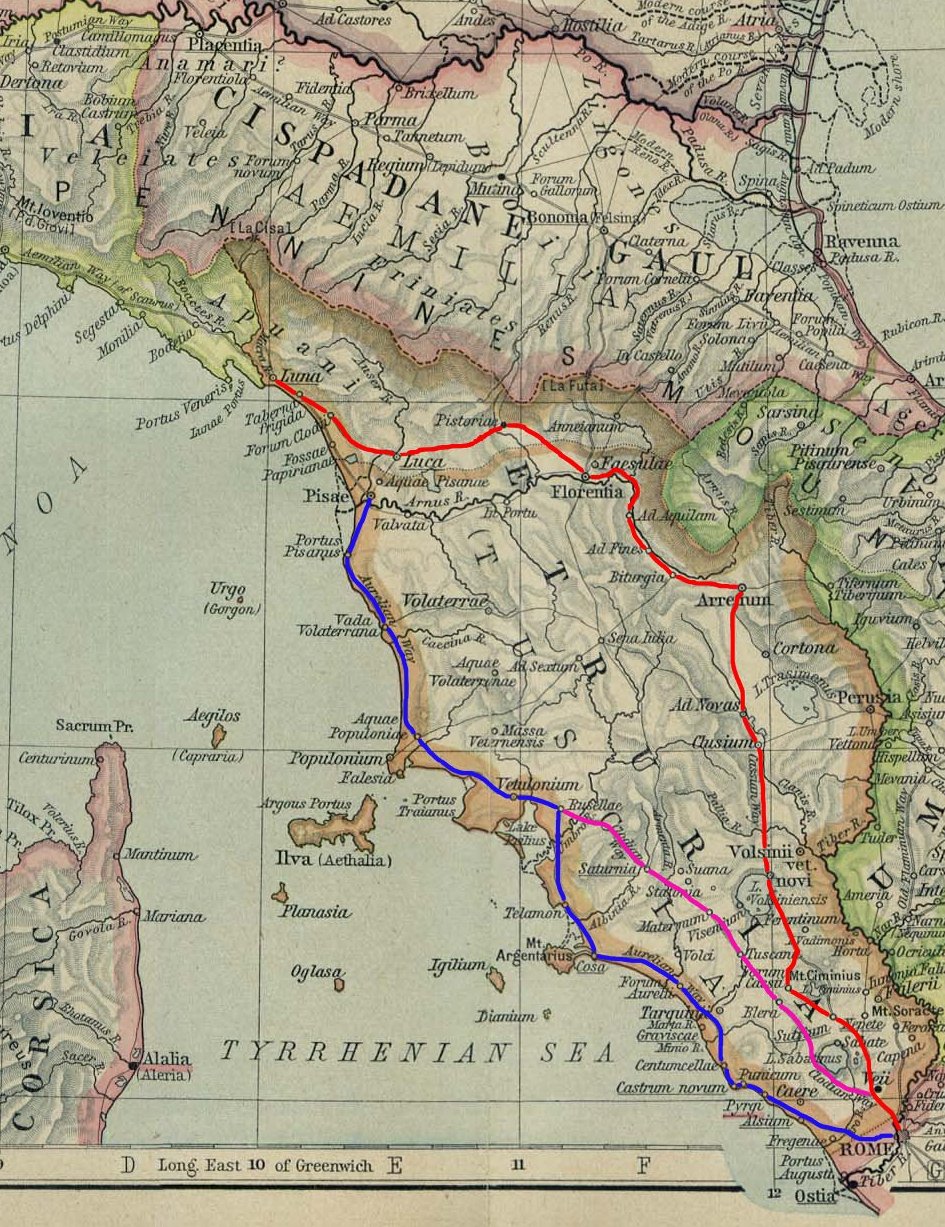
The Via Cassia () was an important Roman road striking out of the Via Flaminia near the Milvian Bridge in the immediate vicinity of Rome and, passing not far from Veii, traversed Etruria. The Via Cassia passed through Baccanae, Sutrium, Volsinii, Clusium, Arretium, Florentia, Pistoria, and Luca, joining the Via Aurelia at Luna.
The Via Cassia intersected other important roads. At mile 11 the Via Clodia diverged north-north-west. At Sette Vene, another road, probably the Via Annia, branched off to Falerii. In Sutrium, the Via Ciminia split off and later rejoined.
The date of its construction is uncertain: it cannot have been earlier than 187 BC, when the consul Gaius Flaminius constructed a road from Bononia to Arretium, which must have coincided with a portion of the later Via Cassia. It is not mentioned by any ancient authorities before the time of Cicero, who in 45 BC speaks of the existence of three roads from Rome to Mutina: the Flaminia, the Aurelia and the Cassia. A milestone of AD 124 mentions repairs to the road made by Hadrian from the boundary of the territory of Clusium to Florentia, a distance of 86 mi.
Via Amerina
The Via Amerina was a road that broke off from the Via Cassia near Baccanae, and held north through Falerii, Tuder, and Perusia, rejoining the Via Cassia at Clusium. When the incursions of Faroald, the Lombard Duke of Spoleto, cut the Via Flaminia, the lifeline between Rome and Ravenna, the Via Amerina was improved and fortified at intervals, works that represented some of the last road-building carried out in Italy in late antiquity. As the new military and strategic route, the Via Amerina "became the communications core of Imperial Italy and the chief support to the claim that imperial Italy was still extant".
Bridges
There are the remains of several Roman bridges along the road, including the Ponte San Lorenzo and Ponte San Nicolao.
Sport
The road was used as part of the individual road race cycling route for the 1960 Summer Olympics in Rome.
References
References
- Annapaola Mosca. (2002). "Via Cassia: un sistema stradale romano tra Roma e Firenze". Olschki.
- William Smith. (1873). "A Dictionary of Greek and Roman Geography". J. Murray.
- {{EB1911. Thomas. Ashby
- Jan T. Hallenbeck, "Pavia and Rome: The Lombard Monarchy and the Papacy in the Eighth Century" ''Transactions of the American Philosophical Society'' New Series '''72'''.4 (1982 pp. 1-186) p 8.
This article was imported from Wikipedia and is available under the Creative Commons Attribution-ShareAlike 4.0 License. Content has been adapted to SurfDoc format. Original contributors can be found on the article history page.
Ask Mako anything about Via Cassia — get instant answers, deeper analysis, and related topics.
Research with MakoFree with your Surf account
Create a free account to save articles, ask Mako questions, and organize your research.
Sign up freeThis content may have been generated or modified by AI. CloudSurf Software LLC is not responsible for the accuracy, completeness, or reliability of AI-generated content. Always verify important information from primary sources.
Report