From Surf Wiki (app.surf) — the open knowledge base
Vetulicola
Fossil genus of marine animal
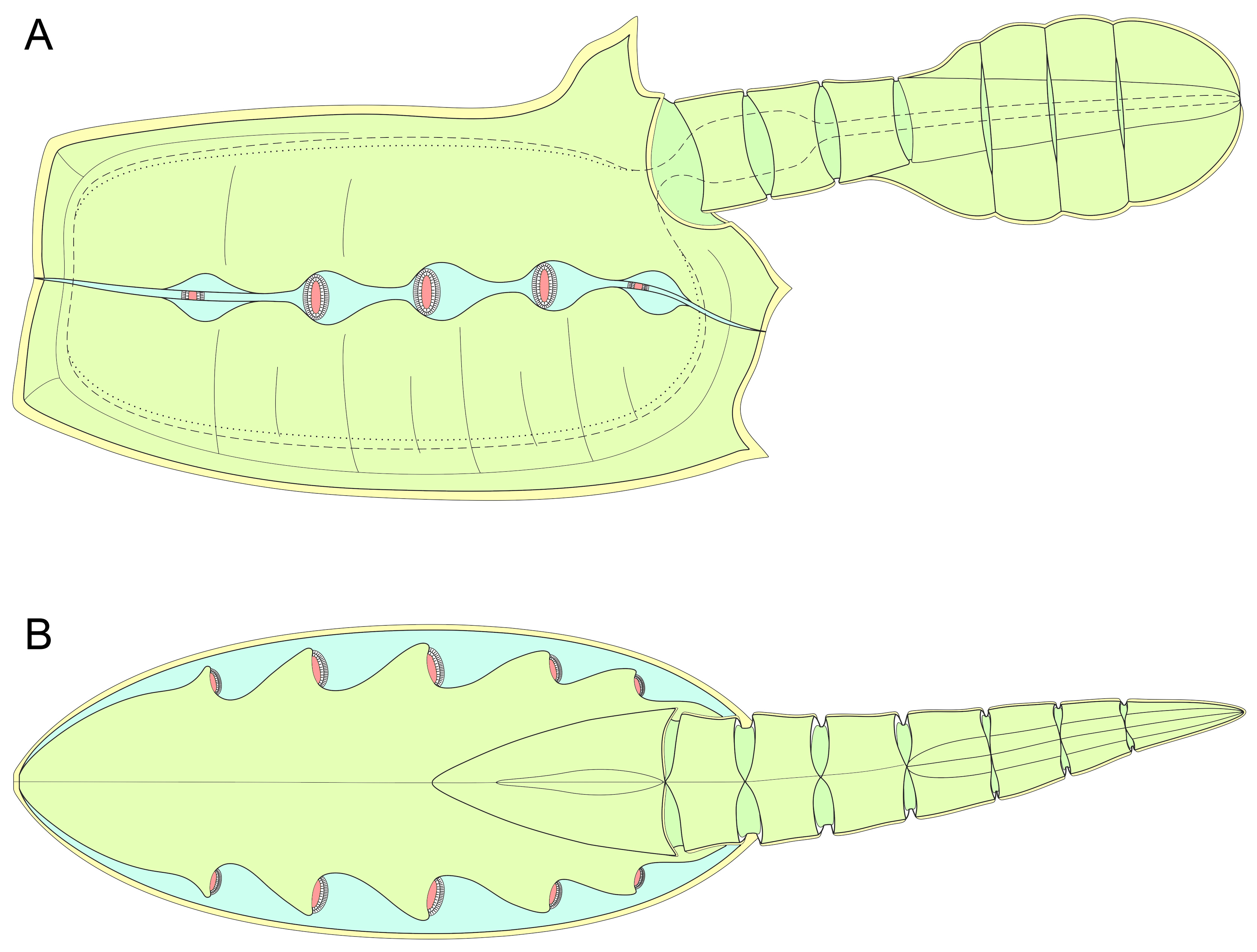
Fossil genus of marine animal
- V. cuneata Hou, 1987
- V. rectangulata Luo & Hou, 1999
- V. gantoucunensis Luo et al., 2005
- V. monile Aldridge, et al. 2007
- V. longbaoshanensis Yang et al. 2010
Vetulicola is an extinct genus of marine animal discovered from the Cambrian of China. It is the eponymous member of the enigmatic taxon Vetulicolia, which is of uncertain affinities but may belong to the deuterostomes. The name was derived from Vetulicola cuneata, the first species described by Hou Xian-guang in 1987 from the Lower Cambrian Chiungchussu Formation in Chengjiang, China.
Etymology
Vetulicola is a compound Latin word composed of vetulus, meaning "old," or "ancient," and -cola, meaning "inhabitant."
Description
The type species, Vetulicola cuneata, as originally described by Hou Xian-guang in 1987, has a body plan similar to those of arthropods and composed of two distinct parts of approximately equal length. The anterior part is rectangular with a carapace-like structure of four rigid cuticular plates, with a large mouth at the front end. The posterior section is slender, strongly cuticularised and placed dorsally. Paired openings connecting the pharynx to the outside run down the sides. These features are interpreted as possible primitive gill slits. Vetulicola cuneata could be up to 9 cm long. The Vetulicola are thought to have been swimmers that were possible filter feeders.
Other Vetulicola species described are Vetulicola rectangulata (Luo and Hu, 1999), V. gantoucunensis (Luo et al., 2005), V. monile (Aldridge et al., 2007), and V. longbaoshanensis (Yang et al., 2010). The mouth openings of all the other species are smaller, and do not protrude as in V. cuneata. All other species, with the stark exception of V. gantoucunensis, are smaller than the type species.
Taxonomy
Vetulicola is the namesake genus of the family Vetulicolidae, which also includes Ooedigera and Beidazoon.
The family has been recovered as a monophyletic clade even in a 2024 analysis that yielded a paraphyletic Vetulicolia and Vetulicolida, although that same analysis found that the sole species of Beidazoon, B. venustrum, is more closely related to V. monile than V. monile is to other members of Vetulicola:
An earlier study in 2014 treated Vetulicola as monophyletic, but was unable to resolve any relationships among vetulicolians as a group:
Paleobiology
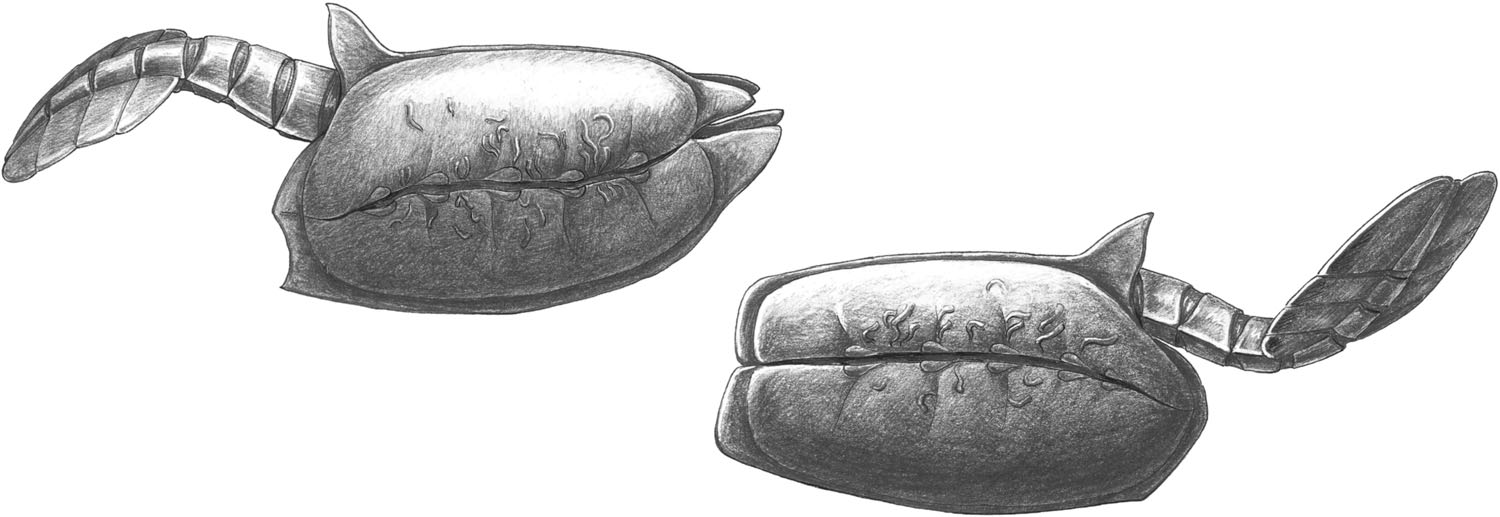
Vetulicola was the host of the symbiotic organism Vermilituus gregarius, which appears to have lived inside *Vetulicola'''s anterior body. Only around 2% of Vetulicola individuals had Vermilituus infestations, but Vermilituus could be very numerous: one Vetulicola specimen had 88 individuals of Vermilituus infesting it. Such large numbers of symbiotic organisms were probably harmful to the host *Vetulicola''.
References
References
- (2005). "Wonderful strife: systematics, stem groups, and the phylogenetic signal of the Cambrian radiation". Paleobiology.
- Lacalli, Thurston C.. (2002). "Vetulicolians—are they deuterostomes? chordates?". BioEssays.
- Hou, Xian-guang. (1987). "Early Cambrian large bivalved arthropods from Chengjiang, Eastern Yunnan". Acta Palaeontologica Sinica.
- (2001-11-22). "Primitive deuterostomes from the Chengjiang Lagerstätte (Lower Cambrian, China)". Nature.
- (2020-09-18). "Symbiotic fouling of Vetulicola, an early Cambrian nektonic animal". Communications Biology.
- (2018). "The enigmatic metazoan Yuyuanozoon magnificissimi from the early Cambrian Chengjiang Biota, Yunnan Province, South China". Journal of Paleontology.
- (2024). "A new interpretation of ''Pikaia'' reveals the origins of the chordate body plan". Current Biology.
This article was imported from Wikipedia and is available under the Creative Commons Attribution-ShareAlike 4.0 License. Content has been adapted to SurfDoc format. Original contributors can be found on the article history page.
Ask Mako anything about Vetulicola — get instant answers, deeper analysis, and related topics.
Research with MakoFree with your Surf account
Create a free account to save articles, ask Mako questions, and organize your research.
Sign up freeThis content may have been generated or modified by AI. CloudSurf Software LLC is not responsible for the accuracy, completeness, or reliability of AI-generated content. Always verify important information from primary sources.
Report