From Surf Wiki (app.surf) — the open knowledge base
Very-high-energy gamma ray
Gamma radiation with photon energies between 100GeV and 100TeV
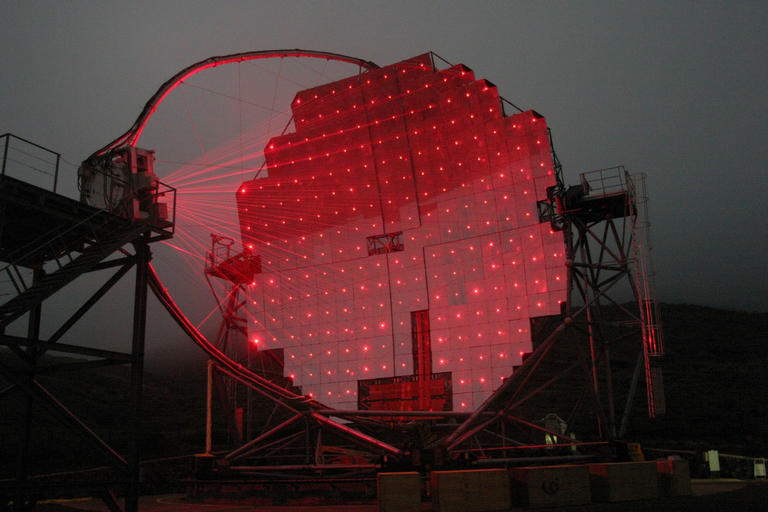
Gamma radiation with photon energies between 100GeV and 100TeV
A very-high-energy gamma ray (VHEGR) is gamma radiation with photon energies of 100 GeV (gigaelectronvolt) to 100 TeV (teraelectronvolt), i.e., 1011 to 1014 electronvolts.{{citation wavelengths between 10−17 and 10−20 meters, or frequencies of 2 × 1025 to 2 × 1028 Hz. Such energy levels have been detected from emissions from astronomical sources such as some binary star systems containing a compact object. 3C 66A Markarian 421 and Markarian 501. Various other sources exist that are not associated with known bodies. For example, the H.E.S.S. catalog contained 64 sources in November 2011.
Detection
Instruments to detect this radiation commonly measure the Cherenkov radiation produced by secondary particles generated from an energetic photon entering the Earth's atmosphere. VERITAS and Chicago Air Shower Array which closed in 2001. Cosmic rays also produce similar flashes of light, but can be distinguished based on the shape of the light flash. Also having more than one telescope simultaneously observing the same spot can help exclude cosmic rays. Extensive air showers of particles can be detected for gamma rays above 100 TeV. Water scintillation detectors or dense arrays of particle detectors can be used to detect these particle showers.
Air showers of elementary particles made by gamma rays can also be distinguished from those produced by cosmic rays by the much greater depth of shower maximum, and the much lower quantity of muons.
Very-high-energy gamma rays are too low energy to show the Landau–Pomeranchuk–Migdal effect. Only magnetic fields perpendicular to the path of the photon causes pair production, so that photons coming in parallel to the geomagnetic field lines can survive intact until they meet the atmosphere. These photons that come through the magnetic window can make a Landau–Pomeranchuk–Migdal shower.
| Class | Energy | Frequency | Wavelength | Comparison | Properties | SI prefix eV | eV | SI prefix J | Hertz | meters |
|---|---|---|---|---|---|---|---|---|---|---|
| Near infrared | 1 | 1 | 0.1602 aJ | 241.8 THz | 1.2398 μm | for comparison | ||||
| Very-high-energy gamma rays | 100 GeV | 1 × 10¹¹ | 0.01602 μJ | 2.42 × 1025 Hz | 1.2 × 10⁻¹⁷ m | Z boson | ||||
| 1 TeV | 1 × 10¹² | 0.1602 μJ | 2.42 × 1026 Hz | 1.2 × 10⁻¹⁸ m | flying mosquito | produces Cherenkov light | ||||
| 10 TeV | 1 × 10¹³ | 1.602 μJ | 2.42 × 1027 Hz | 1.2 × 10⁻¹⁹ m | air shower reaches ground | |||||
| 100 TeV | 1 × 10¹⁴ | 0.01602 mJ | 2.42 × 1028 Hz | 1.2 × 10⁻²⁰ m | ping pong ball falling off a bat | causes nitrogen to fluoresce | ||||
| Ultra-high-energy gamma rays | ||||||||||
| 1 PeV | 1 × 10¹⁵ | 0.1602 mJ | 2.42 × 1029 Hz | 1.2 × 10⁻²¹ m | ||||||
| 10 PeV | 1 × 10¹⁶ | 1.602 mJ | 2.42 × 1030 Hz | 1.2 × 10⁻²² m | potential energy of golf ball on a tee | |||||
| 100 PeV | 1 × 10¹⁷ | 0.01602 J | 2.42 × 1031 Hz | 1.2 × 10⁻²³ m | penetrate geomagnetic field | |||||
| 1 EeV | 1 × 10¹⁸ | 0.1602 J | 2.42 × 1032 Hz | 1.2 × 10⁻²⁴ m | ||||||
| 10 EeV | 1 × 10¹⁹ | 1.602 J | 2.42 × 1033 Hz | 1.2 × 10⁻²⁵ m | air rifle shot |
Importance
Very-high-energy gamma rays are of importance because they may reveal the source of cosmic rays. They travel in a straight line (in space-time) from their source to an observer. This is unlike cosmic rays which have their direction of travel scrambled by magnetic fields. Sources that produce cosmic rays will almost certainly produce gamma rays as well, as the cosmic ray particles interact with nuclei or electrons to produce photons or neutral pions which in turn decay to ultra-high-energy photons.
The ratio of primary cosmic ray hadrons to gamma rays also gives a clue as to the origin of cosmic rays. Although gamma rays could be produced near the source of cosmic rays, they could also be produced by interactions with the cosmic microwave background by way of the Greisen–Zatsepin–Kuzmin limit cutoff above 50 EeV.
References
References
- (2001). "BL Lac: A new ultrahigh-energy gamma-ray source". Astronomy Reports.
- (March 1998). "Blazar 3C 66A: Another extragalactic source of ultra-high-energy gamma-ray photons". Astronomy Letters.
- "Astrophysics with H.E.S.S.".
- (2011). "The H.E.S.S. Source Catalog". H.E.S.S. Collaboration.
- "High Energy Stereoscopic System".
- (24 August 2010). "The Fascinating TeV Sky". WSPC - Proceedings.
- (4 June 2009). "High Energy Phenomena In The Universe".
- (2 February 2008). "Ultra-High Energy Gamma Rays in Geomagnetic Field and Atmosphere".
This article was imported from Wikipedia and is available under the Creative Commons Attribution-ShareAlike 4.0 License. Content has been adapted to SurfDoc format. Original contributors can be found on the article history page.
Ask Mako anything about Very-high-energy gamma ray — get instant answers, deeper analysis, and related topics.
Research with MakoFree with your Surf account
Create a free account to save articles, ask Mako questions, and organize your research.
Sign up freeThis content may have been generated or modified by AI. CloudSurf Software LLC is not responsible for the accuracy, completeness, or reliability of AI-generated content. Always verify important information from primary sources.
Report