From Surf Wiki (app.surf) — the open knowledge base
Vertex configuration
Notation for a polyhedron's vertex figure
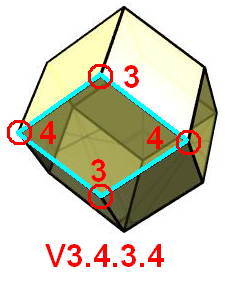
Notation for a polyhedron's vertex figure
In geometry, a vertex configuration is a shorthand notation for representing a polyhedron or tiling as the sequence of faces around a vertex. It has variously been called a vertex description, vertex type, vertex symbol, vertex arrangement,Structure and Form in Design: Critical Ideas for Creative Practice By Michael Hann vertex pattern, face-vector,{{citation
For example, "3.5.3.5" indicates a vertex belonging to 4 faces, alternating triangles and pentagons. This vertex configuration defines the vertex-transitive icosidodecahedron. The notation is cyclic and therefore is equivalent with different starting points, so 3.5.3.5 is the same as 5.3.5.3. The order is important, so 3.3.5.5 is different from 3.5.3.5 (the first has two triangles followed by two pentagons). Repeated elements can be collected as exponents so this example is also represented as (3.5).
Notation
| A vertex needs at least 3 faces, and an angle defect. |
|---|
| A 0° angle defect will fill the Euclidean plane with regular tiling. |
| By Descartes' theorem, the number of vertices is 720°/defect (4π radians/defect). |
A vertex configuration is written as one or more numbers separated by either dots or commas. Each number represents the number of sides in each face that meets at each vertex. An icosidodecahedron is denoted as 3.5.3.5 because there are four faces at each vertex, alternating between triangles (with 3 sides) and pentagons (with 5 sides). This can also be written as (3.5)^2 .
The vertex configuration can also be considered an expansive form of the simple Schläfli symbol for regular polyhedra. The Schläfli notation has the form {p,q} , where p is the number of sides in each face and q is the number of faces that meet at each vertex. Hence, the Schläfli notation {p,q} can be written as p.p.p \cdots (where p appears q times), or simply p^q .
This notation applies to polygonal tilings as well as polyhedra. A planar vertex configuration denotes a uniform tiling just like a nonplanar vertex configuration denotes a uniform polyhedron.
The notation is ambiguous for chiral forms. For example, the snub cube has clockwise and counterclockwise forms which are identical across mirror images. Both have a 3.3.3.3.4 vertex configuration.
Star polygons
The notation also applies for nonconvex regular faces, the star polygons. For example, a pentagram has the symbol {5/2}, meaning it has 5 sides going around the centre twice.
For example, there are 4 regular star polyhedra with regular polygon or star polygon vertex figures. The small stellated dodecahedron has the Schläfli symbol of {5/2,5} which expands to an explicit vertex configuration 5/2.5/2.5/2.5/2.5/2 or combined as (5/2)5. The great stellated dodecahedron, {5/2,3} has a triangular vertex figure and configuration (5/2.5/2.5/2) or (5/2)3. The great dodecahedron, {5,5/2} has a pentagrammic vertex figure, with vertex configuration is (5.5.5.5.5)/2 or (55)/2. A great icosahedron, {3,5/2} also has a pentagrammic vertex figure, with vertex configuration (3.3.3.3.3)/2 or (35)/2.
| {5/2,5} = (5/2)5 | {5/2,3} = (5/2)3 | 34.5/2 | 34.5/3 | (34.5/2)/2 | {5,5/2} = (55)/2 | {3,5/2} = (35)/2 | V.34.5/2 | V34.5/3 | V(34.5/2)/2 | |||||||
|---|---|---|---|---|---|---|---|---|---|---|---|---|---|---|---|---|
| [[File:Great dodecahedron vertfig.png | 150px]] | [[File:Great icosahedron vertfig.svg | 150px]] | [[File:DU57 facets.svg | 150px]] | [[File:DU72 facets.png | 150px]] | [[File:DU74 facets.png | 150px]] |
Inverted polygons
Faces on a vertex figure are considered to progress in one direction. Some uniform polyhedra have vertex figures with inversions where the faces progress retrograde. A vertex figure represents this in the star polygon notation of sides p/q such that p
All uniform vertex configurations of regular convex polygons
Semiregular polyhedra have vertex configurations with positive angle defect.
NOTE: The vertex figure can represent a regular or semiregular tiling on the plane if its defect is zero. It can represent a tiling of the hyperbolic plane if its defect is negative.
For uniform polyhedra, the angle defect can be used to compute the number of vertices. Descartes' theorem states that all the angle defects in a topological sphere must sum to 4π radians or 720 degrees.
Since uniform polyhedra have all identical vertices, this relation allows us to compute the number of vertices, which is 4π/defect or 720/defect.
Example: A truncated cube 3.8.8 has an angle defect of 30 degrees. Therefore, it has vertices.
In particular it follows that {a,b} has 4 / (2 − b(1 − 2/a)) vertices.
Every enumerated vertex configuration potentially uniquely defines a semiregular polyhedron. However, not all configurations are possible.
Topological requirements limit existence. Specifically p.q.r implies that a p-gon is surrounded by alternating q-gons and r-gons, so either p is even or q equals r. Similarly q is even or p equals r, and r is even or p equals q. Therefore, potentially possible triples are 3.3.3, 3.4.4, 3.6.6, 3.8.8, 3.10.10, 3.12.12, 4.4.n (for any n2), 4.6.6, 4.6.8, 4.6.10, 4.6.12, 4.8.8, 5.5.5, 5.6.6, 6.6.6. In fact, all these configurations with three faces meeting at each vertex turn out to exist.
The number in parentheses is the number of vertices, determined by the angle defect.
;Triples
- Platonic solids 3.3.3 (4), 4.4.4 (8), 5.5.5 (20)
- prisms 4.4.n (2n)
- Archimedean solids 3.6.6 (12), 3.8.8 (24), 3.10.10 (60), 4.6.6 (24), 4.6.8 (48), 4.6.10 (120), 5.6.6 (60).
- regular tiling 6.6.6
- semiregular tilings 3.12.12, 4.6.12, 4.8.8
;Quadruples
- Platonic solid 3.3.3.3 (6)
- antiprisms 3.3.3.n (2n)
- Archimedean solids 3.4.3.4 (12), 3.5.3.5 (30), 3.4.4.4 (24), 3.4.5.4 (60)
- regular tiling 4.4.4.4
- semiregular tilings 3.6.3.6, 3.4.6.4
;Quintuples
- Platonic solid 3.3.3.3.3 (12)
- Archimedean solids 3.3.3.3.4 (24), 3.3.3.3.5 (60) (both chiral)
- semiregular tilings 3.3.3.3.6 (chiral), 3.3.3.4.4, 3.3.4.3.4 (note that the two different orders of the same numbers give two different patterns)
;Sextuples
- regular tiling 3.3.3.3.3.3
Face configuration
The uniform dual or Catalan solids, including the bipyramids and trapezohedra, are vertically-regular (face-transitive) and so they can be identified by a similar notation which is sometimes called face configuration. Cundy and Rollett prefixed these dual symbols by a V. In contrast, Tilings and patterns uses square brackets around the symbol for isohedral tilings.
This notation represents a sequential count of the number of faces that exist at each vertex around a face. For example, V3.4.3.4 or V(3.4)2 represents the rhombic dodecahedron which is face-transitive: every face is a rhombus, and alternating vertices of the rhombus contain 3 or 4 faces each.
References
| title-link = Mathematical Models (Cundy and Rollett)
- Uses Cundy-Rollett symbol.
- Pp. 58–64, Tilings of regular polygons a.b.c.... (Tilings by regular polygons and star polygons) pp. 95–97, 176, 283, 614–620, Monohedral tiling symbol [v1.v2. ... .vr]. pp. 632–642 hollow tilings.
- The Symmetries of Things 2008, John H. Conway, Heidi Burgiel, Chaim Goodman-Strauss, (p. 289 Vertex figures, uses comma separator, for Archimedean solids and tilings).
References
- [https://www.uwgb.edu/dutchs/symmetry/archpol.htm Archimedean Polyhedra] {{Webarchive. link. (2017-07-05 Steven Dutch)
- [http://www.orchidpalms.com/polyhedra/uniform/uniform.html Uniform Polyhedra] Jim McNeill
- [http://www.software3d.com/Uniform.php Uniform Polyhedra and their Duals] Robert Webb
- [http://hrcak.srce.hr/file/111177/ Symmetry-type graphs of Platonic and Archimedean solids], Jurij Kovič, (2011)
- [http://people.hws.edu/mitchell/tilings/part3.html 3. General Theorems: Regular and Semi-Regular Tilings] Kevin Mitchell, 1995
- Resources for Teaching Discrete Mathematics: Classroom Projects, History, modules, and articles, edited by Brian Hopkins
- [http://polyhedra.mathmos.net/entry/vertexsymbol.html Vertex Symbol] Robert Whittaker
- [https://www.researchgate.net/publication/264848030_Symmetry-type_graphs_of_Platonic_and_Archimedean_solids Symmetry-type graphs of Platonic and Archimedean solids] Jurij Kovič
- (1979). "On Archimedean Solids". The Mathematics Teacher.
- [https://books.google.com/books?id=HjTSBQAAQBAJ&pg=PA164 Divided Spheres: Geodesics and the Orderly Subdivision of the Sphere] 6.4.1 Cundy-Rollett symbol, p. 164
- Laughlin (2014), p. 16
- [https://books.google.com/books?id=nVx-tu596twC&pg=PA18 Crystallography of Quasicrystals: Concepts, Methods and Structures] by Walter Steurer, Sofia Deloudi, (2009) pp. 18–20 and 51–53
This article was imported from Wikipedia and is available under the Creative Commons Attribution-ShareAlike 4.0 License. Content has been adapted to SurfDoc format. Original contributors can be found on the article history page.
Ask Mako anything about Vertex configuration — get instant answers, deeper analysis, and related topics.
Research with MakoFree with your Surf account
Create a free account to save articles, ask Mako questions, and organize your research.
Sign up freeThis content may have been generated or modified by AI. CloudSurf Software LLC is not responsible for the accuracy, completeness, or reliability of AI-generated content. Always verify important information from primary sources.
Report