From Surf Wiki (app.surf) — the open knowledge base
Version 7 Unix
1979 minicomputer operating system
1979 minicomputer operating system
| Field | Value |
|---|---|
| name | Version 7 Unix |
| logo | |
| screenshot | Version 7 Unix SIMH PDP11 Emulation DMR.png |
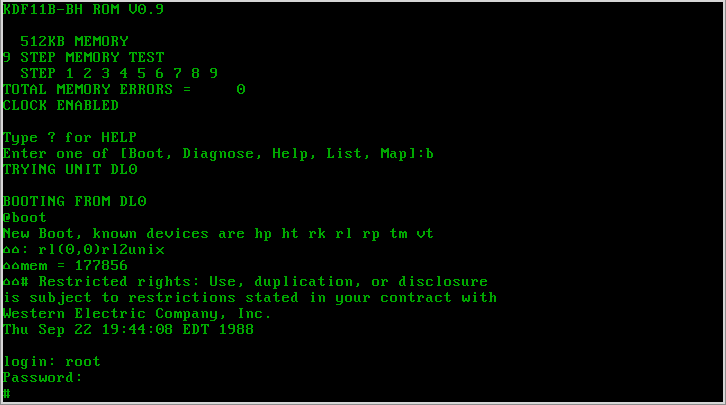
| caption | Version 7 Unix for the PDP-11, running in the SIMH PDP-11 simulator |
| version of | |
| developer | AT&T Bell Laboratories |
| family | Unix |
| working state | Historic |
| source model | Originally proprietary software, now open source |
| released | |
| discontinued | |
| RTM date | |
| GA date | |
| latest preview date | |
| marketing target | Minicomputers |
| programmed in | C, assembly |
| language | English |
| update model | |
| package manager | |
| supported platforms | DEC PDP-11, VAX (32v), x86 |
| kernel type | Monolithic |
| ui | Command-line interface (Bourne shell) |
| license | Originally proprietary commercial software, now free software under a BSD-like license |
| preceded by | Version 6 Unix |
| succeeded by | Version 8 Unix |
| website | |
| support status |
Version 7 Unix, also called Seventh Edition Unix, Version 7 or just V7, was an important early release of the Unix operating system. V7, released in 1979, was the last Bell Laboratories release to see widespread distribution before the commercialization of Unix by AT&T Corporation in the early 1980s. V7 was originally developed for Digital Equipment Corporation's PDP-11 minicomputers and was later ported to other platforms.
Overview
Unix versions from Bell Labs were designated by the edition of the user's manual with which they were accompanied. Released in 1979, the Seventh Edition was preceded by Sixth Edition, which was the first version licensed to commercial users. Development of the Research Unix line continued with the Eighth Edition, which incorporated development from 4.1BSD, through the Tenth Edition, after which the Bell Labs researchers concentrated on developing Plan 9.
V7 was the first readily portable version of Unix. As this was the era of minicomputers, with their many architectural variations, and also the beginning of the market for 16-bit microprocessors, many ports were completed within the first few years of its release. The first Sun workstations (then based on the Motorola 68000) ran a V7 port by UniSoft; the first version of Microsoft Xenix for the Intel 8086 was derived from V7, and Onyx Systems soon produced a Zilog Z8000 computer running V7. The VAX port of V7, called UNIX/32V, was the direct ancestor of UNIX System V and the popular 4BSD family of Unix systems.
The group at the University of Wollongong that had ported V6 to the Interdata 7/32 ported V7 to that machine as well. Interdata sold the port as Edition VII, making it the first commercial UNIX offering.
DEC distributed their own PDP-11 version of V7, called V7M (for modified). V7M, developed by DEC's original Unix Engineering Group (UEG), contained many enhancements to the kernel for the PDP-11 line of computers including significantly improved hardware error recovery and many additional device drivers. UEG evolved into the group that later developed Ultrix.
Reception
Due to its power yet elegant simplicity, many old-time Unix users remember V7 as the pinnacle of Unix development and have dubbed it "the last true Unix", an improvement over all preceding and following Unices. At the time of its release, though, its greatly extended feature set came at the expense of a decrease in performance compared to V6, which was to be corrected largely by the user community.
The number of system calls in Version 7 was only around 50, while later Unix and Unix-like systems continued to add many more:
Released as free software
In 2002, Caldera International released V7 as FOSS under a permissive BSD-like software license.
Bootable images for V7 can still be downloaded today, and can be run on modern hosts using PDP-11 emulators such as SIMH.
An x86 port has been developed by Nordier & Associates.
Paul Allen maintained several publicly accessible historic computer systems, including a PDP-11/70 running Unix Version 7.
New features in Version 7
Many new features were introduced in Version 7.
- Programming tools: lex, lint, and make. :The Portable C Compiler (pcc) was provided along with the earlier, PDP-11-specific, C compiler by Ritchie. :These first appeared in the Research Unix lineage in Version 7, although early versions of some of them had already been picked up by PWB/UNIX.
- New commands: the Bourne shell, at, awk, calendar, f77, fortune, tar (replacing the tp command), touch
- Networking support, in the form of uucp and Datakit
- New system calls: access, acct, alarm, chroot (originally used to test the V7 distribution during preparation), exece, ioctl, lseek (previously only 24-bit offsets were available), umask, utime
- New library calls: The new stdio routines, malloc, getenv, popen/system
- Environment variables
- A maximum file size of just over one gigabyte, through a system of indirect addressing
Multiplexed files
A feature that did not survive long was a second way (besides pipes) to do inter-process communication: multiplexed files. A process could create a special type of file with the mpx system call; other processes could then open this file to get a "channel", denoted by a file descriptor, which could be used to communicate with the process that created the multiplexed file. Mpx files were considered experimental, not enabled in the default kernel, and disappeared from later versions, which offered sockets (BSD) or CB UNIX's IPC facilities (System V) instead (although mpx files were still present in 4.1BSD).
References
References
- Fiedler, David. (October 1983). "The Unix Tutorial / Part 3: Unix in the Microcomputer Marketplace". BYTE.
- James W. Birdsall. "The Sun Hardware Reference, Part II".
- Canter, Fred. "V7M 2.1 SPD". Digital Equipment Corp.
- Salus, Peter H.. (2005). "The Daemon, the Gnu and the Penguin". [[Groklaw]].
- (2013). "Advanced Programming in the UNIX Environment".
- (2002). "Caldera releases original unices under BSD license".
- (2002-01-24). "UNIX is free!". lemis.com.
- Broderick, Bill. (January 23, 2002). "Dear Unix enthusiasts". [[Caldera International]].
- Darwin, Ian F.. (2002-02-03). "Why Caldera Released Unix: A Brief History". [[O'Reilly Media]].
- "Robert Nordier - UNIX v7/x86".
- McIlroy, M. Douglas. (1987). "A Research Unix reader: annotated excerpts from the Programmer's Manual, 1971–1986". Bell Labs.
- Thompson, Ken. (1978). "UNIX Implementation". Bell System Technical Journal.
- {{man. 2. mpx. v7
- {{man. 1. mkconf. v7
- (1986). "An Advanced 4.3 BSD Interprocess Communication Tutorial". Computer Systems Research Group, University of California, Berkeley.
- Ritchie, Dennis M.. (1984). "A Stream Input-Output System". AT&T.
This article was imported from Wikipedia and is available under the Creative Commons Attribution-ShareAlike 4.0 License. Content has been adapted to SurfDoc format. Original contributors can be found on the article history page.
Ask Mako anything about Version 7 Unix — get instant answers, deeper analysis, and related topics.
Research with MakoFree with your Surf account
Create a free account to save articles, ask Mako questions, and organize your research.
Sign up freeThis content may have been generated or modified by AI. CloudSurf Software LLC is not responsible for the accuracy, completeness, or reliability of AI-generated content. Always verify important information from primary sources.
Report