From Surf Wiki (app.surf) — the open knowledge base
Vernation
New leaf or frond development in botany
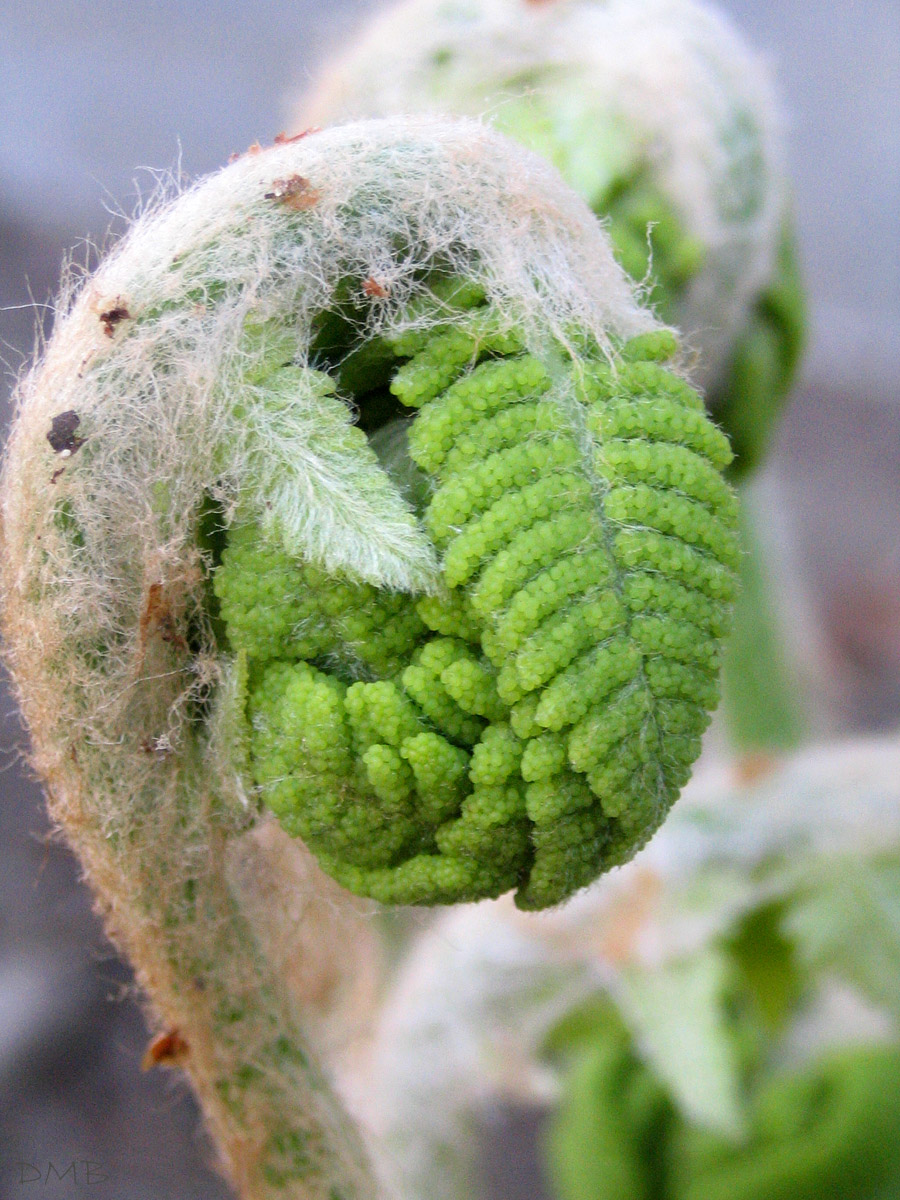
New leaf or frond development in botany
Vernation or leafing is the formation of new leaves or fronds. In plant anatomy, it is the arrangement of leaves in a bud.
Name
etymology
The term vernation is borrowed from New Latin {{linktext|vernatio}}, the act of being verdant or flourishing (vernare). It is cognate with {{linktext|ver}} (Latin for "spring") and {{linktext|vernalis}} ("vernal").
Circinate vernation
circinate
Circinate vernation (or circinnate, from Latin "made round") is the manner in which most fern fronds emerge. As the fern frond is formed, it is tightly curled so that the tender growing tip of the frond (and each subdivision of the frond) is protected within a coil. At this stage it is called a crozier (after the shepherd's crook) or fiddlehead (after the scrollwork at the top of a violin). As the lower parts of the frond expand and toughen up, they begin to photosynthesize, supporting the further growth and expansion of the frond. By photosynthesizing, the frond increases the amount of solute inside the frond, which lowers the internal water gradient and facilitates an increase in volume that forces uncoiling. In the case of many fronds, long hairs or scales provide additional protection to the growing tips before they are fully uncoiled. Circinate vernation may also be observed in the extension of leaflets, in the compound leaves of cycads. Circinate vernation is also typical of the carnivorous plant family Droseraceae, for example see this photo of Drosera filiformis. It is also seen in the related genera Drosophyllum and Triphyophyllum, and in the much more distantly related Byblis; however in these three genera, the leaves are coiled outwards towards the abaxial surface of the leaf (reverse circinate vernation): this appears to be unique to these three plants among the angiosperms.
Convolute vernation
convolute

The process of convolute vernation involves the wrapping of one margin of the leaf's blade over the other. This folding mechanism makes the emerging leaf look like a tube.
Involute vernation
involute

In involute vernation both margins on opposing sides of the leaf are rolled up towards the upper (axial) surface of the leaf, forming two tubes that may meet at the midrib of the leaf.
Revolute vernation
revolute
Revolute vernation is the opposite of involute vernation: the margins of the leaf are rolled up towards the under (abaxial) surface of the leaf.
References
References
- (2023). "Merriam-Webster".
- "circinate (adj.)".
- "Circinate vernation".
- Cameron, K. M.. (2002). "Molecular evidence for the common origin of snap-traps among carnivorous plants". American Journal of Botany.
- (2018). "Carnivorous plants: physiology, ecology, and evolution". Oxford University Press.
- Beentje, Henk. (2010). "The Kew Plant Glossary". [[Royal Botanic Gardens, Kew]].
This article was imported from Wikipedia and is available under the Creative Commons Attribution-ShareAlike 4.0 License. Content has been adapted to SurfDoc format. Original contributors can be found on the article history page.
Ask Mako anything about Vernation — get instant answers, deeper analysis, and related topics.
Research with MakoFree with your Surf account
Create a free account to save articles, ask Mako questions, and organize your research.
Sign up freeThis content may have been generated or modified by AI. CloudSurf Software LLC is not responsible for the accuracy, completeness, or reliability of AI-generated content. Always verify important information from primary sources.
Report