From Surf Wiki (app.surf) — the open knowledge base
Vera Kholodnaya
Russian actress

Russian actress
| Field | Value |
|---|---|
| name | Vera Vasilyevna Kholodnaya |
| Вера Васильевна Холодная | |
| image | Vera Kholodnaya photo.jpg |
| birthname | Vera Vasilyevna Levchenko |
| birth_date | |
| birth_place | Poltava, Russian Empire |
| death_date | |
| death_place | Odessa, Ukrainian People's Republic |
| occupation | Actress |
| years_active | 1914–1918 |
| spouse | |
| children | 2 |
Вера Васильевна Холодная Vera Vasilyevna Kholodnaya (née Levchenko; ; ; 5 August 1893 – 16 February 1919) was a Russian cinema actress. She was the first star of Imperial Russian silent cinema. Only five of her films still exist, and the total number she acted in is unknown, with speculation ranging from 50 to 100.
She predominantly acted in the genres of drama, melodrama, and short films, working with directors such as Yevgeni Bauer, Pyotr Chardynin, and others. Her co-stars included Vitold Polonsky, Vladimir Maksimov, and Osip Runich.
She gained fame for her roles in films such as The Song of Triumphant Love (1915), Mirages (1915), A Life for a Life (1916), Forget the Fireplace... (1917), and many others. Only five films featuring Vera Kholodnaya have survived, though the actual number of her films may range from 50 to 100. Even after her death at the age of 25, her popularity endured during the Russian Revolution of 1917 and the Civil War. The official cause of her death was Spanish flu, but it sparked numerous rumors and myths.
Early life
Born in Poltava (Russian Empire, now Ukraine), she went to live in Moscow with her widowed grandmother at the age of 2. As a girl, she dreamed of a career in classical ballet and enrolled at the Bolshoi Theatre ballet school. From early childhood. Vera participated in family theatricals. When she was age 10, Vera was sent to the famous Perepelkina's grammar school.
Personal life
At the graduation prom she met Vladimir Kholodny, who was then a student, an editor of a daily sport newspaper and a race-driver, said to be one of the early Russian car racers. They got married in 1910 despite disapproval of both families. Vera often accompanied him in races, which resulted in road accidents. She also adopted his surname, which translates to "the cold one". Later, many took it for a well-chosen pseudonym. Their daughter Evgeniya was born in 1912, and they adopted a girl, Nata, a year later.
Career rise
In 1908, Vera attended a performance of Francesca da Rimini, with Vera Komissarzhevskaya in the title role. She was deeply impressed with Komissarzhevskaya's artistry and decided to venture in film acting. She approached Vladimir Gardin, a leading Russian film director, who cast her in a minor role in his grand production of Anna Karenina.
In 1915 Yevgeni Bauer was to direct the film Song of Triumphant Love (Pesn Torzhestvuyushchey Lyubvi), a mystical love drama (after Turgenev) and was searching for an actress of outstanding beauty. When Vera Kholodnaya was introduced to Bauer, he at once approved her for the role, being impressed by her beauty.
Song of Triumphant Love was an enormous success and Yevgeni Bauer immediately started shooting his another movie starring Kholodnaya. It was a melodrama Flame of the Sky (Plamya Neba) about guilty love of a young woman married off to an old widower, and his son. Although Flame of the Sky was shot after Song of Triumphant Love, it was the first to go on screen and so brought fame to Vera Kholodnaya.
At first it was hard for Vera to convey complex psychological nuances and so she imitated the acting of Asta Nielsen but gradually developed her own style. Vera's extravagant costumes and large gray eyes made her an enigmatic screen presence which fascinated audiences across Imperial Russia.
Her next picture was The Children of the Age (Deti veka), aired in 1915, a drama with pretensions to revealing social problems.
Tremendous success was Pyotr Chardynin's tragic melodrama The Mirages (1916), followed by the 'fancy drama' Beauty Must Reign in the World by Yevgeni Bauer, melodrama Fiery Devil, and another melodrama A Life for a Life, which turned one of the most popular films in Vera Kholodnaya's career and brought her the title 'the Queen of Screen'. The author of this title was Alexander Vertinsky who venerated the actress and frequented her house. In 1916 Khanzhonkov's company started making the film Pierrot with Vertinsky and Kholodnaya playing the leads. Unfortunately, the film was not completed.
In the beginning of 1917 was released of one of the best films with Vera Kholodnaya, namely By the Fireplace (U kamina), based on a popular romance. The tragic film about a family broken by a rich lover ended with the death of the protagonist played by Vera Kholodnaya. The triumph of the drama exceeded all the films shot in Russia before that. It was so until 1918 when the movie Be Silent, My Sorrow, Be Silent (Molchi, grust, molchi) aired and received even great acceptance. Like many of her films, it was based on a Russian traditional love song. At the same time there was probably no other film so much criticized, especially after the revolution. By the middle of 1918 Vera Kholodnaya turned from just a popular and admired actress into a real phenomenon of the Russian cinema.
Her latest movies were Krasnaya zarya (1918), Zhivoy trup (1918), The Last Tango (1918).
However, only five works with Kholodnaya have been preserved. The Children of the Age was the earliest of them. The other four extant films are: The Mirages (1916), A Life for a Life (1916), A Corpse Living (1918), and Be Silent, My Sorrow, Be Silent (1918).
A Life for a Life was the film that definitively established Kholodnaya's star status.
World War I and the Russian Revolution
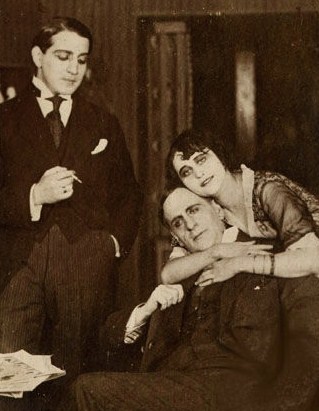
After her husband was drafted to fight in World War I, Kholodnaya signed with a rival Khanzhonkov studio.
During World War I, Kholodnaya took part in charity concerts, selling gifts to support soldiers and their families. Soldiers worshipped Kholodnaya, calling her "our Verochka". In breaks between shooting sessions, Kholodnaya travelled to the front to visit her husband.
By the time of the Russian Revolution, a new Kholodnaya film was released every third week. At the Fire Side (1917) was her massive commercial success: the movie was run in cinemas until 1924, when the Soviet authorities ordered many of the Kholodnaya features destroyed. At the Fire Side was a drama based on a love triangle. The film's success prompted its director Petr Chardynin to make a sequel, Forget about the Fire, the Flame's Gone Out (1917), which was released during the October revolution. Forget about the Fire, together with another film, Be Silent, My Sorrow, Be Silent (1918) both with a circus theme broke all commercial records for Russian pre-revolutionary cinema.
During the Russian Civil War, the Bolshevik authorities requested film companies to produce less melodrama and more adaptations of classics. Accordingly, Kholodnaya was cast in a screen version of Tolstoy's The Living Corpse. Her acting abilities in this film were applauded by Konstantin Stanislavski, who welcomed Vera to join the troupe of the Moscow Art Theatre.
By this time, the actress had determined to move with her film company to Odessa, where she died at the age of 25 in the 1918 flu pandemic. On learning about her death, Alexander Vertinsky, wrote one of his most poignant songs, "Your fingers smell of church incense, and your lashes sleep in grief..." A director with whom she had worked for several years filmed her large funeral. Ironically, this seems to be her best known film today.
Circumstances of her death
Official Russian records state that Vera Kholodnaya died of the Spanish flu during the pandemic of 1919. While that seems quite likely, there is much speculation around her death. Other stories claim she was poisoned by the French ambassador with whom she reportedly had an affair and who believed that she was a spy for the Bolsheviks.
During her funeral in Odesa, a large number of people gathered to pay their final respects to Kholodnaya. She was buried on February 19 at the First Christian Cemetery of Odesa. In 1937, the cemetery was demolished by the Communist authorities. In its place, the "Park of Ilyich" with amusement attractions was established, and part of the territory was transferred to the local zoo. Today, only a few reburials from the old cemetery are known with certainty, and there is no confirmed information regarding the reburial of Kholodnaya.
Vladimir Kholodnyy lived only a few months and died of typhus.
Many people refused to believe that the great actress had died. Others were shocked by her skin, which had turned bluish due to the embalming fluid. The star’s death gave rise to numerous rumors and a host of legends. According to one version, she was executed as a French spy; another claimed she suffocated from the scent of poisoned white lilies allegedly sent by French consul Enno; a third suggested that Kholodnaya was strangled by a jealous lover. The rumors intensified after the arrest and execution of Kholodnaya’s husband, but her family and close friends confirmed the official cause of death—Spanish flu.
There were also whispers that the doctor had been blackmailed into signing off on the Spanish flu diagnosis. Some even claimed that the woman buried was not Vera Kholodnaya at all, but an unknown woman, and that the actress had faked her death and fled abroad due to the threat of her secret mission being exposed. Another rumor alleged she had been kidnapped because she was wearing a large amount of jewelry. No evidence has ever been found to support any of these theories.
Legacy
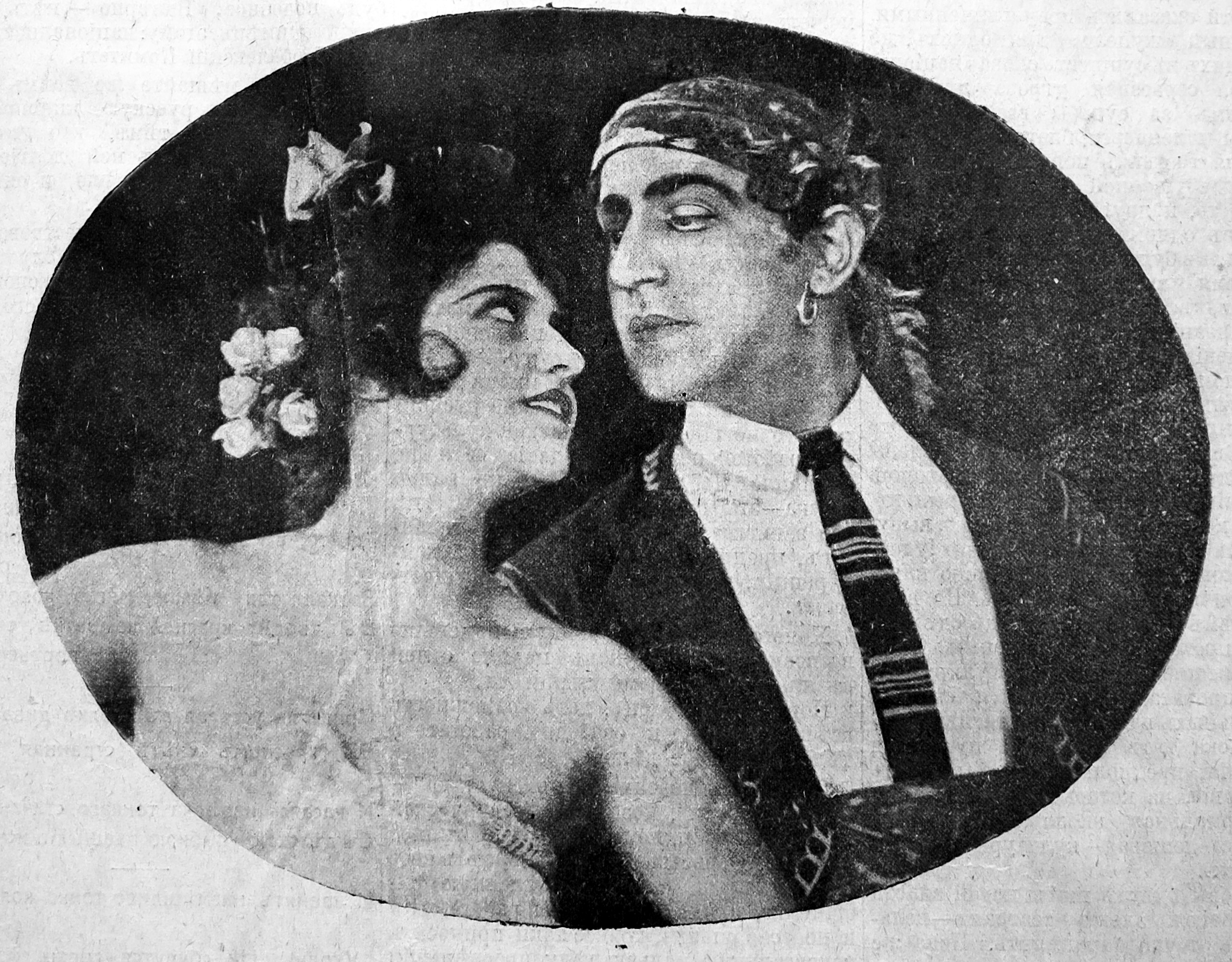
Her life was dramatised in Nikita Mikhalkov's film A Slave of Love (1976). A documentary on her life was filmed in 1992. A year later, her image was depicted on a postage stamp and in 2003 a life-size bronze statue of her was erected in Odessa, created by the artist Alexander P. Tokarev.
- Director Vadim Tsalikov created a documentary film titled Farewell Beauty, dedicated to the actress.
- A feature film inspired by the life and film career of Vera Kholodnaya, A Slave of Love (1975), was directed by Nikita Mikhalkov. The lead role was played by Elena Solovey, who later emigrated to the United States.
- In February 1996, a small square at the corner of Bunin and Preobrazhenskaya Streets in Odesa was renamed in honor of Vera Kholodnaya.
- In 2003, a monument was erected near the house in Odesa where the actress lived and died.
- In 2010, Odesa hosted the silent film and contemporary music festival Silent Nights, with one of the sets dedicated to Vera Kholodnaya.
- In 2017, Yulia Sak created a short artistic film dedicated to Vera Kholodnaya, titled Elegy of Love: Vera Kholodnaya.
- In 2022, Marshal Rokossovsky Street in the city of Kremenchuk was renamed Vera Kholodnaya Street as part of the de-Russification process.
Filmography
Only eight of Kholodnaya's films have survived, in part or in whole:
| Year | Title |
|---|---|
| 1914 | Anna Karenina |
| 1915 | Children of the Age |
| 1916 | Mirages |
| 1916 | A Life for a Life |
| 1917 | Tormented Souls (Izterzannye dushi) |
| 1918 | Be Silent, My Sorrow, Be Silent |
| 1918 | Skazka liubvi dorogoi |
| 1918 | The Last Tango |
Lost films
| Year | Title |
|---|---|
| 1915 | Vaniushin's Children (Deti Vaniushina) |
| 1915 | Flame of the Sky (Plamia neba) |
| 1915 | Song of Triumphant Love (Pesn' torzhestvuiushchei liubvi) |
| 1915 | Nakazannyi Antosha |
| 1915 | Probuzhdenie |
| 1916 | Beauty Must Rule the World (V mir dolzhna tsarit' krasota) |
| 1916 | Odna iz mnogikh |
| 1916 | Lunnaia krasavitsa |
| 1916 | Shakhmaty zhizni |
| 1916 | Razorvannye tsepi |
| 1917 | Stolichnyi iad |
| 1917 | Radi schast'ia |
| 1917 | Pytka molchaniia |
| 1917 | By the Fireplace |
| 1917 | ** |
| 1917 | Izterzannye dushi |
| 1917 | Pochemu ia bezumno liubliu |
| 1917 | Kak oni lgut |
| 1917 | Na altar' krasoty |
| 1917 | Toboi kaznennye |
| 1917 | Bluzhdaiushchie ogni |
| 1917 | Pozabud' pro kamin, v nem pogasli ogni |
| 1917 | ''Chelovek-zver''' |
| 1918 | Zhivoi trup |
| 1918 | ''Ternistyi slavy put''' |
| 1918 | The Woman who Invented Love (Zhenshchina, kotoraia izobrela liubov') |
| 1918 | Meshchanskaia tragediia |
| 1919 | Azra |
| 1919 | Krasnaia zaria |
| 1919 | V tiskakh liubvi |
| 1919 | Pesn' Persii |
| 1919 | Kira Zubova |
Films that were never released
| Year | Title |
|---|---|
| 1918 | Kniazhna Tarakanova |
| 1918 | Ispoved' monakhini |
| 1919 | Tsyganka Aza |
| 1919 | Dama s kameliiami |
References
References
- Peter Rollberg. (2009). "Historical Dictionary of Russian and Soviet Cinema". Rowman & Littlefield.
- (2000). "Women in World History: A Biographical Encyclopedia". Yorkin Publications.
- Sergei Eisenstein. (1996). "Selected Works, Volume 3". BFI Pub..
- "Vera Kholodnaya Russian silent cinema actress :: people :: Russia-InfoCentre".
- (8 June 2015). "European Silent Films on Video: A Critical Guide". McFarland.
- (13 December 2013). "Early Cinema in Russia and Its Cultural Reception". Routledge.
- "Muchnik's Picks: Music in Moscow Over the Weekend {{!}} Arts and Ideas".
- Ioffe, Nadezhda. (1 January 1995). "Back in Time: My Life, My Fate, My Epoch : the Memoirs of Nadezhda A. Joffe". Mehring Books.
- Feinstein, Elaine. (19 March 2006). "Anna of All the Russias". The New York Times.
- "L'ENCINEMATHEQUE: La collectionneuse".
- "The Presidential Library to di...".
- Sobolev, R. P.. (1961). "Liudi i fil'my russkogo dorevoliutsnnogo kino". Iskusstvo.
- Kashchenko, E. S.. (2012). "Izmenenie sistemy stereotipov v otechestvennom kinematografe 1910-1930-kh gg. (na primere fil'mov "Zhizn' za zhizn'" (1916) i "Semero smelykh" (1936))". Noveishaia Istoriia Rossii: Zhurnal.
- Banchik, N.. (2002). "Svet sgorevshei zvezdy—skvoz' goda, okeany". Russkii Bazar: Zhurnal.
- (2007). "Kinematografii︠a︡ dorevoli︠u︡t︠s︡ionnoĭ Rossii". Agraf.
- "Gloria Swanson".
- [http://www.ukrposhta.com/www/upost.nsf/9937667e31ca17f9c22573b1004740fa/28e8ef39cb5b1f7ec22577280023778f/$FILE/PW_41_%202013.pdf Віра Холодна. 1893–1919. 120 років від дня народження]
- (2012-07-27). "Список захороненных людей".
- Головань В. (2012-02-27). "Старое кладбище в Одессе: здесь нашли пристанище многие из лучших сынов и дочерей Отечества".
- Шевчук А. (2010-08-14). "Спасти мемориал — защитить честь города".
- Жовнір Н. (2010-05-08). "Королева німого кіно: феномен Віри Холодної".
- "A Slave of Love".
- (2015-04-02). "Сквер Віри Холодної".
- (2020-05-20). "Елегія любові. Віра Холодная". Фільм Юлії Сак".
- Ігор Ізотов. (2022-10-14). "У Кременчуці на Полтавщині погодили нові назви для ще 29 вулиць".
- (2002). "Velikiĭ kinemo : katalog sokhranivshikhsi︠a︡ igrovykh filʹmov Rossii, 1908–1919". Novoe literaturnoe obozrenie.
This article was imported from Wikipedia and is available under the Creative Commons Attribution-ShareAlike 4.0 License. Content has been adapted to SurfDoc format. Original contributors can be found on the article history page.
Ask Mako anything about Vera Kholodnaya — get instant answers, deeper analysis, and related topics.
Research with MakoFree with your Surf account
Create a free account to save articles, ask Mako questions, and organize your research.
Sign up freeThis content may have been generated or modified by AI. CloudSurf Software LLC is not responsible for the accuracy, completeness, or reliability of AI-generated content. Always verify important information from primary sources.
Report