From Surf Wiki (app.surf) — the open knowledge base
Vekenega
Croatian Benedictine nun, C11th/12th abbess of Benedictine monastery of St. Maria in Zadar

Croatian Benedictine nun, C11th/12th abbess of Benedictine monastery of St. Maria in Zadar
Vekenega (Zadar - Zadar, September 27, 1111) was a Croatian Benedictine nun from the House of Madi, a noble family from Zadar. She was the daughter of Čika and took over from her mother as abbess of the Benedictine monastery of St. Maria in Zadar some time after entering the order in 1072. Vekenaga is also known for the richly illuminated evangelistary which she commissioned from the scriptorium of the monastery of St. Krševan in Zadar in 1096.
Life
Vekenega was the daughter of Čika, a member of the noble patrician Madi family and Andrija. She had a sister, Domnana. She was the maternal granddaughter of Dujam and Vekenega, after whom she was named. A maternal ancestor was Prior Madi. Her mother Čika (d. after 1095) is known to have founded the Benedictine monastery of St. Mary in Zadar in 1066 after she was widowed. Vekenega was married to Dobroslav.
Čika founded and entered the Benedictine monastery of St. Maria in Zada and became its abbess. When the king Petar Krešimir IV placed the monastery under the royal protection, he referred to Čika as his sister.
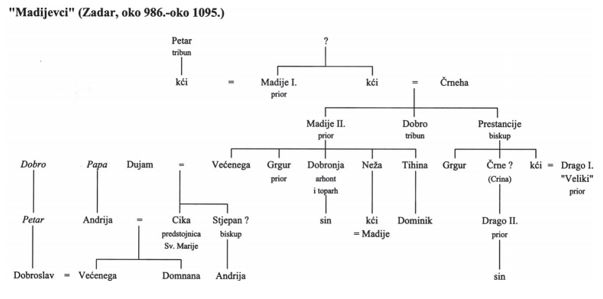
After the tragic death of her husband, Dobroslav, Vekenega became a nun in 1072, and entered the monastery of St. Mary. At some point after 1095, Vekenega replaced her mother as abbess.
In 1097, Coloman, King of Hungary invaded Croatia, defeated its last native king Petar Snačić, and was eventually crowned king of Croatia in 1102. Vekenega sought the support and financial assistance of Coloman to help complete building the monastery of St. Maria and tactfully stated that he had restored the "peace of the land and the sea". The monastery's Romanesque bell tower still has an inscription of Coloman's name and the year 1105, commemorating the king's entrance into Zadar following his siege of the city. His patronage enabled Vekenega to complete building the three-aisled basilica and new monastic buildings, including the assembly hall, considered one of the most important Romanesque buildings in Croatia.
Vekenega died on 27 September 1111 and was buried at the monastery. Her tomb was decorated with Latin verses.
The Vekenega Evangelistary
In 1095 or 1096, the Evangelistary of Zadar, also known as the Vekenega Evangelistary, was created at the request of Vekenega. The 285 × 190 mm book was scribed in the Beneventan script, imported to what was then Dalmatia from Italy. The book is now housed in the Bodleian Library in Oxford, having been purchased by the institution in 1817, after having passed through the hands of Matteo Luigi Canonici and Giuseppe Canonici in the late eighteenth and early nineteenth century. It is now known as MS. Canon. Bibl. Lat. 61. It was digitised in 2018 and is viewable online. Vekenega is referred to though the Bodleian records as abbess Uekanega.
In 1996 the Vekenega Evangelistary was celebrated on a stamp issued by the newly independent Republic of Croatia to celebrate the 900th anniversary of its creation.
References
References
- Josip Bratulić i Stjepan Damjanović, Hrvatska pisana kultura, 1. svezak, 8. - 17. stoljeće, str. 63, {{ISBN. 953-96657-3-6
- Curta, Florin. (2019-06-25). "The Western Balkans in the High Middle Ages (900–1200)". Brill.
- (2019-03-25). "Byzantium in Dialogue with the Mediterranean: History and Heritage". BRILL.
- Stipišić, J. i M. Šamšalović, ur. Codex Diplomaticus Regni Croatiae, Dalmatiae et Slavoniae, sv. 1. Zagreb: Izdavački zavod Jugoslavenske akademije znanosti i umjetnosti, 1967., p. 102. (Dalje: CD I)
- . ["St Mary"](https://svstosijazadar.hr/sv-marija/).
- Maupas, Dojmo. (1863). "Prospetto cronologico della storia della Dalmazia: con riguardo alle provincie slave contermini". Battara.
- Font, Márta. (2001). "Koloman the Learned, King of Hungary". Szegedi Középkorász Műhely.
- Curta, Florin. (2019-07-08). "Eastern Europe in the Middle Ages (500-1300) (2 vols)". BRILL.
- "MS. Canon. Bibl. Lat. 61 - Medieval Manuscripts".
- (2018). "Bodleian Library MS. Canon. Bibl. Lat. 61 (full digital facsimile)".
- "Bodleian Library MS. Canon. Bibl. Lat. 61 (27 images from 35mm slides)".
- "Vekenega".
This article was imported from Wikipedia and is available under the Creative Commons Attribution-ShareAlike 4.0 License. Content has been adapted to SurfDoc format. Original contributors can be found on the article history page.
Ask Mako anything about Vekenega — get instant answers, deeper analysis, and related topics.
Research with MakoFree with your Surf account
Create a free account to save articles, ask Mako questions, and organize your research.
Sign up freeThis content may have been generated or modified by AI. CloudSurf Software LLC is not responsible for the accuracy, completeness, or reliability of AI-generated content. Always verify important information from primary sources.
Report