From Surf Wiki (app.surf) — the open knowledge base
VEGF receptor
Protein family
Protein family
| Field | Value |
|---|---|
| Symbol | VEGF |
| Name | VEGF receptor |
| image | 1djs.jpg |
| caption | fms-related tyrosine kinase 1 (vascular endothelial growth factor/vascular permeability factor receptor) |
| InterPro | IPR009135 |
| Membranome family | 1335 |
VEGF receptors (VEGFRs) are receptors for vascular endothelial growth factor (VEGF). There are three main subtypes of VEGFR, numbered 1, 2 and 3. Depending on alternative splicing, they may be membrane-bound (mbVEGFR) or soluble (sVEGFR).
Inhibitors of VEGFR are used in the treatment of cancer.
VEGF
Main article: Vascular endothelial growth factor
Vascular endothelial growth factor (VEGF) is an important signaling protein involved in both vasculogenesis (the formation of the circulatory system) and angiogenesis (the growth of blood vessels from pre-existing vasculature). As its name implies, VEGF activity is restricted mainly to cells of the vascular endothelium, although it does have effects on a limited number of other cell types (e.g. stimulation monocyte/macrophage migration). In vitro, VEGF has been shown to stimulate endothelial cell mitogenesis and cell migration. VEGF also enhances microvascular permeability and is sometimes referred to as vascular permeability factor.
Receptor biology
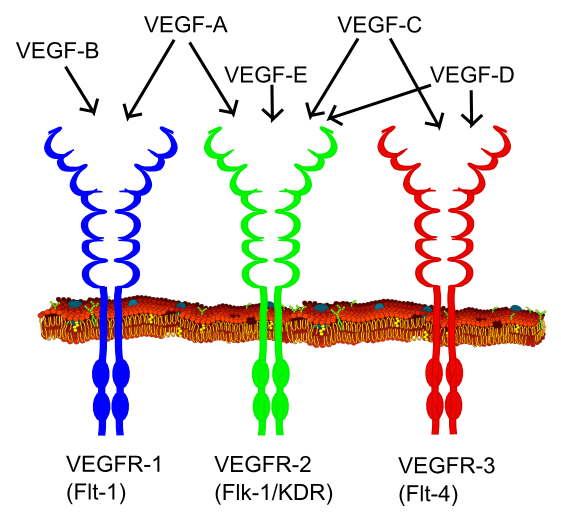
All members of the VEGF family stimulate cellular responses by binding to tyrosine kinase receptors (the VEGFRs) on the cell surface, causing them to dimerize and become activated through transphosphorylation. The VEGF receptors have an extracellular portion consisting of 7 immunoglobulin-like domains, a single transmembrane spanning region and an intracellular portion containing a split tyrosine-kinase domain.
VEGF-A binds to VEGFR-1 (Flt-1) and VEGFR-2 (KDR/Flk-1). VEGFR-2 appears to mediate almost all of the known cellular responses to VEGF. The function of VEGFR-1 is less well defined, although it is thought to modulate VEGFR-2 signaling. Another function of VEGFR-1 is to act as a dummy/decoy receptor, sequestering VEGF from VEGFR-2 binding (this appears to be particularly important during vasculogenesis in the embryo). In fact, an alternatively spliced form of VEGFR-1 (sFlt1) is not a membrane bound protein but is secreted and functions primarily as a decoy. A third receptor has been discovered (VEGFR-3), however, VEGF-A is not a ligand for this receptor. VEGFR-3 mediates lymphangiogenesis in response to VEGF-C and VEGF-D.
In addition to binding to VEGFRs, VEGF binds to receptor complexes consisting of both neuropilins and VEGFRs. This receptor complex has increased VEGF signalling activity in endothelial cells (blood vessels). Neuropilins (NRP) are pleiotropic receptors and therefore other molecules may interfere with the signalling of the NRP/VEGFR receptor complexes. For example, Class 3 semaphorins compete with VEGF165 for NRP binding and could therefore regulate VEGF-mediated angiogenesis.
References
References
- (October 2007). "Vascular endothelial growth factor receptor-2: structure, function, intracellular signalling and therapeutic inhibition". Cellular Signalling.
- (September 2009). "Structure and function of VEGF receptors". IUBMB Life.
- (July 2008). "Vascular endothelial growth factor-A is a survival factor for nucleus pulposus cells in the intervertebral disc". Biochemical and Biophysical Research Communications.
- [http://www.cancerpublications.com/newsletter/colorectal/AIO/v2n3/Article2/a2f1.gif cancerpublications.com.]
- [http://www.researchvegf.com/researchvegf/images/interactVEGF.gif Interactions of VEGF ligands and VEGF receptors] ResearchVEGF.com, retrieved on November 13, 2009
- (August 2011). "Semaphorin-PlexinD1 signaling limits angiogenic potential via the VEGF decoy receptor sFlt1". Developmental Cell.
- (March 1998). "Neuropilin-1 is expressed by endothelial and tumor cells as an isoform-specific receptor for vascular endothelial growth factor". Cell.
- (August 2011). "VEGF binding to NRP1 is essential for VEGF stimulation of endothelial cell migration, complex formation between NRP1 and VEGFR2, and signaling via FAK Tyr407 phosphorylation". Molecular Biology of the Cell.
- (2014). "A perspective on the role of class III semaphorin signaling in central nervous system trauma". Frontiers in Cellular Neuroscience.
This article was imported from Wikipedia and is available under the Creative Commons Attribution-ShareAlike 4.0 License. Content has been adapted to SurfDoc format. Original contributors can be found on the article history page.
Ask Mako anything about VEGF receptor — get instant answers, deeper analysis, and related topics.
Research with MakoFree with your Surf account
Create a free account to save articles, ask Mako questions, and organize your research.
Sign up freeThis content may have been generated or modified by AI. CloudSurf Software LLC is not responsible for the accuracy, completeness, or reliability of AI-generated content. Always verify important information from primary sources.
Report