From Surf Wiki (app.surf) — the open knowledge base
Vedanta Society
Religious organisation

Religious organisation
Vedanta Societies refer to organisations, groups, or societies formed for the study, practice, and propagation of Vedanta, the culmination of Vedas. They refer to branches of the Ramakrishna Order located outside India.
Carl Jackson writes that "Vedanta came to America in the form of Vedanta societies", starting with the appearance of Swami Vivekananda at the Parliament of Religions in Chicago in 1893 and his founding of the New York Society in 1894.
Branches of the Ramakrishna Order located outside India are under the spiritual guidance of the Ramakrishna Order. The work of the Vedanta Societies in the west has primarily been devoted to spiritual and pastoral activities, though many of them do some form of social service. Many of the Western Vedanta societies have resident monks, and several centers have resident nuns. The first Vedanta Society outside India was founded by the Indian Hindu monk Swami Vivekananda in New York in November 1894. In 1900, on Swami Vivekananda's second trip to the west, he established the San Francisco Center. Other direct disciples of Ramakrishna who came with Vivekananda to America include Swamis Turiyananda, Saradananda, Trigunatitananda, and Abhedananda.
In the 1940s and 1950s, many of the leading intellectuals and authors were attracted to various Vedanta Societies in the US: Aldous Huxley, Gerald Heard, and Christopher Isherwood were initiated by Swami Prabhavananda at the Vedanta Society of Southern California, Huston Smith studied under Swami Satprakashananda at the Vedanta Society of St. Louis, and J.D. Salinger and Joseph Campbell studied under Swami Nikhilananda at the Eastside New York Vedanta Society.
History
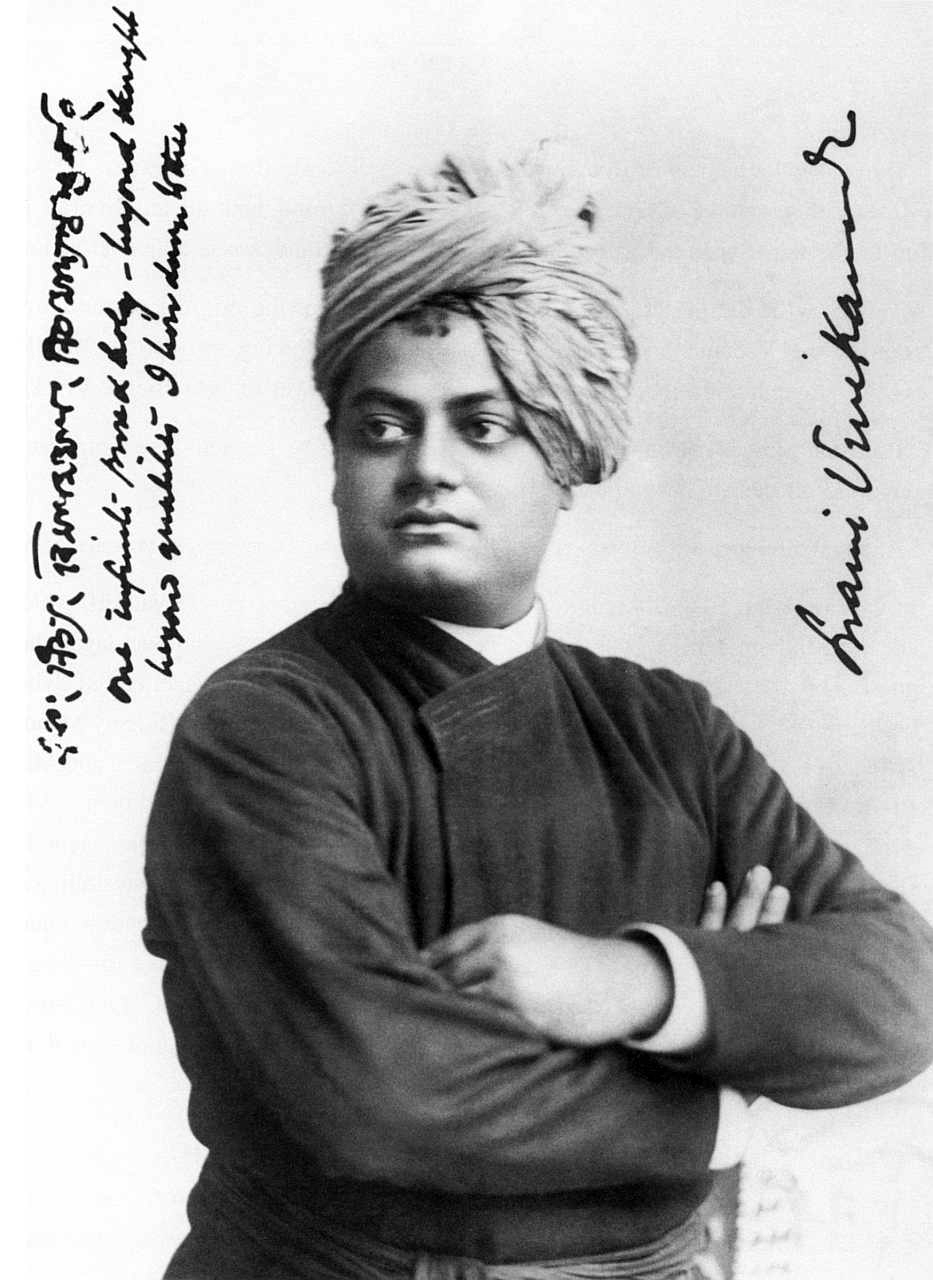
The Vedanta Society was founded by Swami Vivekananda on his first trip to the West. Swami Vivekananda, whose guru was the spiritual leader Ramakrishna, came to the United States to represent Hinduism at the 1893 Parliament of the World's Religions in Chicago. Although his primary intent for the journey was to raise money for humanitarian reform work in India, the reception he received inspired him to establish a separate Western mission.
Following his success at the Parliament, Swami Vivekananda spent two years lecturing in various parts of eastern and central United States, appearing chiefly in Chicago, Detroit, Boston, and New York. In November 1894, he established the first Vedanta Society, the Vedanta Society of New York, which gained a physical location in January 1895. For two months, starting in June 1895, he conducted private lectures to a dozen of his disciples at Thousand Island Park. Vivekananda focused on establishing an American Vedanta that emphasized practical spiritual teachings, adapting the tradition to Western audiences. The tradition attracted followers that formed small, elitist societies focused on discussing religious philosophy.
On Vivekananda's second trip to the west (1899-1900), he founded the Vedanta Society of Northern California in San Francisco. Vivekananda spent three months teaching Vedanta in the San Francisco Bay Area. By 1906, the San Francisco society was based in a large Victorian house.
Before returning to India, Vivekananda told his followers he would be succeeded by Swami Turiyananda.
Organization
Since the founding of the first society in New York, each society has a spiritual head from the Ramakrishna Order, board of directors or trustees, for the education and ministry of the lay devotees, often referred to as students of Vedanta.
Major centers
Vedanta Society of New York
Main article: Vedanta Society of New York
.jpg)
After the 1893 Parliament of Religions in Chicago, Swami Vivekananda went on a speaking tour of the Midwest and the East Coast. In 1894, he founded the first Vedanta Society in New York.
In 1895, Vivekananda broke off his speaking tour and held a six-week retreat at Thousand Island Park, where he trained and initiated his first disciples to continue the work after his return to India. In 1897, Vivekananda sent Swami Abhedananda to lead the New York branch. For the first two decades of the 20th century, Swami Abhedananda was the "best-known Asian religious teacher in the United States." In 1921, the physical location of the Society (34 West Seventy First Street) was acquired through a gift from Mary Morton, daughter of a former governor of New York. Notable swamis who have led the center include Swami Paramananda, Swami Bodhananda (1906–1950), Swami Pavitrananada (1951–1977), Swami Tathagatananda (1977–2016). Its current head is Swami Sarvapriyananda.
Vedanta Society of Northern California
On Swami Vivekananda's second trip to the United States, in 1900, he founded the Vedanta Society of San Francisco and called for a fellow direct disciple of Ramakrishna, Swami Trigunatitananda, to take charge of the center. It was under Trigunatitananda that was advertised as, "the first Hindu Temple in the Whole Western World". The unique architecture of the Hindu temple served an active role in the cultural contact.
The temple survived the 1906 San Francisco Earthquake, but in 1914, a "demented follower had exploded a homemade bomb in the Hindu temple, fatally injuring Trigunatita". There was a series of swamis in charge until Swami Ashokananda took over in 1932 and continued until his death in 1969. During Ashokananda's time he greatly expanded the Northern California center to include a huge retreat in Olema, Marin Country, CA, a temple in Berkeley, CA, a temple in Sacramento, a convent in San Francisco, and another convent in San Rafael, CA. In 1959 he dedicated a greatly expanded "New Temple" at Fillmore and Vallejo. Swami Tattwamayananda is currently the Minister of the Vedanta Society of Northern California, San Francisco.
Vedanta Society of Southern California

Prabhavananda was head of the center until his death on July 4, 1976. Swami Swahananda, who had been the head of the Berkeley Society took over and was head of the center until his death in 2010. Swami Sarvadevananda continues as the spiritual leader to the present.
Ramakrishna Monastery, Trabuco Canyon
Main article: Vedanta Society Of Southern California, Ramakrishna Monastery
In the early 1940s, Gerald Heard decided to establish his own monastery in Trabuco Canyon, in Orange County, Southern California, to practice intense spiritual exercises with a strict and physically demanding schedule, feeling that Prabhavananda was too lax. Aldous Huxley spent six weeks there working on his Perennial Philosophy. However, there were not enough followers to support the effort, so in 1949 he donated the entire property, buildings and furnishing to the Vedanta Society of Southern California, which became the Ramakrishna Monastery.
Vedanta Temple and Sarada Convent in Santa Barbara
Main article: Santa Barbara Vedanta Temple
Vedanta Center of Greater Washington DC, Maryland
The Center was established in April 1997 as part of the Vedanta Society of Southern California under the guidance of Swami Swahananda and Ramakrishna Math and Mission in Belur Math, West Bengal. Swami Swahananda was the head from 1997 to 2012. Swami Sarvadevananda is the current head of the Center.
Swami Atmajnanananda, currently the resident minister at the Vedanta Center of Greater Washington, DC, in Silver Spring, Maryland, USA. He is a scholar in Indian philosophy and traveled extensively throughout India and Bangladesh; contributed various articles and translations to some of the books and magazines of the Ramkrishna Order. One of his articles was published in Living Wisdom: Vedanta in the West. He also authored Jiva Gosvamin's Tattvasandarbha: A Study on the Philosophical and Sectarian Development of the Gaudiya Vaisnava Movement, published by Motilal Banarsidass in 1986 under his pre-monastic name.
Ramakrishna-Vivekananda Center, New York
Main article: Ramakrishna-Vivekananda Center
.jpg)
The Ramakrishna-Vivekananda Center located on the upper East Side of Manhattan Island was founded in 1933 by Swami Nikhilananda, when he and a group of followers broke off from the Vedanta Society of New York, while still maintaining its affiliation with the Ramakrishna Order in India.
The center has a main temple and monastery in New York City and a retreat property at Thousand Island Park on the Hudson, where Swami Vivekananda stayed for 7 weeks in the summer of 1895. Swami Nikhilananda produced some of the most important English translations of Vedanta scripture and literature including, The Gospel of Ramakrishna. Notable students of the Swami include Joseph Campbell (who helped edit the Gospel) and J.D. Salinger, who began his association with the Swami shortly after returning from WWII.
After Nikhilananda's death in 1973, Swami Adiswarananda took over, until his death in 2007. Currently, Swami Yuktatmananda [[File:Vedanta Society of New York 71 St jeh.jpg|right|upright|thumb|Vedanta Society of New York]]
heads the center.
Vedanta Society of St. Louis
The St. Louis Vedanta Society was founded by Swami Satprakashananda (1888–1979) in 1938. The Swami was a monk of the Ramakrishna Order and a disciple of Swami Brahmananda (considered to be the spiritual son of Ramakrishna) and first president of the Ramakrishna Order. The swami was a sought-after scholar and wrote several books on Vedanta. He was recommended by Aldous Huxley to a young Huston Smith who was moving to St. Louis in 1947, as someone who could teach Vedanta Philosophy in depth. Huston Smith took weekly tutorial sessions with the Swami for a decade, which became the foundation of the course, the TV Series and Book, all titled, The Religions of Man.
When the Society wanted to buy a building in a prominent and prestigious Church Row neighborhood in St. Louis, the swami was denied, as he had "brown skin", so Huston Smith and his wife Kendra bought the property and then turned it over to the society.
Swami Chetanananda was the assistant minister under Swami Prabhavananda at the Vedanta Society of Southern California from 1971 to 1979. As Satprakashananda's health declined, Chetanananda was assigned to St. Louis as the assistant there.
After Satprakashananda died, Swami Chetanananda became the head of the center, and continues in that role to today. Chetanananda continued the St. Louis Center's tradition of writing and translating important books on Vedanta and the early founders of the Ramakrishna Order. Chetanananda is, "One of the movement's most scholarly swamis".
Chetanananda's books include the teachings of the Ramakrishna Order's most important leaders, as well as biographies of many of the Direct Disciples of Ramakrishna:
- The Breath of God 1988 – 130+ short stories of spiritual practices.
- They Lived with God: Life Stories of Some Devotees of Sri Ramakrishna 1989.
- Vedanta Voice of Freedom 1990 – A collection of teachings of Swami Vivekananda.
- Sri Ramakrishna and His Divine Play 2003 – A new translation of Swami Saradananda's biography of Sri Ramakrishna.
- Sri Sarada Devi and Her Divine Play 2015 – A biography of Sarada Devi, wife of Ramakrishna.
Ramakrishna Vedanta Society, Boston
The Ramakrishna Vedanta Society, Boston was founded in 1909, and is one of the oldest Vedanta Society in North America. It is a branch of Ramakrishna Order founded by Swami Vivekananda.
Swami Paramananda founded the Vedanta center in Boston in 1909. In 1941 Swami Akhilananda moved it to its present location at 58 Deerfield Street, Boston, MA. After Akhilananda died in 1962, Swami Sarvagatananda led the Vedanta Society for forty years until his formal retirement in 2002.
Swami Tyagananda became the head of the Society in 2002, after the retirement of Swami Sarvagatananda. The Society provides spiritual seekers and students from local colleges and universities, participates in interfaith gatherings and promotes coexistence of the various religious traditions of the world.
Vedanta Society of Portland
After an early attempt to start a Portland Vedanta study group in 1925 by Swami Prabhavananda, Swami Devatmananda established a permanent Center in 1932 and acquired the large retreat property 20 miles outside of Portland. Swami Aseshananda, who had been the assistant minister under Swami Prabhavananda in Hollywood, took over in 1955 and remained in charge until his death in 1996. In Aseshananda's later years, he was the most senior monk in the Ramakrishna Order and the last living monastic disciple of Sarada Devi, the wife of Ramakrishna.
Similar organisations
The term "Vedanta Society" generally refers to branches of the Ramakrishna Order. Other societies, groups, organisations, and institutes which are aligned with this mission and goal of teaching Vedanta include:
- Chinmaya Mission
- International Vedanta Society
References
Sources
References
- Review of Vedanta Societies in the US, published by Harvard Divinity School [https://pluralism.org/the-vedanta-society]
- ''The Life of Swami Vivekananda'', Kolkata: [[Advaita Ashrama]], 2000, Vol 1 p 514.
- (25 May 2006). "Life of Swami Abhedananda".
- Isherwood, Christopher. (1980). "My Guru and His Disciple". Farrar Straus Giroux.
- McDermott, Robert A.. (April 1975). "Indian Spirituality in the West: A Bibliographical Mapping, University Press of Hawaii". [[University of Hawaiʻi Press]].
- Barrows, John Henry. (1893). "The World's Parliament of Religions". The Parliament of Religions Publishing Company.
- Isherwood, Christopher. (1965). "Ramakrishna and His Disciples". Methuen & Co. Ltd..
- "Impact on History - Frank Parlato Jr".
- (13 January 2025). "New York celebrates the anniversary of Swami Vivekananda's birth".
- Sen, Arijit. (2013). "Staged Disappointment - Interpreting the Architectural Facade of the Vedanta Temple, San Francisco".
- Dunaway, David King. (1989). "Huxley in Hollywood". Anchor Books.
- ''Vedanta In the West'' January 1951 – December 1962 (shortly after Huxley's death)
- ’’Time Magazine” February 12, 1945
- "Vedanta Society of Southern California".
- "Center".
- Elkman, Stuart. (1986). "Jīva Gosvāmin's Tattvasandarbha: A Study on the Philosophical and Sectarian Development of the Gauḍīya Vaiṣṇava Movement".
- Larsen, Stephen and Robin. (2002). "Joseph Campbell: A Fire in the Mind". Inner Traditions.
- Slawenski, Kenneth. (2010). "J.D. Salinger: A Life". Random House.
- [https://belurmath.org/past-presidents/swami-brahmananda/ Official Website of the Ramakrishna Order]
- Townsend, Tim. (25 November 2010). "Vedanta Society offers respite from religious extremism". [[St. Louis Post-Dispatch]].
- “Back Matter.” Journal of the American Oriental Society, vol. 110, no. 4, 1990, pp. 789–98. JSTOR, http://www.jstor.org/stable/602945. Accessed 15 Dec. 2023.
- (1989). "Reviewed work: Vedanta: Voice of Freedom, Swami Vivekananda, Swami Chetanananda". Journal of the American Oriental Society.
- Review Harris, Ruth. Guru to the World: The Life and Legacy of Vivekananda. Harvard University Press, 2022. JSTOR, [https://doi.org/10.2307/j.ctv2wdtm48] Accessed 13 Dec. 2023.
- [https://www.goodreads.com/review/show/4407355984 Review]
- Boston, Ramakrishna Vedanta Society. "The Pluralism Project". Harvard University.
- [https://www.americamagazine.org/content/all-things/death-swami-and-his-bliss Review of SWami Sarvagatananda life and work by Fr. Francis X. Clooney]
- Tyagananda, Swami. "Hindu Chaplains". Harvard University.
- Newsletter, Bhagirathi. "The Center for Indic Studies at the University of Massachusetts Dartmouth". UMASS Dartmouth.
- "Vedanta Institutes {{!}} Chinmaya Mission Worldwide". Chinmaya Mission Worldwide.
- "houstonvedanta".
This article was imported from Wikipedia and is available under the Creative Commons Attribution-ShareAlike 4.0 License. Content has been adapted to SurfDoc format. Original contributors can be found on the article history page.
Ask Mako anything about Vedanta Society — get instant answers, deeper analysis, and related topics.
Research with MakoFree with your Surf account
Create a free account to save articles, ask Mako questions, and organize your research.
Sign up freeThis content may have been generated or modified by AI. CloudSurf Software LLC is not responsible for the accuracy, completeness, or reliability of AI-generated content. Always verify important information from primary sources.
Report