From Surf Wiki (app.surf) — the open knowledge base
Vauxhall Cadet
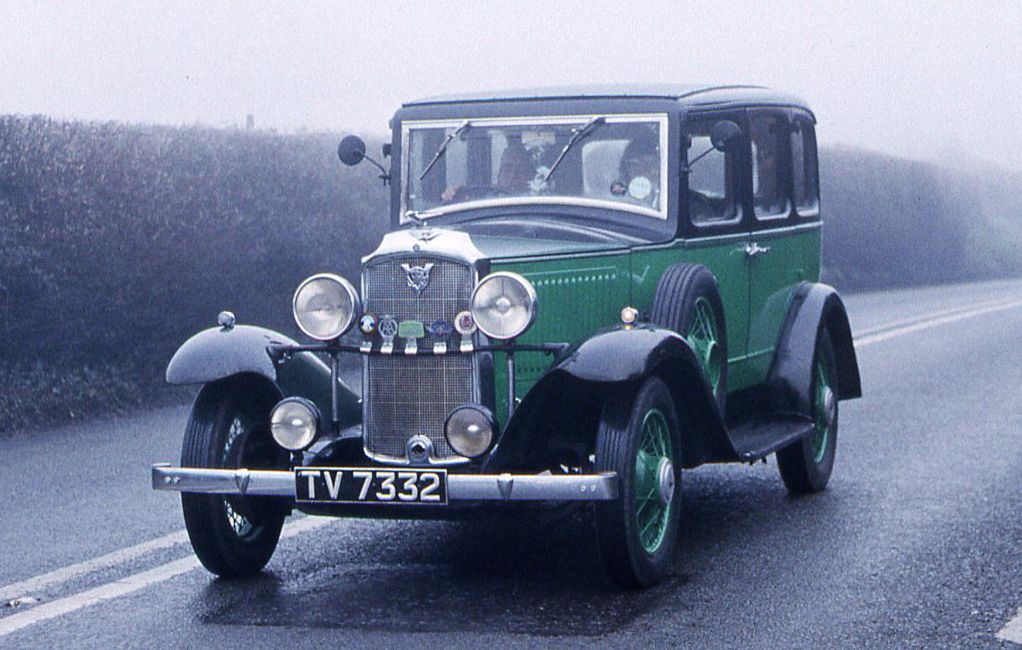
| Field | Value |
|---|---|
| name | Vauxhall Cadet VY and export VX |
| image | Vauxhall Cadet Grosvenor bodied 1933 at Knebworth 2013.JPG |
| caption | Grosvenor saloon de luxe £325 1933 |
| manufacturer | Vauxhall (General Motors) |
| aka | Bedford VYC/BYC (for panel van) |
| production | quantity 9,691 |
| 1930–33 | |
| 1932-1939 (for panel van) | |
| predecessor | None, a move downmarket |
| successor | Vauxhall Big Six 20 h.p. and Vauxhall Light Six |
| body_style | saloon, 2-seater and two coupés catalogued also other bodies by Grosvenor and Salmons (Tickford), 2-door panel van |
| layout | FR layout |
| engine | 2,048 cc 6-cylinder in-line ohv |
| 3178 cc in the export VX | |
| transmission | Single dry-plate clutch, three forward speed gearbox, synchromesh on 2 and 3 from end 1931 |
| open propeller shaft with Hardy Spicer universals and final drive through a spiral bevel gear | |
| wheelbase | 8' 11", 107 in |
| Track 4' 8", 56 in | |
| Ground clearance 8½", 8.5 in | |
| weight | 26 cwt |
| sp | uk |
1930–33 1932-1939 (for panel van) 3178 cc in the export VX open propeller shaft with Hardy Spicer universals and final drive through a spiral bevel gear Track 4' 8", 56 in Ground clearance 8½", 8.5 in
The Vauxhall Cadet VY is an automobile produced by Vauxhall from 1930 until 1933. It was an entirely new model announced by Vauxhall on 6 October 1930. The first Vauxhall priced below £300, it was intended to supplement the existing 24 h.p. 20-60 thereafter to be known as the Vauxhall Eighty. When exported it was usually supplied with a 27 h.p. engine and named VX. The first truly new Vauxhall since General Motors' purchase of the business in 1925, it was an American-style car with certain local amendments.
The mascot on the Cadet's radiator cap became the (two-dimensional) BOAC Speedbird logo.
Synchromesh gearbox
The first British car fitted with a gear-box "embodying the now famous Synchro-Mesh principle", a system of gear change making every driver an expert. Providing a faultless shift-speed operation it was fitted to all Cadets from late 1931.
Body
The front seats are easily moveable. There is a ventilator in the scuttle. The rear-most glasses of the six side windows are fixed while the middle ones can be wound down more than half-way and the forward ones fully. The one-piece windscreen opens out fully. The spare wheel and tyre are in a well in the nearside front wing, tools in a locked cupboard under the bonnet. The metal panelled saloon can be had in three colours.
Pricing :Vauxhall Cadet standard saloon £280—or with sliding roof and protectoglass, £298 :Two-seater, £295 :Sports coupé, £298 :Four-light coupé, £298
1933
For 1933 detailed refinements were made to provide more comfort and better appearance, "the bodies are more imposing and the cars look lower". Bonnet flutes, lamps and bumpers were chromium-plated. The saloon's rear seats were deeper and finer quality leather upholstery provided. An eddy-free roof front, anti-glare sloping windscreen and anti-dazzle dipping headlamps were fitted, and dual electric screenwipers replaced the single vacuum instrument.
.jpg)
:4-door saloon with flush-type weatherproof sliding roof, £295 :Grosvenor saloon de luxe £325 :Tickford all-weather saloon, £335 :Fixed-head coupé (2 or 4-light), £295 :Romney 2-seater drop-head coupé, £325 :Denton 4-seater drop-head coupé, £335
.jpg)
_-_34661579701.jpg)
"The Tickford model is a double purpose car, as the head can quickly and easily be wound down, and the windows lowered to make what is practically an open car. The windows can also be used up with the head back to avoid draughts or too much air. This Salmons body has stood the test of time in regard to utility and durability." The Times Tax rating 16.9 hp
Engine
The 17 h.p. six-cylinder engine's overhead valves are operated by pushrods, the unit itself being suspended on rubber at four points damping out all vibration in top gear. The carburettor has interconnected choke and throttle controls ensuring immediate starting from cold. The radiator is in a shell with a stone guard. There is no thermostatic control within the engine cooling system. The three branch inlet manifold is on the near or left side of the engine above the four-branched square-sectioned exhaust manifold. Timing is by duplex roller chain. The crankshaft runs in four bearings.
A 26.3 h.p. engine is provided for export in a model named VX.
Better carburation was provided for 1933, which gave improved acceleration and better fuel consumption.
Chassis
Steering is by cam and lever. Rear suspension is by half-elliptical, and practically flat, springs mounted beneath the axle and on rubber pads. Front springs are splayed. Single-acting hydraulic shock absorbers are employed in front and back. Bumpers are supplied fore and aft and there is a folding luggage grid.
Brakes are on all four wheels, they are half servo type and have part rods and part cables in front and cables behind. Rods are used for the handbrake.
Smaller wheels with larger tyres, heavier bumpers, smoother springing, improved shock absorbers were all improvements listed for 1933.
Performance
The motoring correspondent of The Times described the engine as having an almost turbine-like silence and smoothness with beautifully responsive acceleration. Flexibility was demonstrated by "the ability to flash away from 3 m.p.h. in top gear into express train speed in a few seconds without the least suspicion of transmission jerk". Reportedly in the teeth of a high wind maximum speed was 65 m.p.h. Petrol consumption was good, about 23 mp.pg. and oil consumption about 900 m.p.g.
"At its price this car provides luxury motoring in the very best sense and within the reach of people of moderate means."
Bedford VYC/BYC
.JPG)
A panel van named the Bedford VYC was developed based on the Vauxhall Cadet. Production started in 1932, it retained the Cadet engine and chassis. Later on, a more powerful engine was used alongside the 6-cylinder engine of the Vauxhall Big Six. Some time later, it was renamed the Bedford BYC and continued in production until 1939. It was replaced by the Bedford HC.
File:Vauxhall 1931 Cadet VX 4dr F.JPG|Standard saloon 1931 File:Vauxhall 1931 Cadet VX 4dr R.JPG|rear view File:Vauxhall Cadet VX sports coupé by Holden 1932.jpg|Sports coupé 1932 body by Holden
References
References
- (16 December 1930). "Cars Of To-Day". The Times.
- (1 December 1931). "Cars Of To-Day". The Times.
- (21 September 1932). "Cars Of 1933". The Times.
- (29 September 1932). "Display advertisement". The Times.
- (12 June 1931). "Vauxhall Motors, Ltd.". The Times.
- (18 October 1932). "The Olympia Show". The Times.
- Skinner, James T.. (19 June 1933). "Luxury Motoring". The Times.
- https://ccmv.aecsouthall.co.uk/p491736945
This article was imported from Wikipedia and is available under the Creative Commons Attribution-ShareAlike 4.0 License. Content has been adapted to SurfDoc format. Original contributors can be found on the article history page.
Ask Mako anything about Vauxhall Cadet — get instant answers, deeper analysis, and related topics.
Research with MakoFree with your Surf account
Create a free account to save articles, ask Mako questions, and organize your research.
Sign up freeThis content may have been generated or modified by AI. CloudSurf Software LLC is not responsible for the accuracy, completeness, or reliability of AI-generated content. Always verify important information from primary sources.
Report